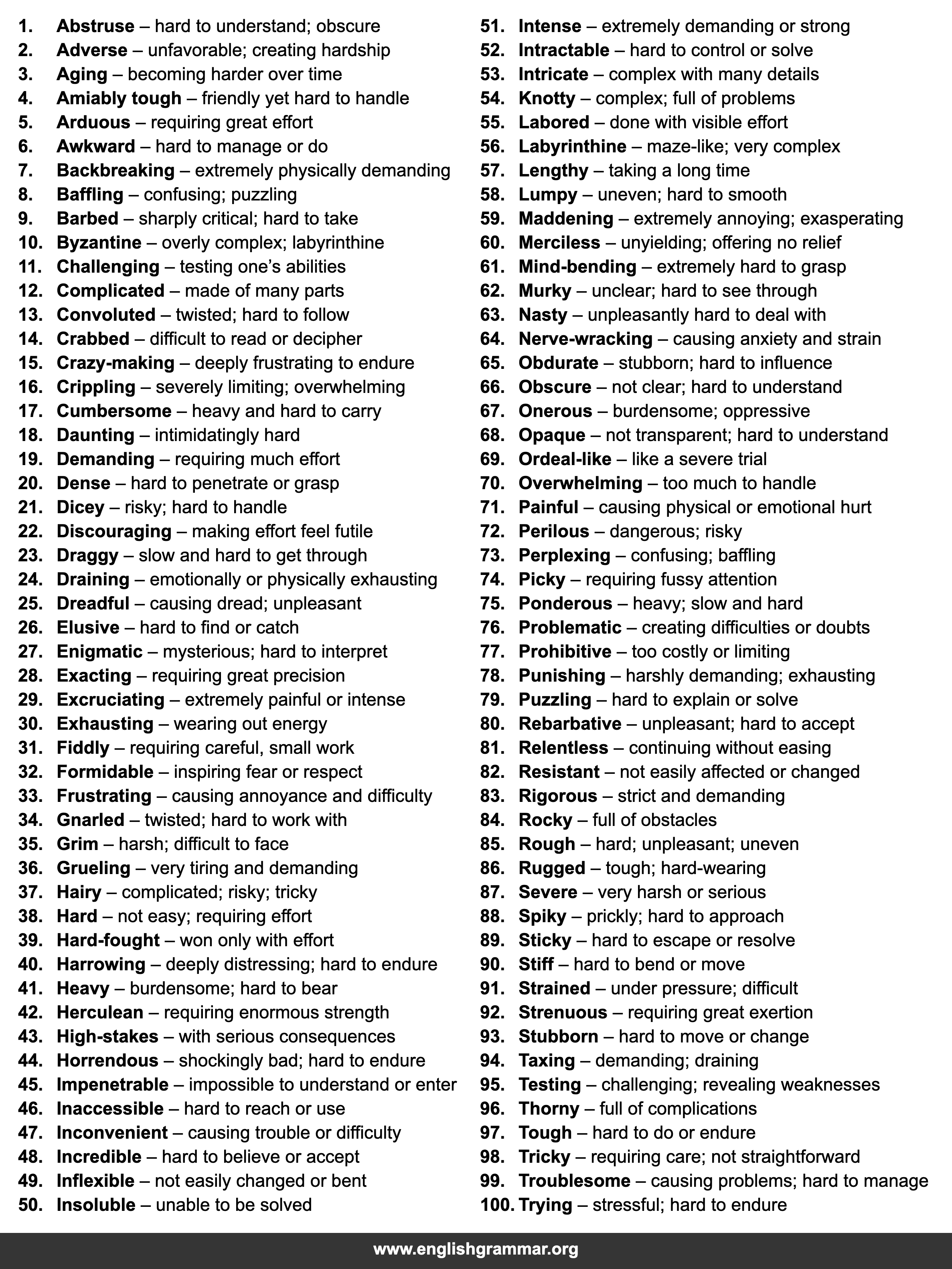
The word "hard" is one of the most frequently used adjectives in the English language due to its versatility, yet this very flexibility often leads to repetitive and imprecise writing. To find a different word for hard, you must first identify the context: are you describing a difficult task, a solid physical object, a strict personality, or a high level of intensity? Common professional alternatives include challenging, arduous, or strenuous for tasks; solid, rigid, or firm for physical objects; and stern, severe, or callous for describing character.
In the fast-evolving communication landscape of 2026, precision in language is more than just a stylistic choice—it is a requirement for clarity in both human and AI-driven interactions. Using the same generic descriptor for a complex mathematical equation and a piece of granite obscures the unique qualities of the subject. By expanding your vocabulary, you provide the reader with a more sensory and intellectually accurate experience.
The Semantic Versatility of "Hard"
Before selecting a replacement, it is essential to understand why "hard" is so ubiquitous. It serves as a linguistic "catch-all" that spans several distinct semantic fields. In linguistics, this is known as polysemy—a single word having multiple related meanings.
When a writer says a task is "hard," they might mean it requires high intelligence, immense physical strength, or a great deal of patience. When they say a surface is "hard," they might mean it is impenetrable, uncomfortable, or simply non-pliant. Distinguishing between these nuances is the first step in upgrading your prose.
1. Synonyms for Difficulty and Effort
This is the most common usage of the word. When "hard" refers to the level of effort required to complete a task, the replacement should reflect the specific type of struggle involved.
Challenging and Taxing
"Challenging" is perhaps the most common professional substitute. It carries a slightly positive connotation, suggesting that while the task is difficult, it is also stimulating and potentially rewarding. "Taxing," on the other hand, implies that the task is draining your resources—whether those resources are mental, physical, or financial.
Arduous and Laborious
If the difficulty stems from a long, drawn-out process, "arduous" is the superior choice. It is frequently used to describe journeys or long-term projects (e.g., "an arduous climb to the summit"). "Laborious" specifically highlights the "labor" involved, suggesting a task that is slow, tedious, and requires significant physical or mental toil.
Grueling and Strenuous
When the difficulty reaches an extreme level of physical or emotional exhaustion, "grueling" is the appropriate term. It evokes the image of someone being "ground down" by the intensity of the work. "Strenuous" is more clinical, often used in medical or fitness contexts to describe activity that requires great exertion (e.g., "avoid strenuous exercise after surgery").
Onerous and Burdensome
In legal or formal contexts, "hard" is often replaced by "onerous." This word suggests that a task or responsibility is not just difficult, but unfairly or oppressively so. If a contract has "onerous terms," it means the obligations are excessively heavy.
2. Synonyms for Physical Texture and Density
When describing the physical properties of an object, "hard" is often too vague. Does it resist scratching? Does it resist bending? Does it resist breaking?
Rigid and Inflexible
"Rigid" refers to an object that cannot be bent or forced out of shape. It is a technical term in engineering and physics but works well in creative writing to describe anything from a steel beam to a stiff collar. "Inflexible" carries the same meaning but is more commonly applied to materials that lack the ability to stretch.
Solid and Compact
If you are describing the internal consistency of an object, "solid" is the primary alternative. It implies that there are no gaps, holes, or soft spots. "Compact" suggests that the matter is pressed closely together, often implying a high density in a small space.
Petrified and Calcified
These are more specialized terms. "Petrified" literally means "turned to stone," usually through organic processes over millennia. "Calcified" refers to the hardening of tissue through the deposition of calcium salts. Using these words adds a level of scientific precision that "hard" cannot provide.
Impenetrable and Impervious
If the defining characteristic of the "hardness" is that nothing can get through it, these are your best options. An "impenetrable" forest or shield cannot be pierced. An "impervious" surface (like treated glass) does not allow liquids or light to pass through.
3. Synonyms for Character and Emotion
Using "hard" to describe a person can be ambiguous. Are they disciplined? Are they mean? Are they emotionally distant?
Stern and Severe
A "stern" person is someone who is serious and strict, often in a position of authority like a judge or a teacher. "Severe" is a step further, suggesting a lack of adornment or a harshness in appearance and temperament. A "severe critic" is much more intimidating than a "hard critic."
Callous and Obdurate
If the person lacks empathy, "callous" is the precise term. It comes from the word "callus" (hardened skin), suggesting that the person has become "thick-skinned" to the feelings of others. "Obdurate" is a more literary term for someone who is stubbornly resistant to persuasion or softening of the heart.
Resilient and Dauntless
If "hard" is meant as a compliment to someone’s strength of character, "resilient" is the better choice. It describes the ability to recover quickly from difficulties. "Dauntless" suggests a person who is "hard" in the sense of being fearless and unable to be intimidated.
| Context | Recommended Synonym | Nuance/Usage |
|---|---|---|
| Intellectual Task | Intricate | Suggests complexity and many moving parts. |
| Physical Effort | Strenuous | Highlights high energy expenditure and strain. |
| Material Science | Tempered | Refers to metal or glass hardened by heating and cooling. |
| Personal Demeanor | Stoic | Someone who endures hardship without complaint. |
| Legal/Financial | Stringent | Describes regulations or requirements that are very strict. |
| Weather/Climate | Inclement | Used to describe "hard" or harsh weather conditions. |
| Economic State | Austere | Describes "hard times" involving reduced spending and luxury. |
4. Synonyms for Intensity and Force
Sometimes "hard" is used as an adverb to describe how an action is performed (e.g., "he hit the ball hard" or "it was raining hard").
Violently and Vigorously
Instead of "hitting hard," one might hit "violently" (implying destructive force) or "vigorously" (implying energetic and healthy force).
Torrentially and Profusely
"It was raining hard" is better described as "it was raining torrentially." If someone is "sweating hard," they are "sweating profusely." These adverbs provide a much clearer picture of the volume and intensity of the action.
Assiduously and Diligently
When describing someone "working hard," "assiduously" and "diligently" are the gold standards. They convey not just the effort, but the care, persistence, and attention to detail involved in the work.
The Importance of Precision in 2026 Professional Writing
As we navigate through 2026, the reliance on automated summaries and search-optimized content means that specific keywords carry more weight than ever. If you are writing a technical manual, using the word "hard" to describe a material’s properties might lead to safety misunderstandings. In engineering, "hardness" is a specific measurable value (often using the Mohs scale), whereas "toughness" or "stiffness" means something entirely different.
Replacing "hard" with a more specific term doesn't just make your writing "fancier"—it makes it more functional. In a world saturated with information, the writer who can convey the exact nature of a difficulty or the exact texture of a material saves the reader time and mental energy.
Common Pitfalls When Replacing "Hard"
While seeking a different word for hard, writers often fall into the trap of "thesaurus syndrome"—choosing a word that is too obscure or doesn't quite fit the tone of the piece.
- Over-complicating Simple Actions: If you are writing a children's book, "the rock was petrified" is likely less effective than "the rock was hard." Contextual appropriateness is key.
- Ignoring Connotation: "Difficult" and "Formidable" both mean hard, but "formidable" implies an element of fear or awe. You wouldn't call a simple but "hard" math problem "formidable" unless it was truly life-altering.
- Misusing Technical Terms: Don't use "rigid" when you mean "hard" in a tactile sense. A diamond is hard (it resists scratching), but a diamond is not necessarily described as "rigid" in common parlance because rigidity refers more to structural bending than surface integrity.
How to Choose the Right Word
To select the perfect alternative, follow this three-step process:
- Identify the Category: Is it difficulty, texture, character, or intensity?
- Determine the "Temperature": Is the tone of your writing formal, scientific, casual, or poetic? Use "arduous" for formal reports, but "tough" for a casual blog post.
- Assess the Result: Does the new word change the meaning? If you replace "a hard boss" with "a callous boss," you have moved from describing their expectations to describing their lack of soul. Ensure that is your intention.
Frequently Asked Questions
What is the most common synonym for hard?
The most common synonym for "hard" in the context of difficulty is difficult. In the context of physical objects, the most common synonym is solid or firm. These are safe, all-purpose replacements that work in almost any setting.
Is "tough" a good replacement for "hard"?
"Tough" is an excellent replacement but has its own nuances. While "hard" often implies something that might break under pressure (like glass), "tough" implies something that can withstand great strain without breaking (like leather or a resilient person). Use "tough" when you want to emphasize durability and endurance.
What is a "hard" word for hard?
If you are looking for high-level, sophisticated vocabulary (often called "Tier 3" words), consider herculean (for a task requiring great strength), adamantine (for something physically unbreakable), or intransigent (for someone who is stubbornly "hard" in their views).
Why should I avoid using "hard" in professional emails?
In 2026, professional communication favors clarity and brevity. Using "hard" can be ambiguous. Telling a client a project is "hard" might make you sound incapable. Telling them it is "complex" or "technically demanding" explains why it is taking time, which builds more trust and provides more information.
What is another word for "hard" when describing food?
In culinary contexts, "hard" is rarely a compliment. Better words include stale (for old bread), al dente (for perfectly cooked pasta that still has some "bite"), crunchy or crisp (for snacks), or tough (for overcooked meat).
Practical Recommendation
When revising your work, highlight every instance of the word "hard." For each one, ask yourself: "What specifically makes this hard?" If it is hard because it has many parts, use complex. If it is hard because it makes you tired, use exhausting. If it is hard because you can't push your finger into it, use firm.
By forcing yourself to define the nature of the hardness, you naturally move toward a more sophisticated and effective vocabulary. This practice not only improves the specific document you are working on but also trains your brain to notice the subtle differences in the world around you, ultimately making you a more observant and articulate communicator in 2026 and beyond.