The fundamental difference between atomic weight and mass number lies in their scope: mass number is the count of protons and neutrons in a specific atom's nucleus, always resulting in a whole number, while atomic weight is a weighted average of the masses of all naturally occurring isotopes of an element, typically expressed as a decimal.
Understanding the distinction between these two terms is essential for anyone studying chemistry, physics, or materials science. While they are related—both describe the "heaviness" of atoms—they serve different purposes in the laboratory and in theoretical calculations. In the current scientific landscape of 2026, precision in these definitions is more important than ever as we delve deeper into isotopic analysis and high-accuracy stoichiometry.
Understanding the Mass Number (A)
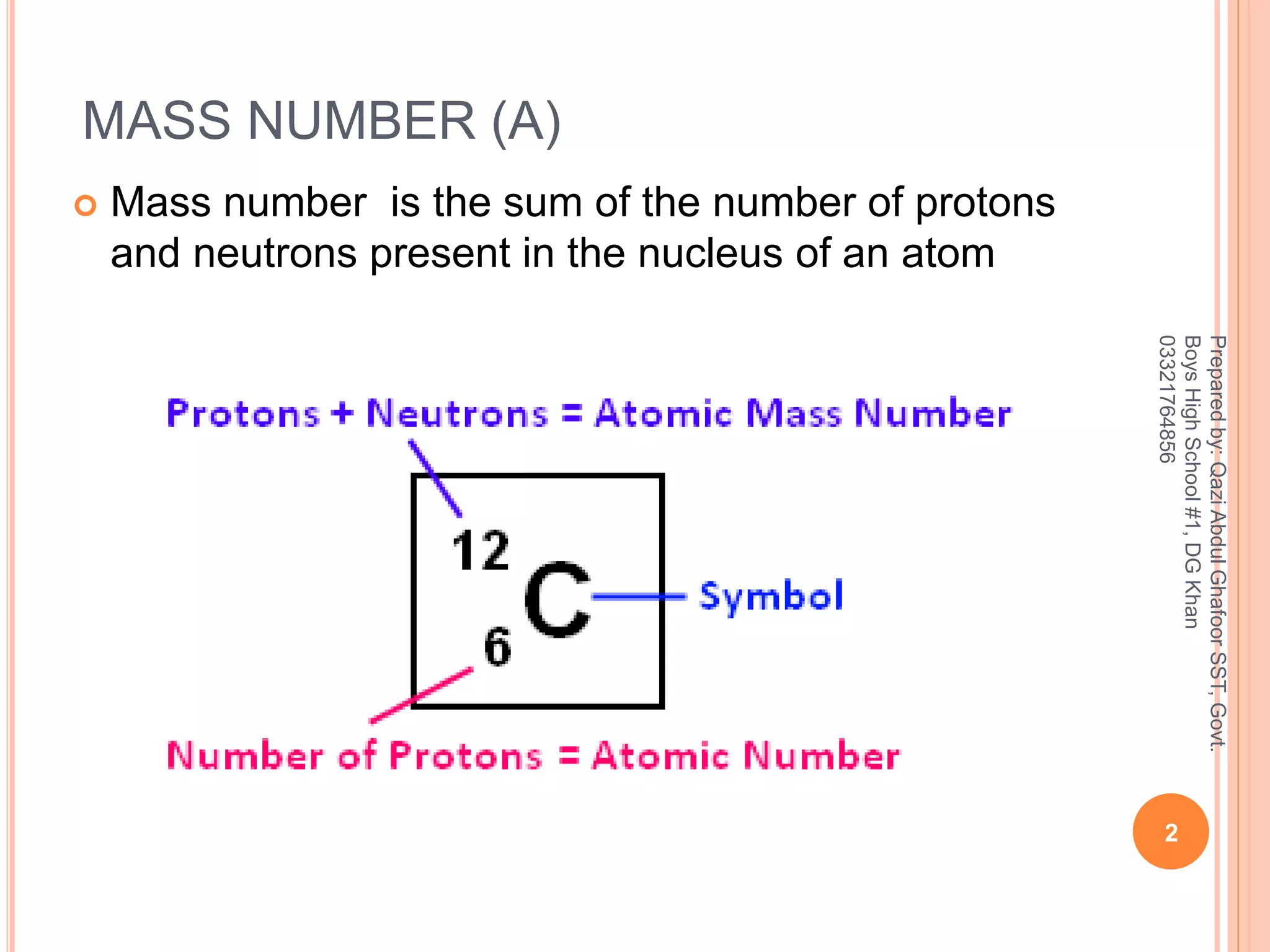
The mass number, denoted by the symbol A, is a property of a specific isotope of an element. It represents the total number of nucleons—protons and neutrons—within the nucleus of a single atom. Because it is a simple tally of physical particles, the mass number is always a positive integer.
The Composition of the Nucleus
To calculate the mass number, one must know the number of protons (the atomic number, Z) and the number of neutrons (N). The formula is straightforward: A = Z + N
For example, a standard carbon atom has 6 protons and 6 neutrons, giving it a mass number of 12. This specific atom is referred to as Carbon-12. However, another carbon atom might have 6 protons and 7 neutrons, resulting in a mass number of 13 (Carbon-13). Despite having different mass numbers, both remain carbon because their atomic number (number of protons) is identical.
Why Mass Number is an Integer
In the context of basic chemistry, protons and neutrons are treated as discrete units. You cannot have a fraction of a neutron in a stable or unstable nucleus. Consequently, when you sum these units, the result is invariably a whole number. This number is used primarily to distinguish between different isotopes of the same element in nuclear notation, such as $^{12}\text{C}$ or $^{14}\text{C}$.
Understanding Atomic Weight (Relative Atomic Mass)
Atomic weight, often more accurately called relative atomic mass, is a much more complex value than the mass number. It does not describe a single atom but rather the average "behavior" of a collection of atoms as they are found in nature.
The Influence of Isotopes
Most elements exist in nature as a mixture of different isotopes. For instance, if you were to take a sample of pure chlorine gas, you wouldn't find that every atom is identical. Instead, you would find a mixture: approximately 75.77% of the atoms are Chlorine-35, and 24.23% are Chlorine-37.
Because of this natural variation, scientists cannot use a single mass number to represent the element in chemical reactions. Instead, they calculate a weighted average based on the natural abundance of each isotope.
The Calculation of Atomic Weight
To calculate the atomic weight of an element, scientists multiply the mass of each isotope by its fractional abundance and then sum the results.
Example: Chlorine
- Isotope 1 (Cl-35): Mass ≈ 34.969 amu; Abundance = 0.7577
- Isotope 2 (Cl-37): Mass ≈ 36.966 amu; Abundance = 0.2423
- Calculation: (34.969 × 0.7577) + (36.966 × 0.2423) = 35.45 amu
This value, 35.45, is what appears on the periodic table. It tells a chemist that while no individual chlorine atom weighs 35.45 amu, a bulk sample will behave as if its average mass is 35.45 amu per atom.
Critical Differences: Atomic Weight vs. Mass Number
To clarify the relationship between these two concepts, it is helpful to view them side-by-side across several technical dimensions.
| Feature | Mass Number (A) | Atomic Weight (Relative Atomic Mass) |
|---|---|---|
| Definition | Sum of protons and neutrons in a nucleus. | Weighted average mass of all natural isotopes. |
| Value Type | Always a whole number (Integer). | Usually a decimal (Fractional). |
| Scope | Refers to a single, specific atom/isotope. | Refers to the element as found in nature. |
| Unit | Unitless (it is a count). | Atomic Mass Units (amu) or Daltons (Da). |
| Location | Not on the periodic table (found in isotope notation). | Found prominently on the periodic table. |
| Variability | Changes depending on the specific isotope. | Constant for a standard sample of the element. |
The Role of the Atomic Mass Unit (amu)
Both mass number and atomic weight rely on the concept of the Atomic Mass Unit (amu), also known as the Dalton (Da). As of 2026, the international standard remains tied to the Carbon-12 isotope.
By definition, one atom of Carbon-12 has a mass of exactly 12 amu. Therefore, 1 amu is defined as 1/12th the mass of a single Carbon-12 atom. This provides a relative scale that allows chemists to discuss the mass of atoms without using the incredibly small numbers associated with grams or kilograms (a single proton weighs approximately $1.67 \times 10^{-27}$ kg).
Mass Defect and Binding Energy
A point of high technical depth often confused by students is why the mass of a specific isotope (like Chlorine-35) isn't exactly a whole number. While the mass number is 35, the actual mass is 34.969 amu.
This discrepancy is due to binding energy. When protons and neutrons combine to form a nucleus, a small amount of their mass is converted into energy to hold the nucleus together, following Einstein’s equation $E=mc^2$. This "lost" mass is called the mass defect. Because of this phenomenon, only Carbon-12 has an exactly integer atomic mass (by definition); all other isotopes have masses that are slightly different from their mass numbers.
Practical Applications in Chemistry and Physics
Knowing the difference between these two values is not merely an academic exercise; it is foundational for practical laboratory work.
Stoichiometry and Molar Mass
When performing chemical calculations (stoichiometry), chemists almost exclusively use atomic weight. If you are reacting 10 grams of Magnesium, you need to know how many moles are present. Since the sample of Magnesium contains multiple isotopes (Mg-24, Mg-25, and Mg-26), the atomic weight (24.305) provides the necessary average to convert mass to moles accurately.
Mass Spectrometry
In analytical chemistry, mass spectrometry is used to identify substances by measuring the mass-to-charge ratio of ions. A mass spectrometer is sensitive enough to see individual isotopes. Therefore, a mass spectrum will show peaks for individual mass numbers (or more accurately, isotopic masses) rather than a single peak at the atomic weight. If you run a sample of Neon, you will see distinct peaks at 20 and 22, representing the isotopes, rather than one peak at 20.18.
Nuclear Physics and Radiocarbon Dating
In nuclear physics, the mass number is the priority. When discussing radioactive decay, such as the decay of Uranium-238 into Thorium-234, the atomic weight of Uranium is irrelevant. What matters is the specific nucleus involved in the nuclear reaction. Similarly, in radiocarbon dating, scientists look specifically at the ratio of Carbon-14 (mass number 14) to Carbon-12, ignoring the average atomic weight of carbon.
IUPAC Standards and Modern Variations
The International Union of Pure and Applied Chemistry (IUPAC) is the body responsible for maintaining the official "Standard Atomic Weights." In recent years, and continuing into 2026, IUPAC has moved toward expressing atomic weights as intervals for certain elements.
Because the isotopic composition of elements like Hydrogen, Carbon, and Oxygen can vary slightly depending on where the sample was collected (e.g., in a glacier versus the deep ocean), a single decimal number is sometimes insufficient for high-precision work. For these elements, the periodic table now often lists a range (e.g., [1.00784, 1.00811] for Hydrogen) to reflect natural variation.
Common Misconceptions
- "Atomic weight is the same as atomic mass." While often used interchangeably in casual conversation, they are technically different. Atomic mass refers to the mass of a single atom, while atomic weight refers to the weighted average of an element's isotopes.
- "The mass number is the weight of the atom." The mass number is a count of particles. While it is a good approximation of the weight (since protons and neutrons weigh about 1 amu each), it does not account for the mass defect or the mass of electrons.
- "Atomic weight can be found by adding protons and neutrons." This only works for mass number. Atomic weight requires knowing the percentage of every isotope existing in nature.
Summary Table: Isotopic Examples
| Element | Isotope | Mass Number | Atomic Mass (amu) | Natural Abundance | Standard Atomic Weight |
|---|---|---|---|---|---|
| Hydrogen | H-1 | 1 | 1.0078 | 99.98% | 1.008 |
| H-2 | 2 | 2.0141 | 0.02% | ||
| Carbon | C-12 | 12 | 12.0000 | 98.93% | 12.011 |
| C-13 | 13 | 13.0033 | 1.07% | ||
| Oxygen | O-16 | 16 | 15.9949 | 99.76% | 15.999 |
| O-18 | 18 | 17.9991 | 0.20% |
Frequently Asked Questions
Why isn't the mass number on the periodic table?
The periodic table is designed to help chemists work with bulk samples of elements. Since most elements are mixtures of isotopes, the mass number of a single isotope would be misleading. Instead, the periodic table provides the atomic weight, which is the average value needed for laboratory calculations.
Can two different elements have the same mass number?
Yes. Atoms of different elements that have the same mass number are called isobars. For example, Carbon-14 and Nitrogen-14 both have a mass number of 14. However, they are different elements because Carbon has 6 protons and Nitrogen has 7.
Why is atomic weight sometimes called "relative atomic mass"?
The term "relative" is used because the values are calculated relative to the mass of Carbon-12. It is a dimensionless ratio comparing the average mass of the element's atoms to 1/12th of the mass of a carbon-12 atom. However, for most practical purposes, it is expressed in atomic mass units (amu).
Does the mass of electrons affect atomic weight?
While electrons do have mass, they are approximately 1,836 times lighter than protons and neutrons. In most chemical and even high-precision calculations, the mass of electrons is considered negligible and does not significantly impact the atomic weight or mass number.
How do you find the number of neutrons if you have the mass number?
If you have the mass number (A) and the atomic number (Z, which is the number of protons), you simply subtract the atomic number from the mass number: Neutrons (N) = A - Z. This is a fundamental step in identifying isotopes in nuclear chemistry.
Final Recommendation for Students and Professionals
When working in a laboratory or solving chemistry problems, always verify whether you need the mass of a specific isotope or the average mass of the element. For balancing chemical equations and calculating yields, the atomic weight found on the periodic table is your primary tool. If you are dealing with radioactivity, half-lives, or mass spectrometry, you must use the mass number to ensure your calculations reflect the specific nuclear identity of the atoms in question. For the most up-to-date values as of 2026, refer to the NIST Physical Measurement Laboratory or the latest IUPAC Periodic Table releases.