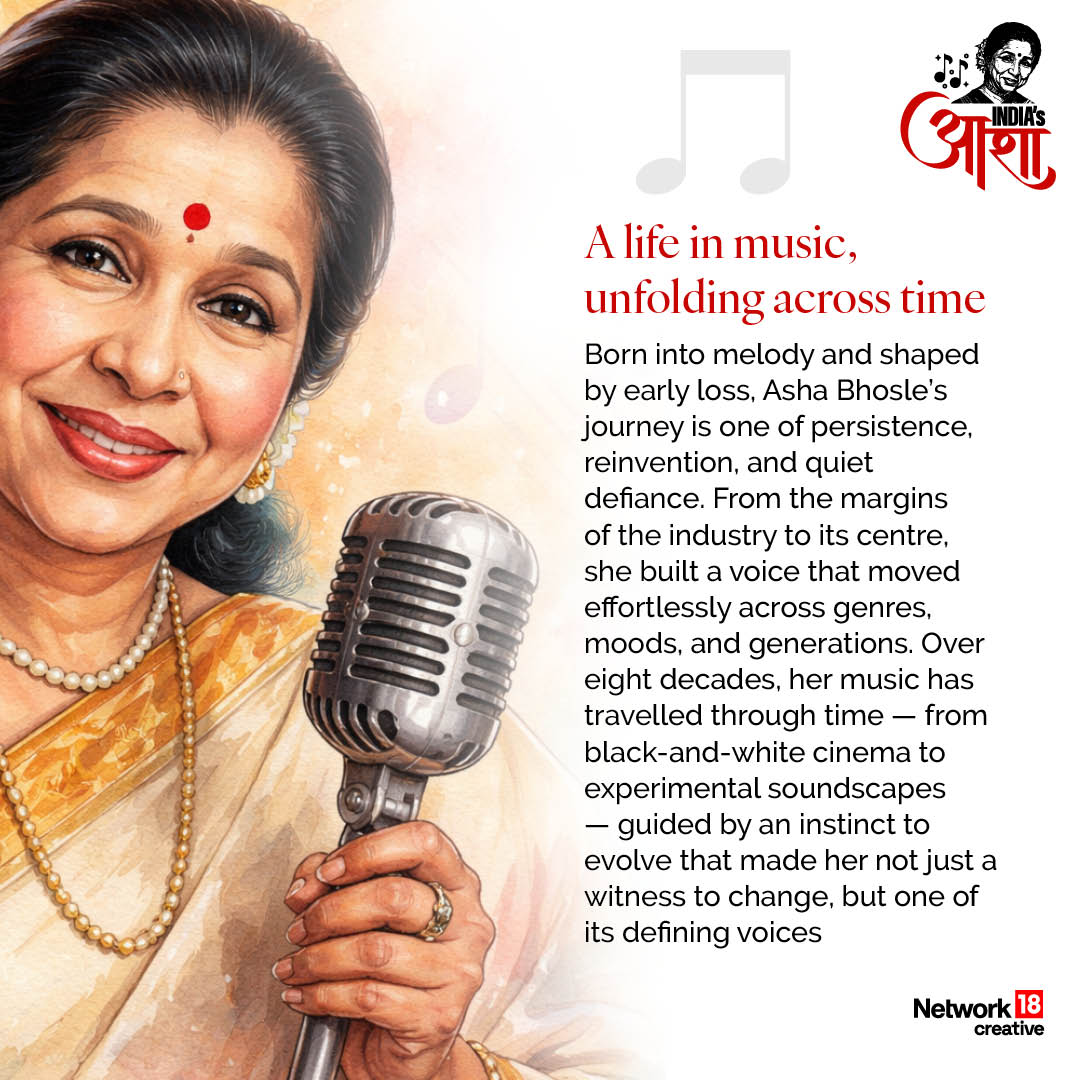
Asha Bhosle is an iconic Indian playback singer whose career spans over eight decades, encompassing thousands of recorded songs across multiple languages, genres, and eras of cinematic history. Celebrated for her remarkable vocal versatility, expressive range, and ability to adapt to changing musical landscapes, she remains one of the most influential and enduring figures in the history of Indian popular culture and cinema.
Introduction to the Legend of Indian Music
The history of Indian playback singing is defined by a few towering figures who shaped the sonic landscape of generations of filmgoers. Among them, Asha Bhosle stands out not only for her extraordinary longevity but also for her fearless experimentation. Born on September 8, 1933, in the small village of Goar in Sangli state, Maharashtra, she grew up immersed in classical music under the tutelage of her father, Pandit Deenanath Mangeshkar, a classical singer and theatrical actor. Following her father's untimely death, Asha and her elder sister, Lata Mangeshkar—who also became a legendary playback singer—began singing and acting in films to support their family.
Over a career that began in the 1940s, Bhosle transitioned from singing classical and semi-classical numbers to defining the sound of modern Bollywood. Her voice has captured heartbreak, rebellion, romance, and unadulterated joy. While her sister Lata largely dominated the melancholic and traditional romantic heroine space in early Indian cinema, Asha carved out a distinct identity by embracing complex, fast-paced, westernized, and unconventional compositions. This ability to navigate diverse genres made her the preferred voice for cabaret numbers, jazz-infused tracks, ghazals, bhajans, and playful folk melodies.
Early Life, Training, and Entry into Cinema
Understanding Asha Bhosle’s monumental impact requires examining her rigorous early training and the socio-economic pressures that drove her and her siblings into the film industry. Pandit Deenanath Mangeshkar recognized early talent in his children, providing rigorous foundational instruction in Hindustani classical music. However, the sudden loss of the family patriarch in 1942 forced young Lata and Asha to enter the Marathi and Hindi film industries as child artists and chorus singers.
Bhosle’s first playback singing assignment in a Hindi film came with the song "Chala Chala Nav Bala" for the Marathi film Maajhe Baal (1943), and her first Hindi film solo was "Saajan Ki Ho Jaoungi" in Chalta Purana (1947), composed by Pandit Govind Ram. During her initial years, she navigated a male-dominated industry that was rapidly shifting following the partition of India and the rise of the studio system in Bombay (now Mumbai). Working under legendary music directors such as Anil Biswas, C. Ramchandra, and S.D. Burman, she steadily built a reputation as a reliable and technically proficient vocalist capable of handling intricate improvisations under tight studio schedules.
The Golden Era and Collaboration with O.P. Nayyar
The 1950s and 1960s marked the golden era of Hindi cinema music, and Asha Bhosle played a foundational role in defining its rhythms. Her creative partnership with music director O.P. Nayyar during the mid-1950s transformed her career. Nayyar utilized her distinct vocal timbre to pioneer a westernized, upbeat sound that relied heavily on heavy percussion, dholaks, saxophones, and fast tempos.
Together, Bhosle and Nayyar delivered timeless hits for films such as C.I.D. (1956), Naya Daur (1957), Tumsa Nahin Dekha (1957), Howrah Bridge (1958), and Kashmir Ki Kali (1964). Songs like "Maang Ke Saath Tumhara," "Aaiye Meherban," and "Pukarta Chala Hoon Main" (duet with Mohammed Rafi) established Bhosle as the definitive voice of the modern, vivacious, and free-spirited heroine. Unlike the demure female leads of earlier decades, these characters were portrayed as independent and expressive, perfectly matched by Bhosle’s energetic vocal delivery.
Beyond her work with Nayyar, Bhosle collaborated extensively with S.D. Burman, especially when tensions or scheduling conflicts temporarily interrupted Burman's relationship with Lata Mangeshkar. During these periods, Bhosle recorded iconic numbers for films like Guide (1965) and Jewel Thief (1967), proving that she possessed the emotional depth required for deeply introspective and complex melodies.
Musical Evolution and the R.D. Burman Era
If the 1950s established Asha Bhosle as a versatile commercial singer, the 1970s cemented her status as an absolute musical innovator. Her personal and professional partnership with composer Rahul Dev (R.D.) Burman, whom she married in 1980, inaugurated a revolutionary phase in Bollywood music history. R.D. Burman introduced Western rock, funk, disco, jazz, and Latin American beats to Indian cinema, and Bhosle was his primary instrument for these experiments.
The 1970s and 1980s produced groundbreaking tracks that shattered traditional boundaries. For the film Dum Maro Dum (Hare Rama Hare Krishna, 1971), Bhosle delivered a gritty, hypnotic rock anthem that became a counterculture phenomenon. She seamlessly transitioned from smoky cabaret numbers like "Piya Tu Ab To Aaja" (Caravan, 1971) and "Monica, O My Darling" (Caravan, 1971) to soulful, haunting classical-based compositions like "Dil Cheez Kya Hai" and "In Aankhon Ki Masti Ke" for Umrao Jaan (1981).
For her work in Umrao Jaan, directed by Muzaffar Ali, Bhosle worked intensively on the nuances of Urdu diction, breathing control, and emotional restraint. Her renditions of Khayyam’s compositions earned her the National Film Award for Best Female Playback Singer, validating her immense range beyond pop and cabaret tracks.
Milestones and Major Career Highlights
| Era / Decade | Key Music Directors | Notable Collaborators | Iconic Songs |
|---|---|---|---|
| 1950s | O.P. Nayyar, Anil Biswas, C. Ramchandra | Mohammed Rafi, Kishore Kumar | "Aaiye Meherban", "Maang Ke Saath" |
| 1960s | S.D. Burman, Ravi, Roshan | Mohammed Rafi, Mahendra Kapoor | "Aage Bhi Jaane Na Tu", "Rahen Na Rahen Hum" |
| 1970s | R.D. Burman, Laxmikant-Pyarelal | Kishore Kumar, Mukesh | "Dum Maro Dum", "Piya Tu Ab To Aaja", "Chura Liya Hai Tumne" |
| 1980s | Khayyam, R.D. Burman, Hridaynath Mangeshkar | Bhupen Hazarika, Jagjit Singh | "Dil Cheez Kya Hai", "Mera Kuchh Saamaan" |
| 1990s–Present | A.R. Rahman, Ismail Darbar, Anu Malik | Udit Narayan, Hariharan | "Tanha Tanha", "Rangeela Re", "Kahin Aag Lage" |
Longevity and Collaboration with Contemporary Composers
Unlike many artists who struggle to remain relevant as musical tastes shift, Asha Bhosle continually reinvented her style to match successive generations of composers. In the 1990s, when a new wave of youth-centric cinema emerged, she collaborated with A.R. Rahman on landmark soundtracks such as Rangeela (1995) and Dil Se.. (1998). Her rendition of "Tanha Tanha" and the title track "Rangeela Re" for Ram Gopal Varma’s Rangeela introduced her distinctive voice to a younger demographic that had grown up on pop and electronic dance music.
Furthermore, Bhosle demonstrated her willingness to cross genres by releasing independent non-film albums. Her 2005 collaboration with the Kronos Quartet on the album You've Stolen My Heart: Songs from R.D. Burman earned a Grammy Award nomination in the Best Contemporary World Music Album category, showcasing her global appeal and timeless artistic curiosity. She also recorded ghazals with maestro Ustad Ali Akbar Khan and ventured into pop collaborations with modern Indian artists.
Awards, Honors, and Cultural Legacy
Over an eight-decade career, Asha Bhosle has received numerous prestigious accolades recognizing her immense contribution to Indian arts and culture:
- Padma Vibhushan (2008): India’s second-highest civilian award, conferred by the Government of India.
- Dadasaheb Phalke Award (2000): India's highest cinema award, presented for lifetime contribution to Indian cinema.
- National Film Awards: Won multiple times, notably for Umrao Jaan (1981) and Ijaazat (1987).
- Filmfare Awards: Secured numerous wins and established records for nominations in the playback singer category before requesting to be taken out of competition to give younger artists opportunities.
- Guinness World Records: Recognized in the early 2000s for recording the highest number of solo studio songs in music history, spanning thousands of tracks across dozens of languages.
Bhosle’s cultural footprint extends beyond her vocal output. She broke barriers for female independence in the entertainment industry, established a successful international restaurant chain (Asha’s), and served as a role model for resilience in the face of personal and professional adversity.
Frequently Asked Questions
How many songs has Asha Bhosle recorded in her career?
Asha Bhosle has recorded tens of thousands of songs across more than twenty regional Indian and foreign languages, including Hindi, Marathi, Bengali, Gujarati, Punjabi, Tamil, Malayalam, English, and Russian. Exact totals vary due to historical record-keeping practices in early Indian cinema, but her vast output earned her global recognition, including listings in record books for prolific studio recording.
What is the relationship between Asha Bhosle and Lata Mangeshkar?
Asha Bhosle is the younger sister of the late legendary playback singer Lata Mangeshkar. While both sisters dominated the Indian playback singing landscape for decades, they carved out distinct professional niches. Lata Mangeshkar was primarily celebrated for classical, devotional, and romantic balladry, while Asha Bhosle became renowned for her extraordinary versatility, handling jazz, cabaret, rock, ghazals, and fast-paced dance tracks with equal proficiency.
What are some of Asha Bhosle's most famous songs?
Some of her most celebrated tracks include "Dum Maro Dum" (Hare Rama Hare Krishna), "Piya Tu Ab To Aaja" (Caravan), "Chura Liya Hai Tumne Jo Dil Ko" (Yaadon Ki Baaraat), "Dil Cheez Kya Hai" (Umrao Jaan), "Mera Kuchh Saamaan" (Ijaazat), and "Rangeela Re" (Rangeela). These songs represent her wide-ranging ability to transition across moods, eras, and musical styles.
Did Asha Bhosle sing only in Hindi films?
No. While she is most famous for her work in Hindi cinema (Bollywood), Bhosle has recorded extensively in Marathi, Bengali, Assamese, Kannada, Malayalam, Telugu, Tamil, Punjabi, and English. She has also recorded albums in non-film genres such as ghazals, bhajans, traditional folk music, and Western contemporary fusion.
What international collaborations has Asha Bhosle undertaken?
Bhosle collaborated with the American string ensemble Kronos Quartet on the 2005 Grammy-nominated album You've Stolen My Heart, which reinterpreted compositions by R.D. Burman. She has also performed live concerts extensively across Europe, North America, the Middle East, and Asia, introducing traditional and modern Indian music styles to global audiences.
Conclusion and Continuing Influence
Asha Bhosle’s journey from a young child artist in rural Maharashtra to a global musical icon reflects the evolution of modern Indian music itself. Through relentless discipline, vocal agility, and an unwavering willingness to embrace new musical idioms, she transcended the traditional boundaries of playback singing. Her legacy endures not merely in the vast archives of Indian cinema, but in the ongoing inspiration she provides to contemporary vocalists navigating an evolving global music industry.