In 2007, celebrated photographer Annie Leibovitz became the first American artist commissioned to create official portraits of Queen Elizabeth II. Across two landmark sittings in 2007 and 2016, Leibovitz produced an iconic body of work that bridged centuries of royal portraiture traditions with contemporary fine-art photography, capturing both sovereign majesty and intimate domestic life.
The First American Royal Portraitist: Historical Context and Significance
For centuries, royal portraiture served as a primary instrument of statecraft, institutional continuity, and public messaging. From Hans Holbein’s formidable depictions of the Tudor court to Sir Thomas Lawrence’s Regency canvases, official images of British monarchs were strictly controlled by court painters and, eventually, specialized Royal Warrant photographers. During the twentieth century, photographers such as Cecil Beaton, Anthony Armstrong-Jones (Lord Snowdon), and Patrick Demarchelier shaped the visual narrative of the House of Windsor.
When Buckingham Palace selected Annie Leibovitz in early 2007 to photograph Queen Elizabeth II ahead of her official state visit to the United States, it marked a historic departure from tradition. Leibovitz—renowned for her dramatic, painterly lighting and editorial covers for Rolling Stone, Vanity Fair, and Vogue—became the first American photographer invited to take an official portrait of the reigning British monarch.
The collaboration represented a convergence of two distinct cultural spheres: the ancient protocols of the British monarchy and the hyper-curated aesthetic of modern celebrity portraiture. Rather than reducing the sovereign to a pop-culture icon, Leibovitz approached the sittings with a deep study of classical art, drawing visual cues from seventeenth-century European oil painting and traditional court portraiture while maintaining her signature narrative staging.
The 2007 Buckingham Palace Sittings: Drama, Regalia, and "Crowngate"
The initial portrait sittings took place in March 2007 inside Buckingham Palace. The commission had a specific diplomatic purpose: commemorating Queen Elizabeth II’s state visit to the United States, which marked the 400th anniversary of the founding of the Jamestown settlement in Virginia.
Leibovitz prepared extensively for the session, analyzing historical paintings of previous British sovereigns by artists such as Thomas Gainsborough and Sir Joshua Reynolds. The production was expansive, involving heavy lighting grids, background drops, and digital medium-format camera systems, reflecting Leibovitz’s signature cinematic scale.
Visual Composition of the 2007 Series
The sittings resulted in four primary official portraits, each exploring a different balance of imperial iconography and atmospheric solitude:
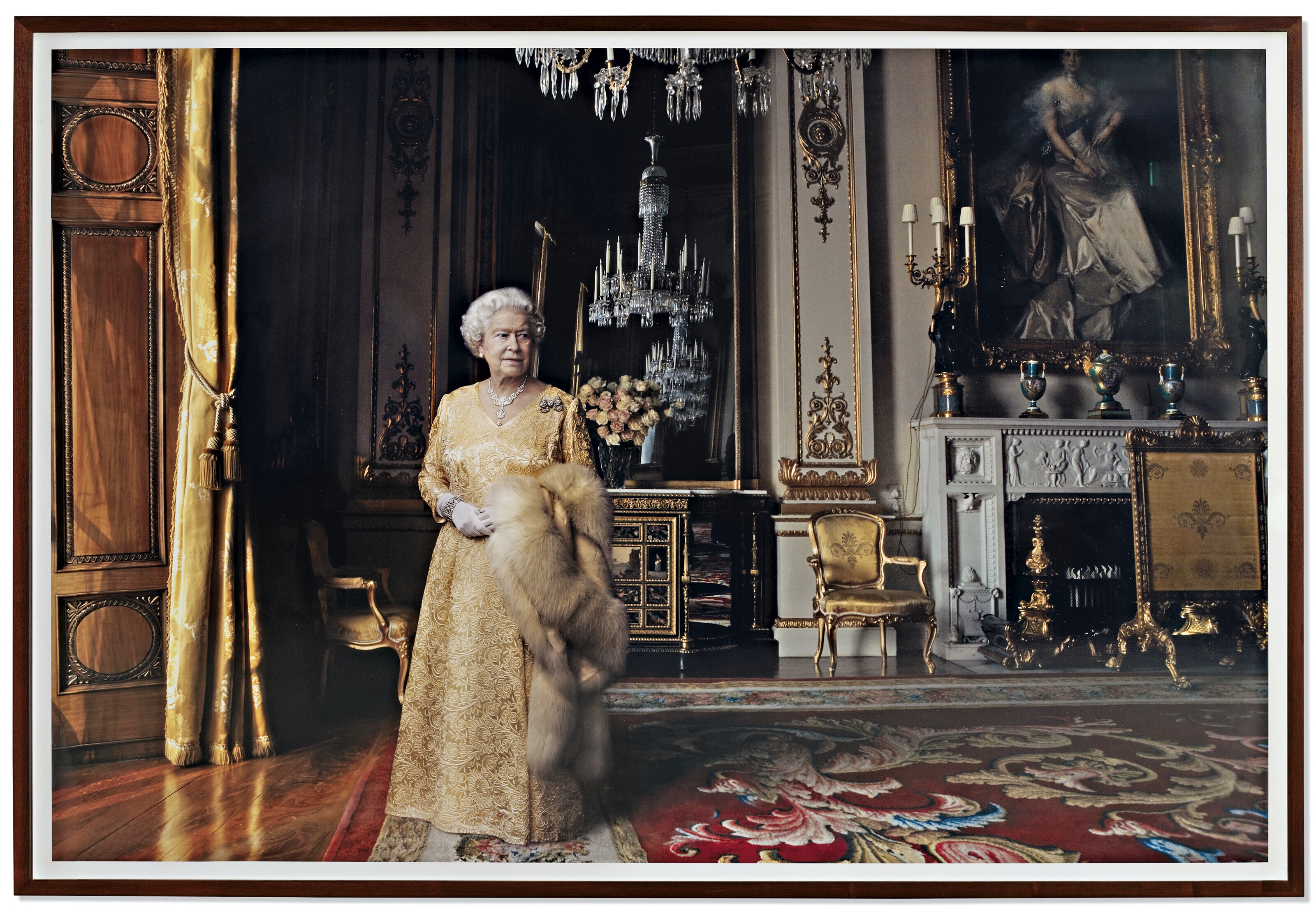
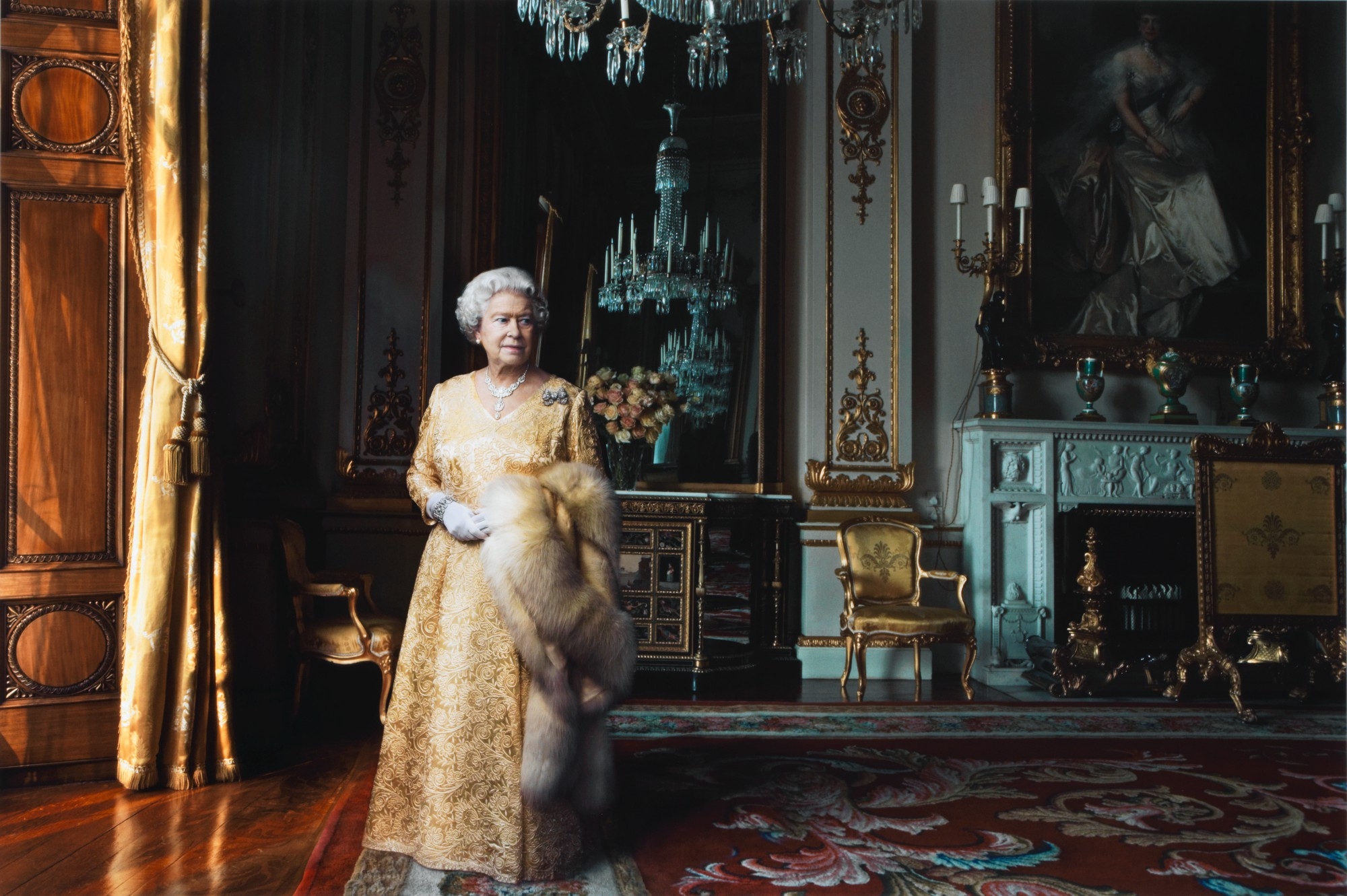
- The Window Portrait: Set within the White Drawing Room, the Queen stands near an expansive window overlooking the palace gardens. Draped in the deep velvet Order of the Garter mantle, wearing the Diamond Diadem, and holding her gloves, she faces into dramatic, stormy light. The composition frames her as a resolute figure standing against the tides of time and weather.
- The Seated Grand Portrait: Positioned in a gilded armchair within the ceremonial reception rooms, the Queen is shown in full state regalia. The dark, moodily lit backdrop evokes Old Master canvas textures, minimizing modern palace fixtures in favor of timeless monumentality.
- The Balcony Silhouette: Captured outdoors on the Buckingham Palace balcony, this image frames the Queen against a grey, overcast London sky. Her robes sweep across the stone balustrade, emphasizing her physical presence against the sprawling city below.
- The Unrobed Intimate Study: A less formal composition where the Queen sits without the heavy velvet mantle, offering a quieter, more reflective perspective amid the grand architecture of the palace.
| Feature | 2007 Buckingham Palace Session |
|---|---|
| Location | White Drawing Room & Balcony, Buckingham Palace, London |
| Key Attire | Order of the Garter robes, Diamond Diadem, state jewels |
| Primary Themes | Sovereign duty, historical majesty, dramatic atmosphere |
| Visual References | Gainsborough, Reynolds, 17th-century chiaroscuro painting |
The BBC Editing Controversy ("Crowngate") Explained
Despite the critical acclaim the portraits ultimately received, the 2007 sittings were initially overshadowed by a high-profile media controversy often referred to as "Crowngate."
During the shoot in the White Drawing Room, Leibovitz politely suggested that the Queen remove her crown to achieve a slightly less formal look. "I think it will look better without the crown," Leibovitz remarked, adding, "less dressy, because an Order of the Garter robe is so extraordinary."
Queen Elizabeth II responded with her characteristic sharp wit: "Less dressy? What do you think this is?" She gestured to her elaborate robes, pointing out that one does not simply dress down full chivalric state regalia. Despite the banter, the Queen complied with the creative direction, and the shoot proceeded smoothly.
However, in July 2007, during a press launch for the upcoming BBC documentary series The Monarchy: The Royal Family at Work, the BBC screened a promotional trailer. The trailer had been deliberately edited out of chronological order. It showed the Queen walking briskly down a palace hallway, telling her lady-in-waiting, "I'm not changing anything. I've had enough of dressing like this, thank you very much," immediately after Leibovitz's comment about the crown.
The edit created the false impression that the Queen had stormed out of the session in anger. Media outlets worldwide picked up the story, reporting an apparent clash between the British monarch and the American photographer.
The BBC quickly realized the error and issued a full public apology to both Queen Elizabeth II and Annie Leibovitz, acknowledging that the sequence was miscut and that the Queen had behaved with complete professionalism throughout. The fallout from the editing misrepresentation led to the resignation of BBC One Controller Peter Fincham and independent production company executive Stephen Mitchell, making the incident a historic case study in broadcast ethics and media management.
The 2016 Windsor Castle Sittings: Celebrating the 90th Birthday
Nine years after the Buckingham Palace sittings, Annie Leibovitz was invited back by the Royal Household for a second major commission. Released in April 2016, this series was created to mark Queen Elizabeth II’s 90th birthday.
In contrast to the grand, sweeping state portraits of 2007, the 2016 portfolio focused on intimacy, domesticity, and family continuity. Staged at Windsor Castle—the Queen’s preferred weekend residence and ancestral home—the photographs provided a rare glimpse into the monarch's personal world as a mother, grandmother, great-grandmother, and country living enthusiast.
| Feature | 2016 Windsor Castle Session |
|---|---|
| Location | Green Drawing Room, East Terrace, & Grounds, Windsor Castle |
| Key Attire | Cardigans, pleated skirts, everyday day dresses (informal) |
| Primary Themes | Family continuity, maternal warmth, pastoral life |
| Visual References | Dutch Golden Age group portraiture, classic country lifestyle |
Intimacy and Intergenerational Legacy: The Grandchildren and Great-Grandchildren
The most famous photograph from the 2016 series is an extraordinary group portrait taken in the Green Drawing Room at Windsor Castle. It features Queen Elizabeth II seated at the center, surrounded by her two youngest grandchildren and her five great-grandchildren.
The composition was carefully arranged yet disarmingly natural:
- Prince George and Princess Charlotte: Positioned near the Queen, representing the direct line of succession.
- Mia Tindall: Daughter of Zara and Mike Tindall, the two-year-old spontaneously picked up the Queen’s trademark black Launer handbag during the setup. Leibovitz wisely decided to leave the unscripted moment in the final image, creating a warm, human centerpiece that captivated audiences globally.
- James, Viscount Severn, and Lady Louise Windsor: The children of Prince Edward and the Duchess of Edinburgh (then the Earl and Countess of Wessex), standing dutifully to the side.
- Savannah and Isla Phillips: Daughters of Peter Phillips, completing the domestic gathering.
The photograph echoed traditional European group portraiture, utilizing soft directional window light to illuminate the children's expressions while maintaining a muted palette of dusty pinks, blues, and cream tones.
The Royal Family and the Working Dogs: Windsor Grounds
Another defining image from the 2016 collection features the Queen walking on the steps of Windsor Castle's East Terrace, accompanied by her beloved dogs. The composition includes her corgis (Willow and Holly) and her dorgis (Vulcan and Candy).
Rather than posing the monarch on a throne, Leibovitz captured her on stone steps clad in a casual jacket, headscarf, and stout walking shoes. The image highlighted the Queen's lifelong passion for animals and the outdoors, presenting an image of a sovereign at peace in her domestic environment after more than six decades on the throne.
A Mother and Daughter Study: The Princess Royal
The third key piece in the 2016 portfolio is a quiet, contemplative portrait of Queen Elizabeth II seated on a couch alongside her only daughter, Anne, Princess Royal.
Taken in the White Drawing Room at Windsor, the photograph is striking in its simplicity. Both women dress in comfortable, everyday attire, leaning slightly toward one another in quiet solidarity. The portrait highlights the profound personal and working relationship between the Queen and Princess Anne, providing an intimate counterweight to the formal state portraits of previous decades.
Visual Aesthetics and Technique: How Leibovitz Reimagined Royal Imagery
Annie Leibovitz’s royal portraits stand out in the history of photographic portraiture because of her distinct technical methodology and narrative vision. Rather than treating the royal sittings as quick press photo-ops, Leibovitz applied fine-art production principles to every frame.
Masterful Use of Lighting and Palette
Leibovitz is known for using custom painterly lighting setups that mimic natural window illumination found in Dutch Masters such as Johannes Vermeer and Rembrandt van Rijn. In both the 2007 and 2016 sittings, she combined ambient daylight with soft flash fill to separate her subjects gently from the background.
She deliberately suppressed hyper-saturated colors. In the 2007 state portraits, deep blues, gold highlights, and rich velvet reds dominate the palette, conveying power and tradition. In the 2016 Windsor series, the tones shift to soft earth tones, sage greens, and muted pastels, reinforcing themes of home, comfort, and longevity.
| Feature | 2007 Buckingham Palace Sittings | 2016 Windsor Castle Sittings |
|---|---|---|
| Setting | Formal State Rooms & Balcony | Private Drawing Rooms & Castle Grounds |
| Wardrobe Style | Regalia, Garter Mantle, Diadem | Day dresses, cardigans, outdoor wear |
| Subject Focus | The Sovereign / Monarch | The Matriarch / Family & Animals |
| Color Palette | Deep reds, gold, dark navy, velvet | Muted pastels, sage, cream, earth |
| Tonal Mood | Dramatic, powerful, institutional | Warm, serene, intimate, domestic |
| Cultural Function | US State Visit Commemorative | 90th Birthday Celebration |
Storytelling Through Narrative Composition
A signature element of Leibovitz’s approach is narrative staging. In formal royal portraiture prior to the 2000s, monarchs were frequently posed centrally, staring directly into the lens against neutral or architectural backdrops.
Leibovitz introduced dynamic environmental storytelling:
- Framing the Queen near windows to symbolize her gaze outward toward the nation and the world.
- Including small, unscripted human elements—such as Mia Tindall holding the handbag—to cut through rigid court protocol.
- Placing animals in active, unposed positions around the monarch to ground the scene in physical reality.
Critical Reception and Cultural Legacy
The photographs created by Annie Leibovitz across her two sessions with Queen Elizabeth II are widely regarded by art historians and photography critics as defining visual records of the modern Elizabethan era.
Evolution of Royal Image-Making
Throughout her 70-year reign, Queen Elizabeth II witnessed a dramatic transformation in how the public consumed images of royalty. In the 1950s, Cecil Beaton photographed her in romantic, fairytale compositions that emphasized isolation and magical majesty. By the 1970s and 1980s, Lord Snowdon brought a sharper, modern photographic style to the royal household.
Leibovitz synthesized these two approaches. Her 2007 portraits honored the theatrical heritage of court art, while her 2016 portraits humanized the monarch without stripping away her dignity. By inviting an American fine-art photographer into the private spheres of Buckingham Palace and Windsor Castle, the Royal Household demonstrated an ability to adapt royal iconography for a global, digital audience.
Inclusion in National Collections
Prints from both the 2007 and 2016 sittings have been exhibited in major institutions worldwide, including the Royal Collection Trust, the National Portrait Gallery in London, and international photographic retrospectives. They serve as valuable study materials for researchers analyzing contemporary portraiture, state visual strategy, and the intersection of public duty and private identity.
Frequently Asked Questions
Why did Annie Leibovitz ask Queen Elizabeth II to remove her tiara in 2007?
Annie Leibovitz suggested removing the tiara/crown to achieve a less formal, more modern aesthetic that focused primarily on the Queen's face and expression rather than the grandeur of the state jewels. The Queen humorously declined, noting that one does not dress down full Order of the Garter state robes.
What was the "Crowngate" scandal involving the BBC?
"Crowngate" was a media controversy caused when a BBC promotional trailer edited footage of the 2007 photoshoot out of order. The trailer made it appear as though Queen Elizabeth II stormed out of the session after Leibovitz asked her to remove her crown. In reality, the shoot went smoothly, and the footage showed the Queen entering the session. The BBC issued a formal public apology, and top executives resigned over the editorial error.
How many times did Annie Leibovitz photograph Queen Elizabeth II?
Annie Leibovitz conducted two major official portrait sessions with Queen Elizabeth II: the first at Buckingham Palace in March 2007 (released May 2007) and the second at Windsor Castle in early 2016 (released April 2016 for the Queen's 90th birthday).
Who was the little girl holding the purse in the 2016 portrait?
The two-year-old girl holding Queen Elizabeth II’s black handbag was Mia Tindall, daughter of Zara Tindall (née Phillips) and Mike Tindall, and a great-granddaughter of the Queen. The moment was unscripted; Mia picked up the handbag during the shoot setup, and Leibovitz chose to capture the candid interaction.
Where were the 2016 90th birthday photographs taken?
All the official 90th birthday portraits taken by Annie Leibovitz in 2016 were shot on location at Windsor Castle, utilizing the Green Drawing Room, the White Drawing Room, and the outdoor steps of the East Terrace.
Practical Recommendations for Art Historians and Photography Students
For researchers, photography practitioners, and art historians looking to study Annie Leibovitz’s work with Queen Elizabeth II in greater detail, the following steps offer direct avenues for further analysis:
- Examine the Official Royal Collection Trust Archives: Access the official records maintained by the Royal Collection Trust to study high-resolution digital files of the portraits, alongside official notes on provenance, wardrobe details, and historical exhibition catalogues.
- Analyze Lighting Schemes: Study Leibovitz's key lighting choices by reviewing her publication Annie Leibovitz at Work, which outlines her technical approach to large-scale environmental sittings, lighting setups, and camera selection during royal and state portraiture.
- Review Broadcast Ethics Case Studies: For media students, review the official BBC Trust findings and independent reports published following the 2007 documentary trailer incident to understand the legal, ethical, and editorial standards governing broadcast editing and public figure representation.