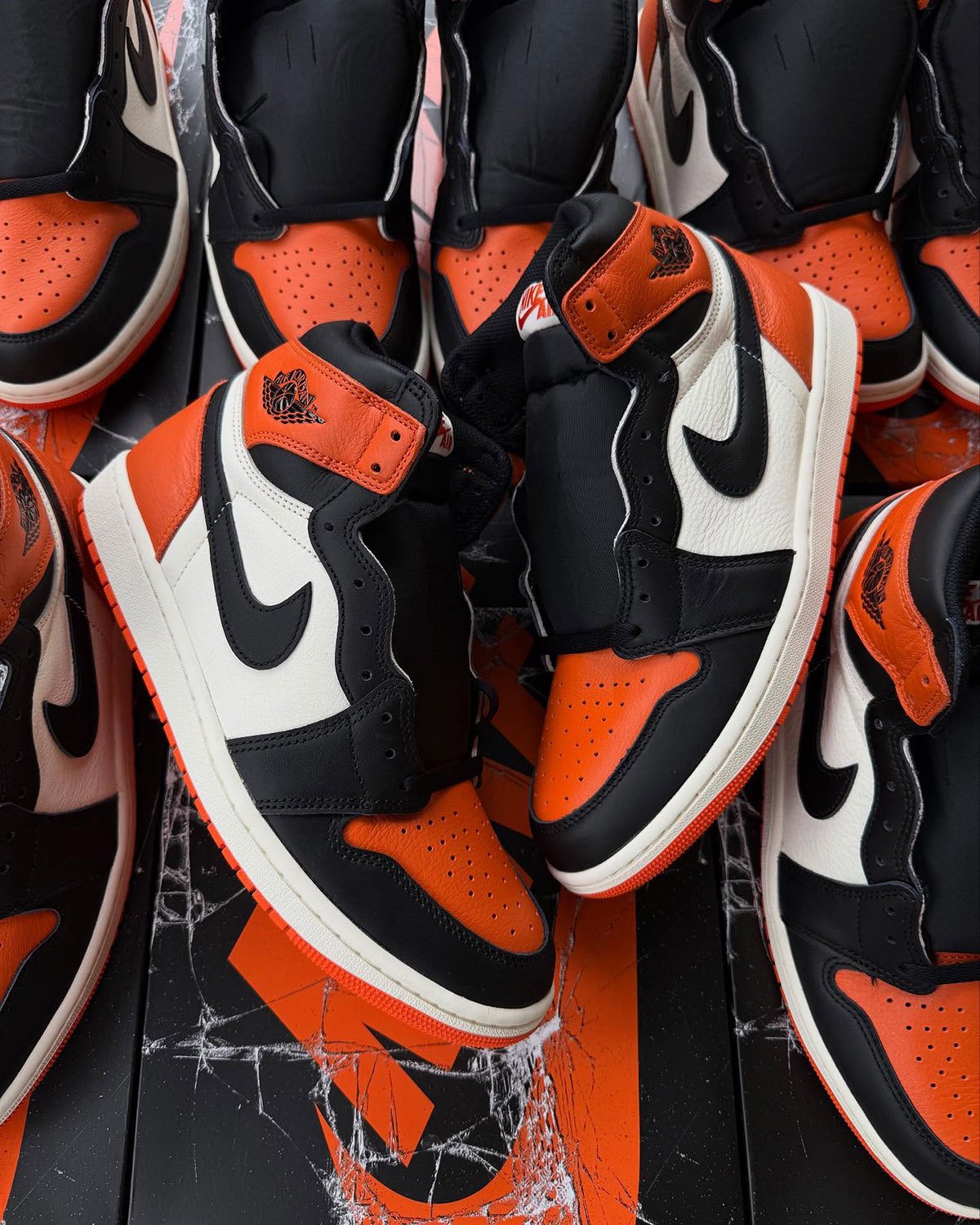
The Air Jordan 1 Shattered Backboard, released in 2015, is a high-top sneaker that commemorates Michael Jordan’s iconic 1985 exhibition game in Trieste, Italy, where he famously shattered a glass backboard. Recognized for its premium "Starfish" orange tumbled leather and superior craftsmanship, it remains one of the most coveted and valuable non-original colorways in the entire Jordan Brand portfolio.
The Historical Origin: Trieste, 1985
To understand why the 2015 "Shattered Backboard" (often abbreviated as SBB 1.0) holds such a hallowed place in sneaker culture, one must look back to August 25, 1985. During a Nike-sponsored exhibition game in Trieste, Italy, Michael Jordan played for the local team, Stefanel Trieste. Dressed in an orange, black, and white jersey, Jordan delivered a performance that culminated in a powerful dunk so forceful it completely shattered the glass backboard, raining shards down on the court and the opposing players.
While the event was a footnote in Jordan’s early career for many years, Nike and Jordan Brand revisited this moment three decades later. The "Shattered Backboard" Air Jordan 1 High OG was designed to tell this specific story. The color palette of the shoe—Starfish Orange, Black, and Sail—was directly inspired by the jersey Jordan wore during that game. This storytelling approach transformed a "non-OG" colorway (one that Jordan never wore during an official NBA game) into a piece of historical memorabilia that resonated deeply with collectors who value the narrative behind the footwear.
Technical Specifications and Material Excellence
In 2015, the Air Jordan 1 "Shattered Backboard" set a new benchmark for what collectors expected from the "Remastered" series. Prior to this release, many Air Jordan 1 retros were criticized for using stiff, synthetic-feeling leathers. The SBB 1.0 changed that narrative entirely.
Leather Quality and Texture
The defining characteristic of the 2015 release is the quality of the leather. The "Sail" side panels and the "Starfish" orange toe box and heel utilize a heavy, full-grain tumbled leather. This material is remarkably soft to the touch and develops a unique patina and character with wear. Unlike many other releases that use a polyurethane coating to mimic high-end leather, the SBB 1.0 felt organic and premium, leading many enthusiasts to label it the "best quality AJ1" of the modern era.
Color Accuracy and Blocking
The color blocking follows the classic "Black Toe" layout but replaces the traditional red with Starfish orange.
- Starfish Orange: A vibrant, saturated orange that leans slightly toward a burnt hue, avoiding the neon or pastel tones seen in later variations.
- Sail: Instead of a stark, sterile white, Jordan Brand used "Sail"—an off-white, slightly creamy tone. This choice gave the shoe a vintage, "pre-aged" aesthetic that complemented the 1985 theme.
- Black: Used on the overlays, swoosh, and laces to provide a sharp contrast that anchors the design.
Structural Details
The 2015 model features the "High OG" silhouette, which includes the nine-lace-hole design and the "Nike Air" branding on the tongue, rather than the Jumpman logo found on "Mid" or "standard" High models. The insoles also featured a unique graphic of a shattered backboard, a detail often omitted in subsequent iterations of the SBB line.
Market Value and Investment Status in 2026
As of 2026, the Air Jordan 1 Shattered Backboard 2015 has solidified its status as a "Blue Chip" sneaker investment. While most sneakers lose value as they age and the materials begin to degrade, the SBB 1.0 has defied standard depreciation curves.
Price Evolution
Upon its initial release in June 2015, the shoe retailed for $160 USD. Almost immediately, the secondary market price surged. By 2018, pairs were trading for approximately $800. In the current 2026 market, a "Deadstock" (brand new, never worn) pair in a popular size can command anywhere from $1,600 to $2,400. Even "Very Great Condition" (VNDS) used pairs often sell for over $1,000, provided the leather has been well-maintained and the "stars" on the outsole are still visible.
Factors Influencing 2026 Valuation
Several factors contribute to the sustained high price of the 2015 version:
- Scarcity: Unlike modern "hype" releases that see massive restocks, the 2015 SBB has never been officially re-released in its original form.
- The "Quality" Reputation: Even with dozens of high-end collaborations (such as those with Travis Scott or Fragment Design), the 2015 SBB is still the "gold standard" for leather quality in the community.
- Cultural Impact: It is widely considered the shoe that proved non-OG colorways could be just as desirable as the original Chicago or Bred versions.
Authentication Guide: Identifying a Genuine 2015 Pair
The high resale value of the Shattered Backboard 2015 has unfortunately made it a frequent target for high-quality replicas. When verifying a pair in 2026, collectors must look for specific technical markers that are difficult for counterfeiters to replicate perfectly.
The Hourglass Shape
When viewing the shoe from the back, a genuine Air Jordan 1 High should have a distinct "hourglass" shape—wide at the top, narrowing at the middle (where the swoosh wraps around), and widening again at the heel. Many replicas have a "boxy" or straight vertical shape.
The Wings Logo
The "Air Jordan" Wings logo on the lateral ankle should be deeply embossed, not just printed. On the 2015 SBB, the "R" and "D" in "Jordan" should touch at the bottom, and the glossiness of the ink should be subtle, not overly shiny.
The Corner Stitching
The "corner stitch" refers to the 90-degree angle of stitching located just above the swoosh on the side panels. While it is a common myth that the stitch should never touch the swoosh, on a retail SBB 2015, there is typically a small gap between the corner stitch and the top of the swoosh.
Leather "Tumble" and Grain
The tumbling on the orange leather should look natural and irregular. Counterfeit pairs often have a "stamped" tumbling pattern that looks too uniform. Furthermore, the Sail leather should feel plush; if it feels like hard plastic, it is likely a fake.
Comparing the Shattered Backboard Lineage
Following the success of the 2015 original, Jordan Brand released several variations. However, none have quite matched the prestige of the 1.0.
| Feature | SBB 1.0 (2015) | SBB 2.0 / Away (2016) | SBB 3.0 (2019) | SBB Low OG (2021) |
|---|---|---|---|---|
| Color Blocking | Black Toe / Orange Heel | Chicago-style Orange | All-over Orange/Black | Low-top Starfish |
| Primary Leather | Ultra-Soft Tumbled | Smooth / Light Tumble | Crinkled Patent Leather | Smooth Leather |
| Midsole Color | Sail (Off-White) | Sail (Off-White) | Pale Vanilla | White |
| Resale Value | Highest ($1.6k+) | High ($800 - $1.2k) | Moderate ($400 - $600) | Moderate ($300 - $450) |
| Defining Trait | Set the quality standard | "Reverse" colorway | Controversial "Greasy" look | Summer-friendly variant |
The SBB 2.0 (Away) is also highly regarded for its leather quality, but it uses more white/orange and less black, giving it a brighter appearance. The SBB 3.0 remains the most controversial due to its "crinkled patent leather" upper, which many fans felt looked "greasy" or "shiny," though it has gained a cult following in recent years for its durability and unique texture.
Maintenance and Long-term Preservation
For those fortunate enough to own a pair in 2026, preservation is key. The Air Jordan 1 is a sturdy shoe, but 11 years after its production, certain risks emerge.
- Sole Oxidation: The Sail midsole can begin to yellow further or even develop "midsole crumbling" if stored in extremely humid environments. While AJ1 soles are made of solid rubber and are much more durable than the foam soles of the AJ3 or AJ4, they still require a cool, dry environment.
- Leather Conditioning: Because the 2015 SBB uses high-quality natural leather, it can dry out over time. Periodically using a high-quality leather conditioner (pH-balanced) will keep the fibers supple and prevent cracking on the toe box creases.
- Storage: Avoid clear plastic drop-front boxes that are exposed to direct sunlight, as UV rays will fade the Starfish orange pigment. Use acid-free tissue paper; the original black paper included in some 2015 boxes can occasionally bleed dye onto the Sail panels if it gets damp.
Frequently Asked Questions
Why is it called "Shattered Backboard"?
The name refers to a 1985 exhibition game in Trieste, Italy, where Michael Jordan dunked so hard that the glass backboard shattered. The shoe’s colors (Orange, Black, and Sail) match the jersey Jordan wore during that specific game.
Is the leather on the 2015 SBB actually different from other Jordans?
Yes. During the 2015 "Remastered" campaign, Jordan Brand used a higher grade of full-grain tumbled leather for this specific release. It is noticeably softer and thicker than the leather used on standard Air Jordan 1 releases from the same era, such as the 2015 "Chicago" or "UNC" colorways.
How can I tell the 2015 version from the newer releases?
The 2015 version (1.0) has a "Black Toe" color blocking (black around the toe box) and uses tumbled Sail-colored leather on the side panels. The 2016 version (2.0) has an orange toe box with white overlays, and the 2019 version (3.0) is made of very shiny, crinkled patent leather.
Does the Air Jordan 1 Shattered Backboard 2015 run true to size?
Generally, yes. The 2015 SBB follows the standard Air Jordan 1 fit. However, because the leather is so soft, many users find that the shoe "breaks in" more comfortably than stiffer versions, occasionally making it feel slightly roomier after multiple wears.
Is it still worth buying in 2026?
From a historical and quality standpoint, yes. However, buyers should be aware that at 11 years old, the glue bonds between the upper and the sole may begin to weaken. If you plan to wear them, check for signs of sole separation. As an investment piece, it remains one of the most stable assets in the sneaker market.
Recommendation for Buyers and Collectors
If you are looking to acquire the Air Jordan 1 Shattered Backboard 2015 in 2026, prioritization should be placed on authenticity and leather condition over the state of the original box. Due to the high volume of fakes, always use a reputable secondary market platform that offers physical authentication services.
For those who find the $2,000 price point prohibitive, the Air Jordan 1 Low OG "Starfish" (2021) or the Air Jordan 1 "Bred Toe" offer a similar aesthetic and high-quality leather feel at a significantly lower entry price. However, for the serious collector, the 2015 High OG remains an essential cornerstone of any complete Jordan collection—a rare instance where the "hype" is fully supported by the actual quality of the product.