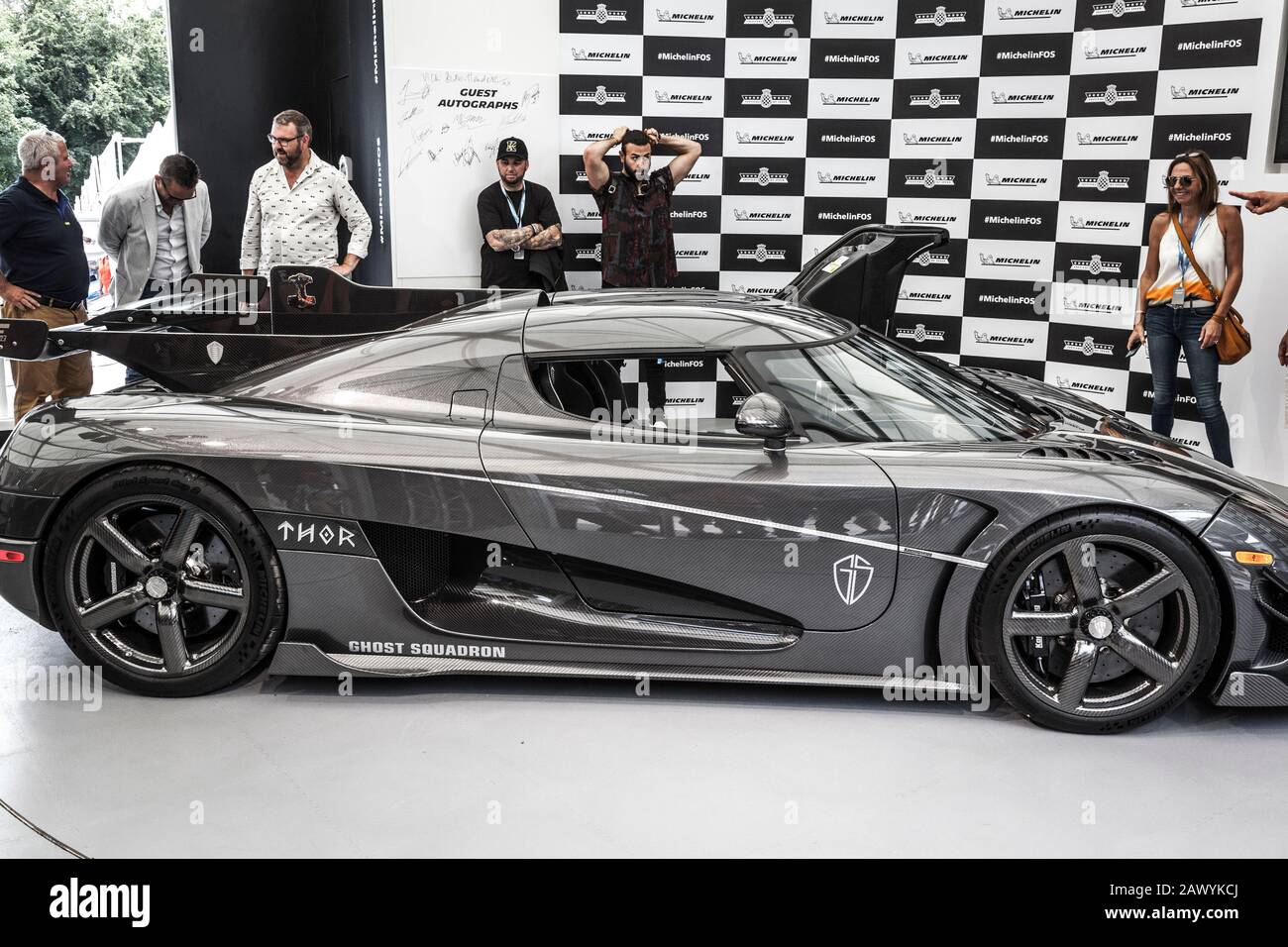
The Koenigsegg Agera RS Thor is one of two "Final Edition" models produced by the Swedish manufacturer to mark the end of the Agera line. It features a bespoke "Le Mans" style rear wing, a 1,360-horsepower 1MW engine upgrade, and a unique two-tone clear carbon fiber finish infused with real diamond flakes.
The Agera RS Thor represents the absolute zenith of the Agera platform, a vehicle series that redefined the capabilities of a production internal combustion engine. Unveiled in 2018 as part of a two-car conclusion to the Agera RS production run (the other being "Väder"), Thor was designed to showcase the maximum technical and aesthetic potential of the platform before Koenigsegg transitioned to the Jesko. As of 2026, Thor remains one of the most coveted and valuable modern hypercars in existence, serving as a functional piece of automotive history.
The Genesis of the Agera RS Final Edition
The Agera RS production run was originally limited to 25 units, but the demand for the vehicle was so high—and its performance so world-beating—that Koenigsegg decided to conclude the series with three distinct "Final Edition" cars. The first was the "One of 1," followed by the dual release of Thor and Väder. These cars were not merely late-production models; they were engineered as a bridge between the record-breaking Agera RS and the then-upcoming Jesko.
The owner of Thor, a prominent collector known for his bespoke taste, worked closely with Christian von Koenigsegg and the design team at Ängelholm to ensure the car possessed a distinct personality. While Väder focuses on aggressive, dark aesthetics with gold leaf accents and rear strakes, Thor is defined by its metallic brilliance and silver-toned clear carbon fiber. In the context of 2026, these Final Edition cars are viewed as the "Grand Finale" of the analog-feeling, twin-turbo V8 era of Koenigsegg, preceding the ultra-high-revving nature of the Jesko’s Light Speed Transmission (LST) system.
Technical Specifications: The 1MW Heart
The core of the Agera RS Thor is its powertrain. While the "standard" Agera RS was already a marvel of engineering, Thor came factory-equipped with the 1MW (One Megawatt) engine upgrade. This package was derived directly from the Koenigsegg One:1, effectively turning the Agera RS into a more refined, road-compliant version of that track-focused monster.
The 5.0-Liter Twin-Turbo V8
The engine is a 5.0-liter, twin-turbocharged V8, which utilizes a flat-plane crankshaft to allow for higher RPMs and a more visceral exhaust note. To achieve 1,360 horsepower (exactly one megawatt of power) and 1,011 lb-ft of torque, Koenigsegg engineers utilized several specialized components:
- 3D-Printed Variable Geometry Turbos: The housing for the turbochargers is 3D-printed from Inconel, allowing for complex internal geometries that reduce lag and improve heat management.
- Carbon Fiber Intake Manifold: This part is designed to optimize airflow into the combustion chambers while minimizing weight.
- Flex-Fuel Capability: To reach its maximum power output, the engine is designed to run on E85 biofuel. When running on standard 95-octane gasoline, the power is slightly reduced but still remains well above 1,000 hp.
Transmission and Power Delivery
Thor uses a 7-speed paddle-shift gearbox coupled with an electronic differential developed in-house by Koenigsegg. Unlike traditional dual-clutch transmissions of the era, Koenigsegg’s unit was designed to be incredibly lightweight while handling the immense torque of the V8. This transmission provides the "analog" tactile feel that many collectors in 2026 still prefer over the more seamless, digital-feeling gearboxes found in newer competitors.
Aerodynamics: The Le Mans Influence
The most visually striking technical feature of Thor is its aerodynamic package. Unlike the standard Agera RS, which uses a more traditional active rear wing mounted on two pillars, Thor features a massive, top-mounted "Le Mans" style active wing.
The Central Fin and Active Wing
The wing is supported by a large central pillar that acts as a stabilizer at high speeds. This design is reminiscent of LMP1 race cars, providing increased lateral stability during high-speed cornering and under heavy braking. The wing itself is active, meaning the onboard computers can adjust its angle of attack in real-time. During high-speed runs, the wing flattens to reduce drag; during braking, it flips up to act as an airbrake, significantly shortening stopping distances.
Front-End Downforce
To balance the massive downforce generated by the rear wing, Thor is equipped with enlarged front winglets and a custom front splitter. These components work in tandem with the "Triplex" suspension system—a third damper in the rear that prevents the car from "squatting" under the massive downforce generated at speeds exceeding 200 mph. This ensures that the car's aerodynamic platform remains stable, preventing the front end from lifting or the rear from dragging.
Aesthetic Identity: Clear Carbon and Diamond Flakes
The name "Thor" is reflected in the car's aesthetic, which evokes the imagery of lightning and polished metal. The bodywork is constructed entirely from pre-impregnated carbon fiber, finished in a two-tone clear coat.
- Diamond Flake Finish: One of the most expensive and complex paint options in automotive history, the clear coat on Thor is infused with real crushed diamond flakes. This gives the car a unique sparkle that is only visible under direct sunlight, transforming the dark carbon weave into a shimmering metallic surface.
- Silver Foil Accents: Instead of traditional paint for the pinstriping, Thor utilizes genuine silver leaf and foil accents. These lines trace the car's aerodynamic curves, highlighting the "C-line" that defines the Agera's silhouette.
- The Interior: The cabin is a blend of black Alcantara, polished carbon fiber, and silver stitching. The "Thor" logo is embroidered into the headrests, and the center console features the signature "ghost" lighting that shines through the machined aluminum buttons.
Comparative Analysis: Thor vs. Standard Agera RS
Understanding the significance of Thor requires a comparison with the standard Agera RS production models. The following table highlights the key technical and performance differences.
| Feature | Agera RS (Base) | Agera RS Thor (FE) |
|---|---|---|
| Engine Output | 1,160 hp | 1,360 hp (1MW) |
| Torque | 944 lb-ft | 1,011 lb-ft |
| Rear Wing Design | Dual-pillar Active | Top-mount "Le Mans" Active |
| Wheel Construction | Aircore Carbon Fiber | Aircore Carbon Fiber (Bespoke) |
| Finish | Standard Paint/Clear Carbon | Diamond-flake Clear Carbon |
| Production Count | 25 Total | 1 of 1 (Final Edition) |
| Special Aero | Standard RS Package | Extended Front Winglets |
The Legacy of the Agera RS Record-Breakers
Thor was built on the same foundation as the Agera RS that broke the world production car top speed record in 2017. In Pahrump, Nevada, a customer-owned Agera RS achieved a two-way average of 277.9 mph. Thor is essentially a more aerodynamic, more powerful evolution of that record-breaking chassis.
As of 2026, the Agera RS Thor is seen as a "bridge" vehicle. It retains the raw, mechanical character of the early Koenigseggs but introduces the advanced material science and aerodynamic modeling that would later define the Jesko Absolut. For collectors, Thor represents the last time a driver could experience 1,360 hp through a single-clutch-style transmission architecture, providing a level of engagement that many modern, more "electronic" hypercars lack.
Maintenance and Ownership in 2026
Maintaining a vehicle as complex as the Agera RS Thor requires a specialized infrastructure. Koenigsegg operates a "Flying Rangers" service, where factory-trained technicians travel globally to the car's location to perform maintenance.
Software and Telemetry
Despite being several years old, Thor remains connected to the Koenigsegg cloud. This allows the factory in Sweden to monitor engine health, track maintenance intervals, and even push over-the-air (OTA) updates to the active aerodynamics and engine management systems. In 2026, this level of support ensures that Thor is not just a museum piece but remains a fully functional, high-performance machine.
Value and Collectibility
The market for Final Edition Koenigseggs has seen unprecedented growth. While the original price was in the low millions, Thor’s status as a "1 of 1" within the Final Edition series—combined with its unique diamond finish—has placed its current estimated valuation well into the eight-figure range. It is frequently cited by analysts as one of the safest "blue-chip" automotive investments due to its rarity and its place at the end of the Agera production cycle.
Frequently Asked Questions
What is the difference between Thor and Väder?
Thor and Väder are the two "Final Edition" Agera RS models. Thor features a two-tone clear carbon finish with diamond flakes and a "Le Mans" style rear wing. Väder is finished in dark clear carbon with gold leaf accents and features unique rear strakes (additional aerodynamic fins) on the rear wing pillars. Both cars feature the 1MW engine upgrade.
How fast can the Agera RS Thor go?
While Thor has not been officially tested for a top speed run like the record-setting RS in Nevada, its 1,360 hp engine and improved aerodynamics suggest it is capable of exceeding 278 mph. However, its high-downforce "Le Mans" wing is designed more for track stability and cornering than for absolute top speed, which would be the domain of a "low-drag" setup.
Who owns the Koenigsegg Agera RS Thor?
Thor was commissioned by a high-profile collector known as @dan_am_i on social media. He is known for owning several of the world's most exclusive hypercars. The car is often seen at major automotive events in Southern California and is part of one of the most significant private collections in the world.
Can the Agera RS Thor be driven on the street?
Yes, the Agera RS Thor is fully street-legal. Unlike the One:1, which faced some registration hurdles in certain jurisdictions due to its extreme nature, the Agera RS (including the Final Editions) was designed with global homologation in mind, including US DOT and EPA standards.
Is the 1MW engine standard on all Agera RS models?
No, the 1MW (1,360 hp) engine was an optional upgrade for most Agera RS buyers. However, it was included as standard equipment for the "Final Edition" series (Thor and Väder) to ensure they represented the peak of the platform's performance.
Final Recommendation for Enthusiasts and Collectors
For those studying the history of Koenigsegg, the Agera RS Thor is more than just a car; it is a technical case study in how to retire a legendary platform. If you are a collector looking for the ultimate expression of the Agera lineage, Thor (and its sibling Väder) represent the absolute pinnacle.
For enthusiasts, Thor serves as a reminder that the transition to electrification does not diminish the legacy of internal combustion. The engineering required to make a 5.0-liter V8 produce 1,360 hp reliably remains one of the greatest achievements in automotive history. As we move further into the 2020s and beyond, the Agera RS Thor will likely only increase in historical significance as the "Final Viking" of the analog hypercar age.