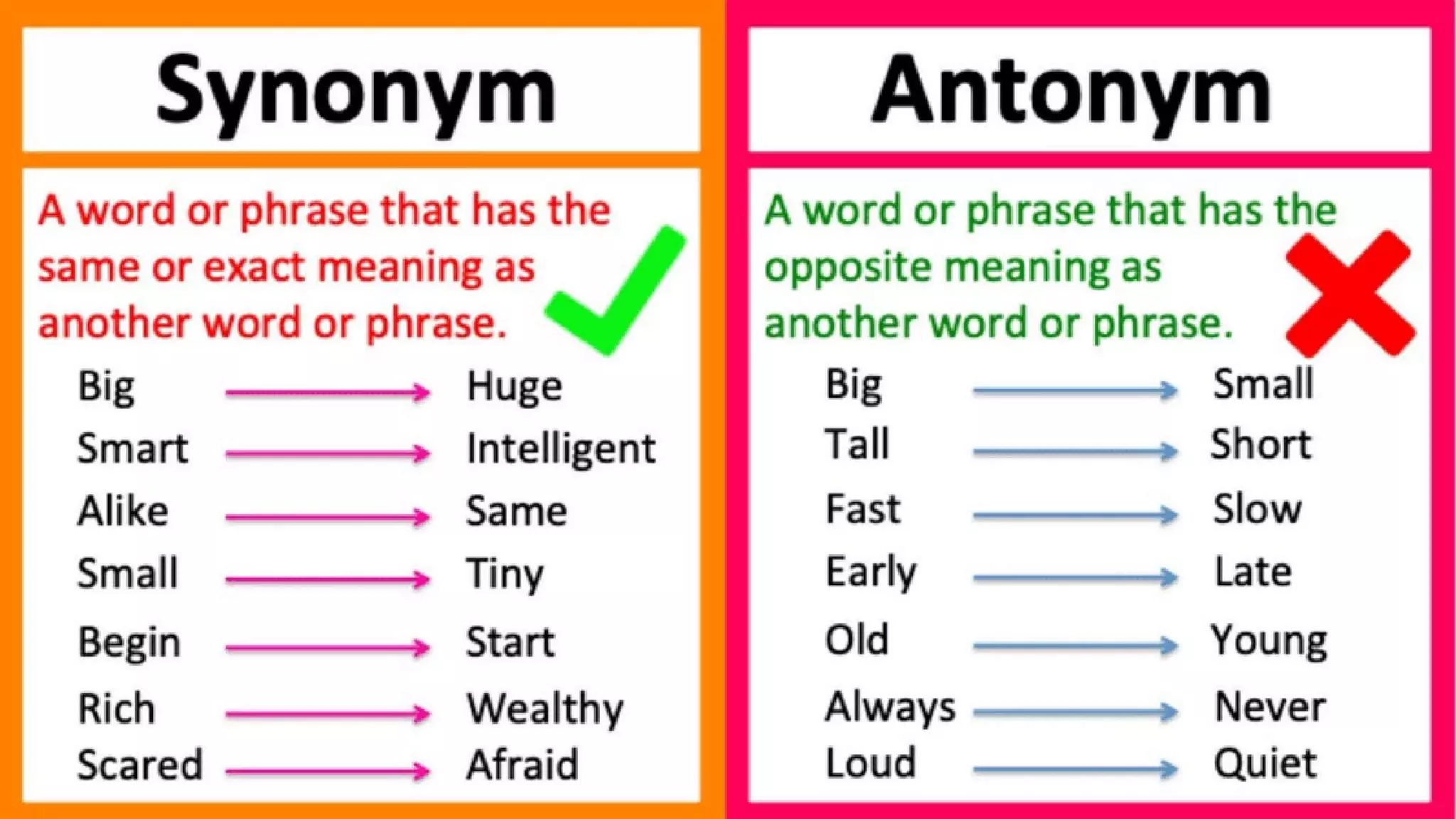
Abundant synonyms in English refer to the vast collection of alternative words that share similar meanings, allowing writers and speakers to achieve precision, tone variation, and stylistic elegance. Navigating this lexical richness requires understanding nuance, register, and context to ensure that a chosen word accurately conveys the intended message without distorting its original connotation.
The Linguistic Architecture of English Synonyms
English is a unique language characterized by its massive lexicon, which is largely the result of its historical development. Unlike languages that rely on a single root source, English is a Germanic language that absorbed thousands of words from Old Norse, Norman French, Latin, and Greek. This confluence of linguistic traditions is the primary reason why English possesses such an abundance of synonyms.
When you look for a synonym for a simple word like "big," you are not just finding an equivalent; you are often choosing between words that originated in different linguistic eras. "Large" comes from the Old French large, while "great" is of Germanic origin. This historical layering gives English speakers a choice of registers—the level of formality or informality in speech or writing. Understanding these roots helps you determine whether a synonym is appropriate for a formal academic paper, a casual conversation, or a professional technical document.
The Importance of Nuance and Denotation vs. Connotation
While two words may be synonyms, they are rarely identical in meaning. A dictionary will provide the denotation, which is the literal, objective definition of a word. However, the nuance—the subtle difference in shade of meaning—is what separates a good writer from a great one. This is dictated by connotation, the emotional or cultural associations attached to a word.
Consider the synonyms for the word "stubborn":
- Obstinate: Often implies a refusal to change one's mind despite logic.
- Tenacious: Suggests a positive, admirable trait of persistence.
- Headstrong: Implies a reckless or impulsive disregard for advice.
- Dogmatic: Suggests an arrogant, unyielding adherence to a belief system.
If you are writing a performance review, describing an employee as "tenacious" carries a complimentary tone, whereas calling them "obstinate" suggests a performance issue. Mastering these distinctions is the primary technical requirement for using abundant synonyms effectively.
Strategic Selection: How to Choose the Right Word
To utilize the English language’s vast synonym database effectively, you must employ a systematic approach to word selection. Relying solely on a thesaurus without critical analysis can lead to "thesaurus syndrome," where a writer chooses an unnecessarily complex word that sounds unnatural or pretentious.
1. Define the Context
Before seeking a synonym, identify the context. Is the subject technical, creative, or persuasive? Technical writing demands precision above all else; creative writing allows for evocative, sensory-rich language.
2. Consult Multiple Resources
Avoid relying on a single digital thesaurus. Use a variety of sources to cross-reference shades of meaning:
- Merriam-Webster’s Dictionary of Synonyms: Excellent for nuanced distinctions.
- Oxford English Dictionary (OED): Provides historical context and usage examples.
- Thesaurus.com or similar digital tools: Useful for rapid brainstorming but require careful verification.
3. Evaluate the Register
Ensure the synonym matches the formality of your existing text. Using an archaic or overly formal synonym in a conversational context can cause friction for the reader, breaking the flow of communication.
Comparison Table: Nuanced Synonyms for Common Terms
The following table demonstrates how synonyms for common concepts vary based on the intended emotional weight and situational appropriateness.
| Primary Word | Synonym (Formal) | Synonym (Casual) | Synonym (Technical/Specific) |
|---|---|---|---|
| Important | Paramount | Big | Critical |
| Change | Alteration | Switch | Modification |
| Fast | Rapid | Quick | Velocity-oriented |
| Sad | Melancholy | Down | Depressed |
| Help | Assist | Give a hand | Facilitate |
| Thinking | Contemplating | Figuring out | Analyzing |
Common Pitfalls and How to Avoid Them
Even experienced writers can fall into traps when utilizing the abundant synonyms in English. Recognizing these errors is the first step toward clearer communication.
The "Big Word" Bias
The most common mistake is assuming that a longer, more obscure synonym is inherently better than a simple word. If a direct, simple word exists, it is often more powerful. Using "utilize" when "use" suffices can clutter prose unnecessarily. Use synonyms to add color or precision, not just to increase the complexity of your vocabulary.
Ignoring Collocations
Collocations are words that naturally occur together, such as "make a decision" rather than "do a decision." Even if "perform" is a synonym for "make," you cannot say "perform a decision." When swapping words, always check if the new word fits the natural partnership of the surrounding phrase.
Overlooking Register Clashes
Blending registers—such as using a colloquial term like "hang out" in the same sentence as an academic synonym like "contemplate"—creates an uneven, jarring reading experience. Strive for consistency throughout your document to maintain a professional voice.
Practical Tips for Expanding Your Vocabulary
Improving your access to synonyms is a cumulative process that requires deliberate practice. By integrating the following habits into your daily writing routine, you will naturally broaden your linguistic reach.
- Read Widely and Actively: Don't just consume information; observe how authors choose their words. When you come across a word that perfectly captures a sentiment, look up its synonyms to understand why the author chose that specific term over others.
- Keep a "Word Journal": When you find a particularly useful synonym, write it down in context. Seeing how a word is used in a real sentence is significantly more effective for retention than memorizing lists.
- Use Feedback Loops: Utilize contemporary AI writing assistants to flag repetitive word usage. When a tool suggests you use the same adjective three times in a paragraph, take the time to find three distinct synonyms that add varying layers of meaning.
- Practice Rewriting: Take a paragraph from a source you admire and rewrite it using different synonyms. Compare your version to the original to see how your word choices changed the rhythm and tone of the piece.
Frequently Asked Questions
Why does English have so many synonyms compared to other languages? English is a "borrowing" language. Throughout its history, it integrated vocabulary from Latin, Greek, French, and various Germanic sources. This resulted in multiple words for the same concept, often with subtle differences in origin and social class usage, which have persisted into modern 2026 usage.
Is there a risk of using synonyms that are too similar? Yes. This is called synonym redundancy. Using two synonyms together—like "full and complete"—can be useful for emphasis, but if done accidentally, it makes your writing repetitive and bloated. Ensure that every synonym you introduce provides a distinct contribution to the sentence.
How do I know if a synonym is too formal? A simple heuristic is to check the word's etymology. Words of Latin or French origin often sound more formal in English, while words with Germanic roots (like "ask," "work," or "house") tend to sound more grounded and common. If your writing feels "stiff," try replacing a Latin-rooted synonym with a more direct, Germanic-rooted counterpart.
Can using too many synonyms confuse the reader? Absolutely. If you change your terminology too frequently for the same subject, the reader may suspect you are talking about different things. For example, if you describe a "car" as an "automobile," then a "vehicle," then a "transportation unit" in three consecutive sentences, you may create confusion. Maintain consistency for technical nouns and use synonyms primarily for descriptors and verbs.
Are there digital tools that can help me manage synonym usage in 2026? Yes. Modern word processors and dedicated grammar platforms now offer "style" suggestions that go beyond basic spell-checking. They look at sentence variety and vocabulary diversity. However, remember that these tools are aids, not arbiters. Always apply your human judgment to ensure the synonym retains the exact meaning you require.
Final Recommendation
To master the use of abundant synonyms in English, adopt a "precision-first" mindset. Instead of scanning for the most sophisticated word, scan for the most accurate one. Begin by identifying the specific nuance you need to convey, confirm the word’s collocation, and verify its register. By consistently applying this disciplined approach, you will transform your writing from a mere delivery of information into a sophisticated vehicle for clear, impactful, and expressive communication.