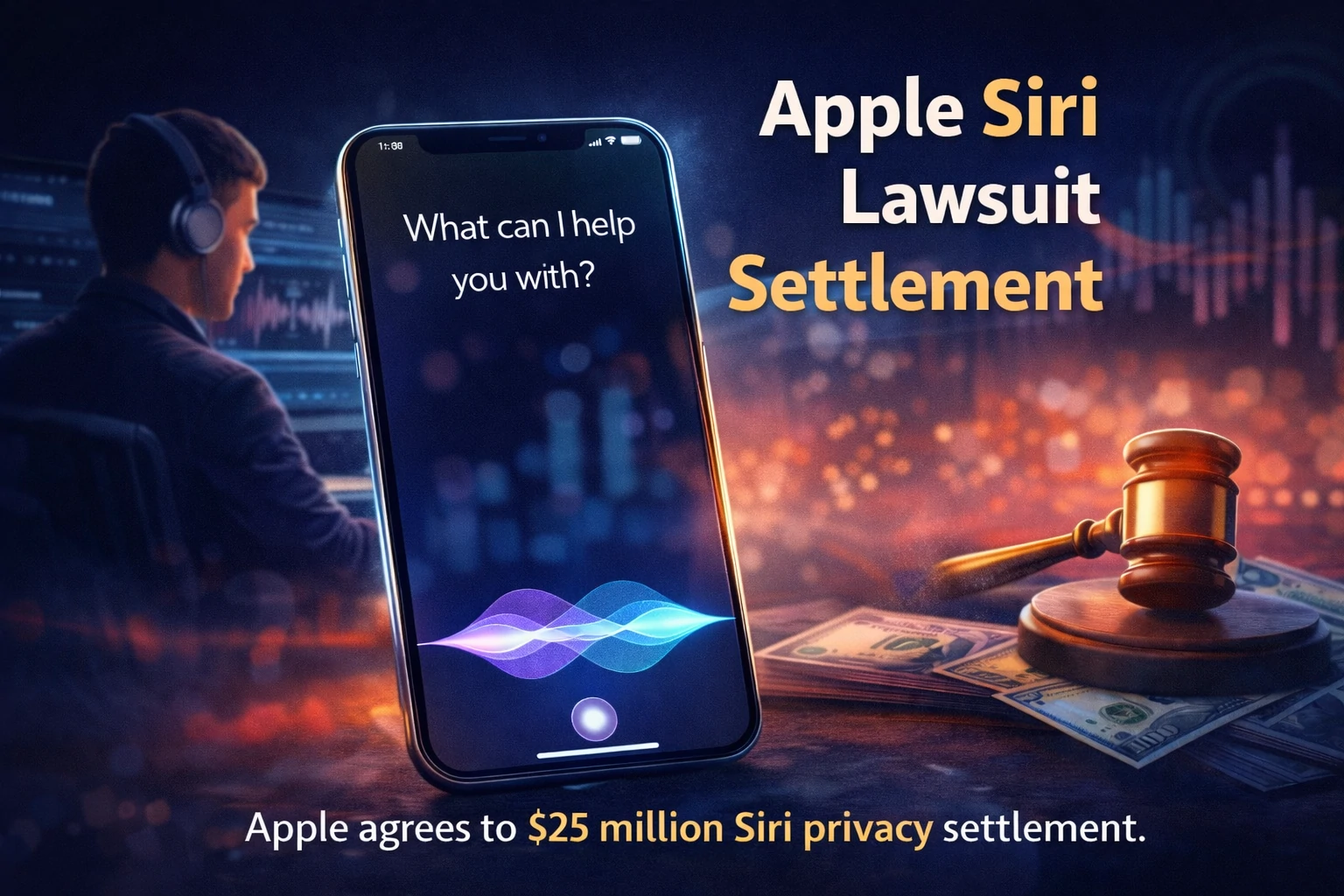
The $95 million Apple settlement over Siri privacy claims resolved a major class-action lawsuit alleging that Apple’s voice assistant recorded private conversations without user consent. As of 2026, the settlement process has concluded, providing financial compensation to eligible users and forcing significant changes to how Apple handles voice data through "grading" and accidental triggers.
Background of the Siri Privacy Litigation
The legal battle against Apple began in 2019 following investigative reports that revealed Apple contractors were regularly listening to private Siri recordings. These recordings often occurred due to "accidental activations"—instances where Siri mistakenly believed it heard its wake word ("Hey Siri") or was triggered by an accidental button press.
The lawsuit, Lopez v. Apple Inc. (Case No. 4:19-cv-04577), was filed in the U.S. District Court for the Northern District of California. The plaintiffs argued that Apple violated the California Information Privacy Act (CIPA) and other consumer protection laws by recording users without their knowledge or consent. Specifically, the complaint alleged that Siri recorded sensitive information, including medical discussions, business deals, and private domestic interactions, which were then reviewed by human contractors to improve the software's accuracy.
This practice, known in the industry as "grading," was common among tech giants at the time, including Amazon (Alexa) and Google (Assistant). However, the lack of transparency regarding human intervention and the frequency of unintended recordings became the focal point of the litigation.
Detailed Breakdown of the $95 Million Settlement
The $95 million settlement fund was established to resolve all claims related to these privacy violations. While $95 million is a substantial sum, it is important to understand how these funds were distributed across the various stakeholders involved in the class action.
Allocation of Funds
The settlement fund was not exclusively distributed to Apple users. Like most large-scale class-action settlements, the gross amount was divided into several categories:
- Administrative Costs: Millions were allocated to the settlement administrator for the purposes of notifying the class, managing the website, and processing claims.
- Legal Fees and Expenses: The attorneys representing the plaintiffs typically requested and received a significant portion of the fund—often up to 25% or 30%—as compensation for years of litigation.
- Service Awards: The named plaintiffs who represented the class in court received incentive awards for their time and effort in pursuing the case.
- The Net Settlement Fund: The remaining balance was distributed among the "Class Members" who filed valid claims.
Estimated Payouts to Users
Given that tens of millions of users were eligible to join the class, the individual payouts remained relatively modest. Most claimants received amounts ranging from $15 to $30, though the final figure depended heavily on the total number of approved claims. In class-action law, as more people file claims, the individual payout per person decreases.
Eligibility Requirements and Participation
To qualify for a portion of the $95 million settlement, individuals had to meet specific criteria regarding their device usage and the timeframe of the alleged privacy breaches.
The Settlement Class Definition
The settlement generally covered individuals who:
- Resided in the United States.
- Owned or operated an Apple device capable of running Siri (including iPhone, iPad, Apple Watch, HomePod, Apple TV, or Mac).
- Used these devices between October 12, 2011, and September 30, 2019.
The 2011 start date corresponds with the initial launch of Siri on the iPhone 4S, while the 2019 end date marks the point at which Apple suspended its human grading program and introduced new privacy controls to address the controversy.
Eligible Devices
The scope of the lawsuit was broad, covering nearly every hardware product Apple sold during that eight-year window. This included:
- iPhones: From the 4S through the iPhone 11 series.
- iPads: All models including Mini, Air, and Pro.
- Apple Watches: Series 0 through Series 5.
- HomePods: The original smart speaker launched in 2018.
- Mac Computers: Any Mac running macOS Sierra or later, which introduced Siri to the desktop.
How the Settlement Process Worked
By 2026, the claims window for this specific settlement has long since closed. However, understanding the process provides a blueprint for how similar privacy settlements are managed.
Filing the Claim
Eligible users were required to submit a claim form through a dedicated settlement website. Claimants generally had to provide a "Notice ID" (sent via email or mail to known users) or provide their device's serial number to verify ownership. Because Apple maintains extensive records of Apple IDs and device registrations, the verification process was more streamlined than in other consumer settlements.
Verification and Approval
The settlement administrator reviewed claims for duplicates and fraudulent entries. Because the settlement was based on privacy violations rather than a physical product defect, users did not need to prove that Siri had actually recorded them accidentally; merely owning a Siri-enabled device during the class period was sufficient to establish membership in the class.
Distribution of Payments
Once the court granted "Final Approval" to the settlement and any subsequent appeals were resolved, the administrator began issuing payments. In this case, payments were primarily distributed via digital means (such as PayPal, Venmo, or Zelle) or through traditional paper checks for those who requested them.
| Key Milestone | Date / Period |
|---|---|
| Class Period Covered | Oct 12, 2011 – Sept 30, 2019 |
| Lawsuit Filing | August 2019 |
| Settlement Agreement Reached | May 2022 |
| Final Approval Hearing | Late 2023 / Early 2024 |
| Primary Payment Distribution | 2024 – 2025 |
| Status in 2026 | Completed / Fund Depleted |
Apple's Response and Technical Changes
While the $95 million payout was a significant financial penalty, the lasting impact of the Siri privacy claims was the shift in Apple’s technical operations. The lawsuit pressured the company to transform Siri from an "always-on" data collection tool into a more transparent, user-controlled service.
Ending the "Default" Grading Program
Before the controversy, Apple automatically opted all users into the grading program. Contractors were given snippets of audio to transcribe and evaluate for accuracy. Following the public outcry and subsequent litigation, Apple suspended this program globally. When it was reinstated, it was changed from an "opt-out" system to an "opt-in" system.
New Privacy Controls
Apple introduced several features in iOS 13.2 and subsequent updates to give users more control over their voice data:
- Delete Siri & Dictation History: A setting that allows users to wipe all stored Siri audio and transcripts from Apple’s servers.
- Improve Siri & Dictation Toggle: A clear on/off switch in the Privacy & Security settings that determines whether Apple can store and review audio.
- On-Device Processing: Apple shifted much of Siri's request processing from the cloud to the device's local processor (for devices with the A12 Bionic chip or later). This means that for many tasks, the audio never leaves the user's iPhone.
Minimizing Accidental Triggers
The technical core of the lawsuit was the "accidental trigger." Apple engineers worked to refine the acoustic models that recognize "Hey Siri." By using more sophisticated neural networks, the devices became better at distinguishing between the actual wake word and similar-sounding phrases in movies, podcasts, or daily conversation.
Impact on Consumer Privacy Laws
The $95 million settlement over Siri privacy claims served as a catalyst for broader discussions on the legal definitions of consent in the age of AI. It highlighted the gaps in existing laws like the California Consumer Privacy Act (CCPA) regarding "passive" data collection.
Redefining Consent
The lawsuit established that a general Terms of Service agreement is often insufficient for sensitive data like ambient audio. Courts and regulators increasingly view "meaningful consent" as requiring a specific, granular notification at the time the data is collected, or a clear "opt-in" mechanism for any human review of that data.
International Repercussions
The Siri privacy issues weren't limited to the US. European regulators, operating under the General Data Protection Regulation (GDPR), also scrutinized Apple’s practices. The US settlement influenced the global standard, leading Apple to implement the same privacy-first controls in all markets, not just those where they faced active litigation.
Common Challenges and Troubleshooting for Claimants
Throughout the settlement lifecycle, participants faced several common hurdles. While the 2026 perspective looks back on a completed process, these points illustrate the complexities of high-tech class actions.
- Verification Failures: Some users who purchased devices second-hand or through unauthorized retailers struggled to verify their serial numbers if the device was never linked to an active Apple ID during the class period.
- Email Notification Issues: Many eligible users missed the initial notice because it was flagged as spam or sent to an inactive email address associated with an old Apple ID.
- Payment Delays: The transition from "Preliminary Approval" to "Final Approval" often takes over a year. Many users became frustrated with the timeline, assuming the settlement was a scam due to the long wait times.
- Small Payout Amounts: A common complaint in the Siri settlement—and class actions generally—is that the individual reward feels insignificant compared to the perceived privacy violation. However, the legal goal of such cases is often "deterrence" and "disgorgement" (forcing the company to give up profits) rather than fully compensating every user for emotional distress.
Related Questions
Can I still file a claim for the $95 million Siri settlement?
No, the deadline for filing a claim in the Lopez v. Apple Inc. settlement has passed. Generally, in large consumer class actions, the window for submitting claims closes several months before the final approval hearing. By 2026, the funds have been distributed and the case is closed.
Did this settlement apply to users outside of the United States?
The $95 million settlement specifically resolved claims for residents of the United States. While Apple faced similar privacy scrutiny and regulatory fines in other jurisdictions (such as the EU), those were handled through different legal frameworks and did not necessarily result in direct "class-action" style payouts to individual international users.
How do I know if my Siri recordings are still being listened to?
In 2026, Apple operates on an "opt-in" basis for human review. To check your status, go to Settings > Privacy & Security > Analytics & Improvements. Look for the toggle labeled "Improve Siri & Dictation." If this is turned off, Apple does not store or allow humans to listen to your audio samples. You can also go to Settings > Siri & Search > Siri & Dictation History to delete any data currently on their servers.
What happened to the contractors who were listening to the audio?
When the privacy claims first surfaced in 2019, Apple terminated its contracts with many of the third-party firms (such as GlobeTech in Ireland) that were responsible for the grading process. Apple eventually brought most of the remaining grading tasks in-house to ensure stricter adherence to privacy protocols, though the overall volume of human review was drastically reduced.
Practical Recommendations for Privacy in 2026
Even though the $95 million settlement is a matter of historical record, the privacy lessons it taught remain relevant for anyone using voice-activated technology today.
- Audit Your Settings Regularly: After every major OS update, verify that your "Improve Siri & Dictation" settings have not been reset. While Apple generally respects these toggles, software bugs can occasionally revert settings to defaults.
- Use On-Device Processing: If you are concerned about privacy, prioritize using newer Apple hardware (iPhone 12 and later) which handles the majority of Siri requests locally. This prevents the audio from being transmitted to a server in the first place.
- Mute When Necessary: For highly sensitive conversations, use the physical mute switch on your device or disable "Hey Siri" temporarily.
- Monitor for Accidental Triggers: If you notice your device "lighting up" or vibrating as if Siri is listening when you haven't prompted it, check your surroundings. High-frequency noises or specific speech patterns might be triggering the assistant. Reporting these (if you have opted into analytics) helps the engineers improve the trigger models for everyone.