Finding the right fan for your home involves balancing airflow performance, noise levels, energy efficiency, and available space to ensure year-round comfort. Selecting the best fan requires evaluating your specific cooling needs, room dimensions, and architectural constraints, moving beyond basic aesthetics to focus on air velocity, oscillation range, and motor technology.
When the warm weather arrives or indoor air grows stagnant, homeowners often look for effective ways to improve home comfort without immediately relying on energy-intensive air conditioning. While whole-house HVAC systems are effective, they can be costly to run continuously. Strategically placed fans—whether tower, pedestal, desk, box, or ceiling models—provide an economical, highly adjustable method of maintaining comfortable airflow. This guide examines five of the best fan options currently available for the home, analyzing their features, performance capabilities, and ideal use cases to help you make an informed purchasing decision.
Understanding Home Cooling and Air Circulation Needs
Before selecting a specific fan model, it is helpful to understand how air circulation works within residential spaces. Fans do not actually lower the ambient temperature of a room; instead, they cool people by accelerating the evaporation of moisture from the skin through wind chill effect. Because of this mechanical principle, running a fan in an empty room wastes electricity.
Key metrics to consider when shopping for a home fan include:
- CFM (Cubic Feet per Minute): Measures the volume of air a fan can move per minute. Higher CFM ratings generally indicate stronger cooling power.
- Decibel (dB) Ratings: Crucial for bedroom or home office applications, where low noise levels are necessary for sleep or concentration.
- Oscillation: Determines the horizontal or vertical sweep angle, ensuring air is distributed across a broader zone rather than hitting a single stationary spot.
- Motor Type: Brushless Direct Current (DC) motors typically offer higher energy efficiency, quieter operation, and finer speed adjustments compared to traditional Alternating Current (AC) motors.
The 5 Best Fans for the Home
To address different room layouts and personal preferences, the following selections represent top-performing categories in home air movement.
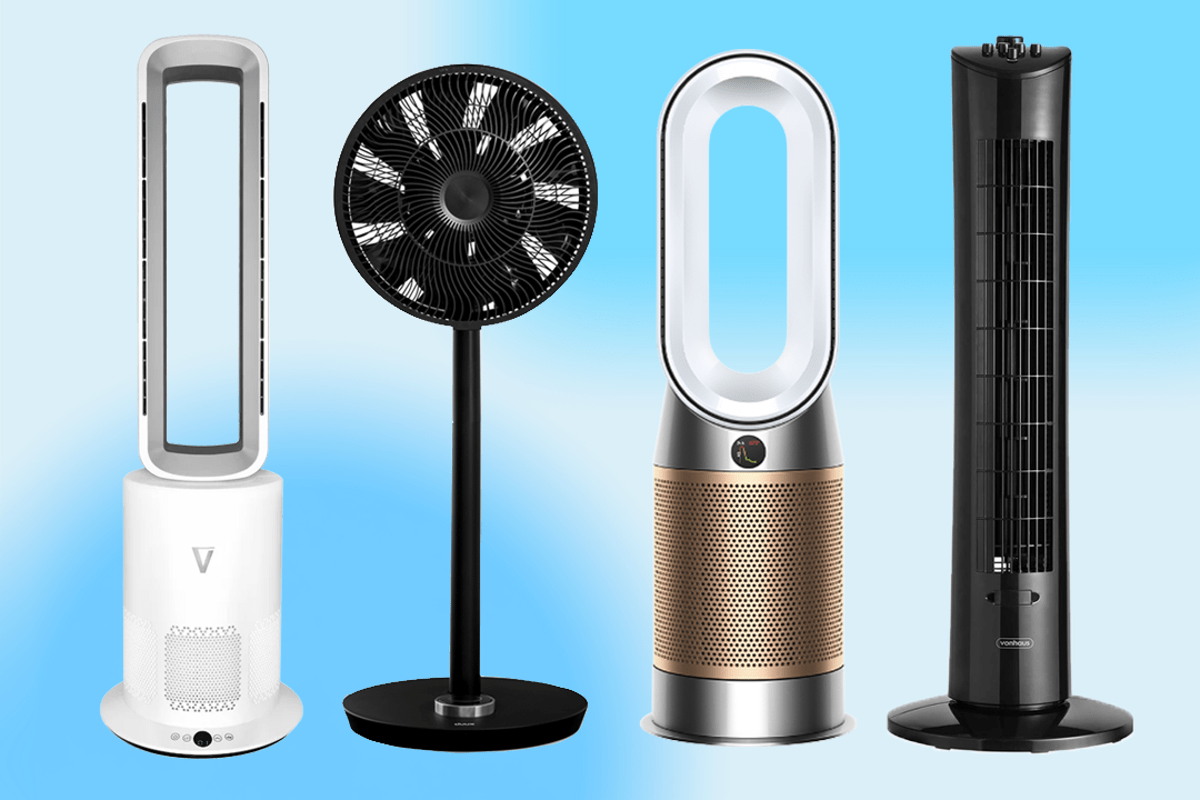
1. The Best Overall Tower Fan: Vornado Tower Whole Room Air Circulator
Tower fans are prized for their sleek, vertical footprints that fit seamlessly into tight corners or narrow spaces. Traditional tower fans, however, sometimes struggle to move air across larger distances. The Vornado Tower Whole Room Air Circulator addresses this limitation by combining the vertical profile of a tower fan with Vornado’s signature vortex action.
- Design and Build: Standing between 30 and 40 inches tall, this unit utilizes an elongated outlet grill designed to funnel a continuous column of air rather than a choppy, oscillating breeze.
- Performance: It draws in air from the back and launches it at high velocity, allowing the airstream to travel up to 70 feet. This makes it effective not just for localized cooling, but for circulating air throughout an entire medium-to-large bedroom or living room.
- Features: Multiple speed settings (typically four to six), electronic push-button or touch controls, and a remote control. Many models include a programmable timer for energy savings.
- Pros: Exceptional air reach, small footprint, modern aesthetic, stable base.
- Cons: Can be louder on maximum settings due to high air velocity.
2. The Best Pedestal Fan for Large Rooms: Lasko Wind Curve Stand Fan
When you need adjustable height and wide-area oscillation to cover a large living room, open-plan kitchen, or master suite, a traditional pedestal stand fan remains a reliable choice. The Lasko Wind Curve balances performance with a sophisticated design that avoids the industrial look of older metal fans.
- Design and Build: Featuring a woodgrain accent or sleek metallic finish, the Wind Curve stands roughly 42 to 48 inches tall with an adjustable telescoping pole.
- Performance: Designed to move a high volume of air efficiently. Its widespread oscillation sweeps across wide angles to cool multiple people sitting in a room simultaneously.
- Features: Easy-to-use electronic controls, multi-function remote control, and an auto-off timer ranging from 0.5 to 7.5 hours. It also features built-in carry handles for portability.
- Pros: High airflow output, adjustable height, wide oscillation sweep, convenient remote storage.
- Cons: Plastic components require careful handling during assembly and cleaning.
3. The Best Desk and Tabletop Fan: Honeywell TurboForce Power Air Circulator
For localized cooling on a work desk, bedside table, or kitchen counter, a compact circulator delivers targeted performance without taking up excessive surface area. The Honeywell TurboForce Power Air Circulator is widely recognized for punching above its weight class.
- Design and Build: Compact and lightweight, engineered with aerodynamic blades designed to maximize air movement. The head pivots up to 90 degrees vertically, allowing users to direct airflow straight ahead or straight up toward the ceiling.
- Performance: Despite its small size, it can be felt from up to 25 or 30 feet away on its highest setting. It excels at breaking up stagnant air pockets in stuffy home offices.
- Features: Three speed settings, wall-mount capability, and a removable grille for straightforward blade cleaning.
- Pros: Powerful for its size, versatile positioning, affordable price point, wall-mountable.
- Cons: Noticeable motor hum on the highest speed setting.
4. The Best Whole-Room Air Circulator: Vornado 630 Medium Whole Room Circulator
Distinct from standard oscillating fans that swing back and forth, specialized air circulators use deep-pitch blades and specialized inlet cones to create a high-velocity vortex that forces all the air in a room into continuous motion.
- Design and Build: A compact, cube-like housing unit that sits low to the floor or on sturdy furniture. The multi-directional tilt head allows you to point the airflow horizontally, vertically, or at any angle in between.
- Performance: By bouncing air off walls and ceilings, the Vornado 630 creates a gentle, room-wide blending effect that eliminates hot and cold spots. This is particularly useful in winter when paired with heating systems to push trapped warm air down from the ceiling.
- Features: Simple mechanical dial with three speed settings, durable polymer construction, and a stable base.
- Pros: Excellent thermal mixing, durable construction, highly effective for multi-season use.
- Cons: Lacks remote control functionality on base models; directional air may feel harsh if pointed directly at individuals.
5. The Best Bladeless Fan for Safety and Aesthetics: Dyson Purifier Cool TP07
For households with small children or pets, or for individuals prioritizing modern interior design and air quality filtering, premium bladeless fans offer an innovative solution. While carrying a higher price tag, units like the Dyson Purifier Cool combine high-end air movement with multi-stage filtration.
- Design and Build: A smooth, continuous loop amplifier with no fast-spinning external blades. The base houses a 360-degree glass HEPA filter and activated carbon filter.
- Performance: Draws in polluted air and dust while projecting purified, smooth airflow across the room. Oscillation angles can be adjusted up to 350 degrees.
- Features: LCD screen reporting real-time air quality metrics, smartphone app integration, voice control compatibility, night mode with dimmed display and quiet operation, and a sleep timer.
- Pros: Exceptional safety, built-in air purification, ultra-smooth airflow, highly customizable settings.
- Cons: Significantly higher initial cost than traditional fans; replacement filters add ongoing maintenance expenses.
Comparative Analysis of Home Fan Types
To help determine which model matches your living space and budget, the following table compares key specifications across the reviewed categories.
| Fan Type / Model | Primary Use Case | Average Noise Level | Air Reach | Standout Feature | Price Range |
|---|---|---|---|---|---|
| Vornado Tower Circulator | Medium rooms, corners | Moderate | High (up to 70 ft) | Vertical vortex action | Mid-Range |
| Lasko Wind Curve Stand Fan | Large living spaces | Moderate to Low | High CFM output | Adjustable height & remote | Budget-Friendly |
| Honeywell TurboForce | Desks, small bedrooms | Low to Moderate | Medium (up to 30 ft) | Compact size, pivoting head | Budget-Friendly |
| Vornado 630 Circulator | Whole-room air mixing | Low to Moderate | High volume mixing | Multi-directional tilt | Mid-Range |
| Dyson Purifier Cool TP07 | Safety, air purification | Very Low (on lower settings) | Smooth projection | HEPA filtration & smart app | Premium |
Key Considerations When Choosing a Fan
Selecting the ideal fan requires evaluating several practical factors related to your home environment:
Room Size and Layout
Match the fan's output capacity to the square footage of the room. A small desk fan will struggle to cool a vaulted living room, while an industrial-strength pedestal fan might overpower a small home office and blow loose papers across the room.
Noise Tolerance
Consider where the fan will be placed. Bedrooms require whisper-quiet operation, often utilizing low or medium settings on fans equipped with DC motors or specialized quiet blades. Home offices may tolerate slightly higher white noise levels to help mask background sounds.
Cleaning and Maintenance
Dust accumulation on fan blades can degrade aerodynamic performance and trigger allergies. Look for models featuring easily removable grilles, tool-free access points, or smooth surfaces that can be wiped down with a microfiber cloth.
Energy Consumption
Fans consume a fraction of the electricity required by air conditioning units. However, opting for models with energy-efficient motors or programmable auto-off timers can further reduce utility usage during peak summer months.
Common Mistakes to Avoid
- Leaving Fans Running in Empty Rooms: Because fans cool people rather than spaces, running them continuously in unoccupied rooms wastes electricity without lowering ambient temperatures.
- Ignoring Regular Cleaning: Allowing dust to build up on blades creates drag, reduces airflow efficiency, and recirculates allergens into the breathing zone.
- Improper Placement: Placing a fan directly against a wall or heavy furniture obstruction chokes the intake vents, significantly reducing the unit's cooling efficacy.
Frequently Asked Questions
Do fans actually lower the temperature of a room?
No, electric fans do not reduce ambient room temperature. They cool the human body directly through convective air movement and the evaporation of perspiration. In fact, running a fan in an empty room can slightly increase the room temperature due to the heat generated by the motor over time.
How do I choose between an oscillating fan and an air circulator?
Oscillating fans are designed to sweep a breeze back and forth across a specific area, providing intermittent relief to people in the room. Air circulators use specialized vortex aerodynamics to continuously mix all the air in a room, eliminating temperature stratification and creating a uniform climate.
What is the best type of fan for sleeping?
Tower fans and small pedestal fans with quiet night modes or DC motors are generally best for bedrooms. They provide steady white noise, low decibel output on lower settings, and programmable timers so the fan turns off automatically after you fall asleep.
How often should home fans be cleaned?
During peak usage seasons (summer and winter), fans should be cleaned every two to four weeks. Dust buildup on blades and motor housings restricts airflow and can contribute to indoor air quality issues.
Can running a fan help lower my air conditioning bills?
Yes. Using a fan alongside your air conditioning system allows you to raise your thermostat setting by approximately 4 degrees Fahrenheit without sacrificing perceived comfort, resulting in noticeable energy savings over the cooling season.
Conclusion and Next Action
Choosing the right fan for your home depends on balancing room dimensions, desired noise levels, and specific features like air purification or remote control access. For versatile whole-room cooling, a vortex tower or circulator offers strong performance, while pedestal and desk models provide reliable localized relief. Evaluate your living space's layout and airflow bottlenecks, then select the model that best aligns with your daily comfort requirements.