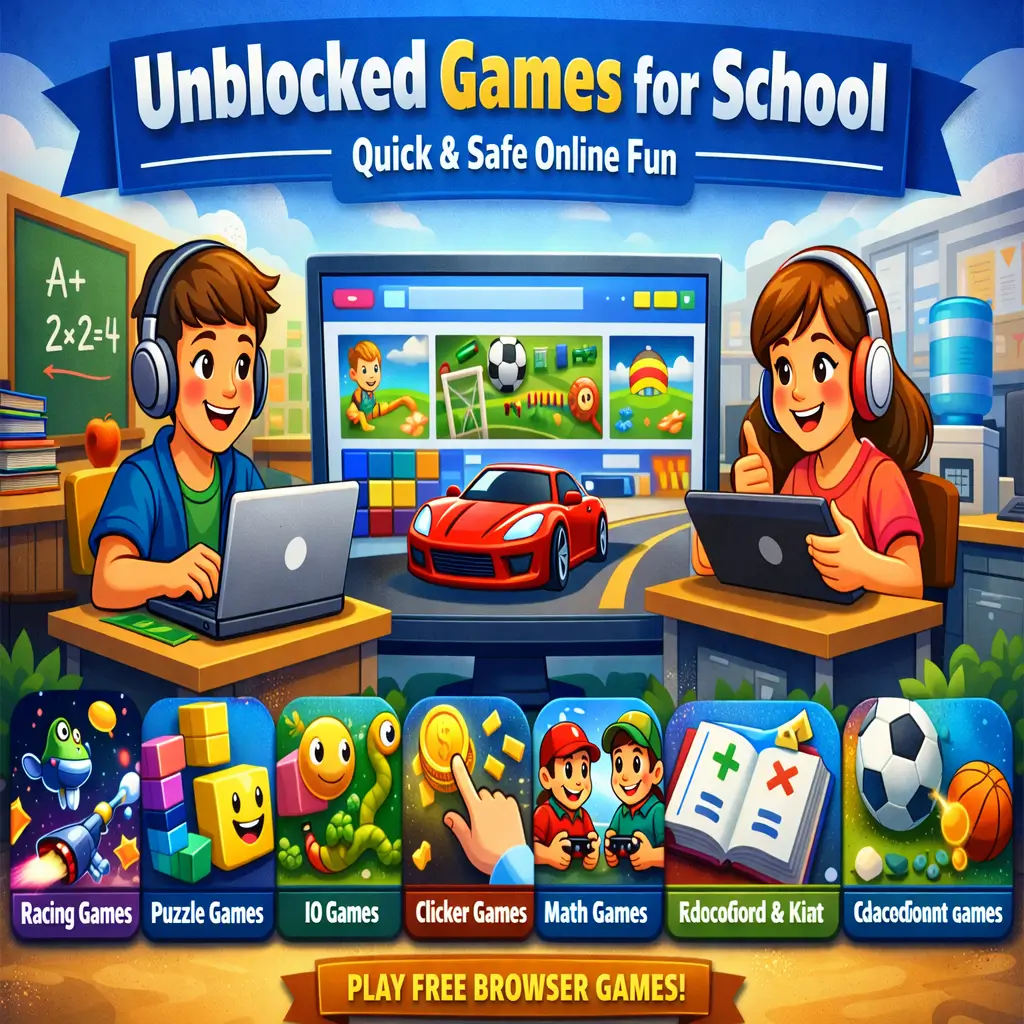
333 Unblocked Games is a specialized web-based repository designed to provide students with access to a library of video games that bypass restrictive school network filters. By utilizing hosting platforms like Google Sites or GitHub, this resource offers a collection of HTML5 and WebGL titles that remain accessible when traditional gaming domains are blocked.
Understanding the 333 Unblocked Games Phenomenon
In the ecosystem of educational technology, the battle between network administrators and students seeking entertainment is a long-standing tradition. As of 2026, the "333 Unblocked Games" brand has established itself as a recognizable name among students who need a quick break during study halls or lunch periods. These sites are essentially "mirror" repositories. Because many schools rely on "whitelisting" or "blacklisting" software to manage internet access, students look for loopholes.
The name "333" often refers to a specific iteration of these sites hosted on Google Sites. Network filters frequently allow traffic from sites.google.com because the platform is used for legitimate educational projects, teacher portfolios, and classroom hubs. By hosting a gaming directory within this trusted domain, 333 Unblocked Games effectively "hides in plain sight." This strategy ensures that while a direct link to a game developer’s site might be blocked, the version hosted on the 333 repository remains functional.
The transition from the era of Adobe Flash to modern web standards has been central to the longevity of these resources. When Flash reached its end-of-life, thousands of school-based gaming sites vanished. However, 333 Unblocked Games and its contemporaries successfully migrated to HTML5 and WebGL. These technologies are natively supported by modern browsers like Chrome and Edge without the need for additional plugins, making them faster, more secure, and significantly harder for outdated filters to detect and block individually.
The Technical Infrastructure of Unblocked Gaming Sites
To understand why 333 Unblocked Games is so effective as a school computer resource, one must examine the underlying mechanics of content delivery networks (CDNs) and web filtering. Most school districts utilize a Unified Threat Management (UTM) system or a specialized educational filter like GoGuardian or Securly. These systems inspect the Uniform Resource Locator (URL) and the IP address of incoming traffic.
Bypassing Through Trusted Domains
The primary reason 333 Unblocked Games remains accessible is its reliance on "Authority Domains." If a school blocks all "Games" categories, the filter looks for keywords and metadata. However, if the game is embedded within a Google Site, the filter may only see traffic originating from Google's servers. Blocking sites.google.com would break thousands of legitimate educational pages, so administrators are often forced to leave it open.
HTML5 and WebGL Integration
In 2026, browser-based gaming has reached a level of sophistication that rivals early console gaming. 333 Unblocked Games utilizes WebGL (Web Graphics Library), a JavaScript API for rendering high-performance interactive 3D and 2D graphics. Because these games run directly in the browser's memory, they do not require "installation" on the school’s local hard drive—a common restriction on school laptops and Chromebooks. This "zero-footprint" execution is the cornerstone of why these sites are the preferred resource for students.
Popular Game Genres Found on 333 Unblocked
The library within 333 Unblocked Games is curated based on what works best in a school environment: games that load quickly, don't require high-end hardware, and can be paused or closed instantly.
Physics-Based Puzzles and Logic Games
These are the most common titles on the platform. Games like "Run 3" or various "Cut the Rope" clones are popular because they are technically educational in nature, involving gravity, trajectory, and spatial reasoning. Many students use these as "brain breaks" between intensive coding or writing sessions.
Multiplayer ".io" Games
The rise of ".io" games (like Slither.io or Agar.io) revolutionized school gaming. These games are lightweight and support real-time multiplayer. 333 Unblocked Games often hosts "proxied" versions of these titles, allowing students to play on the same server even if the official site is restricted. These games utilize WebSockets for low-latency communication, which can sometimes be a red flag for network monitors due to the steady stream of data.
Retro Emulation and Classic Ports
A significant portion of the 333 catalog includes ports of classic arcade games. Using JavaScript-based emulators, the site can run versions of older titles from the 8-bit and 16-bit eras. These are highly efficient, using minimal bandwidth and CPU resources, making them ideal for older school-issued hardware.
Safety, Security, and Ethical Considerations
While 333 Unblocked Games provides a service desired by many students, it is not without its risks and responsibilities. Navigating these sites requires an understanding of digital citizenship and cybersecurity.
Data Privacy and Tracking
Many unblocked game sites are supported by aggressive advertising networks. In 2026, privacy regulations like COPPA (Children's Online Privacy Protection Act) have become stricter, but many third-party game repositories operate in a gray area. Students should be aware that these sites may use tracking cookies or scripts that collect data on browsing habits. Using a privacy-focused browser or an extension that limits script tracking is a recommended technical precaution.
The Risk of Cloned Sites
Because "333 Unblocked Games" is a popular search term, many "bad actors" create malicious clones of the site. These fake versions may prompt users to download "updates" or "plugins," which are often masked malware or adware. The legitimate 333 resource will never ask a user to download an executable file (.exe or .msi) or provide personal login credentials.
Network Congestion and Bandwidth
From the perspective of a school IT administrator, the primary concern isn't always the "distraction" of the game, but the impact on the network. If hundreds of students are accessing high-definition WebGL games simultaneously, it can saturate the school's bandwidth, slowing down essential educational tools like Canvas, Google Classroom, or research databases. This is why many schools eventually implement "deep packet inspection" (DPI) to identify and throttle gaming traffic regardless of the domain name.
Comparison of Unblocked Game Hosting Platforms
Students and educators should understand the different platforms where these games are typically found. Each has different levels of "unblockability" and performance.
| Platform Type | Example | Ease of Access | Performance | Reliability |
|---|---|---|---|---|
| Google Sites | 333 Unblocked Games | High (Often Whitelisted) | Moderate | High (Rarely goes down) |
| GitHub Pages | [username].github.io | High (Technical Domain) | High | Moderate (Can be DMCA'd) |
| Weebly/Wix | [site].weebly.com | Moderate | Moderate | Low (Frequently Filtered) |
| Standalone Proxy | Node Unblocker Sites | Low (Often Blocked) | High | Variable |
| IP-Direct Sites | Numerical IP URLs | Low (Hard to Find) | High | Very Low |
How to Access and Use the Resource in 2026
Accessing 333 Unblocked Games usually involves a simple search, but as school filters evolve, students often use specific techniques to ensure the site loads correctly.
- URL Verification: Always check that the URL contains the trusted "sites.google.com" or "github.io" prefix before interacting with the page.
- Browser Cache Management: If a game fails to load or shows a black screen, it is often due to a conflict in the browser's cache. Clearing the "Hosted App Data" or "Cache" in the browser settings usually resolves the issue.
- Hardware Acceleration: For WebGL-heavy games on the 333 site, ensure that "Hardware Acceleration" is toggled 'On' in the browser settings. This allows the browser to use the computer's GPU rather than putting the entire load on the CPU, which is crucial for the limited processors found in Chromebooks.
Troubleshooting Common Issues
- "Site Blocked" Screen: If the specific 333 URL is blocked, searching for "333 unblocked games mirror" or "333 games version 2" often yields alternative URLs that haven't been added to the school's blacklist yet.
- Lag and Stuttering: This is frequently caused by other background tabs. School computers have limited RAM. Closing extra tabs and disabling unnecessary extensions can significantly improve the frame rate of browser games.
- Game Not Saving Progress: Most unblocked games use "Local Storage" rather than cloud saves. If the browser is set to "Clear data on exit" or if the student is using "Incognito Mode," game progress will be lost every time the tab is closed.
Educational Value vs. Distraction: A Balanced View
There is a growing debate among educators regarding the role of sites like 333 Unblocked Games. While they are primarily seen as distractions, some pedagogical experts argue that they serve a purpose in a balanced digital life.
The Case for Controlled Access
Some schools have moved away from total bans, instead creating "Green Zones" or specific times where sites like 333 Unblocked Games are accessible. The logic is that by providing a sanctioned outlet for gaming, students are less likely to seek out dangerous, unverified "proxy" sites that could compromise the school's entire network security.
Cognitive Benefits
Many of the games hosted on these resources require rapid problem-solving, improved hand-eye coordination, and strategic planning. For example, complex puzzle games can reinforce concepts of logic and sequencing that are fundamental to computer science. When used as a reward for completing assignments, these resources can actually act as a motivator for productivity.
Frequently Asked Questions
Is 333 Unblocked Games legal to use at school?
Accessing the site itself is generally not illegal, but it may violate your school's Acceptable Use Policy (AUP). Most schools require students to sign an agreement stating they will only use school technology for educational purposes. Breaking this policy can lead to disciplinary action or the revocation of computer privileges.
Why do some games on 333 Unblocked Games not work on my Chromebook?
Chromebooks often have limited hardware specifications. Games that require high-performance 3D rendering (WebGL) may crash if the ChromeOS device doesn't have enough RAM or if the GPU is underpowered. Additionally, some schools disable the "WebGL" flag in the browser's backend for security reasons, which prevents these games from running.
Can my school see if I am playing games on a "unblocked" site?
Yes. Even if a site is "unblocked," school IT departments can see your real-time traffic through their network gateway. They can see which URLs you are visiting, how long you stay on a page, and how much data you are consuming. In 2026, many monitoring tools also allow teachers to see a live thumbnail of your screen via software like GoGuardian.
Does 333 Unblocked Games have viruses?
The legitimate versions of 333 Unblocked Games hosted on Google Sites or GitHub are generally safe because they consist of standard web code (HTML/JS). However, clicking on "pop-up" ads or being redirected to external sites can be risky. Never download files from these sites; if a game asks to "install" something, close the tab immediately.
Are there "333 Unblocked Games" alternatives?
Yes, there are many similar resources such as "66 Unblocked Games," "Tyrant Games," and "Cool Math Games." Cool Math Games is often the most "teacher-approved" alternative as it frames its content specifically around educational themes, making it less likely to be blocked by filters.
Final Recommendation
When using 333 Unblocked Games as a school computer resource, the best approach is one of moderation and caution. These sites provide a valuable way to decompress during a long school day, but they should never interfere with academic responsibilities or network security. Always prioritize the official version of the site, avoid clicking on suspicious advertisements, and be mindful of your school's IT policies. For students interested in gaming, a better long-term path is often learning how these games are built—transitioning from a consumer of unblocked games to a creator of them using tools like Scratch or Godot.