In 2026, the selection of a marketing automation platform is defined by its ability to integrate autonomous AI agents, manage real-time data lakes, and orchestrate hyper-personalized customer journeys. HubSpot, Salesforce Marketing Cloud, and ActiveCampaign stand out as the premier choices, offering scalable solutions that transform static lead scoring into predictive behavioral modeling for businesses of all sizes.
The landscape of marketing technology has shifted significantly. No longer is "automation" merely about scheduling emails or setting up basic "if-then" triggers. In 2026, the most effective platforms act as the central nervous system of a business, connecting sales, service, and marketing data to create a unified customer profile. The criteria for the "best" platforms now hinge on data interoperability, the maturity of generative AI tools, and the ease of cross-channel execution.
1. HubSpot: The Leader in Integrated Customer Platforms
HubSpot has maintained its position as the top choice for mid-market companies and rapidly scaling enterprises in 2026. Its evolution from a simple inbound marketing tool to a comprehensive "Smart CRM" has made it indispensable for teams that value a unified user interface and a single source of truth for customer data.
The Power of the Smart CRM and Breeze AI
At the core of HubSpot’s 2026 offering is Breeze AI, an embedded intelligence layer that permeates every "Hub" within the ecosystem. Unlike previous iterations of AI that required manual prompting, Breeze now functions as a proactive assistant. It identifies anomalies in campaign performance, suggests budget reallocations in real-time, and automatically generates content variations based on the high-performing segments of your database.
The platform’s architectural strength lies in its "Crafted, Not Cobbled" philosophy. While competitors often struggle with the friction of acquired technologies, HubSpot’s Marketing, Sales, Service, Operations, and Content Hubs are built on the same underlying database. This ensures that when a marketing automation workflow triggers, it has immediate access to sales notes and service tickets, allowing for incredibly nuanced customer communications.
Key Capabilities for 2026
- Predictive Lead Scoring 2.0: Utilizing machine learning to analyze thousands of data points—including dark social signals and intent data—to predict the likelihood of conversion with over 90% accuracy.
- Omnichannel Orchestration: Seamlessly managing journeys across SMS, WhatsApp, LinkedIn, and email within a single visual builder.
- Content Remix: A sophisticated tool that takes a single piece of long-form content (like a webinar or whitepaper) and automatically generates 20+ optimized assets, including social posts, short-form videos, and follow-up sequences.
Suitability and Investment
HubSpot is ideal for organizations that want a powerful yet intuitive system. While the enterprise-tier pricing has increased to reflect the advanced AI capabilities, the reduction in "tool sprawl" often leads to a lower total cost of ownership (TCO). It is the primary recommendation for businesses prioritizing alignment between marketing and sales departments.
2. Salesforce Marketing Cloud: The Enterprise Powerhouse
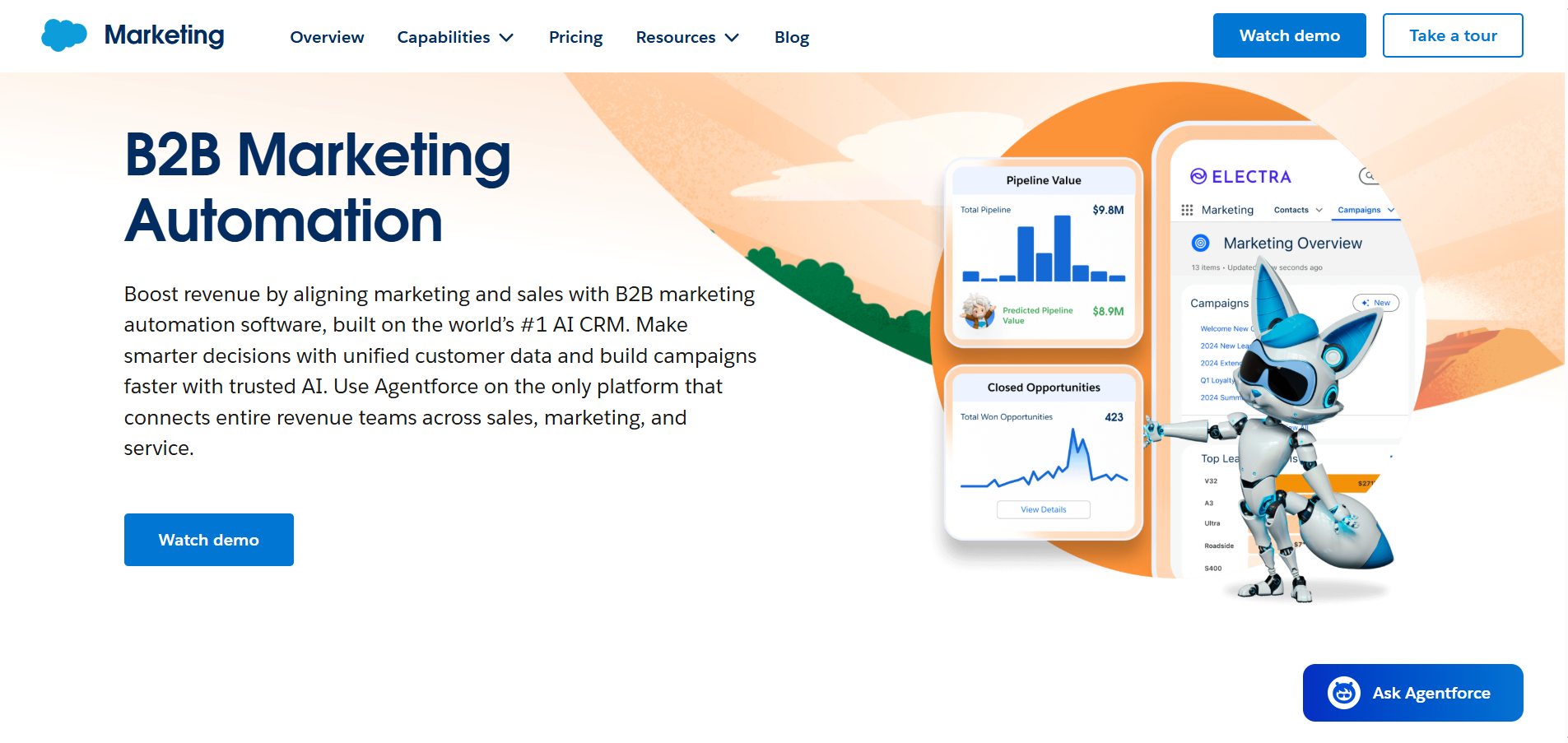
For global enterprises handling massive datasets and complex regulatory requirements, Salesforce Marketing Cloud remains the gold standard in 2026. Its integration with Salesforce Data Cloud has solved the "siloed data" problem that previously plagued large-scale marketing operations.
Data Cloud and Real-Time Personalization
The defining feature of Salesforce in 2026 is its ability to process petabytes of data in real-time. Through Data Cloud, the Marketing Cloud can ingest streaming data from website interactions, mobile apps, and IoT devices, creating a "Golden Record" for every customer. This allows for "Moment Marketing"—the ability to send a highly relevant offer or support message the second a customer interacts with a brand touchpoint.
The Agentforce framework (formerly Einstein) has evolved into a suite of autonomous agents. These agents do more than just write copy; they can build entire marketing segments, optimize send times at an individual level, and even "reason" through complex customer journeys to find the most efficient path to conversion.
Technical Depth and Extensibility
- Personalization (formerly Interaction Studio): Offers sophisticated A/B/n testing and machine-learning-driven product recommendations that update dynamically as a user browses.
- Account Engagement (formerly Pardot): Remains the specialist tool for B2B organizations, focusing on complex lead nurturing and deep integration with the Salesforce Sales Cloud.
- AppExchange Ecosystem: With thousands of third-party integrations, Salesforce can be customized to fit the specific needs of any industry, from healthcare (HIPAA compliance) to financial services.
Implementation Considerations
Salesforce is a "heavy" platform. It typically requires dedicated administrators or external consultants for setup and ongoing management. However, for a Fortune 500 company or a high-volume e-commerce brand, the level of precision and scalability it offers is unmatched by any other platform on the market.
3. ActiveCampaign: The Specialist in Customer Experience Automation (CXA)
ActiveCampaign has carved out a dominant niche in 2026 by focusing on "Customer Experience Automation." It bridges the gap between basic email marketing tools and high-end enterprise suites, providing sophisticated automation at a price point accessible to small and medium-sized businesses.
Behavioral Triggers and Deep Segmentation
ActiveCampaign’s strength has always been its visual automation builder, which remains one of the most flexible in the industry. In 2026, it has doubled down on predictive actions. The platform can now automatically adjust a customer's journey based on "churn probability" or "engagement decay," moving a user from a promotional sequence to a re-engagement sequence without manual intervention.
The platform's 900+ native integrations mean that it can act as the glue between a business’s specialized tools (like Shopify, Calendly, or Zendesk). This "best-of-breed" approach appeals to businesses that don't want to be locked into a single ecosystem like HubSpot or Salesforce but still want a centralized automation engine.
Advanced Features for Growing Teams
- Site Tracking and Attribution: Detailed reporting on which specific marketing touches—whether an ad, a social post, or an email—actually contributed to a sale.
- Predictive Sending: Uses AI to determine exactly when a specific contact is most likely to open an email, significantly increasing open rates.
- Native CRM: While not as robust as HubSpot’s, ActiveCampaign’s built-in CRM is perfect for managing a sales pipeline directly alongside marketing automations.
Value Proposition
ActiveCampaign offers the best "power-to-price" ratio. It provides features often found in enterprise software—such as conditional content and split testing within automations—at a fraction of the cost. It is the best choice for e-commerce brands and service providers who need deep automation without the overhead of an enterprise-grade platform.
Technical Comparison of Top Platforms
The following table compares the key technical specifications and suitability factors for these three leaders as of 2026.
| Feature | HubSpot | Salesforce Marketing Cloud | ActiveCampaign |
|---|---|---|---|
| Primary Audience | Scaling SMBs & Mid-Market | Large Enterprises | SMBs & E-commerce |
| AI Maturity | High (Breeze AI Integration) | Maximum (Agentforce/Einstein) | High (Predictive Models) |
| Ease of Use | Excellent | Steep Learning Curve | Good |
| Data Architecture | Single Unified Database | Data Cloud (Lakehouse) | Integration-heavy / API-first |
| CRM Integration | Native (Best-in-class) | Native (Best-in-class) | Built-in or Third-party |
| Ideal Revenue Range | $5M - $500M | $500M+ | $500k - $50M |
| Implementation Time | 4 - 8 Weeks | 3 - 9 Months | 2 - 4 Weeks |
Implementation Strategies for 2026
Choosing a platform is only the first step. Success in 2026 requires a "Data-First" approach to implementation. Before migrating to or adopting any of these three platforms, organizations must ensure their data hygiene is impeccable. AI-driven automation is only as effective as the data feeding the models.
Step 1: Data Audit and Mapping
Identify all sources of customer data, including offline interactions and third-party apps. Map how this data will flow into your chosen automation platform. In 2026, "Identity Resolution"—ensuring that "John Doe" on your email list is the same "John Doe" browsing your mobile app—is the most critical technical challenge.
Step 2: Defining the Customer Journey
Move away from linear funnels. Modern journeys are cyclical and fragmented. Use the platform’s journey mapping tools to account for multiple entry and exit points. Ensure you have content prepared for every stage of the lifecycle, from awareness to advocacy.
Step 3: Pilot AI Workflows
Don't turn over your entire marketing strategy to AI on day one. Start with specific use cases, such as "Predictive Churn Prevention" or "Automated Content Personalization." Monitor the results, tune the models, and gradually scale the autonomous elements of your campaigns.
Common Mistakes to Avoid
Even with the best tools, marketing automation can fail if implemented incorrectly. One of the most frequent errors in 2026 is Over-Automation. When brands automate every single interaction without a "human-in-the-loop" fail-safe, the brand voice can become robotic and alienated from the customer.
Another common pitfall is Ignoring Privacy Regulations. With the continued evolution of global data privacy laws (like GDPR, CCPA, and new 2025/2026 mandates), your platform must have robust consent management. HubSpot and Salesforce lead the way here with built-in compliance dashboards, but the responsibility ultimately lies with the user to configure them correctly.
Finally, many organizations suffer from Feature Underutilization. Most companies use less than 20% of their automation platform's capabilities. Regular audits of your tech stack and ongoing training for your team are essential to ensure you are getting a return on your investment.
Frequently Asked Questions
Which platform is best for small businesses starting in 2026?
ActiveCampaign is generally the best starting point for small businesses due to its lower entry price and powerful automation capabilities. However, if you plan to scale rapidly and need a robust CRM from the start, HubSpot’s "Starter" tier offers a clear upgrade path.
How has AI changed marketing automation since 2024?
In 2024, AI was largely used for content generation (generative AI). By 2026, AI has shifted toward "Agentic" workflows. Platforms now use AI to autonomously make decisions—such as changing a lead's score, shifting them to a different campaign, or suggesting a new product based on real-time behavior—without a human having to build every specific rule.
Is Salesforce too complex for a medium-sized business?
Typically, yes. Unless a medium-sized business has a highly complex product, global operations, or a massive amount of data that requires the specific power of Salesforce Data Cloud, the overhead of managing Salesforce usually outweighs the benefits. HubSpot is generally the better fit for the "medium-sized" category.
Can I migrate my data between these platforms easily?
While all three platforms offer API access and data export tools, a full migration is a complex technical project. It involves mapping custom fields, recreating automation logic, and ensuring that historical engagement data is preserved. Most companies use specialized middleware or consultancies to handle migrations in 2026.
What is the most important feature to look for in 2026?
The most important feature is Data Interoperability. Your marketing automation platform must be able to "speak" to your CRM, your website, your customer support portal, and your data warehouse in real-time. If the data is delayed or siloed, your automations will be irrelevant to the customer's current needs.
Recommendation for Next Actions
To determine which of these three platforms is right for your business in 2026, begin by documenting your current "Customer Lifecycle." Identify where the biggest gaps exist—is it in lead generation, lead nurturing, or customer retention?
- Request a Demo with a Specific Use Case: Don't just watch a generic walkthrough. Ask the vendor to show you exactly how the platform would handle a specific scenario unique to your business.
- Audit Your Data: Before signing a contract, evaluate the cleanliness of your current database. The cost of cleaning data post-implementation is significantly higher.
- Calculate Total Cost of Ownership: Look beyond the monthly subscription. Factor in the cost of implementation partners, internal headcount for administration, and the cost of third-party integrations.
For most businesses, HubSpot remains the most balanced choice for 2026, offering a powerful combination of ease of use and advanced AI-driven features.