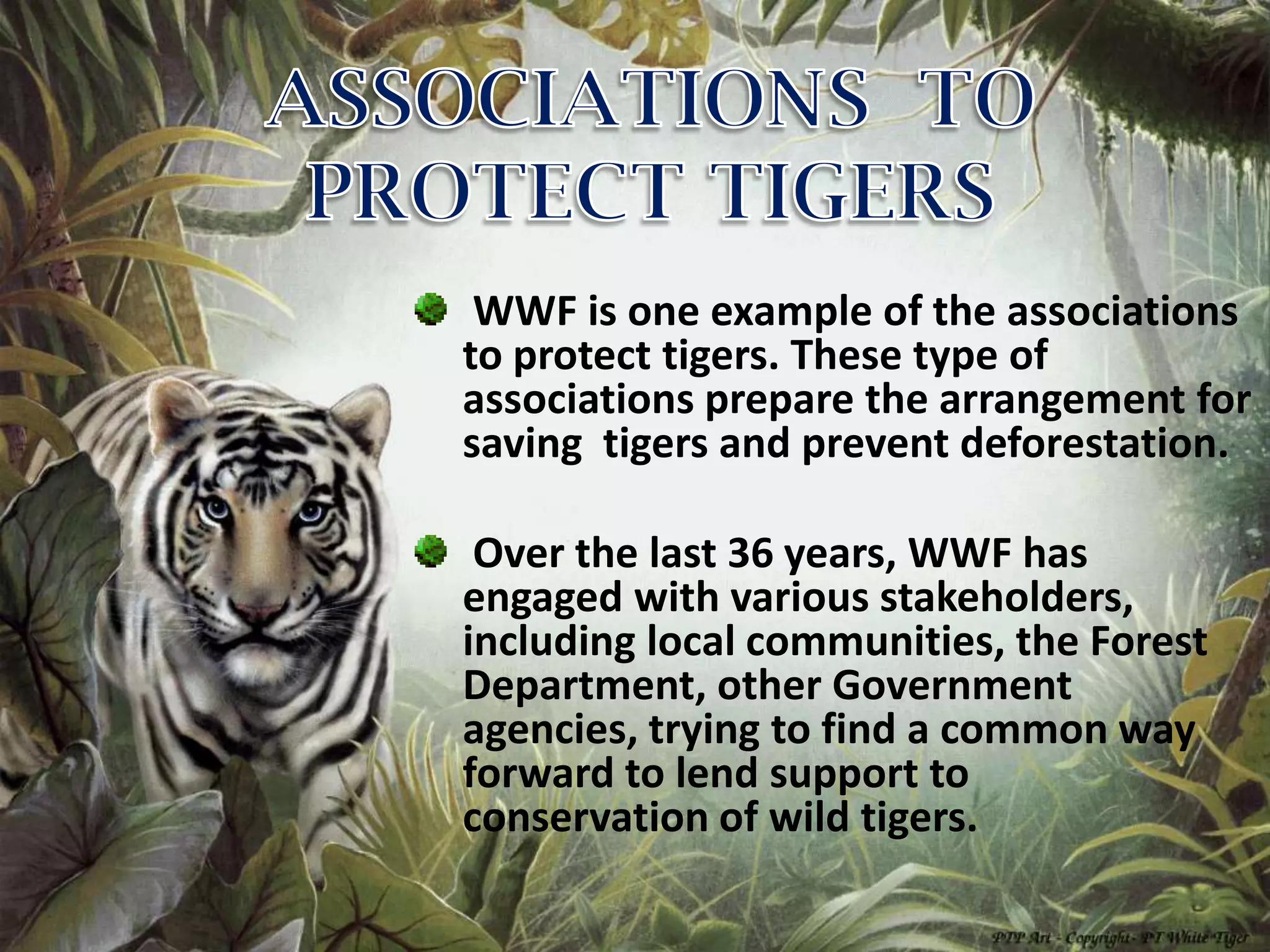
Saving tigers from the brink of extinction requires a multifaceted conservation approach that addresses habitat loss, anti-poaching enforcement, local community engagement, and the illegal wildlife trade. Effective tiger conservation combines rigorous field protection with sustainable landscape management to secure viable breeding populations across their remaining range.
Wild tiger (Panthera tigris) populations face severe pressures across Asia, with numbers historically plummeting due to widespread deforestation, agricultural expansion, and relentless poaching for traditional medicine and illegal trade markets. Today, conservationists estimate that fewer than 4,000 tigers remain in the wild across 13 range countries. Addressing this crisis demands targeted interventions that protect existing habitats, disrupt trafficking networks, and align the economic interests of local communities with wildlife preservation. Understanding the specific mechanisms of tiger conservation allows policymakers, donors, and conservationists to direct resources toward strategies that yield measurable population growth.
1. Support Anti-Poaching Operations and Wildlife Crime Enforcement
Poaching remains an immediate, direct threat to wild tigers. Snares, traps, and firearms deployed by illegal hunters decimate not only tigers but also their primary prey species, such as deer and wild boar.
Effective anti-poaching strategies rely on well-equipped, highly trained forest ranger patrols. Conservation organizations and national governments fund intelligence-led anti-poaching units that utilize specialized tracking technology, spatial monitoring software like SMART (Spatial Monitoring and Reporting Tool), and community informer networks. Strengthening enforcement requires increasing the density of patrols in high-risk core zones, upgrading field gear, and ensuring that judicial systems prosecute wildlife traffickers with penalties that reflect the severity of the crime. When local law enforcement agencies collaborate across borders, they can more effectively dismantle transnational smuggling syndicates that move tiger pelts, bones, and derivatives from range states to consumer markets.
2. Protect and Restore Critical Tiger Habitats
Tigers require vast home ranges with dense forest cover, sufficient prey, and permanent water sources to thrive and reproduce. Fragmentation of these landscapes isolates populations, leading to inbreeding and vulnerability to stochastic events.
Habitat conservation involves designating strict protected areas, national parks, and wildlife sanctuaries where human encroachment is restricted. Beyond safeguarding existing reserves, landscape-level planning focuses on establishing ecological corridors—forested pathways that connect isolated protected areas. These corridors allow tigers to disperse, find mates, and maintain genetic diversity. Reforestation initiatives often involve restoring degraded lands with native flora, which simultaneously rebuilds the foundational layers of the ecosystem required by herbivorous prey species.
3. Mitigate Human-Wildlife Conflict Through Coexistence Strategies
As human populations expand and agricultural frontiers push deeper into forested regions, tigers and humans increasingly share the same landscapes. This proximity leads to livestock depredation and, in severe cases, human casualties, which frequently results in retaliatory killing of tigers.
Successful coexistence models focus on proactive mitigation rather than reactive control. Pastoralists and villagers receive support to construct predator-proof livestock corrals using reinforced fencing and chain-link designs. Early-warning systems, utilizing camera traps with cellular transmission or community alert networks, notify villagers when a tiger is in the vicinity. Furthermore, compensation or insurance schemes managed by governments and conservation NGOs reimburse farmers quickly for livestock losses, neutralizing the economic incentive for retaliatory poisoning or shooting.
4. Combat the Illegal Wildlife Trade and Reduce Demand
The illegal trade in tiger parts—driven by demand for pelts, bones used in traditional tonics, and teeth and claws marketed as amulets—operates through sophisticated international smuggling networks.
Halting this trade requires a dual approach: rigorous supply-chain interdiction and targeted demand-reduction campaigns in consumer countries. Law enforcement agencies deploy specialized wildlife crime units at border crossings, ports, and transit hubs, often utilizing trained sniffer dogs to detect hidden animal products. Simultaneously, public awareness campaigns in consumer markets educate the public on the ecological role of wild tigers, highlight the cruelty of the poaching industry, and enforce legal prohibitions against the sale of endangered species products under the Convention on International Trade in Endangered Species of Wild Fauna and Flora (CITES).
5. Support Community-Based Conservation and Sustainable Livelihoods
Conservation initiatives frequently fail if local communities living adjacent to tiger habitats bear the costs of wildlife presence without sharing in the benefits. Engaging these communities as active stewards of their local environment is essential for long-term success.
Community-based conservation programs integrate local populations into eco-tourism ventures, sustainable forestry, and regenerative agriculture. When local residents derive tangible economic benefits from a healthy forest—such as employment as eco-tourism guides, park rangers, or lodge operators—they develop a vested interest in protecting the wildlife that draws visitors. Revenue-sharing models ensure that a percentage of park entry fees or safari permits directly fund community infrastructure, clean water projects, and village schools.
6. Monitor Populations Using Advanced Scientific Research
Accurate data on tiger numbers, distribution, demographics, and health status are foundational to evaluating the effectiveness of conservation interventions. Without reliable science, resource allocation becomes inefficient.
Field biologists employ a range of scientific methodologies to track tiger populations. Camera trapping—deploying automated, motion-activated digital cameras across grid systems—allows researchers to identify individual tigers by their unique stripe patterns. This data is analyzed using capture-recapture statistical models to estimate population density and growth rates. Additionally, non-invasive genetic sampling, which involves extracting DNA from tiger scats collected in the field, provides insights into population connectivity, genetic health, and dietary habits without requiring the capture or immobilization of the animals.
7. Rebuild and Sustain Natural Prey Populations
A primary limiting factor for tiger population recovery is the availability of wild ungulate prey, such as sambar deer, barking deer, wild boar, and gaur. When bushmeat hunting and habitat degradation deplete these prey species, tigers face starvation or are forced to prey on domestic livestock, intensifying human-wildlife conflict.
Restoring tiger food webs requires strict regulation of legal and illegal hunting of herbivores within protected areas. Anti-poaching patrols must target snare lines set for deer just as rigorously as those set for apex predators. In certain degraded habitats where prey bases have collapsed entirely, conservationists evaluate carefully managed translocation programs, moving healthy herbivore populations from high-density reserves to areas capable of supporting them, thereby providing a self-sustaining food source for recovering tiger numbers.
8. Strengthen Policy, Legislation, and Transnational Cooperation
Tigers do not respect international borders; populations frequently range across frontiers shared by countries such as India, Nepal, Bhutan, Bangladesh, Russia, and China. Protecting migratory or dispersing individuals requires robust cross-border collaboration and harmonized legal frameworks.
Governments must enact and enforce stringent national wildlife protection laws that carry mandatory prison sentences and heavy financial penalties for poaching and trafficking. Regional networks, such as the South Asia Wildlife Enforcement Network (SAWEN), facilitate intelligence sharing, joint operations, and standardized investigative protocols among law enforcement officers in different countries. International agreements and global frameworks, including the Global Tiger Recovery Program (GTRP), help align national policies toward common population-doubling targets and facilitate international funding flows for field conservation.
9. Engage in Responsible Eco-Tourism That Benefits Conservation
Eco-tourism, when managed according to strict ecological and ethical guidelines, can generate substantial funding for protected areas and provide a powerful economic rationale for keeping forests intact.
Travelers who wish to support tiger conservation can do so by booking safaris through operators that prioritize low-impact infrastructure, ethical wildlife viewing practices, and direct contributions to local conservation funds. Responsible tourism ensures that vehicle numbers in core zones are strictly capped, noise pollution is minimized, and wildlife behavior is never disrupted for photographic opportunities. Revenue generated directly through park fees, conservation levies, and local employment helps finance anti-poaching patrols, habitat maintenance, and community development projects, aligning tourism directly with wildlife protection.
10. Fund and Support Credible Conservation Organizations
Individual citizens who do not live near tiger range states can still play a vital role by financially supporting and amplifying the work of established, transparent conservation organizations dedicated to protecting wild tigers.
Numerous international and local NGOs focus on specific facets of tiger conservation, ranging from direct field protection and anti-poaching support to legal advocacy and community development. Donors should research organizations to verify their field presence, financial transparency, and adherence to scientific conservation principles. Beyond financial donations, supporters can amplify awareness campaigns, advocate for stronger wildlife protection policies with elected officials, and make sustainable consumer choices—such as avoiding products tied to large-scale deforestation—that reduce overall pressure on tropical forest ecosystems.
Summary of Core Conservation Strategies
| Strategy | Primary Objective | Key Mechanism |
|---|---|---|
| Anti-Poaching | Eliminate direct killing | Ranger patrols, SMART monitoring, legal prosecution |
| Habitat Protection | Secure living space and connectivity | Protected areas, ecological corridors, reforestation |
| Conflict Mitigation | Reduce retaliatory killings | Predator-proof corrals, insurance schemes, early warnings |
| Trade Interdiction | Disrupt illegal markets | Border inspections, CITES enforcement, demand reduction |
| Community Engagement | Align local interests with conservation | Eco-tourism jobs, revenue sharing, sustainable livelihoods |
| Scientific Monitoring | Measure population health and trends | Camera trapping, DNA analysis, capture-recapture models |
Frequently Asked Questions About Saving Tigers
How many tigers are left in the wild?
Current estimates indicate that approximately 3,900 to 4,500 tigers remain in the wild across their fragmented range in Asia. While this represents a modest recovery from historical lows recorded around 2010 due to intensive conservation efforts, populations remain vulnerable to habitat loss, poaching, and disease outbreaks.
Why are tigers endangered?
Tigers are endangered primarily due to habitat loss driven by agricultural conversion, infrastructure development, and logging, combined with relentless poaching for the illegal wildlife trade. The loss of natural prey species due to overhunting further exacerbates their decline and forces tigers into conflict with human communities.
Can captive-bred tigers be released into the wild?
Releasing captive-bred tigers into the wild is extremely difficult, costly, and rarely successful. Captive tigers often lack the hunting skills, fear of humans, and physical conditioning necessary to survive independently. Conservation resources are far more effectively deployed toward protecting wild habitats and existing populations rather than breeding tigers in captivity for release.
What is a tiger corridor and why is it important?
A tiger corridor is a strip of forested or natural land that connects two or more isolated protected areas. These corridors are vital because they allow tigers to move between reserves to find food, establish new territories, and mate with individuals from other populations, thereby preventing inbreeding depression and maintaining genetic diversity.
How does consumer demand affect wild tigers?
Consumer demand for tiger skins, bones, teeth, and traditional medicine products creates a lucrative black market that incentivizes poachers to kill wild tigers. Reducing this demand through education, law enforcement, and cultural shifts in consumer countries is essential to cutting off the financial motivation behind illegal hunting.
Next Actions for Supporters
To move from awareness to effective action, individuals can evaluate their impact by supporting accredited conservation charities operating directly in tiger range states, reducing consumption of commodities linked to deforestation such as unsustainable palm oil, and educating others about the illegal wildlife trade. Supporting well-managed eco-tourism initiatives also ensures that local communities and protected areas continue to receive the financial backing required to keep wild tigers secure for future generations.