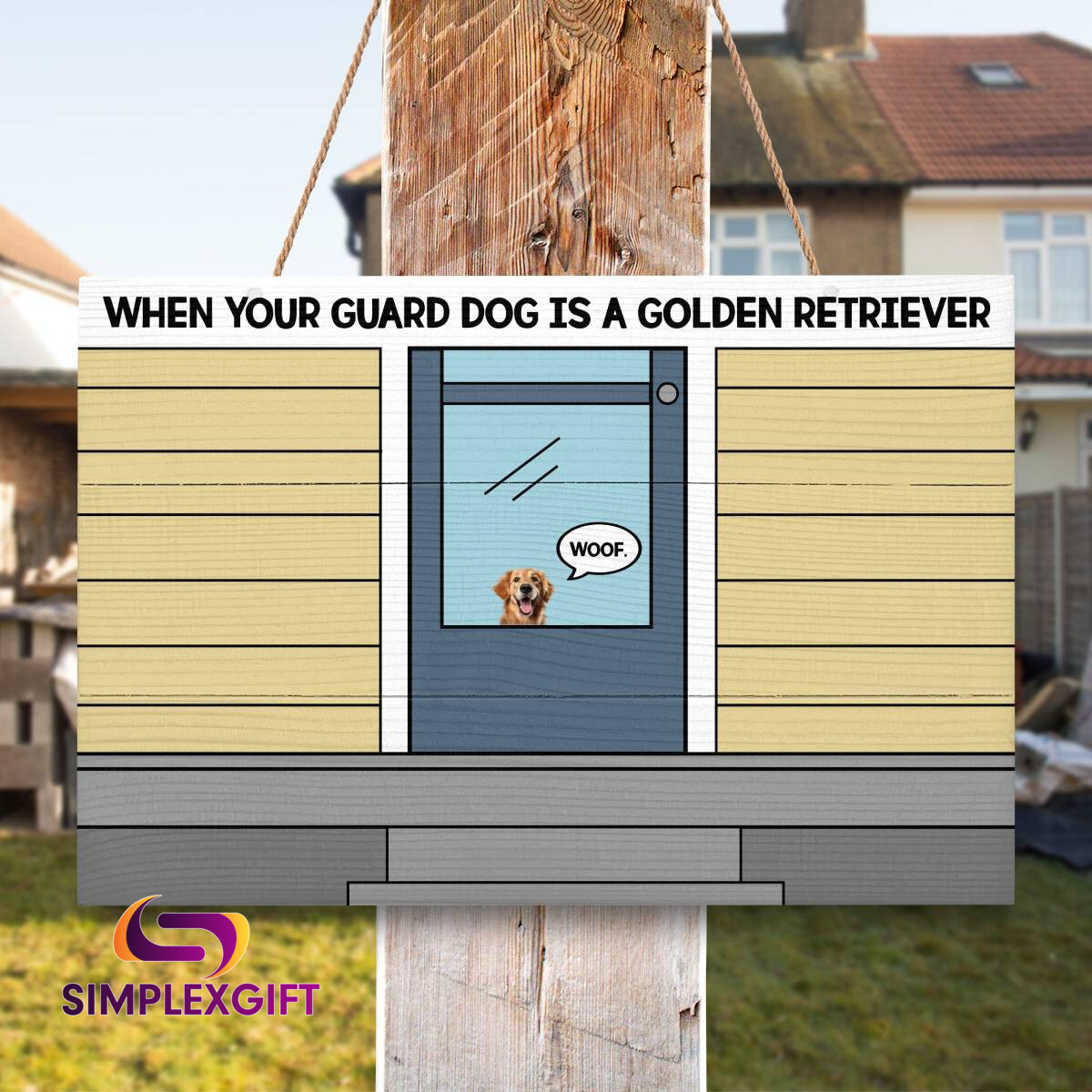
Golden Retrievers are not guard dogs; they lack the inherent aggression, territoriality, and suspicious nature required for protection work. While they may act as watchdogs by barking to alert owners of a visitor, their instinctive friendliness usually leads them to greet intruders with enthusiasm rather than deterrence.
The question of whether a Golden Retriever can protect a home is one of the most common inquiries among prospective pet owners. In 2026, as home security needs evolve alongside a growing desire for family-oriented companions, understanding the distinction between a "watchdog" and a "guard dog" is essential. A guard dog is a canine specifically bred and trained to protect property and people through physical intervention if necessary. A Golden Retriever, by contrast, is a sporting breed designed for companionship and cooperation. To understand why this breed consistently fails as a guardian while succeeding as a family member, one must look at their genetic history, psychological profile, and the practical realities of canine behavior.
The Genetic Heritage of the Golden Retriever
To understand a dog's current behavior, one must look at the purpose for which it was originally "manufactured." The Golden Retriever was developed in the mid-19th century in Scotland, primarily through the efforts of Dudley Marjoribanks, also known as Lord Tweedmouth. The goal was to create the ultimate hunting companion capable of retrieving wildfowl from both water and land in the rugged Scottish Highlands.
The foundation of the breed involved crossing the "Yellow Retriever" with the now-extinct Tweed Water Spaniel, with later infusions of Irish Setter and Bloodhound bloodlines. Crucially, the breeders prioritized "biddability"—a dog’s willingness to follow human direction—and a "soft mouth," meaning the ability to carry downed game without damaging it.
In a hunting environment, a dog that was aggressive toward other dogs or humans was a liability. Hunters often worked in groups; therefore, Golden Retrievers had to be exceptionally social and stable. This selective breeding over nearly two centuries has effectively stripped the breed of the "guarding instinct" found in livestock guardian breeds or protection breeds like the Doberman Pinscher or the Rottweiler. As of 2026, the American Kennel Club (AKC) continues to list "friendly, trustworthy, and kind" as the hallmark traits of the breed's temperament. Aggression or even extreme shyness are considered serious faults in the breed standard.
Watchdog vs. Guard Dog: Defining the Difference
In the context of home security, owners often conflate "watchdog" and "guard dog," but the two roles are fundamentally different in terms of canine psychology and training requirements.
The Watchdog Role
A watchdog is an alarm system. Their primary function is to observe the environment and bark when something unusual occurs—such as a delivery person approaching the porch or a car pulling into the driveway. Many Golden Retrievers excel as watchdogs. They are highly observant and often possess a loud, deep bark that can sound intimidating from behind a closed door.
However, the Golden Retriever’s motivation for barking is rarely "keep out." More often, it is "someone is here to play with me." Because they are highly vocal and socially motivated, they will alert you to a presence, but they lack the follow-through to defend the perimeter if that person continues to approach.
The Guard Dog Role
A guard dog is a sentry. Beyond alerting, a guard dog is prepared to use its physical presence, intimidation, or controlled force to stop a perceived threat. This requires a high degree of territoriality and a natural suspicion of strangers—traits that are genetically absent in most Golden Retrievers. While a German Shepherd might stand its ground and show teeth to an intruder, a typical Golden Retriever is more likely to bring the intruder a tennis ball or offer a belly rub.
Why Golden Retrievers Typically Fail as Protection Dogs
There are several biological and psychological reasons why a Golden Retriever is a poor choice for a protection role.
- Lack of Stranger Aversion: Most protection breeds are "aloof" with strangers. They do not seek immediate affection from people they do not know. Golden Retrievers, conversely, are famous for their "everyone is a friend" philosophy. They have a high threshold for social comfort, meaning they rarely feel threatened by a new person.
- Low Territoriality: Many breeds were developed to protect specific boundaries (e.g., the Bullmastiff). Golden Retrievers do not typically view a house or yard as something they must defend. They are more attached to the people within the space than the space itself.
- High Biddability vs. Independent Decision Making: A guard dog often needs to make independent decisions about what constitutes a threat. Golden Retrievers are bred to look to their handlers for cues. If a handler isn't present to give a command, a Golden is likely to default to its baseline personality: friendliness.
- Bite Inhibition: The "soft mouth" mentioned earlier is a deeply ingrained genetic trait. Golden Retrievers are naturally inclined to avoid using their teeth aggressively. While any dog can bite if pushed to an extreme of fear or pain, the Golden Retriever has one of the highest thresholds for biting in the canine world.
Comparing Golden Retrievers to Traditional Guard Breeds
If you are considering a dog for security, it is helpful to see how the Golden Retriever stacks up against breeds that are traditionally used for protection. The following table illustrates the typical behavioral markers as of 2026.
| Feature | Golden Retriever | German Shepherd | Rottweiler | Doberman Pinscher |
|---|---|---|---|---|
| Primary Instinct | Retrieval / Social | Herding / Protection | Guarding / Working | Protection / Sentry |
| Alert Barking | High | High | Moderate | High |
| Stranger Aloofness | Very Low | High | High | Very High |
| Territoriality | Low | High | Very High | High |
| Trainability | Exceptional (Positive) | High | High | High |
| Aggression Potential | Very Low | Moderate (Controlled) | Moderate (Controlled) | Moderate (Controlled) |
| Family Suitability | Excellent | Good (Requires Work) | Good (With Training) | Good (With Training) |
The Risks of Training a Golden Retriever for Protection
Some owners, realizing their Golden Retriever is "too friendly," seek out professional protection training (such as Schutzhund or Personal Protection Dog training). In 2026, most reputable trainers advise against this for this specific breed.
Attempting to "sharpen" a Golden Retriever’s protective instincts often involves inducing stress or fear to elicit a defensive reaction. Because this goes against the dog's natural temperament, it can lead to psychological instability. Instead of becoming a reliable guard dog, the dog may become anxious, fearful, or develop "fear aggression," where they bite out of confusion rather than a calculated desire to protect. This ruins the very qualities—stability and gentleness—that make the Golden Retriever such a desirable pet.
Furthermore, a Golden Retriever that has been taught to be suspicious of people loses its utility as a social companion. You would no longer be able to take the dog to parks, invite neighbors over, or trust the dog around visiting children with the same level of confidence.
When a Golden Retriever Might "Protect"
Despite their friendly nature, there are anecdotal accounts of Golden Retrievers defending their owners. In these rare cases, the behavior is usually not "guarding" in the traditional sense, but rather a response to a high-stress situation where the dog perceives its owner is in genuine physical pain or extreme fear.
This is often referred to as "reactive protection." If an owner is being physically assaulted and screaming, a Golden Retriever may intervene by jumping on the assailant or barking frantically. However, this is unpredictable. Many Goldens will simply hide or become shut down in high-conflict scenarios. Relying on a Golden Retriever for physical protection is a dangerous security strategy.
Modern Home Security Alternatives in 2026
If you love the temperament of a Golden Retriever but still want a secure home, the solution is not to change the dog, but to change your security infrastructure. In 2026, technology provides a more reliable "guard" than a friendly dog.
- Smart Surveillance Systems: High-definition cameras with AI person-detection can alert your phone before an intruder even reaches your door.
- Automated Lighting: Motion-activated floodlights are a significant deterrent for opportunistic criminals.
- Smart Locks and Alarms: Monitored security systems provide 24/7 protection that a dog cannot.
- The "Big Dog" Illusion: Even if your Golden Retriever is a sweetheart, the mere sight of a large dog through a window or the sound of a deep bark is often enough to make a burglar choose a different house. Criminals generally look for the path of least resistance, and any dog—regardless of breed—adds a layer of unpredictability they prefer to avoid.
Frequently Asked Questions
Can a Golden Retriever be a good watchdog?
Yes. A Golden Retriever is an excellent watchdog. Their keen hearing and high energy mean they will likely notice a stranger on your property before you do. Their deep bark serves as a great "doorbell" and can even act as a deterrent to strangers who don't know the dog's friendly personality.
Are Golden Retrievers protective of their owners?
While they are deeply loyal and bonded to their owners, they are not "protective" in a defensive way. They provide immense emotional support and companionship, but they are unlikely to physically confront a threat. Their loyalty manifests as a desire to be near you, not a desire to fight for you.
Will a Golden Retriever bark at a burglar?
Likely, yes. Most Goldens will bark at anyone approaching the home. However, once the "burglar" enters the home, a Golden Retriever is just as likely to wag its tail and look for attention. They lack the discriminatory ability to tell a "bad" stranger from a "good" stranger based on intent alone.
Do Golden Retrievers make good family dogs if they aren't guard dogs?
They are widely considered one of the best family breeds in existence. Their lack of guarding instinct is actually what makes them so safe around children, elderly family members, and other pets. They are tolerant, patient, and highly unlikely to react aggressively to the clumsy movements of a child.
What breed is similar to a Golden Retriever but better at guarding?
If you want a dog with a similar level of intelligence and trainability but with a natural protective instinct, the German Shepherd is the standard choice. For a slightly more "family-first" guardian, some owners look toward the Bernese Mountain Dog, which is generally gentle but more territorial than a Golden.
Summary of Recommendations
If your primary goal is to have a companion that will play fetch, sleep at your feet, and be safe around your neighbors' children, the Golden Retriever is an unmatched choice. You should embrace their friendly nature and not attempt to train them for protection.
For those who require home security, the most effective strategy in 2026 is to combine the emotional benefits of a Golden Retriever with a modern, electronic home security system. This allows you to enjoy the best of both worlds: a loving, stress-free household and a professionally secured property.