Alexandra Grant is a preeminent contemporary artist who explores the symbiotic relationship between language and visual imagery. By translating written text into abstract paintings, sculptures, and drawings, she challenges traditional boundaries of communication. Her multidisciplinary practice positions her as a central figure in the post-conceptual movement, merging literature, philosophy, and fine art.
The contemporary art world in 2026 continues to recognize Alexandra Grant as a visionary who bridges the gap between what we read and what we see. Based in Los Angeles, her work is not merely about the aesthetics of typography but about the profound act of translation—how an idea moves from the mind to the page, and finally to the canvas. Grant’s career is defined by a deep commitment to collaboration, philanthropic engagement, and a rigorous investigation into how language shapes our perception of reality.
The Artistic Philosophy of Linguistic Abstraction
At the core of Alexandra Grant’s practice is the concept of translation. Unlike traditional illustrators who might create a visual accompaniment to a story, Grant treats text as a raw material, much like clay or pigment. She often works with complex literary and philosophical texts, stripping them of their linear narrative and rebuilding them as spatial experiences. This process is often referred to as "transliteration," where the artist moves beyond the literal meaning of words to find their emotional and architectural resonance.
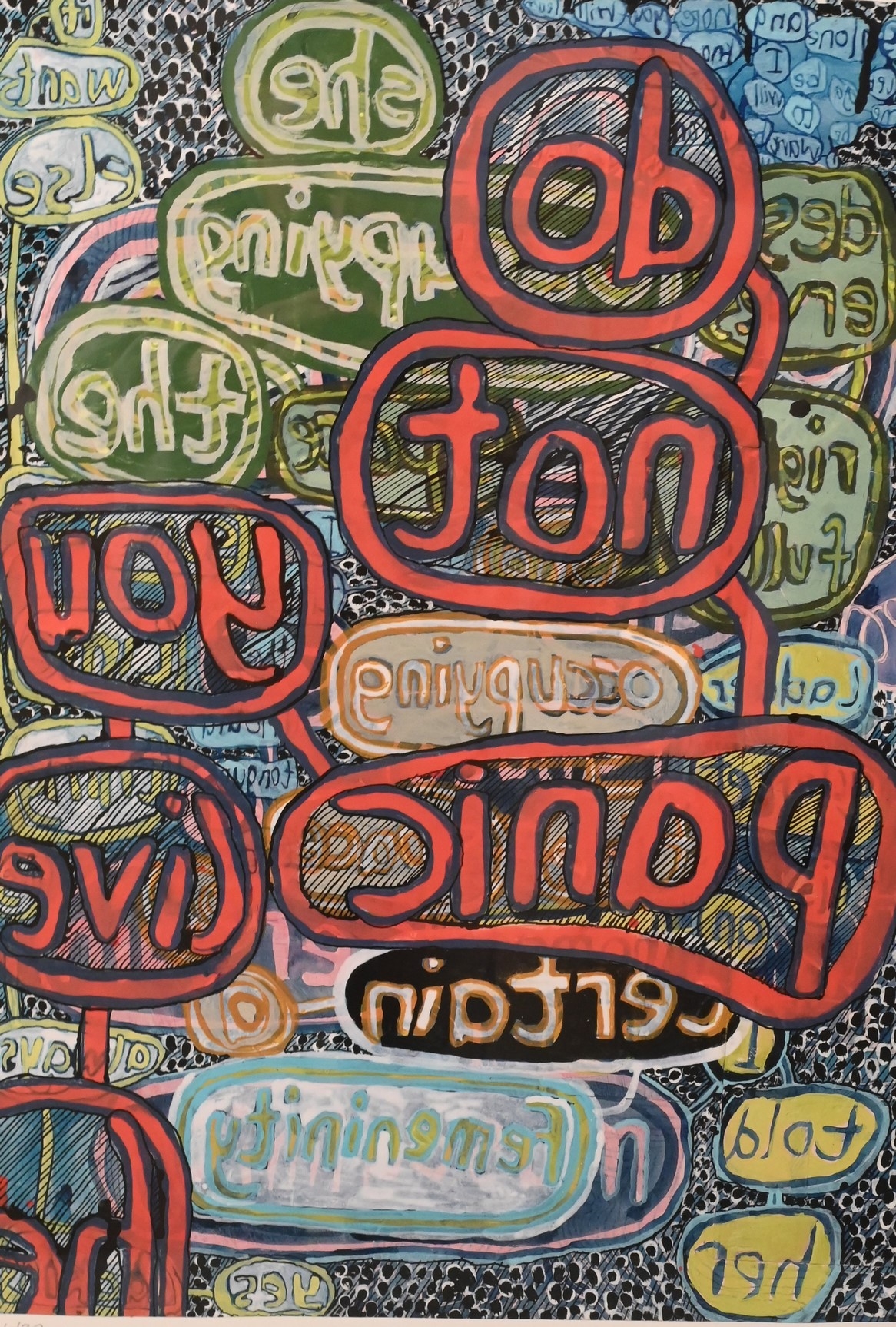
Grant’s fascination with language stems from her multicultural upbringing. Having lived in Mexico, France, and Spain, she experienced the fluidity of meaning across different cultures and tongues. In her studio, this translates to a technique where text is often mirrored, reversed, or layered until it reaches a state of "illegibility." This is a deliberate choice; by making the text difficult to read, Grant forces the viewer to engage with the work as an abstract form first. Only through sustained observation does the linguistic origin reveal itself, mirroring the way we slowly come to understand a foreign concept or a complex emotion.
Her engagement with the French philosopher Hélène Cixous has been particularly influential. Cixous’s theory of écriture féminine (feminine writing)—which suggests that language can be a site of liberation—resonates through Grant’s large-scale canvases. The artist’s "writing-paintings" occupy a space where the act of mark-making is synonymous with the act of thinking, creating a physical record of the intellectual process.
The Evolution of the Antigone 3000 Series
One of Grant’s most significant contributions to contemporary art is the long-running Antigone 3000 series. Inspired by the Greek myth of Antigone—the woman who defied the state to honor her brother—this body of work explores themes of civil disobedience, law, and the female voice. In 2026, these works remain highly relevant as symbols of individual agency against systemic structures.
In the Antigone 3000 paintings, Grant frequently uses the phrase "I was born to love, not to hate." She repeats this mantra across massive canvases, using a combination of acrylic, ink, and wax. The visual style is chaotic yet controlled, featuring "Rorschach-like" symmetry achieved by folding the paper or canvas. This technique creates a mirror image, suggesting that for every action or word, there is an equal and opposite reflection.
The series is characterized by its high-contrast palettes—often deep blues, blacks, and vibrant neons—and its tactile, layered surfaces. The abstraction represents the "noise" of the modern world, while the underlying text provides a moral anchor. For collectors and critics, Antigone 3000 serves as a testament to Grant’s ability to modernize ancient narratives, proving that the struggles of the classical past are inextricably linked to the social and political anxieties of the present.
Collaborative Practice and X Artists' Books
While many artists prefer the solitude of the studio, Alexandra Grant thrives on collaboration. Her career is marked by partnerships with writers, actors, and other artists, moving away from the "lone genius" trope toward a more communal form of creation. This ethos culminated in the founding of X Artists' Books (XAB) in 2017, a publishing house that focuses on artist-centered books that frequently defy categorization.
As of 2026, X Artists' Books has established itself as a critical player in the independent publishing world. The press focuses on titles that are "books as art," where the medium is as important as the message. Grant’s collaborations with Keanu Reeves, such as Ode to Happiness (2011) and Shadows (2016), are early examples of this spirit. In Shadows, Grant’s photography captures Reeves’s silhouette, which is then paired with his poetic ruminations on the nature of the ephemeral.
The collaborative nature of Grant’s work extends to her "Century of the Self" series, where she engaged with the ideas of public relations and the construction of identity. By working with others, Grant ensures her art is a dialogue rather than a monologue. This approach has influenced a younger generation of artists who view the "interdisciplinary" label not as a trend, but as a necessary method for navigating the complexities of the 21st-century art market.
The GrantLOVE Project: Art as Social Practice
Alexandra Grant’s impact on contemporary art is not limited to galleries and museums. Her GrantLOVE Project, launched in 2008, is a benchmark for how artists can utilize their brand for social good. The project produces and sells artworks, clothing, and jewelry featuring Grant’s signature "LOVE" symbol—a stylized, hand-drawn take on the word that emphasizes its organic, fluid nature.
The proceeds from GrantLOVE benefit various Los Angeles-based arts non-profits and community projects. In 2026, the project is cited as a primary example of "social practice" art, where the work's value is measured by its impact on the community. By commodifying the "LOVE" symbol in an ethical way, Grant bridges the gap between high art and accessible philanthropy.
Key Organizations Supported by GrantLOVE:
- Project Angel Food: Providing meals for those affected by life-threatening illnesses.
- LAXART: Supporting independent, artist-driven initiatives in Los Angeles.
- Heart of Los Angeles (HOLA): Providing underserved youth with free programs in academics and arts.
This facet of her career addresses a common critique of the contemporary art world—that it is exclusionary and elite. Through GrantLOVE, she invites a broader audience to participate in the artistic ecosystem, proving that visual culture can be a powerful engine for tangible social change.
Technical Specifications and Mediums
Grant is known for her mastery of diverse materials. Her studio practice is labor-intensive, often involving multiple stages of drawing, painting, and digital manipulation before a piece is finalized.
| Feature | Description | Primary Use in Grant's Work |
|---|---|---|
| Mirror Writing | Writing text in reverse or mirrored formats. | Challenges the viewer's legibility and explores duality. |
| Silver Leaf | Thin sheets of silver applied to the canvas surface. | Adds a reflective, metallic quality to the Shadows series. |
| Encaustic | Pigments mixed with hot wax. | Provides a sculptural, textured depth to large-scale paintings. |
| Rubbings (Frottage) | Creating images by rubbing over textured surfaces. | Used to capture "found texts" from gravestones or monuments. |
| Neon | Glass tubing filled with electrified gas. | Translates her handwriting into luminous, 3D sculptures. |
Her technical depth is most evident in her ability to scale her work. Whether it is a small, intimate drawing on paper or a 20-foot mural, the "hand of the artist" remains visible. She avoids the sterile perfection of digital printing, preferring the "happy accidents" that occur when ink bleeds into paper or when paint drips down a canvas. This commitment to the physical process of making art is a hallmark of her contemporary relevance in an increasingly digital age.
Market Presence and Institutional Recognition
By 2026, Alexandra Grant’s work has been exhibited at some of the world’s most prestigious institutions. Her presence in the permanent collections of the Los Angeles County Museum of Art (LACMA) and the Museum of Contemporary Art (MOCA), Los Angeles, solidifies her status as a pillar of the Southern California art scene. Internationally, she has gained significant traction in Paris and Berlin, where her focus on philosophy and literature resonates with European artistic traditions.
From a market perspective, Grant’s work is highly sought after by collectors who value intellectual depth over mere decorative appeal. Her primary representation through galleries like Miles McEnery Gallery in New York and Lora Reynolds Gallery in Austin has seen her auction prices steadily climb. However, Grant has maintained a level of "underground" credibility through her independent publishing and community work, which prevents her brand from feeling overly commercialized.
For those looking to invest in or study her work, the 2020s have seen a shift toward her large-scale abstract paintings. These works are viewed as the most "complete" expression of her linguistic theories, fetching the highest valuations and receiving the most critical attention in scholarly journals.
Frequently Asked Questions
What is the primary theme of Alexandra Grant's art?
The primary theme of Grant’s art is the translation of language into visual form. She explores how words lose or gain meaning when they are transformed into paintings, sculptures, and photographs. Her work often investigates the intersection of literature, philosophy, and identity, using text as a structural element of abstraction.
How does Alexandra Grant incorporate collaboration into her work?
Grant collaborates frequently with writers, philosophers, and other creators. She co-founded X Artists' Books to publish unconventional, artist-led books and has worked on long-term projects with figures like Michael Joyce and Keanu Reeves. For Grant, collaboration is a way to break the isolation of the studio and treat art as a shared, evolving dialogue.
Why is the Antigone 3000 series so significant?
The Antigone 3000 series is significant because it connects ancient Greek mythology with contemporary issues of social justice and civil disobedience. By using the phrase "I was born to love, not to hate," Grant highlights the power of the female voice and the individual’s moral obligation to stand against injustice.
What is the GrantLOVE project?
The GrantLOVE project is a philanthropic initiative founded by Alexandra Grant that uses the sale of art and merchandise to raise money for non-profit organizations. It serves as a model for "social practice" in art, demonstrating how an artist’s creative output can be leveraged to support community needs and arts education.
Where can I see Alexandra Grant's art in person?
Grant’s work is held in several public collections, including LACMA and MOCA in Los Angeles. She also exhibits regularly at Miles McEnery Gallery in New York and Lora Reynolds Gallery in Austin. Her large-scale public installations and neon works can occasionally be found in various civic spaces and university galleries across the United States.
Practical Recommendations for Art Enthusiasts
To truly understand Alexandra Grant’s place in contemporary art, one must move beyond the canvas. Start by exploring the catalog of X Artists' Books. These publications provide the intellectual framework for her visual art and showcase the literary "raw material" she often draws from.
If you are a collector, focus on her works on paper; these often contain the most direct evidence of her "mirror writing" technique and serve as the blueprints for her larger oil and acrylic works. For students of art history, Grant’s career offers a masterclass in how to build a sustainable practice that balances commercial success with social responsibility. Her ability to remain a "writer's artist" while gaining mainstream recognition is a rare feat in the modern art market, making her an essential study for anyone interested in the future of conceptual abstraction.