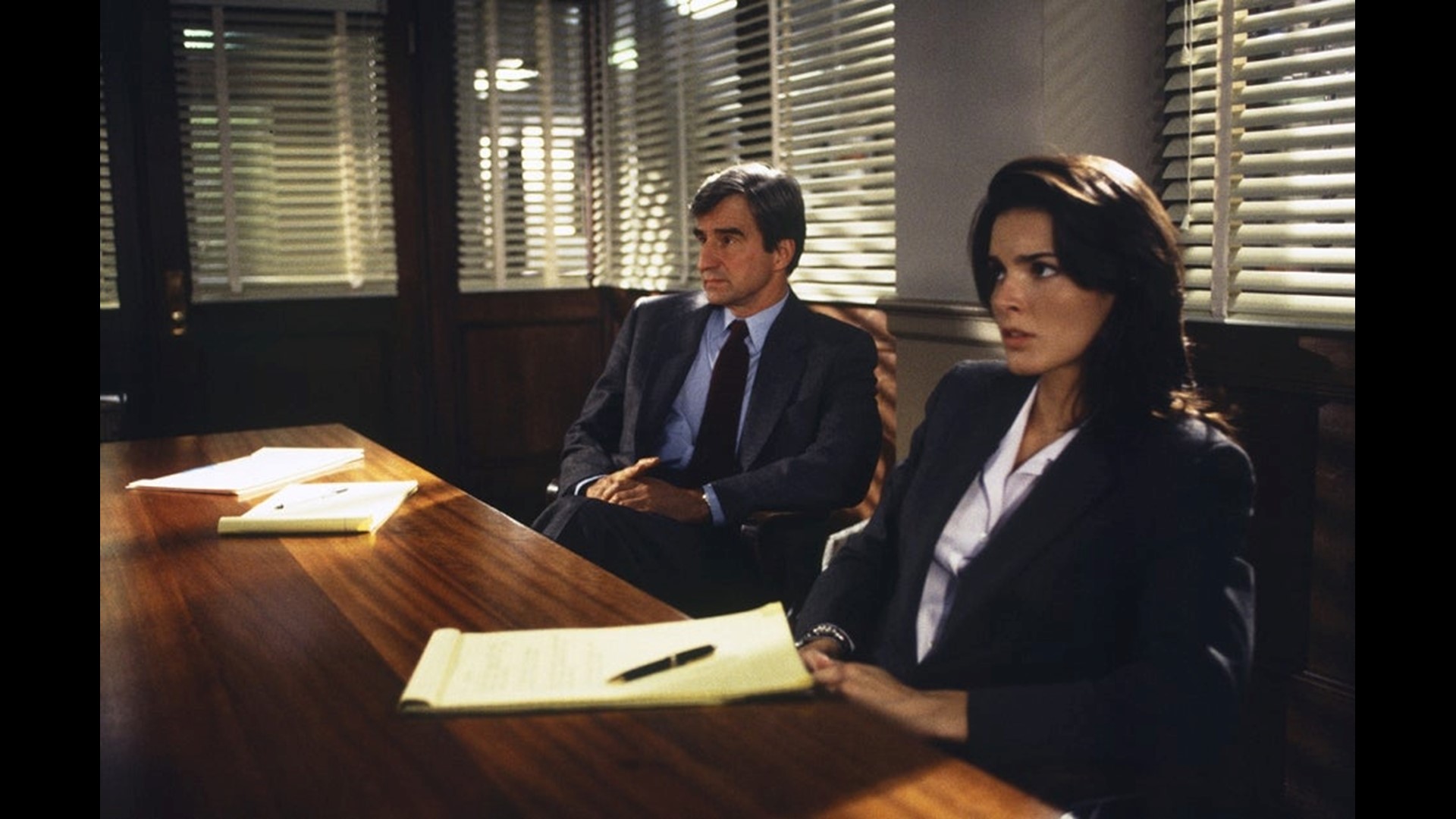
Angie Harmon starred as Assistant District Attorney Abbie Carmichael on Law & Order across Seasons 9, 10, and 11, appearing in 72 episodes between 1998 and 2001. She also portrayed the character in six crossover episodes of Law & Order: Special Victims Unit, establishing Carmichael as one of the franchise's most memorable prosecutors.
Overview of Angie Harmon’s Tenure on Law & Order
When Angie Harmon joined the cast of NBC’s flagship police procedural and legal drama in the fall of 1998, Law & Order was entering its ninth season. The series had already established a revolving-door tradition for the junior partner in the Manhattan District Attorney's office. Following the departures of Jill Hennessy (Claire Kincaid) and Carey Lowell (Jamie Ross), producer Dick Wolf cast Harmon, who had previously gained recognition on Baywatch Nights and C-16: FBI.
Harmon brought an entirely distinct energy to the courtroom side of the program. While her predecessors often operated as liberal or centrist counterweights to Executive Assistant District Attorney Jack McCoy (played by Sam Waterston), Abbie Carmichael took the opposite stance. Carmichael was unapologetically conservative, tough on crime, and eager to pursue maximum penalties, including the death penalty. This philosophical shift revitalized the prosecutorial debates in the second half of each episode, creating intense ideological friction inside the District Attorney's office.
Throughout her three-season run, Harmon’s character was framed as fiercely principled, sharp, and resistant to plea bargains that let violent offenders avoid accountability. Her tenure coincided with the golden era of the franchise's ratings dominance, earning the cast consecutive Screen Actors Guild Award nominations for Outstanding Performance by an Ensemble in a Drama Series from 1999 through 2002.
Season-by-Season Breakdown: Abbie Carmichael’s Run
Season 9 (1998–1999): A Fiery Introduction
Season 9 marked a transitional phase for Law & Order. Benjamin Bratt was completing his final season as Detective Rey Curtis alongside Jerry Orbach’s Detective Lennie Briscoe, while the legal team underwent an ideological overhaul with Carmichael’s arrival.
Carmichael made her debut in the season premiere, "Cherished" (Season 9, Episode 1). Arriving from the Special Narcotics Division, she immediately demonstrated a rigid, uncompromising approach to criminal justice. Unlike Jamie Ross, who often urged caution and institutional restraint, Carmichael argued for swift, punitive indictments.
Key dynamics and narrative highlights of Season 9 include:
- Philosophical Clashes with Jack McCoy: In episodes like "DWB" (Driving While Black), Carmichael's belief in following strict procedure without second-guessing systemic bias challenged McCoy's courtroom instincts. McCoy often found himself playing the moderate, warning Carmichael against overzealous prosecutions.
- The Death Penalty Focus: Season 9 frequently tackled capital punishment. Carmichael proved to be a firm proponent of capital charges, reflecting her background in narcotics prosecution where violent repeat offenders rarely reformed.
- Standout Episode — "Sideshow" (Season 9, Episode 14): A major crossover event with Homicide: Life on the Street pushed Carmichael into federal territory, testing her tenacity against high-level government attorneys during an investigation involving political corruption in Washington and Baltimore.
By the end of Season 9, Harmon had secured critical approval for breaking the mold of previous female ADAs, presenting an ambitious woman who felt no obligation to soften her arguments for collegial comfort.
Season 10 (1999–2000): Established Authority and Moral Complexities
Season 10 saw the introduction of Jesse L. Martin as Detective Ed Green, revitalizing the investigative side of the show, while Harmon’s Carmichael settled into a position of authority in the courtroom. Having earned McCoy's professional respect, Carmichael was entrusted with running sensitive grand jury presentations and leading complex prosecutions.
During this season, the writers peeled back Carmichael's unyielding exterior to reveal personal vulnerabilities and internal ethical struggles:
- Personal Vulnerability in "Merger" (Season 10, Episode 4): When prosecuting a wealthy family connected to a murder, Carmichael revealed her deep personal disgust for familial neglect, showing that her punitive instincts were often fueled by an innate drive to protect vulnerable victims.
- Handling Institutional Bias: In "Trade This" (Season 10, Episode 16), Carmichael navigated Wall Street corporate cultures, refusing to be intimidated by high-priced defense counsel or backroom political pressure.
- The Shift in Office Dynamics: District Attorney Adam Schiff (Steven Hill) frequently acted as the cautious bureaucrat balancing electoral politics against McCoy and Carmichael’s prosecutorial drives. Season 10 served as Hill’s final year on the series, making the McCoy-Carmichael-Schiff trio one of the final classic prosecutor lineups of the series.
Season 11 (2000–2001): Institutional Clashes and Departure
Season 11 brought substantial change to the DA’s office with the arrival of double Oscar-winner Dianne Wiest as Interim District Attorney Nora Lewin, replacing Steven Hill’s Adam Schiff. Lewin’s background as a legal scholar and academic brought a theoretical, rehabilitative focus to the office, creating immediate friction with Carmichael’s pragmatic, hard-line prosecution style.
Throughout Season 11, Carmichael found herself caught between McCoy’s flexible courtroom stratagems and Lewin’s systemic skepticism:
- Ideological Friction with Nora Lewin: In episodes such as "Endurance" (Season 11, Episode 1), Carmichael’s desire to prosecute a mother in the death of her disabled child conflicted sharply with Lewin’s empathetic, policy-driven reservations.
- Complex Murder Cases: In "Thin Ice" (Season 11, Episode 8), Carmichael handled the emotionally fraught prosecution of a youth sports father involved in a fatal brawl, highlighting her insistence on personal accountability regardless of public hysteria or parental pressure.
- Departure Episode — "Deep Vote" (Season 11, Episode 24): In the Season 11 finale, Carmichael faced a career crossroads during an investigation into political corruption and judicial misconduct. At the conclusion of the case, she accepted an offer to join the United States Attorney’s Office for the Southern District of New York, providing a dignified and professionally logical exit for the character.
Angie Harmon’s Law & Order Appearances by Season
The following table summarizes Angie Harmon’s appearances across the flagship series and its sister spin-off during her three years in the franchise.
| Television Series | Season | Year(s) | Episode Count | Notable Episodes / Arcs |
|---|---|---|---|---|
| Law & Order | Season 9 | 1998–1999 | 24 episodes | "Cherished" (Debut), "Sideshow", "Refuge" |
| Law & Order | Season 10 | 1999–2000 | 24 episodes | "Gunshow", "Killerz", "Vaya Con Dios" |
| Law & Order | Season 11 | 2000–2001 | 24 episodes | "Endurance", "Brother's Keeper", "Deep Vote" (Exit) |
| Law & Order: SVU | Season 1 | 1999–2000 | 4 episodes | "Payback" (SVU Premiere), "Closure", "Entitled" |
| Law & Order: SVU | Season 2 | 2000–2001 | 2 episodes | "Baby Killer", "Secrets" |
In total, Harmon filmed 78 appearances as Abbie Carmichael across the franchise: 72 full episodes of the mother ship and 6 guest appearances supporting the detectives of the Special Victims Unit.
The Special Victims Unit Crossovers
During the 1999–2000 television season, Dick Wolf launched Law & Order: Special Victims Unit, starring Christopher Meloni as Elliot Stabler and Mariska Hargitay as Olivia Benson. Because SVU had not yet established its own permanent prosecutorial cast—prior to Stephanie March joining as ADA Alexandra Cabot in Season 2—prosecutors from the main series crossed over to manage grand jury hearings and court filings.
Harmon was instrumental in establishing the legitimacy and continuity of SVU:
- Setting the Legal Baseline: Harmon appeared in the very first episode of SVU ("Payback," September 20, 1999). Her presence assured existing viewers that the new spin-off operated in the exact same Manhattan legal universe as the original show.
- Navigating Sex Crime Realities: Working with the Special Victims Unit forced Carmichael to confront traumatized victims and complex evidentiary challenges that differed from street narcotics. Her hard-edged legalism created natural drama alongside Detectives Stabler and Benson, who prioritized victim welfare over legal technicalities.
- Multi-Part Franchise Events: Harmon played a central role in the two-part crossover event between Law & Order ("Entitled," Season 10, Episode 14) and SVU ("Entitled," Season 1, Episode 15), linking an old unsolved rape and murder to an influential, politically connected family.
Her six appearances on SVU showcased Carmichael’s capability under alternative investigative dynamics, serving as the connective tissue for Wolf Entertainment’s expanding television universe.
Key Character Traits: What Made Abbie Carmichael Unique?
Before Abbie Carmichael, the junior prosecutors in McCoy’s office—Paul Robinette (Richard Brooks), Claire Kincaid (Jill Hennessy), and Jamie Ross (Carey Lowell)—generally shared a skeptical view of state power, often questioning whether police practices crossed civil-liberties thresholds. Carmichael disrupted that uniformity in several distinct ways.
Unapologetic Conservatism
Carmichael was written explicitly as an economic and social conservative who supported strict criminal penalties. Her perspectives were shaped by four years in Special Narcotics, where she witnessed systemic violence perpetrated by repeat offenders. This background left her with little patience for procedural loopholes or psychological defenses that excused criminal culpability.
The "Good Cop / Bad Cop" Courtroom Inversion
Prior to Harmon’s arrival, Jack McCoy was routinely the aggressive prosecutor pushing the limits of constitutional law, with his female assistants urging restraint. With Carmichael, the dynamic inverted. Carmichael frequently urged McCoy to seek the death penalty or refuse plea agreements, forcing McCoy into the unfamiliar role of judicial mediator. This altered dynamic revitalized the writing room, yielding some of the show's most intellectually combative trial preparations.
Professional Boundaries and Composure
Unlike many procedural characters who succumb to emotional outbursts, Carmichael maintained a razor-sharp, disciplined composure. Even when personal history was revealed—such as her past experiences with workplace sexual harassment or her disgust for privileged criminals—she channeled her outrage into procedural rigor and courtroom cross-examinations.
Why Did Angie Harmon Leave Law & Order?
Angie Harmon left Law & Order at the end of Season 11 in May 2001. Unlike abrupt television departures driven by disputes, Harmon’s exit was amicable, planned, and motivated by career ambition.
Harmon had signed a standard three-year contract when joining the series in 1998. When that agreement concluded in 2001, she chose not to renew. Harmon cited the demanding production schedule—which involved ten-month filming calendars in New York City—and her desire to pursue feature films and diverse dramatic roles in Los Angeles. Harmon had recently married NFL player Jason Sehorn and sought a transition away from the grueling procedural grind.
Producer Dick Wolf respected her decision, giving Abbie Carmichael an honorable and dignified exit. Rather than killing off the character—a fate suffered by Claire Kincaid—or subjecting her to professional disgrace, Carmichael received a promotion to the Southern District of New York. This narrative choice kept the door open for potential guest returns and preserved the character’s legacy as an accomplished legal mind.
Following Harmon’s departure, actress Elisabeth Röhm joined the series at the start of Season 12 as Serena Southerlyn, once again shifting the philosophical balance of the District Attorney’s office.
Top 5 Essential Abbie Carmichael Episodes
Viewers looking to experience the best of Angie Harmon’s work on Law & Order should prioritize these five benchmark episodes:
1. "Cherished" (Season 9, Episode 1)
Harmon’s debut remains one of the sharpest character introductions in television history. When an adopted girl is killed, Carmichael clashes with McCoy over how to proceed with the girl's adoptive parents. Carmichael lays down her philosophy instantly: child abuse and domestic crime deserve zero prosecutorial sympathy.
2. "Punk" (Season 9, Episode 8)
This episode delves deeply into Carmichael’s prosecutorial judgment. A female inmate kills a corrections officer, claiming he coerced her into a sexual relationship. Carmichael’s skepticism of the defendant’s claims puts her at odds with McCoy, forcing her to confront the institutional realities of the prison system versus the letter of the law.
3. "Killerz" (Season 10, Episode 2)
A 10-year-old sociopathic boy murders an infant, presenting the District Attorney’s office with a legal nightmare. Carmichael takes an aggressive stance, arguing that the boy lacks empathy and poses a permanent danger to society, requiring trial as an adult. The episode highlights Harmon’s ability to defend deeply controversial positions with intellectual coherence.
4. "Trade This" (Season 10, Episode 16)
When a young stockbroker is murdered, Carmichael leads an aggressive pursuit of corporate corruption. The episode showcases her mastery of complex financial trails and features razor-sharp grand jury questioning, emphasizing that her tough-on-crime philosophy applied to Wall Street executives just as strictly as street-level drug dealers.
5. "Deep Vote" (Season 11, Episode 24)
Harmon’s final episode tests Carmichael’s integrity. The DA’s office uncovers evidence that a judge offered favorable rulings in exchange for campaign contributions in an election recount. Carmichael refuses to allow political loyalty to blind her to judicial corruption, delivering an exceptional final legal performance before transitioning to the U.S. Attorney’s office.
Angie Harmon’s Career After Law & Order
Departing Law & Order allowed Harmon to broaden her career across television and film:
- Film Roles: Following her departure, Harmon appeared in feature films such as Agent Cody Banks (2003) and Fun with Dick and Jane (2005).
- Return to Television: She starred in television dramas such as Inconceivable and the short-lived Women's Murder Club (2007–2008), based on James Patterson’s novels.
- Rizzoli & Isles (2010–2016): Harmon achieved major commercial and critical success on cable television starring as Boston homicide detective Jane Rizzoli in TNT’s Rizzoli & Isles. Opposite Sasha Alexander’s Dr. Maura Isles, Harmon led the series across seven seasons and 105 episodes, cementing her status as one of television’s premier procedural leads.
- Directing and Lifetime Projects: In subsequent years, Harmon expanded into directing and executive producing, helming episodes of television and signing multi-picture development agreements with networks like Lifetime.
How to Watch Angie Harmon’s Law & Order Seasons
Streaming availability for legacy television procedurals depends on active syndication contracts and platform distribution rights.
- Peacock: Because NBCUniversal owns Law & Order, Peacock serves as the primary streaming home for the franchise. Seasons 9 through 11 are regularly hosted on the platform in high definition.
- Digital Purchase (VOD): Seasons 9, 10, and 11 can be purchased digitally on platforms such as Amazon Prime Video, Apple TV, Google Play Movies, and Vudu. Episodes can be acquired individually or by full season.
- Cable Syndication: Reruns of Angie Harmon’s seasons remain in heavy rotation on cable networks, including SundanceTV, WE tv, BBC America, and Charge!, where daytime and weekend Law & Order blocks regularly air.
- Physical Media: For dedicated collectors, Universal Pictures Home Entertainment has released complete DVD box sets for Season 9, Season 10, and Season 11, which include full-length episodes, deleted scenes, and retrospective promotional featurettes.
Frequently Asked Questions
What seasons was Angie Harmon on Law & Order?
Angie Harmon starred on Law & Order for three complete seasons: Season 9 (1998–1999), Season 10 (1999–2000), and Season 11 (2000–2001). She played Assistant District Attorney Abbie Carmichael in 72 episodes of the main series.
What happened to Abbie Carmichael when she left Law & Order?
Abbie Carmichael was not killed off or dismissed from public service. In the Season 11 finale, "Deep Vote," she announced she had accepted an appointment as an Assistant United States Attorney for the Southern District of New York, transitioning from local Manhattan prosecution to federal litigation.
Did Angie Harmon ever return to Law & Order after Season 11?
Angie Harmon did not return as Abbie Carmichael in subsequent seasons of the flagship series, nor did she appear in the 2022 revival of Law & Order. Aside from her 6 crossover appearances on Law & Order: SVU while still a cast member on the original show, Harmon has not reprised the role on television.
Who replaced Angie Harmon on Law & Order?
Harmon was replaced by Elisabeth Röhm, who debuted as Assistant District Attorney Serena Southerlyn in the Season 12 premiere ("Who Let the Dogs Out?", aired fall 2001). Röhm remained in the role through Season 15.
Was Abbie Carmichael on Law & Order: Special Victims Unit?
Yes. Harmon appeared as Abbie Carmichael in six episodes of Law & Order: SVU across its first two seasons (four episodes in Season 1 and two episodes in Season 2), serving as the prosecutor handling arraignments and indictments for Detectives Benson and Stabler before the arrival of ADA Alex Cabot.
Practical Viewing Advice
To appreciate the character development and ideological shift Angie Harmon brought to Law & Order, watch her run in chronological order starting with the Season 9 premiere, "Cherished." Paired with her crossover appearances in Law & Order: SVU Season 1, this viewing sequence provides a complete look at one of the sharpest, most legally rigorous eras in franchise history. Check Peacock or broadcast schedules on SundanceTV to locate these episodes across current streaming and syndication lineups.