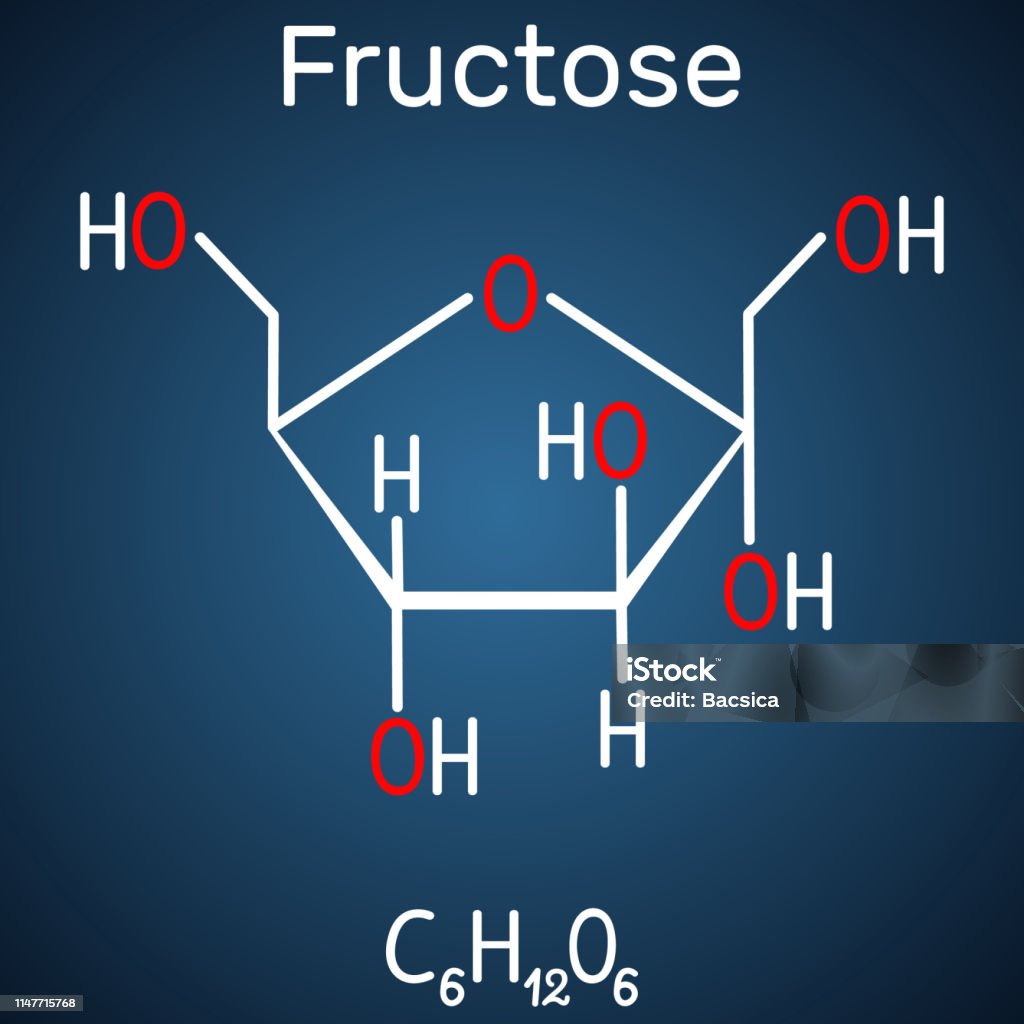
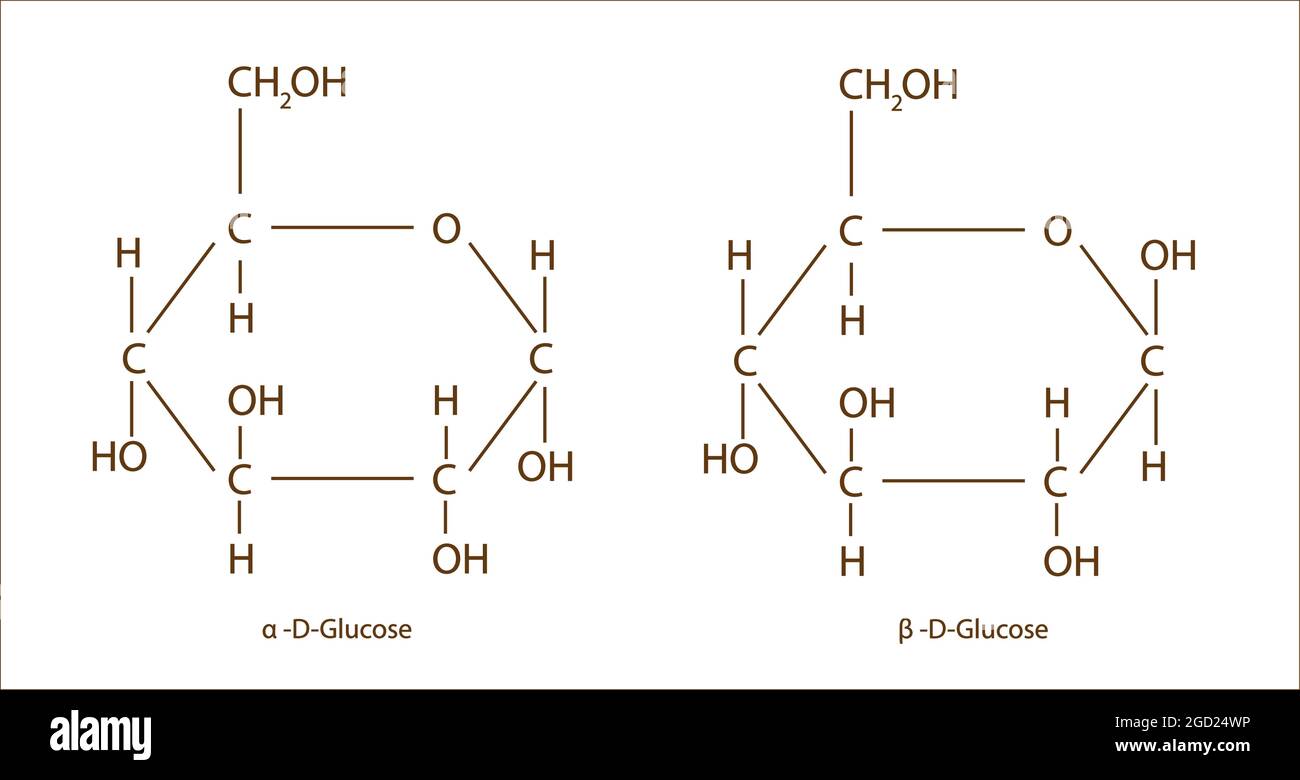
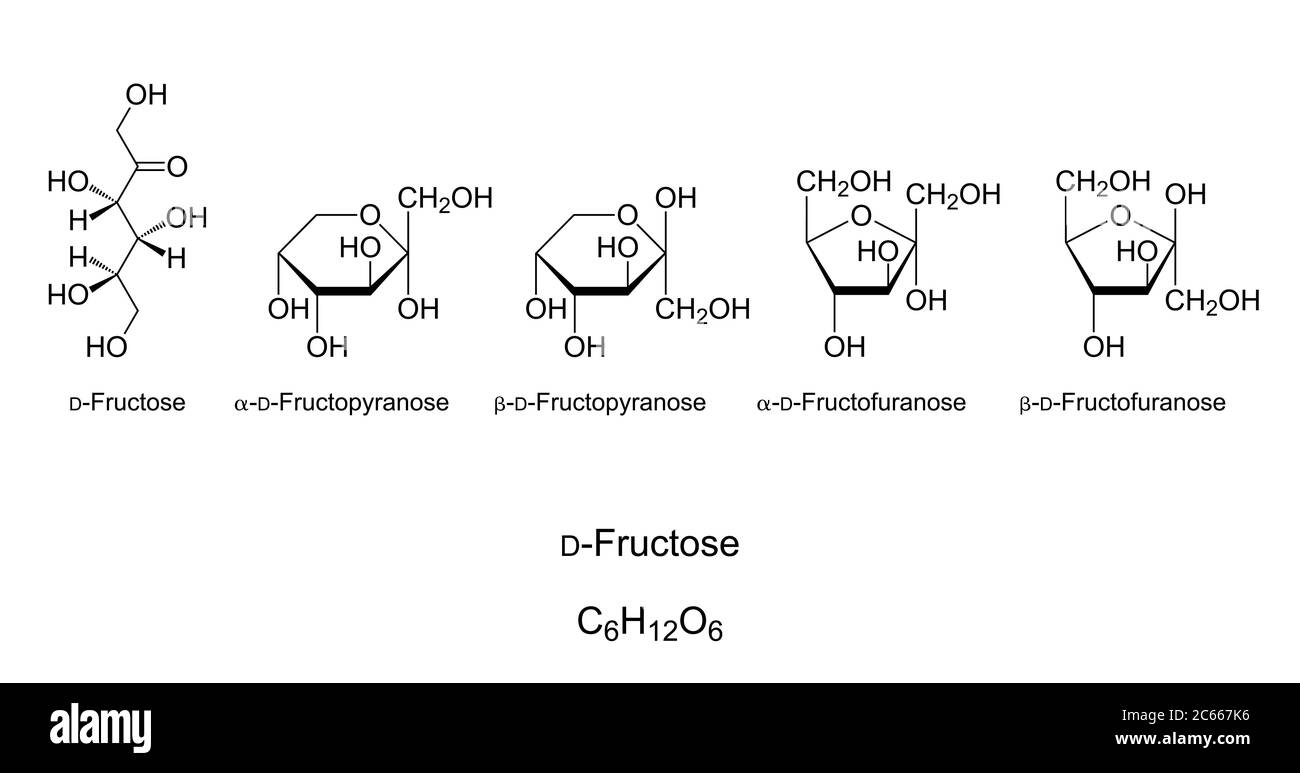
Alpha-D-fructose and beta-D-fructose are the two anomeric forms of the monosaccharide D-fructose, differing only in the spatial orientation of the hydroxyl group on the anomeric carbon (C2). In aqueous solutions, these forms exist in a dynamic equilibrium through a process called mutarotation, where the molecule cycles between open-chain and various ring structures, including five-membered furanose and six-membered pyranose rings.
Fructose, often referred to as "fruit sugar," is a ketohexose—a six-carbon sugar containing a ketone functional group. While its chemical formula ($C_6H_{12}O_6$) is identical to glucose, its structural arrangement and the way it cyclizes in solution create a complex profile of isomers. Understanding the distinction between alpha ($\alpha$) and beta ($\beta$) D-fructose is essential for fields ranging from organic chemistry and structural biology to food science and clinical nutrition.
The Molecular Geometry of D-Fructose
To understand the alpha and beta forms, one must first examine the foundational structure of D-fructose. In its open-chain (acyclic) form, fructose features a carbonyl group ($C=O$) at the second carbon atom (C2). This makes it a ketose, whereas glucose is an aldose (with the carbonyl at C1).
As of 2026, computational modeling in biochemistry has further refined our understanding of how these molecules behave in physiological environments. When D-fructose transitions from a straight chain to a cyclic structure, a nucleophilic attack occurs. Specifically, the hydroxyl group (-OH) on C5 or C6 reacts with the ketone group on C2. This reaction creates a hemiketal and generates a new chiral center at C2, known as the anomeric carbon.
The orientation of the new hydroxyl group formed at C2 determines whether the molecule is the $\alpha$ or $\beta$ anomer:
- Alpha ($\alpha$)-D-Fructose: The hydroxyl group on the anomeric carbon (C2) is positioned on the opposite side of the ring relative to the $CH_2OH$ group at the reference chiral center (usually represented as "down" in a standard Haworth projection for D-sugars).
- Beta ($\beta$)-D-Fructose: The hydroxyl group on the anomeric carbon is on the same side as the $CH_2OH$ group at the reference chiral center (represented as "up" in a Haworth projection).
Pyranose vs. Furanose: The Ring Size Complexity
Fructose is unique among common sugars because it readily forms both five-membered and six-membered rings. This distinguishes it from glucose, which exists almost exclusively in six-membered (pyranose) forms in solution.
1. D-Fructopyranose (Six-Membered Ring)
When the hydroxyl group on C6 attacks the C2 ketone, a six-membered pyranose ring is formed. In crystalline form, D-fructose exists almost entirely as $\beta$-D-fructopyranose. This specific isomer is responsible for the intense sweetness associated with crystalline fructose. In aqueous solutions at room temperature, the pyranose form remains dominant (approximately 70% of the total concentration), primarily in the beta configuration.
2. D-Fructofuranose (Five-Membered Ring)
When the hydroxyl group on C5 attacks the C2 ketone, a five-membered furanose ring is created. Although the furanose forms are less prevalent in pure water at room temperature than the pyranose forms, they are biologically critical. For example, the fructose found in the disaccharide sucrose (table sugar) and the polysaccharide inulin is locked in the $\beta$-D-fructofuranose configuration.
Mutarotation and Equilibrium Dynamics
When pure crystalline $\beta$-D-fructopyranose is dissolved in water, the optical rotation of the solution changes over time until it reaches a constant value. This phenomenon, mutarotation, occurs because the ring opens into a short-lived acyclic intermediate and then re-closes into different anomeric and ring-size forms.
In 2026, advanced NMR (Nuclear Magnetic Resonance) spectroscopy remains the gold standard for quantifying these proportions. At $25^\circ C$, the equilibrium composition of D-fructose in water is approximately:
- $\beta$-D-fructopyranose: ~70%
- $\beta$-D-fructofuranose: ~22%
- $\alpha$-D-fructofuranose: ~6%
- $\alpha$-D-fructopyranose: ~2%
- Acyclic (open-chain): < 0.5%
The Impact of Temperature
Temperature significantly shifts this equilibrium. As the temperature of a fructose solution increases, the proportion of furanose forms increases at the expense of the pyranose forms. Because $\beta$-D-fructopyranose is significantly sweeter than the furanose forms, fructose-sweetened beverages often lose some of their perceived sweetness when heated. This thermodynamic property is a major consideration in food formulation and industrial processing.
Comparison of Alpha and Beta D-Fructose Configurations
The following table summarizes the structural and functional differences between the primary cyclic forms of D-fructose found in aqueous equilibrium.
| Feature | $\alpha$-D-Fructofuranose | $\beta$-D-Fructofuranose | $\beta$-D-Fructopyranose |
|---|---|---|---|
| Ring Size | 5-membered (4 carbons, 1 oxygen) | 5-membered (4 carbons, 1 oxygen) | 6-membered (5 carbons, 1 oxygen) |
| Anomeric OH Position | "Down" (trans to C6) | "Up" (cis to C6) | "Up" (cis to C1) |
| Occurrence in Water ($25^\circ C$) | ~6% | ~22% | ~70% |
| Biological Context | Minor metabolic intermediate | Found in Sucrose and Inulin | Dominant free form in solution |
| Sweetness Intensity | Moderate | Moderate | High (Sweetest naturally occurring sugar) |
| Stability | Lowest among cyclic forms | High at elevated temperatures | Highest in crystalline state and cold water |
Biological and Industrial Significance
The distinction between these anomers is not merely academic; it dictates how fructose interacts with enzymes, how it is stored in plants, and how it is processed by the human body.
Presence in Complex Carbohydrates
The $\beta$-D-fructofuranose anomer is the "functional" unit of fructose in most complex carbohydrates. In sucrose, an $\alpha$-D-glucopyranose unit is linked to a $\beta$-D-fructofuranose unit via a glycosidic bond between C1 of glucose and C2 of fructose. Because this bond involves the anomeric carbons of both sugars, sucrose is a non-reducing sugar.
In fructans like inulin (found in chicory root and Jerusalem artichokes), fructose units are linked in long chains, almost exclusively in the $\beta$-furanose form. Human digestive enzymes lack the ability to break these specific $\beta$-glycosidic bonds in inulin, which is why fructans serve as prebiotic fibers rather than direct calorie sources.
Metabolism and Enzymatic Specificity
Enzymes are highly stereospecific. The enzyme hexokinase, which initiates the metabolism of fructose in the muscles and brain by phosphorylating it to fructose-6-phosphate, can act on different anomers, though often with varying affinities. In the liver, the primary site of fructose metabolism, fructokinase (ketohexokinase) traps fructose by adding a phosphate group to C1. The specific spatial arrangement of the $\alpha$ and $\beta$ anomers influences the rate at which these enzymatic reactions proceed, although the rapid mutarotation in the bloodstream ensures a constant supply of the preferred substrate.
Industrial Applications and Sweeting Power
Food scientists leverage the pyranose-furanose shift to control the flavor profiles of products. High Fructose Corn Syrup (HFCS), which contains a mixture of free glucose and free fructose, relies on the high sweetness of $\beta$-D-fructopyranose. However, in hot applications like baked goods or pasteurized syrups, the shift toward the less-sweet $\alpha$ and $\beta$ furanose forms must be compensated for in the recipe to maintain consistent sensory characteristics.
Laboratory Identification and Verification
Verifying the presence and ratio of alpha and beta D-fructose requires precise analytical techniques. Because the anomers interconvert rapidly in solution, "trapping" them often involves chemical modification.
- Polarimetry: Historically, the change in the angle of polarized light (optical rotation) was used to follow the progress of mutarotation. D-fructose is strongly levorotatory (it rotates light to the left), which gives it the name "levulose."
- NMR Spectroscopy: $C^{13}$ and $H^1$ NMR are the most effective ways to distinguish anomers in 2026. Each anomeric form produces distinct chemical shifts for the C2 carbon and the associated protons, allowing researchers to calculate the exact percentage of each form in a given sample.
- X-Ray Crystallography: This is used to confirm the structure of fructose in its solid state. It has confirmed that the standard "fructose" found in grocery stores is $\beta$-D-fructopyranose.
- Derivatization: By reacting fructose with an alkylating agent, one can form fixed methyl-fructosides. These "locked" versions do not undergo mutarotation, allowing for the physical separation and study of the alpha and beta configurations independently.
Common Mistakes in Categorizing Fructose Anomers
A common error in undergraduate biochemistry is treating fructose as if it only forms five-membered rings. This misconception likely stems from the fact that we almost always see fructose as a furanose in textbooks because that is its form in sucrose. However, for free fructose—the kind found in honey or processed syrups—the six-membered pyranose ring is the more stable and dominant configuration in most ambient conditions.
Another mistake is confusing the D/L designation with the $\alpha$/$\beta$ designation. The "D" refers to the configuration of the highest-numbered chiral center (C5 in fructose) and indicates its relationship to D-glyceraldehyde. The "$\alpha$/$\beta$" refers only to the stereochemistry of the anomeric carbon (C2) created during cyclization.
Practical Recommendations for Researchers and Food Technologists
For those working with fructose in 2026, whether in a laboratory or a manufacturing setting, the following guidelines are essential:
- Temperature Control: Always stabilize the temperature of fructose solutions before measuring Brix or sweetness, as the pyranose/furanose ratio is highly thermally sensitive.
- pH Monitoring: Mutarotation is catalyzed by both acids and bases. In highly acidic environments (like carbonated sodas), the interconversion happens much faster, which can affect the stability of other ingredients.
- Storage of Crystalline Fructose: Ensure anhydrous storage conditions to prevent surface dissolution, which can trigger a local shift from the pyranose form to a mixture of anomers, potentially causing clumping and a change in solubility rates.
Frequently Asked Questions
What is the main difference between alpha and beta D-fructose?
The primary difference lies in the spatial orientation of the hydroxyl (-OH) group on the second carbon (the anomeric carbon). In alpha-D-fructose, the hydroxyl group is on the opposite side of the ring relative to the $CH_2OH$ group on the reference carbon. In beta-D-fructose, the hydroxyl group is on the same side. This small change in geometry affects how the molecule bonds with other sugars and how it fits into enzyme active sites.
Is one anomer sweeter than the other?
Yes. $\beta$-D-fructopyranose (the six-membered ring form) is the sweetest anomeric form. When fructose is dissolved in water and allowed to reach equilibrium, the sweetness decreases slightly as some of the pyranose converts into furanose forms. This is why cold drinks sweetened with fructose often taste sweeter than hot ones; the cold temperature favors the sweeter $\beta$-pyranose configuration.
Why is fructose shown as a five-membered ring in sucrose?
In sucrose, the fructose molecule is chemically bonded to glucose. This "glycosidic bond" locks the fructose into the $\beta$-D-fructofuranose form. While fructose prefers a six-membered ring when it is "free" (floating alone in water), the five-membered ring is the configuration required for its stable linkage within the sucrose disaccharide structure.
How does mutarotation affect the measurement of fructose?
Mutarotation means that the optical rotation of a fructose solution changes until it reaches equilibrium. If you were to measure the concentration of fructose using a polarimeter immediately after dissolving it, the reading would be inaccurate. You must wait for the alpha and beta anomers, as well as the pyranose and furanose forms, to reach their stable ratio.
Can the body distinguish between alpha and beta fructose?
While individual enzymes are stereospecific (meaning they might prefer one anomer), the rapid rate of mutarotation at physiological pH and temperature means the body effectively treats a solution of fructose as a pool of all available anomers. As one form is consumed by a metabolic reaction, the equilibrium shifts to replenish it.
Final Actionable Advice: When formulating products or conducting assays involving fructose, always account for the mutarotation equilibrium. For the most consistent results in sweetness and reactivity, maintain a constant temperature (ideally $20^\circ C$ to $25^\circ C$) and allow the solution to sit for at least 30 minutes to reach its stable anomeric distribution before taking critical measurements.