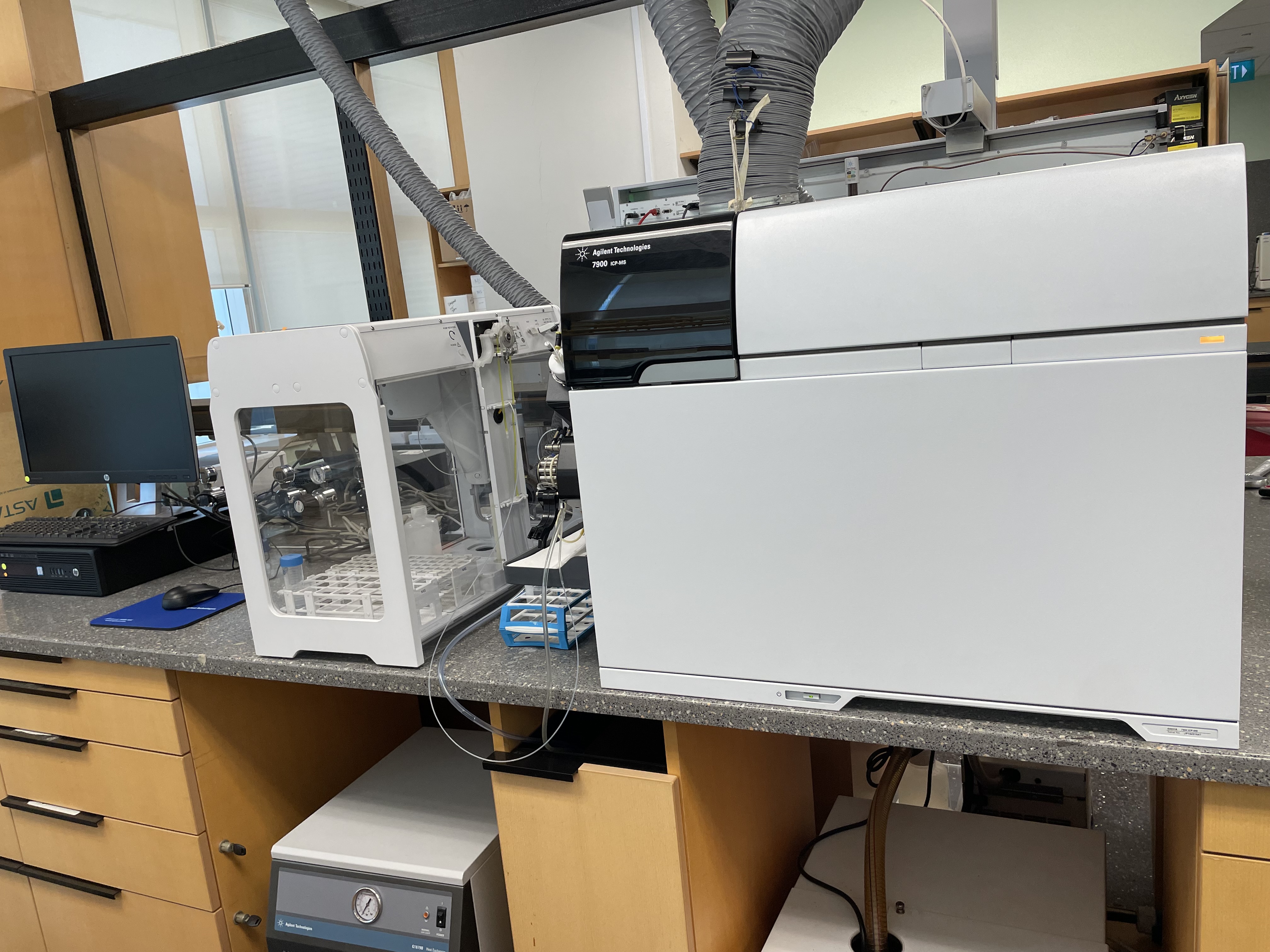
The Agilent 7900 ICP-MS is a benchtop quadrupole mass spectrometer that provides ultra-trace elemental analysis with a wide dynamic range and superior matrix tolerance. By utilizing Ultra High Matrix Introduction (UHMI) and a redesigned Octopole Reaction System (ORS4), it achieves high precision and sensitivity even in samples with 25% total dissolved solids.
The demand for high-precision elemental analysis has reached new heights in 2026, driven by tightening environmental regulations, advanced semiconductor manufacturing requirements, and the evolving needs of pharmaceutical safety testing. The Agilent 7900 Inductively Coupled Plasma Mass Spectrometry (ICP-MS) system remains a cornerstone of the modern analytical laboratory. While newer models have entered the market, the 7900’s architecture—defined by its robust plasma, high-efficiency ion optics, and versatile collision/reaction cell—continues to be the standard for labs requiring consistent, high-throughput performance across diverse sample types.
Core Technology and Design Architecture
High-precision elemental analysis begins with the efficient conversion of a liquid sample into gas-phase ions. The Agilent 7900 utilizes a 27.2 MHz digital-drive Radio Frequency (RF) generator to maintain a stable plasma. This frequency is particularly effective at handling varying solvent loads, ensuring that the energy transfer remains consistent regardless of whether the lab is analyzing acidified water or complex organic matrices.
The interface region of the 7900 is engineered to minimize ion loss while maximizing the rejection of neutral species and photons. This is achieved through a multi-stage vacuum system and precisely machined sampling and skimmer cones. In 2026, laboratory efficiency is often measured by "uptime," and the 7900’s interface design allows for easier maintenance access compared to its predecessors. The extraction lenses are positioned to pull ions from the plasma expansion zone rapidly, reducing the time for recombination and ensuring that the ion beam entering the mass analyzer is both intense and representative of the sample's original elemental composition.
The ion optics system, specifically the Off-Axis Ion Lens, is a critical component for reducing background noise. By bending the ion path, the system ensures that neutral particles and light from the plasma do not reach the detector. This contributes to a signal-to-noise ratio that allows for detection limits in the parts-per-quadrillion (ppq) range for many elements. For high-precision work, this low background is essential for quantifying ultra-trace contaminants in high-purity reagents and semiconductor-grade chemicals.
Achieving High Precision with the Octopole Reaction System (ORS4)
The primary challenge in quadrupole ICP-MS is the presence of polyatomic interferences. These occur when isotopes from the plasma gas (Argon), the solvent (Oxygen, Hydrogen), or the sample matrix (Chlorine, Carbon) combine to form molecules with the same mass-to-charge ratio as the target analyte. For example, $^{40}Ar^{16}O^+$ interferes with the primary isotope of Iron ($^{56}Fe^+$), and $^{40}Ar^{35}Cl^+$ interferes with Arsenic ($^{75}As^+$).
The Agilent 7900 addresses this through the Octopole Reaction System (ORS4). This collision/reaction cell (CRC) uses Kinetic Energy Discrimination (KED) with Helium (He) gas to filter out these larger polyatomic ions. Because polyatomic interferences have a larger cross-sectional area than monotonic analyte ions, they undergo more collisions with the Helium atoms, losing kinetic energy. A potential barrier at the cell exit then prevents these low-energy interferences from reaching the quadrupole, while the smaller, higher-energy analyte ions pass through.
For labs requiring the highest levels of precision, the ORS4 also supports reaction mode using gases like Hydrogen (H2) or Ammonia (NH3). Reaction mode is more selective and can eliminate specific interferences that He-KED might struggle with, such as the $^{40}Ar^{40}Ar^+$ interference on Selenium ($^{80}Se^+$). The ability to switch rapidly between these modes within a single sample run is what defines the 7900's high-precision capabilities, allowing for multi-element analysis without compromising the data quality for difficult-to-measure isotopes.
Managing Complex Samples with UHMI Technology
One of the historical limitations of ICP-MS was its sensitivity to high matrix loads. Traditionally, samples with more than 0.2% Total Dissolved Solids (TDS) would cause signal suppression and physical clogging of the interface cones. The Agilent 7900 overcomes this through Ultra High Matrix Introduction (UHMI) technology.
UHMI is not a simple liquid dilution. Instead, it utilizes an aerosol dilution technique where a makeup gas flow of Argon is introduced after the nebulizer but before the torch. This dilutes the aerosol, reducing the amount of water and matrix that actually enters the plasma. This process increases the plasma temperature relative to the sample load, ensuring more complete ionization and reducing the formation of oxide interferences.
The precision offered by UHMI is superior to manual or automated liquid dilution because it avoids the errors associated with pipetting and volumetric adjustments. In 2026, as laboratories move toward higher automation, UHMI allows the 7900 to analyze seawater, soil digests, and concentrated acids directly. This reduces sample preparation time and the risk of contamination, which are the two most common sources of error in trace elemental analysis.
Analytical Performance and Dynamic Range
The 7900 is famous for its massive linear dynamic range, spanning up to 11 orders of magnitude. This is made possible by its unique orthogonal detector system. The detector can switch between pulse and analog modes in microseconds, allowing the instrument to measure a trace contaminant at 1 ppt and a major matrix element at 500 ppm in the same acquisition.
Precision in ICP-MS is typically measured as the Relative Standard Deviation (RSD) of multiple replicates. The 7900 routinely achieves RSDs of less than 2% for most elements in a standard matrix. This level of precision is vital for applications like isotope ratio measurements, where slight variations can lead to incorrect conclusions about the source of a material or the age of a geological sample.
| Feature | Specification / Capability | Impact on Elemental Analysis |
|---|---|---|
| Matrix Tolerance | Up to 25% TDS with UHMI | Enables direct analysis of brine, salts, and heavy soils without liquid dilution. |
| Dynamic Range | 10 to 11 orders of magnitude | Simultaneous measurement of trace (ppt) and major (percent) elements. |
| Interference Removal | ORS4 (He-KED and Reaction modes) | Eliminates polyatomic interferences for accurate trace quantification. |
| Sensitivity | > 100 Mcps/ppm for heavy elements | Lower detection limits and improved precision for ultra-trace analytes. |
| Mass Range | 2 to 260 amu | Covers everything from Lithium to Uranium and beyond (e.g., isotopes of Transuranics). |
| Integration Time | 0.1 ms minimum | Excellent for single-particle ICP-MS (spICP-MS) and laser ablation (LA) coupling. |
Practical Applications in 2026
As we look at the analytical landscape in 2026, the Agilent 7900 remains integral to several high-stakes industries:
Semiconductor Manufacturing
In the semiconductor industry, even a few atoms of metallic impurities on a silicon wafer can lead to device failure. The 7900 is used to monitor high-purity chemicals (HPC) like Hydrofluoric Acid (HF) and Hydrogen Peroxide ($H_2O_2$). Its high sensitivity allows it to verify that these reagents meet "Grade 5" or "Grade 6" purity standards, where impurities must be below 10 ppt.
Environmental Monitoring
With increasing concerns over heavy metal contamination in water supplies and soil, the 7900 provides the throughput needed for regulatory compliance. It is used extensively for EPA Method 200.8 and ISO 17294 requirements. The 7900's ability to handle high-salt matrices makes it the preferred choice for monitoring coastal waters and industrial effluents.
Pharmaceutical Safety
The pharmaceutical industry relies on ICP-MS for Elemental Impurities testing as mandated by USP <232> and <233>. The Agilent 7900 provides the validated precision required to ensure that toxic elements like Lead (Pb), Arsenic (As), Cadmium (Cd), and Mercury (Hg) are well below the Permitted Daily Exposure (PDE) limits in drug products.
Operational Requirements and Maintenance
To maintain high precision, the Agilent 7900 requires a controlled laboratory environment. This includes stable room temperature (ideally $\pm 2^\circ$C) and humidity, as well as a clean, vibration-free bench. The vacuum system relies on a high-capacity rotary pump and a turbo-molecular pump; the oil in the rotary pump should be checked monthly and changed every six months to ensure the interface vacuum remains within the optimal range (typically $2 \times 10^{-3}$ mbar).
Consumables such as the peristaltic pump tubing, nebulizer, and spray chamber must be cleaned or replaced regularly. High-precision work often requires the use of PFA (perfluoroalkoxy) nebulizers and inert spray chambers to minimize memory effects, particularly for elements like Boron, Mercury, and Silicon.
Internal standards (ISTD) are critical for correcting physical drift and matrix effects. The 7900’s MassHunter software automates the introduction of ISTDs (like Sc, Ge, Rh, In, Tb, and Bi) via a T-piece. The software monitors these signals in real-time; if the ISTD recovery deviates beyond a set percentage (usually 70-130%), the system can automatically flag the data or trigger a re-analysis, ensuring that only high-precision data is reported.
Troubleshooting and Optimization for Precision
When precision begins to degrade—often seen as increasing RSDs or drifting calibration slopes—the first step is typically an inspection of the sample introduction system. A partially clogged nebulizer or a worn pump tube can cause pulses in the aerosol flow, leading to unstable signals.
If the precision issues are related to specific elements, it may indicate a chemical interference or a contamination problem. For example, inconsistent Chromium (Cr) readings might be traced to the stainless steel needles used in an autosampler. In such cases, switching to carbon-fiber or PFA-coated probes can restore precision.
Optimization of the torch position and the ion lens voltages is another key task. The 7900 features an "Autotune" function within the MassHunter software that optimizes these parameters for maximum sensitivity or minimum oxide formation ($CeO/Ce$ ratio < 1.5%). For high-precision elemental analysis, the system should be tuned to achieve a stable, high-intensity signal with the lowest possible background noise.
Comparison with Newer ICP-MS Systems
In 2026, while Agilent has introduced more advanced platforms like the 7850 for routine work and the 8900 Triple Quad (ICP-QQQ) for complex research, the 7900 occupies a vital middle ground. Compared to the 7850, the 7900 offers higher sensitivity and better vacuum performance, making it more suitable for ultra-trace research.
The 8900 Triple Quad is superior for removing isobaric interferences (where different elements have isotopes of the exact same mass, like $^{40}Ca$ and $^{40}Ar$), but it comes with higher capital costs and increased complexity. For the vast majority of environmental, clinical, and industrial applications, the single-quadrupole Agilent 7900 provides the "sweet spot" of high precision, ease of use, and return on investment.
Frequently Asked Questions
What is the maximum TDS the Agilent 7900 can handle?
With the UHMI (Ultra High Matrix Introduction) system, the Agilent 7900 can handle up to 25% Total Dissolved Solids (TDS). This is significantly higher than the 0.2% limit of standard ICP-MS systems. However, for long-term stability and to minimize cone cleaning, most labs operate at a more conservative 3-5% TDS when utilizing gas dilution.
How often do the interface cones need cleaning?
The frequency of cone cleaning depends entirely on the sample matrix. For clean water analysis, cones may last several weeks or months. For high-matrix samples like soil digests or seawater, cleaning may be required weekly. The Agilent 7900 features a "Matrix Tolerance" indicator in the software that can help predict when cone maintenance is necessary based on historical signal stability.
Can the Agilent 7900 perform speciation analysis?
Yes, the Agilent 7900 is commonly coupled with High-Performance Liquid Chromatography (HPLC) or Ion Chromatography (IC) systems to perform speciation. This allows laboratories to distinguish between different chemical forms of an element, such as toxic inorganic Arsenic versus less-toxic organic Arsenic. The 7900’s fast integration times make it ideal for capturing the narrow peaks produced by modern chromatography columns.
What gases are required for the 7900 ORS4 cell?
The primary gas used for interference removal is high-purity Helium (99.999%). This is used in KED mode for most routine applications. For more challenging interferences, Hydrogen can be used as a reaction gas. Some advanced configurations may also use Oxygen or Ammonia, though Helium remains the most versatile and common choice for multi-element precision.
How does the 7900 compare to the older 7700 model?
The 7900 offers a ten-fold increase in sensitivity and a much wider dynamic range (11 orders vs 9 orders) compared to the Agilent 7700. It also introduced the UHMI technology and a faster detector, making it significantly more capable for high-matrix and high-throughput laboratory environments.
Final Recommendation
For laboratories seeking high-precision elemental analysis in 2026, the Agilent 7900 remains an exceptional investment. To maximize the instrument's potential, ensure that the UHMI system is properly calibrated for your specific matrix types and that the ORS4 cell is tuned for Helium mode to manage common polyatomic interferences. Regular maintenance of the vacuum system and sample introduction components is essential for maintaining the sub-2% RSD precision that this instrument is capable of delivering. If your work involves extremely complex isobaric interferences, consider the 8900 Triple Quad; otherwise, the 7900 provides the most reliable and precise single-quadrupole solution available for trace element quantification.