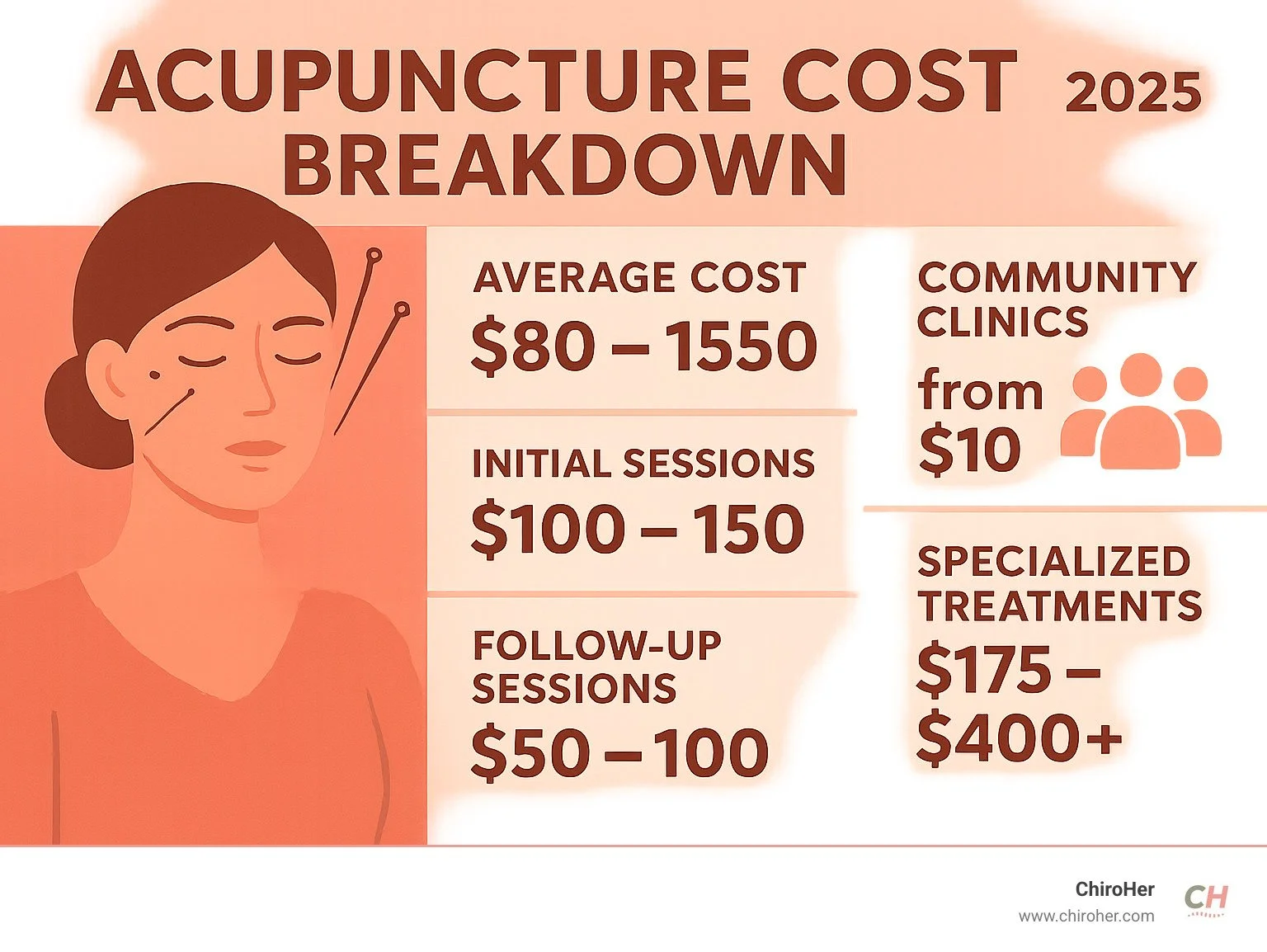
Acupuncture costs typically range from $75 to $150 per follow-up session, while initial consultations generally cost between $100 and $300. Total expenses depend on geographic location, practitioner expertise, and treatment complexity. While many insurance providers now cover acupuncture for specific conditions like chronic pain, out-of-pocket costs remain common for wellness and fertility treatments.
Acupuncture has transitioned from a niche alternative therapy to a mainstream medical staple. As of 2026, the integration of Traditional Chinese Medicine (TCM) into standard healthcare protocols has made pricing both more transparent and more varied. Understanding the financial landscape of acupuncture requires looking beyond the sticker price of a single needle insertion. It involves analyzing clinic models, geographic economic factors, the duration of treatment plans, and the evolving role of health insurance.
The Structure of Acupuncture Pricing
When you book an acupuncture appointment, you are not just paying for the physical needles. The fee covers the practitioner’s diagnostic expertise, the overhead of a sterile medical environment, and the time spent monitoring your physiological response during the session.
Initial Consultation vs. Follow-up Visits
The first visit is almost universally more expensive than subsequent sessions. This is because the acupuncturist must conduct a comprehensive intake. In 2026, a standard initial intake involves a detailed review of medical history, pulse and tongue diagnosis, and often an initial treatment.
- Initial Intake (60–90 minutes): $100 to $300.
- Follow-up Sessions (45–60 minutes): $75 to $150.
The higher cost of the first visit reflects the administrative time required to establish a patient file and the clinical time needed to formulate a long-term treatment strategy. If a practitioner charges a flat rate for both the first and subsequent visits, they may be rolling the intake cost into the overall fee or offering a simplified diagnostic process.
Diagnostic Time and "Table Time"
The cost is also split between diagnostic time and "table time." Diagnostic time is the face-to-face interaction where you discuss symptoms. Table time is the period where needles are retained—usually 20 to 40 minutes—while you rest. Higher-priced "boutique" clinics often provide more face-to-face diagnostic time, whereas high-volume clinics focus on getting needles in quickly to maximize the resting period.
Regional Variations in Pricing
Geography is one of the most significant determinants of acupuncture costs. Just as rent and labor costs vary by city, so do the overhead expenses for an acupuncture clinic.
High-Cost-of-Living (HCOL) Urban Centers
In cities like New York, San Francisco, London, or Tokyo, a single session can easily exceed $200. Practitioners in these areas face high commercial rents and must charge premium rates to maintain a viable business. Furthermore, urban centers often attract highly specialized practitioners who focus on high-demand areas like sports medicine for professional athletes or advanced fertility support.
Suburban and Rural Pricing
In suburban areas, prices tend to stabilize toward the national average of $85 to $110 per session. Rural areas may offer even lower rates, sometimes as low as $60, though the availability of practitioners is often a limiting factor. However, patients in rural areas should account for "travel costs" and time when calculating the true expense of a treatment plan that may require twice-weekly visits.
Types of Clinic Models and Their Impact on Cost
The business model of the clinic you choose will dictate the price more than almost any other factor. There are three primary models in the 2026 marketplace.
1. Private Practice (Standard Model)
This is the most common model where you have a private room and one-on-one time with the practitioner. You pay for the privacy and the individualized attention. Prices here are standard ($75–$150).
2. Community Acupuncture (Sliding Scale)
Community acupuncture is designed for affordability. Treatments are administered in a large, quiet room with multiple recliner chairs or massage tables. The practitioner moves between patients, and you remain fully clothed (treating points on the arms, legs, and head).
- Cost: Usually a sliding scale of $20 to $60 per session.
- Structure: You choose what you can afford within the range. No proof of income is typically required. This model is ideal for those who need frequent treatments (3+ times per week) but have a limited budget.
3. Integrative Medical Centers and Hospital Settings
Many hospitals now have acupuncture departments, particularly for oncology support or chronic pain management. These sessions are often the most expensive—sometimes exceeding $300—but they are also the most likely to be covered by high-end insurance plans or billed as part of a larger medical package.
Practitioner Expertise and Specialization
Not all "acupuncturists" have the same level of training, and their titles often reflect their price point.
- Licensed Acupuncturist (L.Ac.): These professionals have completed a three-to-four-year master’s or doctoral degree in TCM. They are the standard for care and usually fall within the average price ranges.
- Doctor of Acupuncture and Oriental Medicine (DAOM): This represents the highest level of clinical training. These practitioners often charge a premium for their advanced diagnostic skills.
- Medical Acupuncturists (MDs or DOs): Some Western physicians practice "medical acupuncture" after completing a shorter certification course. They may charge higher rates because they are billed at physician-level tiers, though their TCM diagnostic depth may differ from a dedicated L.Ac.
Specialization Surcharges
If you are seeking acupuncture for a specific, complex issue, expect to pay more. Specialty areas include:
- Fertility and Reproductive Health: Often involves specialized training and coordination with IVF clinics.
- Cosmetic/Facial Rejuvenation: This is often viewed as an alternative to Botox or fillers and can cost $200 to $500 per session.
- Neuro-acupuncture: Used for stroke recovery or traumatic brain injuries, requiring high-level neurological integration.
Insurance Coverage in 2026
The landscape of insurance for acupuncture has shifted significantly. While it is no longer a "luxury" service in the eyes of many insurers, coverage is rarely universal.
Medicare and Medicaid
As of 2026, Medicare Part B covers acupuncture specifically for chronic low back pain. The guidelines generally allow for up to 12 visits in 90 days, with an additional 8 sessions if the patient shows improvement. However, Medicare does not typically cover acupuncture for other conditions like migraines or tobacco cessation. Medicaid coverage varies strictly by state; some states offer robust coverage for pain management to reduce opioid reliance, while others offer no coverage at all.
Private Health Insurance (PPO/HMO)
Many private insurers (e.g., UnitedHealthcare, Aetna, Blue Cross Blue Shield) include acupuncture in their "Alternative Medicine" or "Physical Medicine" tiers.
- Co-pays: Usually range from $20 to $50 per session.
- Annual Limits: Most plans cap sessions at 12, 20, or 30 per year.
- Medical Necessity: You often need a diagnosis code (ICD-10) from a primary care physician proving the treatment is for a recognized condition like osteoarthritis or chronic tension headaches.
HSA and FSA Eligibility
Acupuncture is a qualified medical expense under Health Savings Accounts (HSA) and Flexible Spending Accounts (FSA). This allows you to use pre-tax dollars to pay for treatments, effectively saving you 20–30% depending on your tax bracket. Always keep your itemized receipts or "Superbills" provided by the practitioner for tax documentation.
Comparison of Acupuncture Costs by Service Type
| Service Type | Estimated Cost (Initial) | Estimated Cost (Follow-up) | Best For |
|---|---|---|---|
| Community Clinic | $30 – $60 | $20 – $50 | Frequent visits, budget-conscious, general stress |
| Private Practice | $100 – $250 | $75 – $150 | Privacy, complex conditions, individualized care |
| Specialist (Fertility/Neuro) | $200 – $400 | $150 – $300 | Targeted medical goals, co-managed care |
| Concierge/Home Visit | $300 – $600 | $250 – $500 | High-profile clients, mobility issues, convenience |
| Cosmetic Acupuncture | $250 – $500 | $200 – $400 | Aesthetic goals, skin health, anti-aging |
Add-on Services and Their Costs
Rarely does an acupuncture session involve only needles. Modern practitioners use several adjunct therapies that may or may not be included in the base price.
- Cupping Therapy: Using glass or silicone cups to create suction on the skin. If added to a session, it may cost an extra $20 to $50. As a standalone service, it can cost $60 to $80.
- Electro-Acupuncture: Attaching small electrodes to the needles to provide a micro-current. This is often included in the base price for pain management, but some clinics charge a $10 to $20 equipment fee.
- Moxibustion (Moxa): The burning of mugwort near the skin to facilitate healing. Due to the ventilation requirements and time, this may add $15 to $30 to the bill.
- Herbal Consultations: TCM often relies on herbal formulas. While the consultation might be included in the acupuncture fee, the herbs themselves are an additional cost, typically $40 to $100 per month.
How to Reduce Your Acupuncture Expenses
If you require long-term care but are concerned about the cost, consider these strategies to make treatment more sustainable.
1. Purchase Treatment Packages
Most private practitioners offer "bundles." For example, if a single session is $100, a package of 10 might cost $850, saving you $150 over the course of treatment. This also encourages the consistency necessary for acupuncture to be effective.
2. Request a "Superbill"
If your practitioner is out-of-network, they won't bill your insurance directly. However, they can provide a Superbill—a standardized receipt with medical coding. You can submit this to your insurance company for potential reimbursement. Many patients are surprised to find their "out-of-network" benefits cover 50–80% of the cost.
3. Seek Teaching Clinics
If you live near a college of Traditional Chinese Medicine, you can receive treatment in a Student Clinic. Treatments are performed by senior students and supervised by licensed faculty.
- Cost: Often $30 to $50 for a full private session.
- Trade-off: The sessions take longer because the supervisor must check the student’s work at every step.
4. Frequency over Luxury
For many conditions, two sessions a week in a community setting ($40 total) are more effective than one session a month in a luxury setting ($150 total). Prioritize the clinical frequency recommended by the practitioner over the "spa-like" experience if your goal is symptomatic relief.
Hidden Costs and Red Flags
When evaluating an acupuncturist’s fees, be wary of certain practices that can inflate your bill without adding clinical value.
- Excessive Supplement Sales: While herbs are a legitimate part of TCM, a practitioner who pressures you to buy hundreds of dollars of proprietary supplements on your first visit should be approached with caution.
- Mandatory Long-Term Contracts: Beware of clinics that require you to sign a contract for 40+ sessions upfront before you have even had an initial treatment. Professional ethics generally favor "pay-as-you-go" or small, refundable packages.
- Cancellation Fees: Most clinics have a 24-hour cancellation policy. In 2026, these fees often equal the full price of the session. Ensure you understand the policy to avoid unexpected charges.
Frequently Asked Questions
How many sessions of acupuncture do I typically need?
For acute issues like a recent muscle strain, 3 to 5 sessions may suffice. Chronic conditions such as long-term migraines, fertility issues, or autoimmune support usually require 10 to 20 sessions for significant, lasting change. Many patients transition to "maintenance" care once a month after their primary concerns are resolved.
Is acupuncture worth the cost for chronic pain?
Clinical studies, including those summarized by the National Institutes of Health (NIH), consistently show that acupuncture is cost-effective for chronic pain. By reducing the need for expensive pharmaceuticals and preventing lost wages due to disability, the out-of-pocket cost of acupuncture often results in overall long-term financial savings for the patient.
Can I use my 2026 HSA/FSA for acupuncture?
Yes, acupuncture is a recognized medical expense by the IRS. You can use your HSA/FSA debit card at the clinic just as you would at a pharmacy or a dentist's office. No special referral is usually needed to spend these funds on acupuncture.
Why is the initial consultation so much more expensive?
The initial consultation involves a systemic review of your body's "pattern of disharmony." The acupuncturist must evaluate your sleep, digestion, emotional state, and physical symptoms to create a customized "point prescription." This diagnostic work is a one-time intellectual labor that justifies the higher entry price.
Does insurance cover acupuncture for mental health?
In 2026, more insurers are covering acupuncture for anxiety and depression as part of "integrative behavioral health." However, this is less common than coverage for physical pain. Check your specific policy for "mental health parity" clauses that might include acupuncture.
Summary and Next Steps
The cost of acupuncture in 2026 is manageable if you choose the right clinic model for your needs. If you are seeking treatment for chronic back pain, your first step should be checking your Medicare or private insurance policy, as you may only be responsible for a small co-pay. For those without coverage or those seeking wellness-based care, community acupuncture offers a high-quality, low-cost alternative.
Before booking, call 2-3 local clinics and ask:
- What is the total cost of the initial intake?
- Do you offer packages or sliding scales?
- Do you provide a Superbill for insurance reimbursement?
By aligning your budget with the appropriate clinical model, you can access the benefits of acupuncture without financial strain.