Accenture Cloud refers to the holistic suite of multi-disciplinary services provided by Accenture—primarily through its Cloud First division—designed to help organizations migrate, manage, and optimize their business operations across the Cloud Continuum. It integrates consulting, industry-specific solutions, and managed services to drive digital transformation through cloud-native technologies, data mastery, and artificial intelligence.
In 2026, the conversation around cloud computing has shifted from simple infrastructure migration to the concept of total enterprise reinvention. Accenture has positioned itself as the primary orchestrator for companies that no longer view the cloud as a destination, but as an operating model. This guide explores the current state of Accenture’s cloud offerings, the strategic "Cloud First" initiative, and how the firm helps global enterprises navigate the complexities of sovereign clouds, sustainable computing, and AI-driven efficiency.
The Evolution of Accenture Cloud First
Launched as a multi-billion dollar investment several years ago, the Cloud First initiative was created to consolidate Accenture’s cloud expertise into a single, powerhouse entity. By 2026, this division has matured into a global network of over 100,000 cloud professionals who manage thousands of large-scale projects simultaneously.
The core philosophy of Accenture Cloud revolves around the Cloud Continuum. This concept acknowledges that the modern enterprise uses a mix of public, private, and hybrid clouds, alongside edge computing and on-premises data centers. Accenture’s role is to provide a seamless layer of management and strategy across these disparate environments.
The Shift to the Cloud Continuum
While early cloud strategies focused almost exclusively on the public cloud (AWS, Azure, and Google Cloud), the 2026 landscape is more nuanced. Accenture’s current framework emphasizes:
- The Public Cloud: Continued scaling with hyperscalers for agility and innovation.
- The Private Cloud: Enhanced security and control for sensitive workloads.
- The Edge: Processing data closer to the source (IoT devices, factory floors) to reduce latency.
- Sovereign Clouds: Meeting strict national data residency and privacy regulations.
Core Services and Strategic Pillars
Accenture’s cloud offerings are categorized into several functional areas that address different stages of the digital journey. Whether an organization is just beginning to move away from legacy hardware or is looking to optimize an existing multi-cloud environment, Accenture provides a tailored pathway.
1. Cloud Migration and Modernization
Migration is no longer just about "lift and shift." In 2026, Accenture utilizes automated tools and AI-driven assessment frameworks to determine which applications should be retired, replaced, or refactored. Modernization involves moving away from monolithic software architectures toward microservices and serverless environments, which allow for greater scalability and faster update cycles.
2. Data and AI Integration
The cloud is the foundational layer for all modern Artificial Intelligence. Accenture Cloud services focus heavily on creating a "Clean Data Core." By migrating data silos into a unified cloud environment, businesses can leverage generative AI and machine learning to gain predictive insights. In 2026, Accenture’s proprietary AI platforms are often integrated directly into the cloud management layer to automate routine IT tasks and optimize resource allocation.
3. Industry-Specific Cloud Solutions
General-purpose cloud solutions often fall short of meeting the regulatory or operational needs of specific sectors. Accenture has developed pre-configured cloud "blueprints" for various industries:
- Banking: Focused on mainframe modernization and real-time payment processing.
- Healthcare: Centered on patient data interoperability and HIPAA-compliant research environments.
- Retail: Prioritizing edge computing for inventory management and personalized customer experiences.
- Manufacturing: Leveraging "Digital Twins" hosted in the cloud to simulate production lines.
4. Cloud Management and Governance (FinOps)
As cloud footprints expand, so do the costs. FinOps (Financial Operations) has become a critical component of Accenture’s cloud service. They provide tools that offer real-time visibility into cloud spending, helping organizations eliminate "zombie" resources and right-size their instances. This ensures that the cloud provides a measurable return on investment (ROI) rather than becoming an uncontrolled expense.
The Rise of Accenture Sovereign Cloud
One of the most significant developments in 2026 is the rapid adoption of Sovereign Cloud solutions. Governments and regulatory bodies, particularly in Europe and Asia, have tightened rules regarding where data is stored and who can access it.
Accenture’s Sovereign Cloud practice helps clients build infrastructures that comply with these "digital borders." This involves working with local providers and ensuring that encryption keys and administrative access remain within specific jurisdictions. This service is essential for public sector entities, defense contractors, and financial institutions that must balance the innovation of the cloud with the requirements of national security and data privacy.
| Feature | Standard Public Cloud | Accenture Sovereign Cloud |
|---|---|---|
| Data Residency | Global distribution | Strictly localized to specific regions |
| Operational Control | Managed by Hyperscaler (e.g., AWS) | Managed by local entities or screened personnel |
| Compliance Focus | General (SOC2, ISO) | Jurisdiction-specific (e.g., Gaia-X, GDPR+) |
| Security Architecture | Shared responsibility model | Enhanced encryption and isolated hardware |
| Primary Use Case | Global scale and agility | Highly regulated data and critical infrastructure |
Sustainable Cloud and Green Software Engineering
By 2026, sustainability has moved from a corporate social responsibility (CSR) goal to a functional requirement for IT. Accenture Cloud advocates for Green Cloud practices, which involve optimizing software code to consume less energy and selecting data center regions powered by renewable energy.
Accenture’s "Sustainable Value Pipeline" allows organizations to track the carbon footprint of their cloud operations. This data is increasingly required for mandatory environmental reporting in many global markets. By optimizing the "Cloud Continuum," Accenture helps firms reduce their total energy consumption while maintaining high performance.
Major Cloud Partnerships
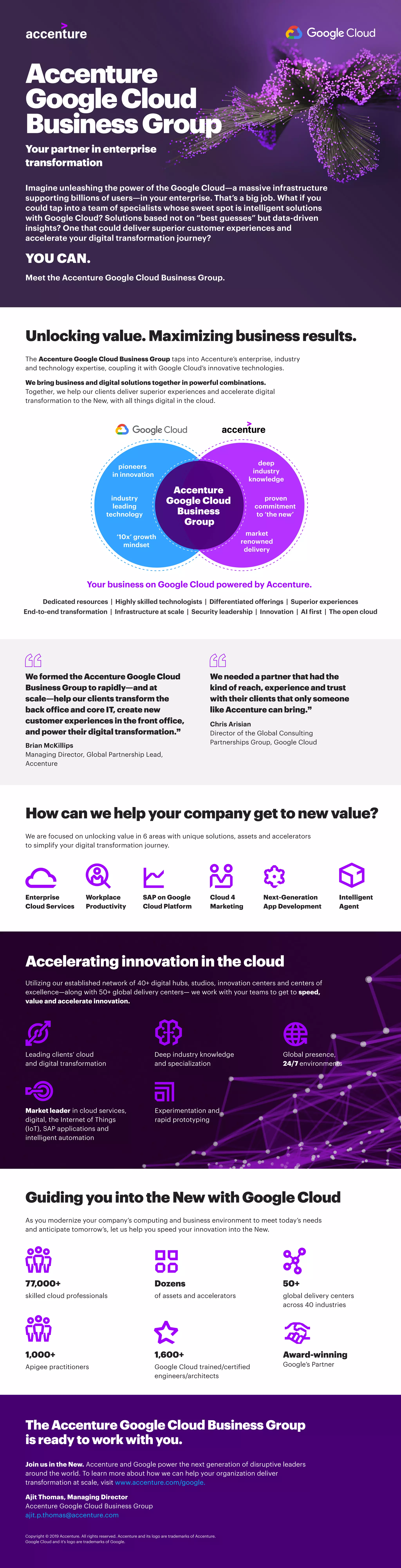
Accenture does not operate its own public cloud infrastructure. Instead, it maintains deep, strategic partnerships with the world’s leading technology providers. This "ecosystem" approach allows Accenture to remain vendor-neutral while offering specialized expertise in each platform.
- Microsoft Azure: Focused on deep integration with enterprise software (Office 365, Dynamics) and AI (via OpenAI partnerships).
- Amazon Web Services (AWS): Focused on massive scale, developers, and advanced cloud-native services.
- Google Cloud (GCP): Prioritizing data analytics, machine learning, and open-source containerization (Kubernetes).
- Oracle Cloud: Frequently used for large-scale ERP migrations and database-heavy workloads.
- SAP and Salesforce: Accenture provides specialized cloud "wrappers" to help these SaaS platforms integrate with a company's broader cloud strategy.
Key Challenges and Troubleshooting in 2026
Despite the maturity of cloud technology, enterprises still face significant hurdles. Accenture’s consulting arm focuses on solving these specific pain points:
The Talent Gap
The demand for cloud architects and data engineers continues to outstrip supply. Accenture addresses this by providing "Managed Services," essentially acting as the client’s cloud department. They also offer training programs to help internal teams upskill in areas like DevSecOps and AI management.
Technical Debt and Legacy Systems
Many organizations still have "anchors" in the form of legacy on-premises software that cannot be easily moved. Accenture uses hybrid cloud architectures to bridge the gap, allowing these legacy systems to communicate with new cloud-native applications through APIs.
Security and Ransomware Resilience
In 2026, cyber threats are more sophisticated, often using AI to find vulnerabilities. Accenture Cloud incorporates Zero Trust security models, ensuring that every user and device is verified before accessing cloud resources. They also implement automated backup and recovery systems to ensure business continuity in the event of a breach.
Frequently Asked Questions
What is the difference between Accenture Cloud and AWS or Azure?
Accenture is a Service Provider and consultancy, whereas AWS and Azure are Infrastructure Providers (Hyperscalers). Accenture helps you choose, implement, and manage the services offered by AWS or Azure. Think of the hyperscalers as providing the bricks and mortar, while Accenture provides the architects, builders, and property managers.
How does Accenture Cloud First help with cost management?
Accenture uses a FinOps framework that combines cultural shifts with automated tools. They analyze your cloud consumption patterns, identify wasted resources (such as over-provisioned servers), and negotiate better pricing structures with cloud vendors. In 2026, they also use AI to predict future spending based on projected business growth.
Is Accenture Cloud suitable for small and medium-sized businesses?
While Accenture primarily works with Fortune Global 500 companies and large government agencies, they have developed mid-market solutions. However, their services are most valuable for organizations with complex, multi-cloud needs or those operating in highly regulated industries.
What is "Cloud-Native" development in the context of Accenture?
Cloud-native development involves building applications specifically to run in the cloud environment. This means using containers, microservices, and managed APIs rather than simply copying old software onto a cloud server. Accenture emphasizes this approach because it makes applications more resilient, easier to update, and more cost-efficient in the long run.
How does Accenture handle data privacy in a multi-cloud environment?
Accenture utilizes a "Security by Design" approach. They implement unified security policies that follow the data regardless of which cloud it resides in. This includes advanced encryption, identity management, and continuous monitoring to ensure compliance with global regulations like GDPR and CCPA.
Practical Recommendations for Organizations
As we navigate through 2026, any enterprise engaging with Accenture for cloud services should prioritize three actions:
- Audit the Data Core: Before moving more workloads to the cloud, ensure your data is clean and organized. Without a solid data foundation, AI initiatives—which are the primary value driver in 2026—will likely fail or produce inaccurate results.
- Adopt a Continuum Mindset: Move away from the idea that everything must be in the public cloud. Evaluate your workloads to see which require the low latency of the Edge or the strict control of a Sovereign Cloud.
- Invest in Governance Early: Cloud costs can spiral out of control within months. Establish a FinOps practice and a clear governance framework at the start of your engagement with Accenture to ensure long-term fiscal health.
Accenture Cloud remains a dominant force in the enterprise sector because it bridges the gap between complex technology and business outcomes. By leveraging their global expertise and massive partner ecosystem, organizations can transform the cloud from a technical necessity into a competitive advantage.