Selecting a retirement plan for a small business helps owners attract top talent, secure valuable tax incentives, and build their own long-term wealth. The optimal structure depends on employee headcount, administrative complexity, and contribution flexibility.
Choosing the right retirement plan is one of the most consequential financial decisions a small business owner can make. Beyond helping you and your employees build long-term financial security, a well-structured retirement plan offers significant tax advantages and acts as a powerful tool for recruiting and retaining skilled workers. However, the sheer variety of options—ranging from ultra-simple individual accounts to robust profit-sharing structures—can make the selection process feel overwhelming.
When evaluating plans, you must balance your business cash flow predictability against your desire to maximize personal contributions. Some plans require mandatory employer contributions regardless of profitability, while others allow you to scale funding up or down based on annual revenue. Understanding the operational mechanics, compliance burdens, and contribution limits of each structure ensures you select a vehicle that aligns with your specific business model.
Below is a detailed breakdown of the five best retirement plans for small businesses, designed to help you navigate your options and make an informed choice.
1. Simplified Employee Pension (SEP IRA)
A Simplified Employee Pension, or SEP IRA, is widely considered the easiest retirement plan for small business owners to set up and maintain. It is particularly popular among sole proprietors, freelancers, independent contractors, and small business owners with few or no employees.
How It Works
Under a SEP IRA, only the employer makes contributions. Employees cannot contribute a portion of their salary. Contributions are made directly to an individual retirement account (IRA) set up for each eligible worker. The administrative burden is remarkably low: you typically complete IRS Form 5305-SEP to establish the plan, and there are generally no complex annual IRS reporting filings required for the business.
Eligibility and Contribution Limits
To be fair and compliant, if you contribute to your own SEP IRA, you must make contributions for all eligible employees at the exact same percentage of compensation. Generally, an eligible employee is someone who is at least 21 years old, has worked for you in at least three of the past five years, and has earned a minimum threshold of compensation (adjusted periodically by the IRS).
For contribution limits, employers can contribute up to 25% of an employee’s compensation, or up to specific statutory dollar limits that adjust annually for inflation. For self-employed individuals, the calculation of net earnings from self-employment includes a special formula to determine the maximum deductible contribution.
Pros and Cons
- Pros: Minimal paperwork, no annual government reporting, high contribution limits, and complete discretion over whether to fund the plan in any given year based on cash flow.
- Cons: Mandatory equal contributions for all eligible employees mean that if you contribute 15% of your own income, you must also contribute 15% of every eligible employee's income. Furthermore, employees are 100% vested immediately, and the plan does not allow for employee salary deferrals or catch-up contributions for older workers.
2. Solo 401(k) (Individual 401(k))
The Solo 401(k), also known as an Individual 401(k) or Uni-ki, is tailored specifically for business owners who have no employees other than a spouse. It offers some of the highest contribution limits and most flexible investment options of any small business retirement vehicle.
How It Works
Because the business owner acts as both the employer and the employee, contributions can be made in two distinct capacities. First, you can make "employee elective deferrals" from your earned income. Second, you can make "employer non-elective contributions" from business profits. This dual-contribution structure allows for massive tax-advantaged savings in a single year.
Eligibility and Contribution Limits
The primary prerequisite for a Solo 401(k) is the absolute absence of common-law employees. If you hire even one part-time or full-time employee who is not your spouse, you generally become ineligible for a Solo 401(k) and must transition to a traditional group plan.
Contribution limits are exceptionally generous. As an employee, you can contribute up to 100% of your earned compensation up to the annual elective deferral limit, plus an additional catch-up contribution if you are aged 50 or older. As the employer, you can add up to 25% of net self-employment earnings (or compensation). The combined total of employee and employer contributions cannot exceed the overall annual additions limit set by the IRS.
Pros and Cons
- Pros: Massive tax-advantaged savings potential, flexibility to choose Roth (after-tax) or traditional (pre-tax) employee contributions, and the option to take a participant loan if your plan document permits it.
- Cons: Completely unavailable if you hire outside employees; requires Form 5500-EZ filing once total plan assets exceed a specific statutory threshold (typically $250,000, though rules require careful monitoring of asset accumulation).
3. Savings Incentive Match Plan for Employees (SIMPLE IRA)
A SIMPLE IRA is designed for small businesses—generally those with 100 or fewer employees—that want to offer a tax-deferred retirement plan with modest administrative overhead. It bridges the gap between individual plans like SEPs and complex corporate 401(k)s.
How It Works
A SIMPLE IRA allows employees to make salary reduction contributions, and requires the employer to make mandatory matching or non-elective contributions. Setting up a SIMPLE IRA involves completing an IRS form (such as Form 5305-SIMPLE) and establishing financial institution accounts for each participating worker.
Employer Contribution Requirements
Employers are legally bound to make one of two types of annual contributions:
- Matching Contribution: Match employee contributions dollar-for-dollar up to 3% of the employee’s compensation. The match can be reduced to as low as 1% in any two out of five years.
- Nonelective Contribution: Make a flat 2% contribution for all eligible employees, regardless of whether the employee chooses to make their own salary deferrals.
Pros and Cons
- Pros: Much lower administrative and setup costs than a traditional 401(k); helps small businesses compete for talent by offering salary deferrals and matching funds; straightforward annual maintenance.
- Cons: Mandatory employer contributions can strain cash flow during lean business years. Additionally, early withdrawal penalties are harsher during the first two years of plan participation (often rising to 25% instead of the standard 10%).
4. Traditional Small Business 401(k)
A traditional 401(k) plan customized for a small business is the most comprehensive tool for retirement savings. While historically burdened by high costs and administrative complexity, modern digital recordkeepers have made small business 401(k)s much more accessible and affordable.
How It Works
Employees contribute a percentage of their pre-tax or Roth-designated salary directly into investment portfolios. Employers have the option to match these contributions or make profit-sharing additions. Traditional 401(k) plans require robust compliance testing—known as nondiscrimination testing—to ensure that high-earning owners and executives are not disproportionately benefiting from the plan compared to rank-and-file workers.
Navigating Nondiscrimination Testing
To bypass the complex and costly annual Actual Deferral Percentage (ADP) and Actual Contribution Percentage (ACP) tests, many small businesses opt for a Safe Harbor 401(k). By making mandatory, predictable employer contributions (such as a Safe Harbor match or a 3% non-elective contribution), the business is automatically deemed compliant with IRS nondiscrimination rules.
Pros and Cons
- Pros: High contribution ceilings, ability to offer Roth options, powerful recruitment tool, and Safe Harbor designs eliminate burdensome nondiscrimination testing.
- Cons: Higher setup and ongoing administrative fees compared to SEPs or SIMPLE IRAs; strict fiduciary responsibilities for the plan sponsor; mandatory annual Form 5500 filings.
5. Defined Benefit Plan
A Defined Benefit Plan is a traditional pension plan tailored for small business owners and high-income professionals who want to maximize tax deductions and accelerate retirement savings late in their careers.
How It Works
Unlike defined contribution plans (like 401(k)s), which specify how much goes into the account, a Defined Benefit Plan defines the exact benefit payout an employee will receive at retirement. An actuary must calculate the annual contributions required from the business to fund those future promised benefits.
Suitability and Contribution Limits
Because contributions are mathematically derived to fund a specific future benefit, older business owners with high incomes can often contribute hundreds of thousands of dollars per year on a tax-deferred basis. This plan is ideal for established, highly profitable small businesses or professional practices (such as medical or legal practices) with stable cash flow and older owners looking to catch up on retirement savings quickly.
Pros and Cons
- Pros: Unmatched contribution limits for high earners nearing retirement age; excellent tax-sheltering mechanism for highly profitable businesses.
- Cons: Extremely high administrative costs, mandatory annual contributions regardless of fluctuating business revenue, mandatory actuarial calculations, and stringent government oversight.
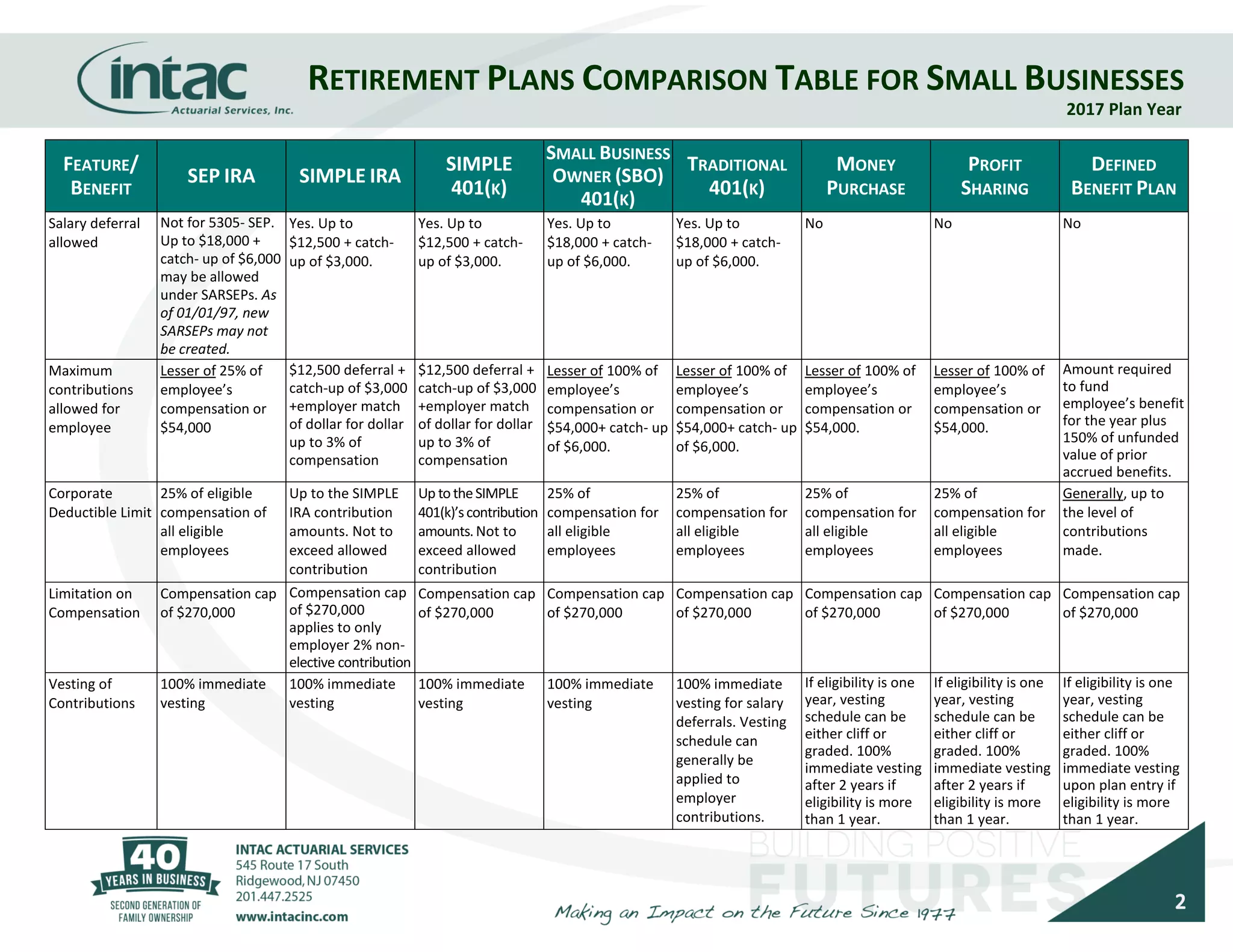
Comparison of Small Business Retirement Plans
| Plan Type | Best For | Employer Contribution | Administrative Burden | Employee Deferrals |
|---|---|---|---|---|
| SEP IRA | Solopreneurs & very small teams | Discretionary (must be equal % for all) | Very Low | No |
| Solo 401(k) | Owners with zero employees | Discretionary (as employer) | Low | Yes (up to employee limit) |
| SIMPLE IRA | Businesses with <100 employees | Mandatory (Match or Non-elective) | Moderate | Yes |
| Small Business 401(k) | Growing companies seeking top talent | Optional (Safe Harbor makes testing easier) | Moderate to High | Yes |
| Defined Benefit Plan | High earners wanting maximum deductions | Mandatory (Actuarially determined) | Very High | Optional (depending on design) |
Frequently Asked Questions
What is the absolute cheapest retirement plan to set up for a small business?
The SEP IRA and Solo 401(k) are generally the least expensive plans to establish and maintain. Many major financial institutions and brokerages offer SEP IRAs and Solo 401(k)s with zero setup fees and no annual administrative maintenance charges, charging only standard investment management fees for the underlying mutual funds or exchange-traded funds.
Can I have both a SEP IRA and a Traditional IRA?
Yes, you can contribute to both a SEP IRA and a traditional individual IRA, but your combined contributions are subject to IRS annual limits. Furthermore, if your income exceeds certain thresholds, your ability to deduct traditional IRA contributions may be phased out if you are covered by an employer-sponsored retirement plan like a SEP.
What happens to employee accounts if I close my small business?
If you close your business, you must formally terminate the retirement plan. Employees retain 100% of the vested funds in their accounts. They can choose to roll over their balances into a traditional IRA, a Roth IRA, or a new employer's retirement plan without facing immediate income taxes or early withdrawal penalties.
Are there tax credits available for small businesses starting a retirement plan?
Yes. Under federal legislation, eligible small businesses with 100 or fewer employees can qualify for tax credits that offset a significant portion of the ordinary administrative costs of starting and maintaining a new 401(k), SIMPLE IRA, or SEP plan for the first three years.
How do I choose between a SIMPLE IRA and a Safe Harbor 401(k)?
A SIMPLE IRA is typically better if you want lower administrative costs and are comfortable with mandatory matching or 2% non-elective contributions for employees. A Safe Harbor 401(k) is preferable if you want higher contribution limits, desire the flexibility of Roth options, and are willing to manage slightly higher recordkeeping responsibilities in exchange for passing IRS nondiscrimination tests automatically.
Next Steps for Business Owners
Evaluating your cash flow stability, employee headcount, and personal retirement goals is the necessary first step before committing to a plan provider. Consult with a certified public accountant (CPA) or a fee-only financial planner who specializes in small business structures to verify your current tax bracket, review your projected payroll expenses, and select a plan that keeps your business compliant while accelerating your wealth accumulation.