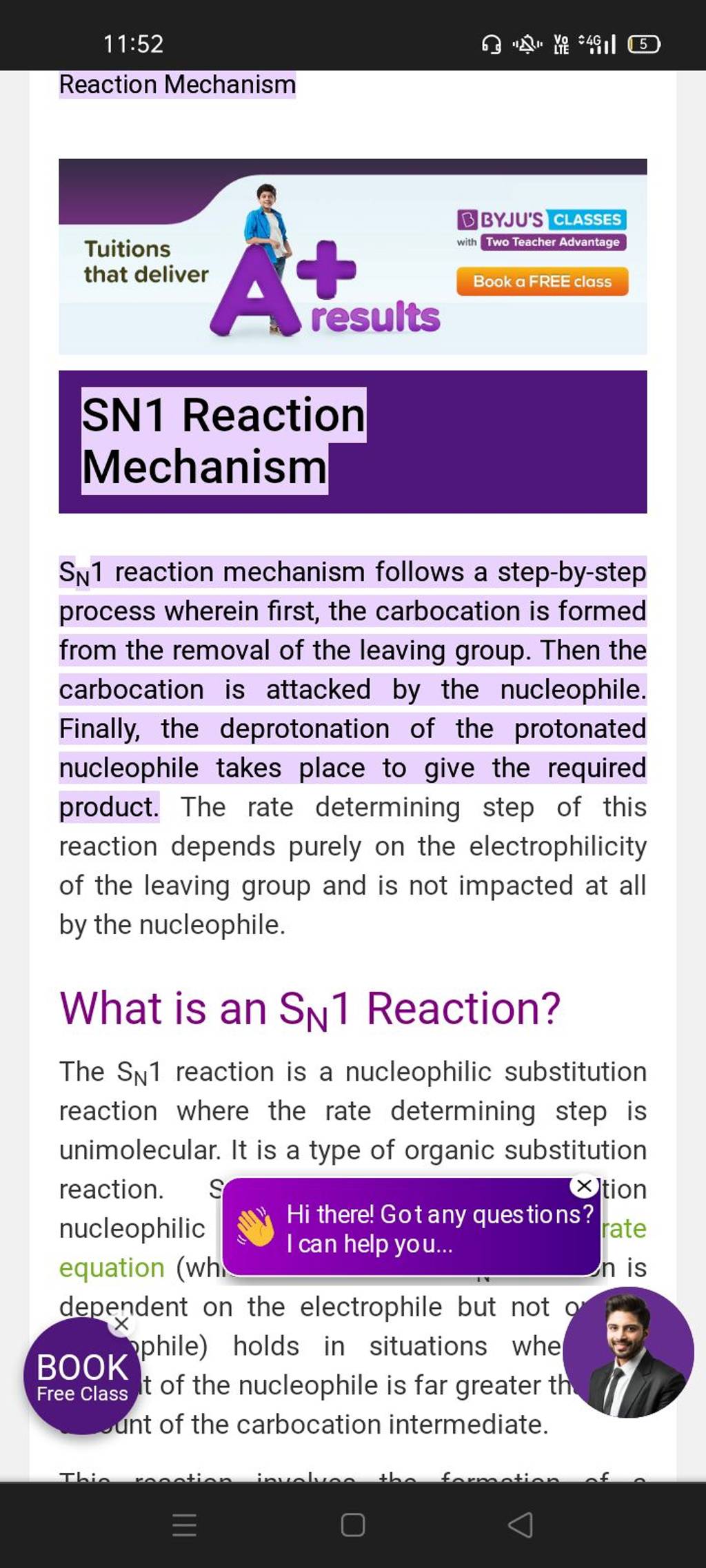
The SN1 reaction rate law is mathematically expressed as Rate = k[Substrate], signifying a first-order kinetic relationship. This unimolecular nature indicates that the reaction velocity depends exclusively on the concentration of the electrophilic substrate, while the concentration of the nucleophile has no measurable effect on the initial rate of the reaction.
The SN1 reaction, or Unimolecular Nucleophilic Substitution, represents one of the foundational pathways in organic chemistry. As we examine chemical kinetics in 2026, the SN1 mechanism remains a critical model for understanding how molecular structure and environment dictate the speed and outcome of chemical transformations. Unlike its bimolecular counterpart (SN2), the SN1 process is characterized by a multi-step sequence where the "bottleneck"—or rate-determining step—involves only a single molecular species.
To fully grasp the SN1 reaction rate law, one must look beyond the simple formula and explore the energetic barriers, intermediate stabilities, and environmental variables that define this pathway.
The Mathematical Foundation: Deriving the Rate Equation
In chemical kinetics, the rate law is an expression that relates the rate of a reaction to the concentrations of the reactants. For an SN1 reaction, experimental observations consistently show that doubling the concentration of the substrate (usually an alkyl halide) doubles the reaction rate. However, doubling the concentration of the nucleophile results in no change to the rate.
This leads to the first-order rate equation: Rate = k[R-L]
Where:
- Rate is the change in concentration over time.
- k is the specific rate constant for the reaction at a given temperature.
- [R-L] represents the molar concentration of the substrate (alkyl group R attached to leaving group L).
The "1" in SN1 stands for unimolecular, referring to the fact that only one molecule is involved in the transition state of the rate-determining step. This is a frequent point of confusion for students, who may assume the "1" refers to the number of steps or the number of products. In reality, it describes the molecularity of the slowest step in the mechanism.
The Two-Step Mechanism: The Source of Unimolecularity
The reason the nucleophile's concentration does not appear in the rate law is rooted in the reaction's step-wise mechanism. An SN1 reaction typically proceeds through two distinct stages.
Step 1: Formation of the Carbocation (The Rate-Determining Step)
The first step is the spontaneous dissociation of the substrate. The bond between the carbon atom and the leaving group breaks heterolytically, meaning the leaving group takes both electrons from the shared bond. This results in the formation of a positively charged carbocation and a negatively charged leaving group (anion).
This step is highly endothermic because it involves breaking a stable covalent bond and creating a high-energy, unstable intermediate. Because this step has the highest activation energy ($E_a$), it is the slowest part of the reaction. In kinetics, the overall rate of a sequence of steps is governed by the slowest step, known as the Rate-Determining Step (RDS). Since only the substrate is involved in this bond-breaking event, the nucleophile is "waiting on the sidelines," and its concentration is irrelevant to the speed at which the carbocation forms.
Step 2: Nucleophilic Attack
Once the carbocation is formed, it is a potent electrophile. The nucleophile, which may be neutral or negatively charged, quickly reacts with the carbocation to form a new bond. This step is extremely fast and has a low activation energy. Because it occurs so much faster than Step 1, it has no impact on the overall rate law. Even if you have a massive excess of nucleophile, the reaction cannot proceed faster than the initial "waiting period" required for the substrate to ionize.
Factors Influencing the SN1 Reaction Rate
While the rate law depends only on the concentration of the substrate, the rate constant (k) is influenced by several physical and chemical factors. These factors determine how easily the substrate can ionize and how stable the resulting intermediate will be.
1. Substrate Structure and Carbocation Stability
The most significant factor affecting the rate of an SN1 reaction is the structure of the alkyl group. The stability of the carbocation intermediate determines the activation energy of the RDS. According to Hammond’s Postulate, the transition state of an endothermic step resembles the product of that step. Therefore, factors that stabilize the carbocation also stabilize the transition state leading to it, thereby lowering the activation energy and increasing the rate constant ($k$).
Carbocation stability follows the trend: Tertiary ($3^\circ$) > Secondary ($2^\circ$) >> Primary ($1^\circ$) > Methyl
- Inductive Effect: Alkyl groups are electron-donating. In a tertiary carbocation, three alkyl groups help disperse the positive charge by pushing electron density toward the deficient carbon.
- Hyperconjugation: This involves the stabilization of the empty p-orbital of the carbocation through overlap with adjacent C-H sigma bonds. The more adjacent alkyl groups, the more opportunities for hyperconjugation.
In practical terms, primary and methyl substrates almost never undergo SN1 reactions because the resulting carbocations are too high in energy to form under standard conditions. Tertiary substrates, conversely, favor SN1 because the $3^\circ$ carbocation is relatively stable.
2. The Leaving Group Ability
The rate-determining step involves the departure of the leaving group. A "good" leaving group is one that can best stabilize the negative charge it acquires after dissociation. Generally, the best leaving groups are the conjugate bases of strong acids (weak bases).
For example, in the halogen series, the rate of SN1 reaction increases as follows: RF < RCl < RBr < RI
Iodide ($I^-$) is an excellent leaving group because it is a very weak base (the conjugate base of $HI$, a very strong acid) and its large size allows it to polarize and stabilize the negative charge effectively. Conversely, fluoride ($F^-$) is a poor leaving group in SN1 because it is a stronger base and holds its electrons tightly.
3. Solvent Effects: The Power of Polar Protic Solvents
The choice of solvent is paramount in SN1 kinetics. Since the RDS involves the creation of ions (a carbocation and an anionic leaving group), a solvent that can stabilize these ions will significantly accelerate the reaction.
Polar protic solvents (such as water, alcohols, or acetic acid) are ideal for SN1 reactions for two reasons:
- Ion Solvation: These solvents have a high dielectric constant, which reduces the electrostatic attraction between the departing leaving group and the carbocation, making it easier for them to separate.
- Hydrogen Bonding: Protic solvents can form hydrogen bonds with the leaving group anion. This "solvation shell" lowers the energy of the leaving group, effectively pulling it away from the substrate and lowering the activation energy of the RDS.
In contrast, polar aprotic solvents (like DMSO or acetone) do not solvate anions well, which can actually favor the SN2 pathway by leaving the nucleophile "naked" and more reactive.
Stereochemical Consequences and Kinetic Evidence
The SN1 rate law is further supported by the stereochemical outcomes of these reactions. Because the intermediate is a planar, $sp^2$-hybridized carbocation, the nucleophile can attack from either the front or the back with roughly equal probability.
In a pure SN1 mechanism, this leads to racemization—the conversion of an optically active starting material into a racemic mixture (a 50:50 mix of enantiomers). However, in many real-world 2026 laboratory scenarios, we observe "partial racemization with an excess of inversion."
This is explained by the Ion Pair Model. Immediately after the leaving group departs, it remains closely associated with the carbocation as a "contact ion pair." The leaving group physically blocks one side of the carbocation, forcing the nucleophile to attack from the opposite side. If the nucleophile attacks quickly before the leaving group diffuses away, inversion of configuration is favored. This nuance does not change the rate law ($Rate = k[Substrate]$), but it provides deep insight into the microscopic behavior of molecules during the unimolecular process.
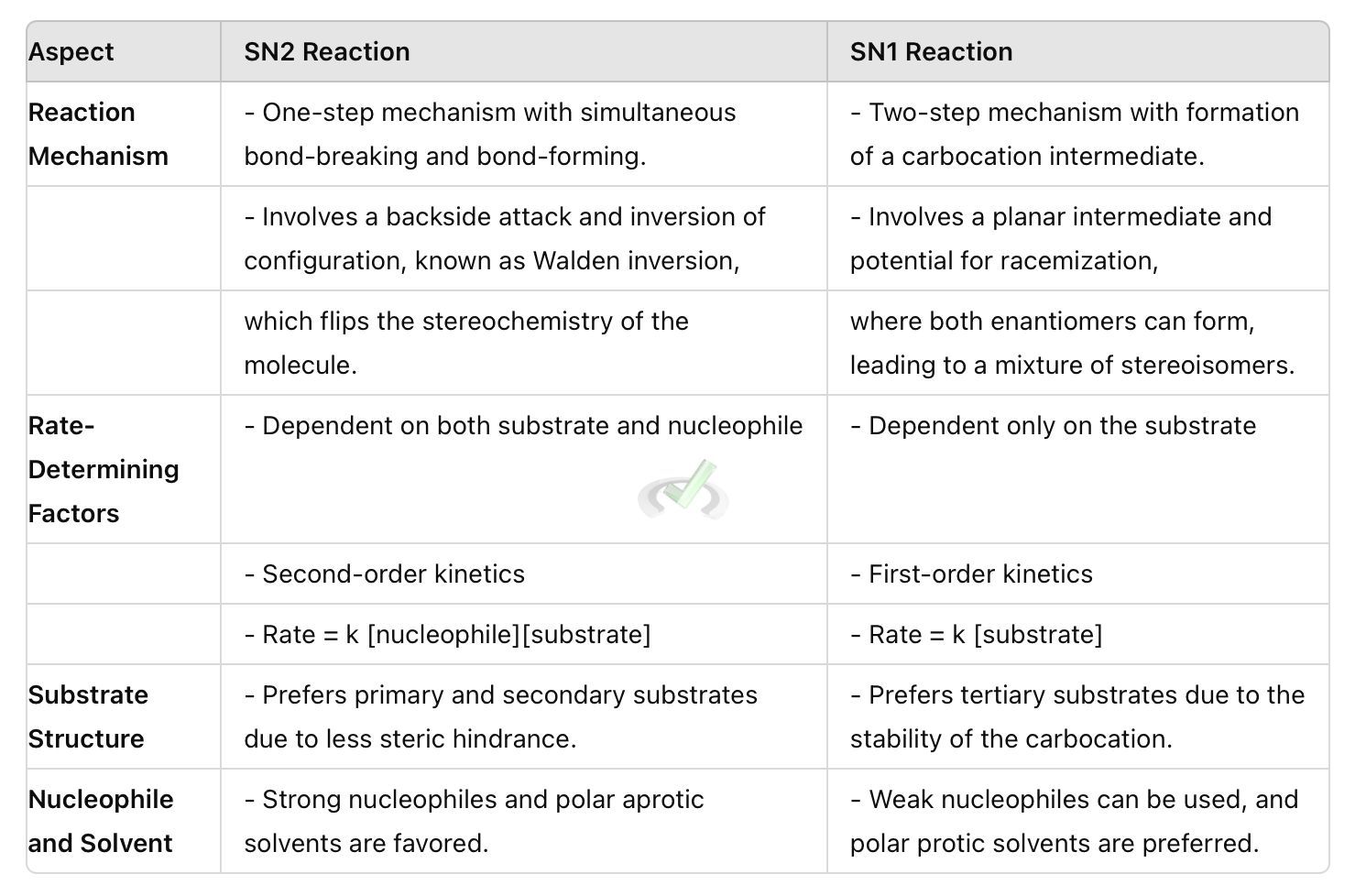
Comparison: SN1 vs. SN2 Kinetics
To understand the SN1 rate law fully, it is helpful to contrast it with the SN2 (Bimolecular Nucleophilic Substitution) mechanism.
| Feature | SN1 Reaction | SN2 Reaction |
|---|---|---|
| Rate Law | Rate = k[Substrate] | Rate = k[Substrate][Nucleophile] |
| Order of Reaction | 1st Order (Unimolecular) | 2nd Order (Bimolecular) |
| Mechanism | Multi-step (Intermediate formed) | Single-step (Concerted) |
| Rate-Determining Step | Substrate ionization | Nucleophile-Substrate collision |
| Substrate Preference | $3^\circ > 2^\circ$ (1°/Methyl rare) | Methyl $> 1^\circ > 2^\circ$ (3° rare) |
| Nucleophile Strength | Weak (often the solvent) | Strong (required) |
| Solvent Preference | Polar Protic | Polar Aprotic |
| Stereochemistry | Racemization (Scrambling) | Stereospecific (Inversion) |
Practical Challenges in Determining SN1 Rates
In a laboratory or industrial setting, measuring the rate of an SN1 reaction requires precise control over environmental variables. Because the reaction rate is so sensitive to the solvent and the temperature, researchers must use thermostatic baths to maintain a constant $k$.
A common complication is the solvolysis reaction. This occurs when the solvent itself acts as the nucleophile (e.g., a reaction in pure ethanol). In solvolysis, the concentration of the nucleophile (the solvent) is so large that it effectively remains constant throughout the reaction. Even though the mechanism is unimolecular, the sheer abundance of the solvent can make it difficult to distinguish from other pathways without careful kinetic isotope effect (KIE) studies or varying the substrate structure.
Furthermore, rearrangements can occur during SN1 reactions. Since a carbocation intermediate is formed, it may undergo hydride or methyl shifts to achieve a more stable state (e.g., a $2^\circ$ carbocation rearranging to a $3^\circ$ carbocation). These rearrangements can alter the expected product distribution, although they do not change the initial rate law which is determined by the formation of the first carbocation.
Frequently Asked Questions
Why does the nucleophile not affect the SN1 rate?
The nucleophile is not involved in the rate-determining step. The slowest part of the reaction is the "waiting time" for the substrate to spontaneously break apart into a carbocation. Because the nucleophile only reacts after this slow step has already occurred, adding more nucleophile cannot speed up the overall process.
Can a primary alkyl halide ever undergo an SN1 reaction?
In standard liquid-phase organic chemistry, primary alkyl halides almost never undergo SN1 reactions because the primary carbocation is too unstable. However, if the primary carbon is adjacent to a double bond (allylic) or a benzene ring (benzylic), the resulting carbocation can be stabilized by resonance, allowing the SN1 pathway to proceed.
How does temperature affect the SN1 rate law?
While temperature does not change the form of the rate law (it remains first-order), it significantly increases the rate constant (k). According to the Arrhenius equation, a small increase in temperature provides more molecules with the energy required to overcome the activation energy barrier of the rate-determining step, leading to a much faster reaction.
What is the difference between molecularity and order of reaction in SN1?
In the context of SN1, molecularity refers to the number of molecules involved in the transition state of the single rate-determining step (which is one). The order of reaction is an experimentally determined value that describes how the rate depends on concentration. For SN1, both the molecularity and the overall reaction order are one.
Does the concentration of the leaving group affect the rate?
Initially, no. However, as the reaction progresses, the concentration of the leaving group (anion) increases. In some cases, the leaving group can compete with the nucleophile to re-attack the carbocation (the "common ion effect"), which can slow down the net rate of product formation, though the initial rate law remains $Rate = k[Substrate]$.
Next Steps for Mastery
To master the SN1 reaction rate law, practitioners should move from theoretical formulas to predictive application. Start by practicing the identification of "SN1-friendly" conditions: look for tertiary substrates, weak nucleophiles (like $H_2O$ or $MeOH$), and polar protic solvents.
When analyzing a reaction in a 2026 lab setting, always check for the possibility of carbocation rearrangements, as these are the hallmark of a mechanism governed by the SN1 rate law. For those moving into advanced synthesis, understanding how to manipulate the rate constant $k$ through solvent engineering provides a powerful tool for controlling complex chemical transformations.