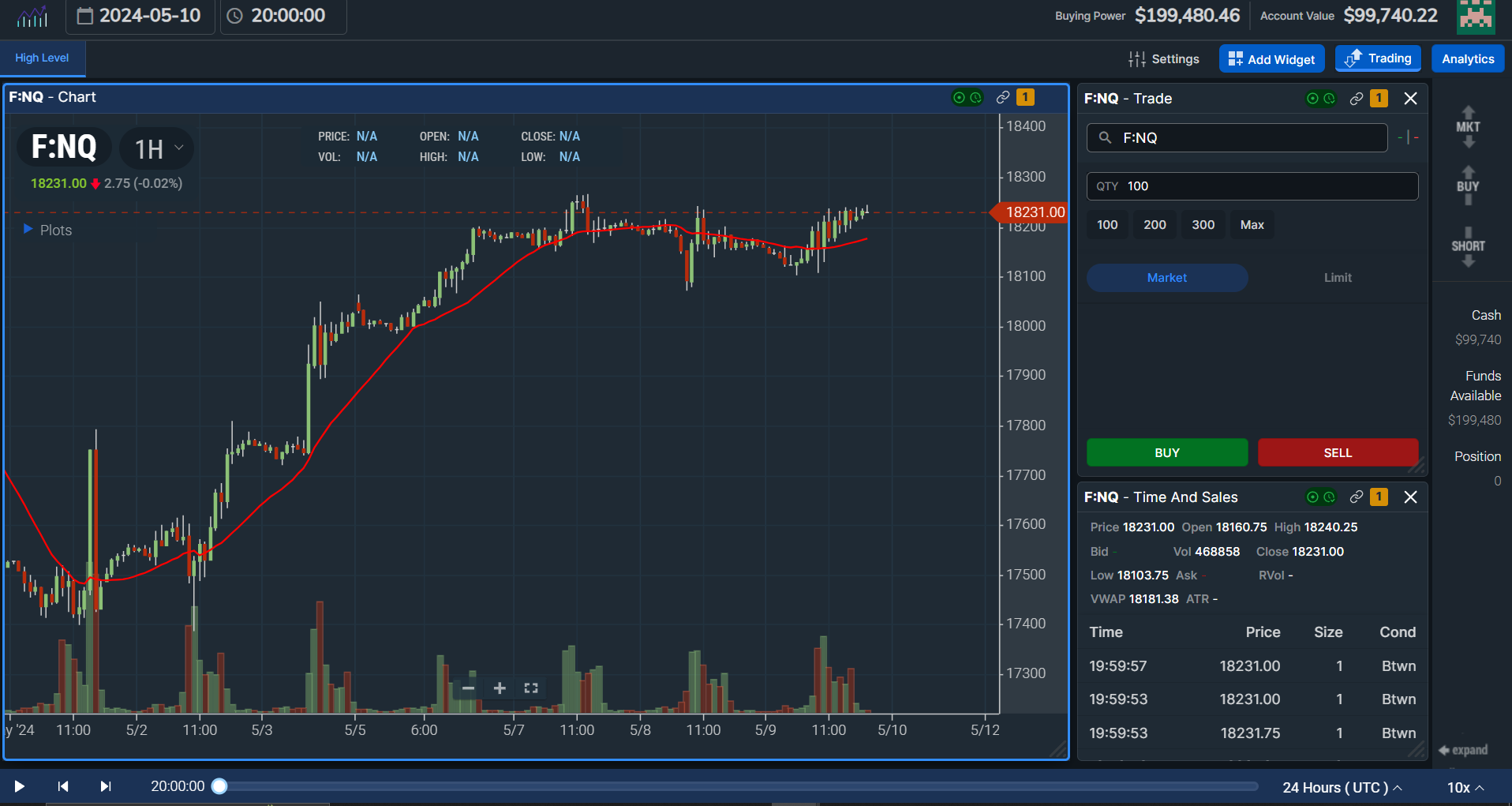
The E-mini Nasdaq-100 contract is a popular equity index futures product traded on the Chicago Mercantile Exchange representing one-fifth of the value of the standard Nasdaq-100 index futures contract. It allows market participants to speculate on or hedge the performance of the 100 largest non-financial companies listed on the Nasdaq stock market with lower capital requirements than standard contracts.
Introduction to E-mini Nasdaq-100 Futures
The financial derivatives landscape offers numerous instruments for institutional and retail market participants seeking exposure to major equity benchmarks. Among these, index futures play a critical role in price discovery, hedging, and directional speculation. Developed to democratize access to institutional-grade index trading, the E-mini Nasdaq-100 contract—traded under the ticker symbol NQ on the Chicago Mercantile Exchange (CME)—has evolved into one of the most heavily traded financial futures contracts globally.
Understanding the mechanics, specifications, margin requirements, and operational characteristics of a single E-mini Nasdaq-100 contract is essential for anyone looking to incorporate index futures into a broader portfolio strategy. Because futures trading involves leverage, marking-to-market accounting, and expiration cycles distinct from equities or exchange-traded funds (ETFs), traders must master the foundational specifications before committing capital.
Underlying Index and Market Composition
To comprehend the behavior of the E-mini Nasdaq-100 contract, one must examine its underlying benchmark: the Nasdaq-100 Index.
What is the Nasdaq-100 Index?
The Nasdaq-100 is a modified market-capitalization-weighted index composed of 100 of the largest non-financial domestic and international securities listed on the Nasdaq Stock Market. Unlike the broader Nasdaq Composite Index—which includes all common stocks, ADRs, and tracking stocks listed on the exchange—the Nasdaq-100 focuses specifically on industry leaders across technology, retail, telecommunications, biotechnology, healthcare, and transportation.
Sector Weightings and Concentration
The index is heavily weighted toward the technology sector, notably encompassing mega-cap software, semiconductor, hardware, and internet services giants. While this sector concentration gives the Nasdaq-100 its characteristic high-growth profile and elevated volatility compared to broad-market indices like the S&P 500, it also means the E-mini Nasdaq-100 contract reacts sharply to earnings reports, regulatory announcements, and macroeconomic shifts affecting major technology corporations.
Core Contract Specifications
Trading E-mini Nasdaq-100 futures requires strict familiarity with the official contract specifications established by the CME Group. Every numerical value associated with the contract dictates the financial exposure and profit-and-loss calculation for a single open position.
| Contract Feature | Specification Details |
|---|---|
| Exchange | Chicago Mercantile Exchange (CME) |
| Ticker Symbol | NQ |
| Contract Size | $20 multiplied by the Nasdaq-100 Index |
| Minimum Price Fluctuation (Tick Size) | 0.25 index points = $5.00 per contract |
| Trading Hours | Sunday 5:00 PM – Friday 4:00 PM CT (with daily maintenance halts) |
| Contract Months | March, June, September, December (Quarterly cycle) |
| Settlement Type | Cash-settled |
| Last Trading Day | Morning of the third Friday of the contract month |
Contract Multiplier and Dollar Value per Tick
The multiplier for the standard E-mini Nasdaq-100 contract is $20. This means if the Nasdaq-100 Index is trading at 18,000, the notional value of a single contract is 18,000 multiplied by $20, which equals $360,000.
The minimum price movement, known as a "tick," is 0.25 index points. Because the multiplier is $20, a single 0.25-point tick change equals $5.00 per contract (0.25 × $20). If the index moves by a full 1.00 point, the value of the contract changes by $20.
Margin Requirements and Leverage Mechanics
One of the primary attractions of the 1 E-mini Nasdaq-100 contract is capital efficiency through leverage. However, leverage is a double-edged sword that magnifies both gains and losses.
Initial Margin vs. Maintenance Margin
Futures do not require full capitalization of the notional value. Instead, brokers require traders to deposit and maintain performance bond margins:
- Initial Margin: The capital amount required to open a new position in 1 E-mini Nasdaq-100 contract. This amount is set by the clearing house (CME) and adjusted based on market volatility, though individual brokerage firms may enforce higher internal margin minimums.
- Maintenance Margin: The minimum equity balance a trader must maintain in their account while the position remains open. If market movements cause the account equity to fall below the maintenance margin level, the broker issues a margin call requiring an immediate deposit of funds or mandatory liquidation of the position.
Intraday vs. Overnight Margins
Many retail futures brokers offer reduced intraday margin rates for traders who square off their positions before the end of the trading session. While overnight holding requirements demand the full CME-mandated maintenance margin, intraday margins can be significantly lower, allowing smaller accounts to trade the NQ contract during active market hours. Traders must verify specific margin policies with their respective Futures Commission Merchant (FCM).
Trading Hours and Liquidity Profiles
The E-mini Nasdaq-100 contract trades nearly 23 hours a day, five days a week, providing exceptional flexibility for risk management and global participation.
Globex Trading Schedule
Trading opens on Sunday evening at 5:00 PM Central Time (CT) and runs through Friday afternoon at 4:00 PM CT. The trading day features a brief daily maintenance halt from 4:00 PM CT to 5:00 PM CT.
Peak Liquidity Windows
While liquidity persists throughout the globex session, volume and tightness of bid-ask spreads peak during regular US cash equity market hours (9:30 AM to 4:00 PM Eastern Time). Secondary liquidity spikes often occur during European morning hours and around major macroeconomic data releases, such as US employment reports, Federal Reserve rate decisions, and Consumer Price Index (CPI) announcements.
Expiration Cycles and Contract Rollover
Unlike equities, which can be held indefinitely, futures contracts have expiration dates. The E-mini Nasdaq-100 follows a quarterly expiration cycle.
Contract Months
Contracts expire in the quarterly months of March (H), June (M), September (U), and December (Z). For example, the September contract is designated as NQ U.
The Rollover Process
As a contract approaches its expiration date, trading volume and open interest migrate from the front-month contract to the next contract in the quarterly cycle (the back month). Traders holding open positions past the last trading day must execute a "rollover"—simultaneously closing the expiring contract and opening a position in the new contract month—to maintain continuous market exposure without taking physical delivery (though NQ is cash-settled, holding past expiration results in automatic cash settlement).
Micro E-mini Nasdaq-100 (MNQ) as an Alternative
For market participants who find the capital requirements or risk parameters of a single standard E-mini Nasdaq-100 contract too large, the CME offers a smaller alternative: the Micro E-mini Nasdaq-100 (MNQ).
| Feature | E-mini Nasdaq-100 (NQ) | Micro E-mini Nasdaq-100 (MNQ) |
|---|---|---|
| Multiplier | $20 per index point | $2 per index point |
| Tick Size | 0.25 points ($5.00) | 0.25 points ($0.50) |
| Notional Size (at 18,000 Index) | $360,000 | $36,000 |
| Primary Use Case | Institutional hedging, active funded accounts | Retail scaling, precise risk management, smaller accounts |
The Micro E-mini contract shares the exact same price action, settlement rules, and trading hours as the standard NQ contract, but its multiplier is one-tenth the size ($2 per point instead of $20). This allows traders with smaller capital bases to practice risk management, test strategies, and scale positions incrementally.
Common Mistakes and Risk Management Strategies
Trading futures contracts requires disciplined risk management due to the presence of leverage and daily mark-to-market settlements.
Overleveraging Small Accounts
The most frequent error made by retail participants is trading too many contracts relative to their total account equity. Even a minor adverse price movement can trigger a margin call or wipe out an undercapitalized account. Utilizing position sizing rules—such as risking no more than 1% to 2% of total capital on a single trade—helps preserve longevity in the markets.
Ignoring Execution Costs and Commissions
Active day trading in E-mini Nasdaq-100 contracts incurs transaction costs, including exchange fees, clearing fees, and broker commissions. Scalpers and high-frequency traders must account for these friction costs when calculating net profitability.
Failing to Account for Overnight Risk
Holding NQ contracts overnight exposes the trader to gap risk—situations where the market opens significantly higher or lower the next morning due to overnight news, international market developments, or geopolitical events. Using stop-loss orders during regular trading hours does not protect against overnight price gaps.
Frequently Asked Questions
What is the exact dollar value of one tick on an E-mini Nasdaq-100 contract?
One tick on a standard E-mini Nasdaq-100 contract (NQ) is 0.25 index points. Because the contract multiplier is $20 per index point, a single tick equals $5.00. For the Micro E-mini Nasdaq-100 (MNQ), which uses a $2 multiplier, a single tick equals $0.50.
How much capital is required to trade 1 E-mini Nasdaq-100 contract?
The capital required depends on your broker's margin requirements and whether you are trading intraday or holding overnight. While the CME sets baseline maintenance margin requirements, brokers often require higher initial margins. Overnight margins typically run in the thousands of dollars, whereas intraday margins can be lower depending on broker policies.
Are E-mini Nasdaq-100 futures cash-settled or physically delivered?
E-mini Nasdaq-100 futures are cash-settled contracts. Upon expiration, open positions are settled in cash based on the Special Opening Quotation (SOQ) of the Nasdaq-100 Index on the third Friday of the contract month, meaning no physical shares of stock change hands.
Can I trade E-mini Nasdaq-100 contracts outside of regular stock market hours?
Yes. The E-mini Nasdaq-100 trades nearly 23 hours a day on the CME Globex platform, starting Sunday evening at 5:00 PM CT and closing Friday afternoon at 4:00 PM CT. This includes overnight and pre-market sessions, though liquidity is highest during regular US cash equities hours.
What is the difference between NQ and MNQ contracts?
NQ is the standard E-mini Nasdaq-100 contract with a $20 multiplier per index point, while MNQ is the Micro E-mini Nasdaq-100 contract with a $2 multiplier (one-tenth the size). Both track the exact same index and share identical expiration cycles, but MNQ allows for smaller position sizing and finer risk control.
Conclusion and Next Actions
Mastering the 1 E-mini Nasdaq-100 contract requires a thorough grasp of its multiplier, tick values, margin mechanics, and expiration schedules. Whether used for hedging an existing equity portfolio or executing short-term directional strategies, the NQ contract offers deep liquidity and efficient market access. To begin trading, ensure your brokerage account is approved for futures trading, review your broker's specific margin and commission schedules, and practice rigorous risk management principles, potentially starting with the smaller Micro E-mini (MNQ) contract to build operational familiarity.