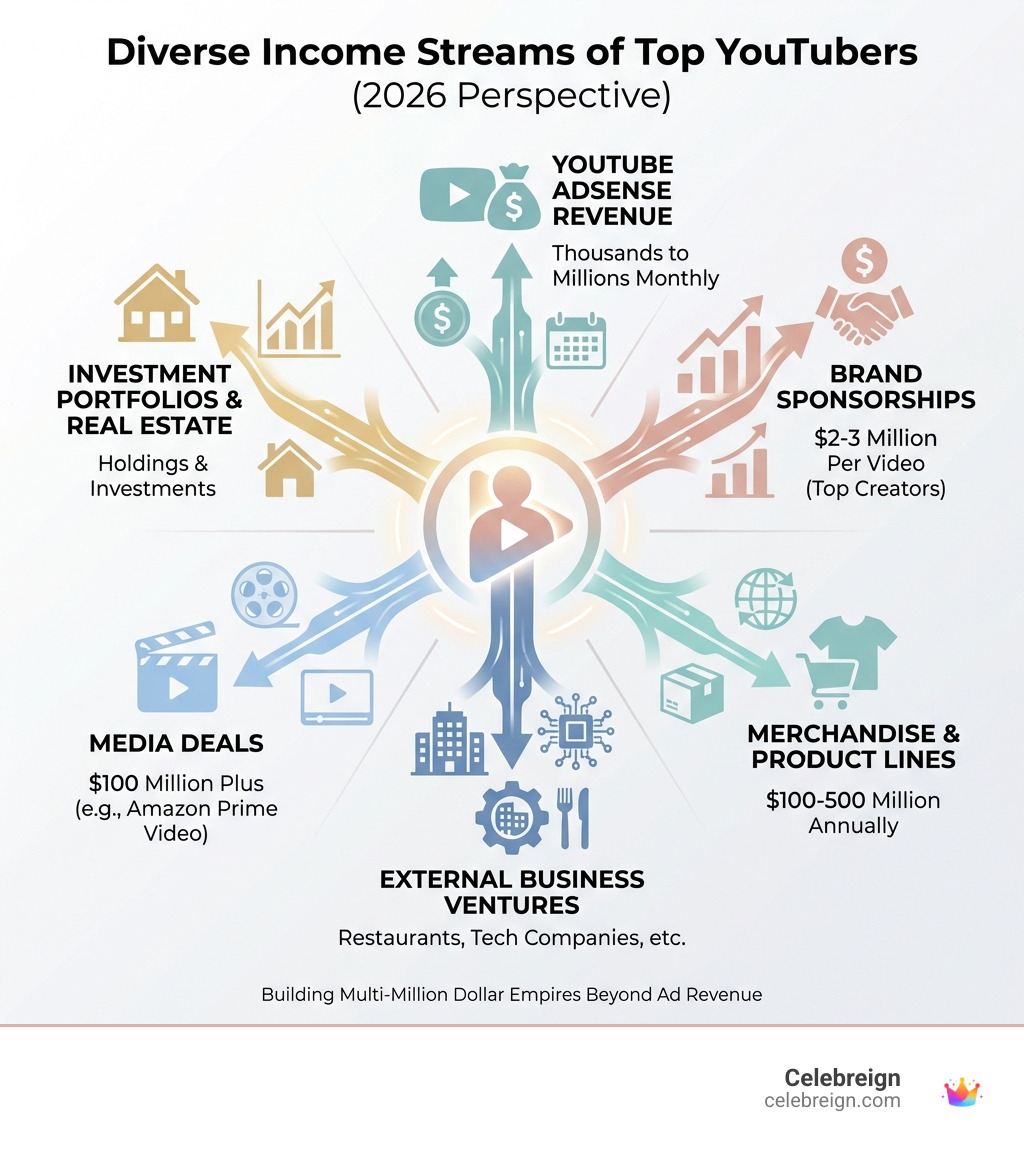
As of 2026, a YouTuber with one million subscribers generally possesses a net worth ranging from $500,000 to $5,000,000. This valuation is rarely a direct result of the subscriber count itself. Instead, it reflects the creator’s ability to leverage that audience through high-RPM niches, diversified revenue streams, and efficient business management.
The "one million subscriber" milestone has long been the gold standard for digital creators, signaling a transition from a hobbyist or solo entrepreneur to a legitimate media entity. However, in the 2026 creator economy, the correlation between subscriber count and net worth has become increasingly decoupled. Understanding the financial reality of these creators requires looking past vanity metrics and into the mechanics of AdSense, brand equity, and operational overhead.
The Subscriber Paradox: Why Numbers Don't Equal Dollars
In the earlier days of the platform, a subscriber was a fairly reliable predictor of views. Today, the algorithm prioritizes individual video performance and viewer interest over subscription status. Consequently, a creator might have one million subscribers but only average 50,000 views per video, while a "trending" creator with 200,000 subscribers might pull in millions of views.
Net worth is an accumulation of assets minus liabilities. For a YouTuber, their "assets" include their cash reserves, the intellectual property of their video library, their equipment, and any spin-off businesses (like merchandise lines or software). Because YouTube income is famously volatile, a creator’s net worth depends heavily on their savings rate and investment strategy rather than just their monthly payout.
The Role of the "Dead" Subscriber
Many channels with one million subscribers are "legacy" channels. These are creators who peaked years ago; their subscriber count remains high because users rarely prune their subscription lists, but their active viewership has dwindled. A legacy creator may have a high net worth from past earnings but a low current income. Conversely, a rapidly growing "rising star" may have high income but hasn't yet had the time to accumulate a high net worth.
Primary Revenue Streams Driving Net Worth in 2026
To understand how a creator reaches a multi-million dollar net worth, one must analyze the five primary pillars of YouTube monetization.
1. YouTube AdSense (RPM and CPM)
AdSense remains the foundation for most creators. In 2026, the industry focuses on RPM (Revenue Per Mille), which is the amount a creator earns per 1,000 views after YouTube takes its cut.
- High-RPM Niches: Finance, Technology, and Real Estate can see RPMs as high as $20 to $50. A creator in this space with one million subscribers and consistent views can earn $500,000 a year from ads alone.
- Low-RPM Niches: Gaming, Comedy, and Vlogs often see RPMs between $1 and $5. These creators must rely on massive volume to match the income of their "Professional" niche counterparts.
2. Brand Sponsorships and Integrated Marketing
For the average million-subscriber creator, sponsorships often surpass AdSense as the largest income source. By 2026, brands have become more sophisticated, moving away from simple "shout-outs" toward multi-video contracts and performance-based equity deals. A creator with a loyal, niche audience can command between $10,000 and $50,000 per integrated video.
3. Affiliate Marketing
Affiliate income provides a passive revenue stream that builds net worth over time. By recommending products through platforms like Amazon Associates or specialized SaaS affiliate programs, creators earn a commission on every sale. For reviewers and "Top 10" channels, affiliate revenue can contribute six figures annually to their bottom line.
4. Direct-to-Consumer (DTC) Products and Merch
The most successful creators in 2026 no longer just sell t-shirts. They launch "creator-led brands." This includes custom software (SaaS), specialized supplements, or physical consumer goods. When a creator owns the supply chain, their profit margins increase significantly, and the business itself becomes a sellable asset that adds millions to their net worth.
5. YouTube Shorts and Multi-Platform Syndication
While Shorts initially offered low payouts, the 2026 monetization model for short-form content has matured. Creators now use Shorts as a "loss leader" to drive traffic to long-form content or digital products. Syndicating content to platforms like TikTok and Instagram also allows for additional brand deals, further inflating the creator's total value.
The Niche Multiplier: Financial Impact of Content Category
The subject matter of a channel is the single greatest predictor of a YouTuber's wealth. Advertisers pay more to reach a 35-year-old looking for investment advice than a 13-year-old looking for Minecraft tips.
| Niche Category | Avg. RPM (2026 Est.) | Primary Revenue Source | Estimated Net Worth Range |
|---|---|---|---|
| Personal Finance / Investing | $30 - $60 | Affiliate (Credit Cards/Brokers) | $2M - $10M |
| B2B Technology / SaaS | $25 - $45 | Software Sponsorships | $1.5M - $7M |
| Lifestyle / Beauty | $8 - $15 | Brand Deals / Own Cosmetics | $1M - $5M |
| Gaming | $2 - $7 | Livestream Donations / Merch | $500K - $3M |
| Entertainment / Pranks | $1 - $4 | High Volume AdSense / Merch | $400K - $2.5M |
Operational Expenses: The Cost of Being a Million-Sub Creator
A high gross income does not always equal a high net worth. As channels grow, so do their "burn rates." Many one-million-subscriber creators operate like small production studios.
Production and Staffing
To maintain the quality expected of a top-tier channel in 2026, creators often employ:
- Video Editors: $50,000 - $100,000/year.
- Thumbnail Designers: $200 - $1,000 per image.
- Research/Scriptwriters: Vital for educational and documentary-style channels.
- Managers/Agents: Usually take a 10% to 20% cut of all brand deals.
Taxes and Legal Structure
Creators earning at this level are essentially small businesses. In the United States, for example, they must navigate Self-Employment Tax and often incorporate as an S-Corp or LLC to protect their personal assets. High-earning creators may lose 30% to 50% of their gross income to federal, state, and local taxes.
Equipment and Software
While a smartphone is enough to start, a million-subscriber channel usually invests in cinema-grade cameras, professional lighting, and high-end server storage for 8K video files. These capital expenditures can total tens of thousands of dollars annually.
Net Worth vs. Liquid Cash
It is a common mistake to assume a YouTuber with a $2 million net worth has $2 million in the bank. Net worth is often tied up in:
- Real Estate: Many creators reinvest their early earnings into property to stabilize their wealth.
- Equity: If a creator has launched a company (like a coffee brand or a production house), the "valuation" of that company contributes to their net worth.
- Retirement Accounts: Diversified stock portfolios (S&P 500, etc.) are standard for creators who have professional financial advisors.
A creator might have a high net worth but experience "cash flow" issues if their views drop suddenly or a major sponsor pulls out. This is why financial literacy has become a major focus for creators in 2026; they are increasingly treating their channels as a "seed engine" for more stable, long-term investments.
The "Exit" Strategy: Selling a YouTube Channel
One of the newest developments in 2026 is the rise of firms that acquire YouTube channels. Historically, a channel was tied to a personality. However, "faceless" or brand-oriented channels can now be sold for multiples of their annual profit (typically 3x to 6x EBITDA). For a channel generating $500,000 in annual profit, an exit could instantly add $2 million to $3 million to a creator's net worth.
Common Mistakes That Erode Creator Wealth
Not every creator with a large following manages to stay wealthy. High-profile "crashes" often stem from:
- Lifestyle Creep: Purchasing luxury cars and mansions based on "peak" earnings rather than average earnings.
- Content Burnout: If the creator is the face of the brand and can no longer film, the income stops immediately.
- Platform Dependency: Relying 100% on YouTube AdSense. If the algorithm changes or a channel is demonetized, the "business" vanishes overnight.
- Tax Neglect: Failing to set aside quarterly tax payments, leading to massive debt to the IRS or relevant tax authorities.
Frequently Asked Questions
Does YouTube pay you a lump sum for reaching one million subscribers? No, YouTube does not provide a monetary bonus for reaching milestones. They provide a Gold Creator Award (a physical plaque) and access to certain support features. All income is earned through the monetization methods mentioned above.
Can a YouTuber with one million subscribers be broke? Yes. If a creator has high production costs, a large staff, and declining views, they can actually lose money. Furthermore, those who do not manage their taxes or who overspend during "viral" periods can find themselves with a high subscriber count but zero net worth.
How much does a YouTuber with 1,000,000 subscribers make per video? It varies by niche and view count. A video that gets 100,000 views might earn $500 in a gaming niche or $5,000 in a finance niche from AdSense alone. With a sponsor included, that single video could earn the creator anywhere from $10,000 to $60,000.
Do Short-form creators with one million subscribers have the same net worth? Generally, no. Creators who reached one million subscribers primarily through YouTube Shorts often have a much lower net worth. This is because Shorts subscribers are less "sticky" and the ad revenue per million views on Shorts is significantly lower than on long-form content.
What is the "average" salary for a YouTuber at this level? There is no "salary," but a healthy million-sub channel usually nets the owner between $150,000 and $600,000 in take-home pay per year after expenses and before taxes.
Practical Recommendation for Aspiring Creators
If you are approaching the one-million-subscriber mark or analyzing this space, focus on diversification. Net worth is built by moving money off the platform. Reinvesting YouTube profits into index funds, real estate, or a separate business entity is the only way to ensure that a platform-wide algorithm change doesn't reset your net worth to zero. Always consult with a certified financial planner (CFP) who understands the unique tax implications of the creator economy.
Note: This article provides financial estimations for educational purposes and does not constitute specific investment or tax advice.