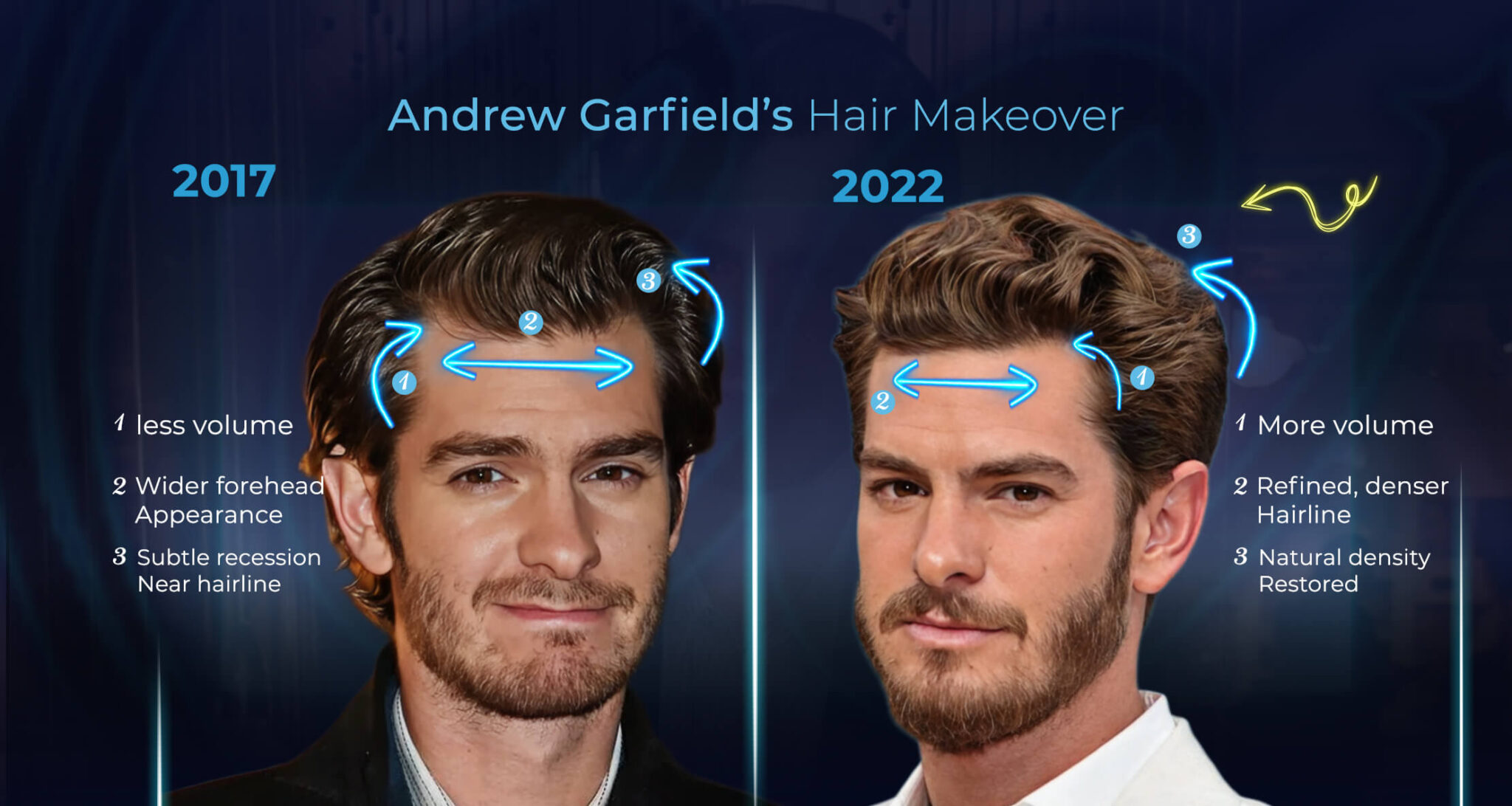
Andrew Garfield’s hair has generated immense public fascination, inspiring endless internet debates, hair transplant rumors, and styling tutorials. The reality behind his iconic, high-volume look is a blend of exceptional natural hair density, a normal mature hairline evolution, strategic celebrity grooming, and cuts tailored to his thick, wavy hair texture rather than cosmetic surgery.
The Andrew Garfield Hair Phenomenon
Few contemporary actors have built as recognizable a signature visual trademark as Andrew Garfield has with his hair. From his breakout performance as Eduardo Saverin in The Social Network (2010) to his towering quiff as Peter Parker in The Amazing Spider-Man (2012) and his wild, curly texture portraying Jonathan Larson in tick, tick... BOOM! (2021), Garfield's hair has consistently stood out for its remarkable density, height, and versatility.
In Hollywood, where male hair preservation is fiercely scrutinized and cosmetic interventions are commonplace, hair that retains exceptional thickness past an actor's late 30s and into his 40s frequently sparks intense curiosity. Fans and cosmetic observers often ask whether such gravity-defying volume is the result of fortunate genetics, hidden hair restoration procedures, intricate movie-set styling tricks, or specialized pharmaceutical routines.
Understanding what makes Andrew Garfield's hair work requires separating celebrity gossip from established trichological principles and professional styling realities.
Myth vs. Reality: Debunking the Rumors
Online forums dedicated to hair loss and celebrity aesthetics frequently dissect images of Garfield across different decades. Disentangling popular internet myths from verified facts highlights how hair density, styling, and natural aging interact.
- Genetics & Density
- Natural Mature Hairline (Temporal Recession ≠ Baldness)
- Professional Styling (Pre-styling + Directional Blow-Drying)
- Iconic Hollywood Volume
Myth 1: Andrew Garfield Had a Surgical Hair Transplant
- The Rumor: Persistent online claims suggest that subtle shifts in Garfield’s temporal hairline around 2015 to 2018 were corrected via Follicular Unit Extraction (FUE) or Follicular Unit Transplantation (FUT).
- The Reality: There is no evidence or verified record indicating Andrew Garfield has undergone hair transplant surgery.
- Trichological Insight: What online observers often mistake for early hair restoration is the standard transition from a juvenile hairline to a mature hairline. Between ages 17 and 30, roughly 96% of Caucasian men experience mild hairline maturation, where the temporal corners recede slightly higher (typically 1 to 2 centimeters above the upper forehead crease) without progressing to androgenetic alopecia (pattern baldness). Garfield’s donor density, temporal points, and hair whorl patterns show natural, continuous growth lines rather than the specific linear patterns or micro-graft distributions typical of hair transplant procedures.
Myth 2: His Hair Volume Is Artificially Created with CGI or Toupees in Movies
- The Rumor: Viewers of The Amazing Spider-Man series often speculated that his massive vertical hair height was enhanced using digital effects, hairpieces, or hidden extensions to give Peter Parker a stylized comic-book silhouette.
- The Reality: Film production notes and onset grooming reports confirm that Garfield’s volume in these roles is entirely his natural hair, shaped through high-performance styling products and thermal tools.
- Grooming Insight: Celebrity hairstylists working on high-budget films use structured blow-drying techniques, pre-styling root lifters, and matte texturizing clays. Combined with Garfield's naturally high follicular density (the number of hairs per square centimeter of scalp), professional styling easily achieves dramatic vertical lift without requiring artificial hair system overlays.
Myth 3: Secret "Miracle" Growth Formulas Are Behind His Thickness
- The Rumor: Social media clips often attribute his hair density to exotic oils, secret celebrity serums, or unproven holistic remedies.
- The Reality: Hair density is predominantly determined by genetics, hormone sensitivity, and overall scalp health.
- Biomedical Insight: Research published through the National Center for Biotechnology Information (NCBI) demonstrates that hair follicle density and hair shaft diameter are largely governed by genetic factors, specifically androgen receptor sensitivity and hereditary follicle programming. While proper scalp care and nutrition maintain existing hair health, no cosmetic product can multiply the total number of native hair follicles a person possesses. Garfield has noted in interviews that thick hair runs in his family, crediting genetics over magical products.
Myth 4: Any Change in Hair Line Indicates Imminent Hair Loss
- The Rumor: Photos showing Garfield’s forehead under harsh red-carpet lighting or pulled-back theatrical styles have periodically led bloggers to claim his hair is thinning rapidly.
- The Reality: Variations in lighting, hair length, parting direction, and wet-versus-dry styling dramatically alter the visual perception of scalp visibility.
- Trichological Insight: High-contrast studio lighting penetrates finer or lighter hair sections easily, making normal hair partings look sparse on camera. Garfield’s overall mid-scalp and crown density remain consistently thick, illustrating that temporary visual exposure of the scalp under bright lights is not a reliable indicator of miniaturization or progressive hair loss.
Evolution of Andrew Garfield’s Hair and Roles
Throughout his career, Garfield’s hair has adapted to suit a wide range of dramatic characters and historical periods, demonstrating the flexibility of high-density hair.
| Era / Project | Hair Evolution |
|---|---|
| 2010: The Social Network | Textured, medium-length casual waves |
| 2012-2014: Spider-Man Era | High-standing quiff with structured volume |
| 2016-2018: Period & Stage | Grown-out, natural, un-styled curls/waves |
| 2021: tick, tick... BOOM! | Mid-length, high-texture curly top |
| 2024-2026: Mature Era | Refined, tailored classic crop with natural lift |
Early Career and The Social Network (2010)
In David Fincher's The Social Network, Garfield portrayed Eduardo Saverin with a classic, medium-length layer cut. His hair exhibited natural texture and soft wave patterns. This style highlighted high hair density without relying on heavy structural products, establishing his natural hairline baseline prior to major franchise styling.
The Amazing Spider-Man Era (2012–2014)
Garfield’s portrayal of Peter Parker introduced what became one of the most famous hair trends of the 2010s: a voluminous, textured quiff standing several inches tall. Achieving this look required creating a solid foundation at the roots using root-activating sprays, blow-drying against the natural growth direction, and sealing the shape with matte finish pomades to retain structure during physically intensive stunt work.
Period Dramas and Stage Work (2016–2018)
For roles in Martin Scorsese’s Silence (2016) and Mel Gibson’s Hacksaw Ridge (2016), as well as the broadway revival of Angels in America (2018), Garfield moved away from high-standing quiffs. His hair was allowed to grow longer, showing off its natural wave patterns, cowlicks, and dynamic movement. These longer styles demonstrated that his hair volume was not an artifact of short, stiff cuts, but an inherent quality of his natural hair structure.
tick, tick... BOOM! and Spider-Man: No Way Home (2021)
In his Oscar-nominated role as composer Jonathan Larson, Garfield wore a full, curly, medium-length style that mirrored Larson’s real-life aesthetic. This style relied on curl-defining cream and diffuser attachments to enhance natural wave separation. Later that year, returning in Spider-Man: No Way Home, he showcased a slightly more mature, controlled variation of his classic Peter Parker style, accommodating natural hairline maturation while keeping his signature lift.
Contemporary Looks (Mid-2020s / 2026 Context)
In recent public appearances, Garfield has adopted refined, tailored cuts that respect his natural hair movement. By keeping the sides neatly trimmed while leaving moderate length on top, his stylists work with his natural hair whorls and mature hairline rather than fighting them, maintaining a sophisticated, age-appropriate aesthetic.
Comparative Analysis: Myths vs. Grooming Realities
To clearly see how public perception compares to actual grooming techniques, consider the following breakdown of Garfield's hair characteristics:
| Speculated Myth | Actual Reality | Trichological / Grooming Explanation | Visual & Contextual Evidence |
|---|---|---|---|
| Surgical Hair Line Restoration (FUE/FUT) | Natural Mature Hairline Progression | The temporal angles recede slightly as part of normal adult male development; follicular grouping remains entirely natural. | Continuous, non-linear hairline growth without characteristic surgical graft patterns. |
| Constant Use of Wigs / Extensions | 100% Native Hair with Professional Pre-Styling | High natural hair density combined with thermal styling tools creates long-lasting vertical lift. | Set footage, behind-the-scenes videos, and unscripted public appearances show identical volume. |
| Genetically Immune to Hair Aging | High Follicular Density with Age-Appropriate Maturation | High hair shaft diameter creates the appearance of extreme volume even as the hairline naturally matures. | Subtle temporal recession visible between age 25 and age 40, typical of normal healthy aging. |
| Effortless "I Woke Up Like This" Hair | Intensive Multi-Step Pre-Styling & Blow-Drying Routine | Heavy, dense hair collapses under its own weight without structured blow-drying and root support. | Red carpet vs. casual paparazzi photography reveals distinct differences between styled and unstyled hair. |
| Single Secret Hair Product | Layered Product Application Strategy | Combining liquid pre-stylers (sea salt/mousse) with dry post-stylers (matte clay/dust) builds structure. | Styling breakdowns shared by celebrity hairstylists working on red-carpet events. |
How to Replicate Garfield’s Signature Volume: A Step-by-Step Blueprint
Men aiming to achieve Andrew Garfield’s classic, gravity-defying volume need to understand that product selection alone is insufficient. High-volume styling relies heavily on mechanical structure, heat control, and working with—not against—natural hair texture.
- STEP 1: Prep & Wet Application (Sea Salt Spray / Volumizing Mousse)
- STEP 2: Directional Blow-Drying (Medium Heat, Root-Lifting with Vent Brush)
- STEP 3: Cold Shot Lock-in (Cool Air to Freeze Hair Shaft Structure)
- STEP 4: Post-Styler Application (Emulsified Matte Clay or Paste at Roots to Mid-Lengths)
- STEP 5: Final Placement & Light Setting Dust (For All-Day Pliable Hold)
1. Hair Type Prerequisites
This styling approach works best for hair that meets specific structural criteria:
- Density: Medium to high hair density.
- Texture: Straight with natural wave, or loose wavy hair.
- Strand Thickness: Medium to coarse hair strands. (Note: Extremely fine or thin hair can still achieve lift using these steps, though the total visual volume will naturally differ.)
2. Essential Tools and Products
To build structural height without weighing the hair down, gather these items:
- Pre-Styler: Sea salt spray or lightweight volumizing mousse.
- Blow Dryer: A dryer equipped with a narrow concentrator nozzle and a dedicated "cool shot" button.
- Brush: A vent brush or small ceramic radial brush.
- Post-Styler: Matte finish hair clay, pliable paste, or texturizing root powder.
3. Step-by-Step Styling Execution
Step 1: Wash and Prepare
Start with clean, towel-dried damp hair. Avoid heavy, oil-rich conditioners if your hair tends to lie flat, as excess oil weighs down the hair shaft near the scalp.
Step 2: Apply the Pre-Styler
Lightly mist sea salt spray evenly from roots to tips, or distribute a golf-ball-sized dollop of volumizing mousse through damp hair. Pre-stylers coat the hair shaft, increasing friction between strands and establishing a firm foundation for blow-drying.
Step 3: Directional Blow-Drying (The Core Volume Step)
Set your blow dryer to medium heat and high airflow. Attach the concentrator nozzle.
- Tilt your head slightly forward or to the side.
- Use your fingers or a vent brush to lift hair upward from the roots, directing the airflow from beneath the hair shaft up toward the tips.
- Dry hair in the opposite direction of its natural growth to force the root upward.
Step 4: Lock in the Lift with the Cold Shot
Once your hair is roughly 90% dry and shaped into its vertical orientation, switch your blow dryer to the cold shot setting. Blow cool air across the roots for 15 to 30 seconds. Cold air cools the keratin bonds in the hair shaft, locking the lifted shape into place.
Step 5: Apply Post-Styler Sparely
Scoop a small pea-sized amount of matte hair clay or texturizing paste. Thoroughly rub and emulsify the product between your palms until it warms up and disappears visually.
- Gently work the product through your hair, starting at the back and moving to the front.
- Focus application on the mid-lengths and roots rather than overloading the tips.
- Use your fingertips to piecify and define individual sections for a natural, effortless texture.
What Men Can Learn From Andrew Garfield’s Approach to Aging and Style
Beyond products and techniques, Andrew Garfield’s public evolution offers valuable aesthetic lessons for men navigating changing hair as they age.
- Adapting to Aging Hair
- Don't Panic: Accept mature hairline maturation as natural.
- Adjust the Cut: Work with density & natural whorls; avoid rigid styles.
1. Distinguish Hairline Maturation from Hair Loss
Many men panic at the first sign of temporal recession around their mid-to-late twenties, assuming it signals impending baldness. Garfield’s hairline shows how a high-density, mature hairline can look strong, masculine, and stylish without requiring aggressive cosmetic intervention.
2. Adapt Your Cuts Over Time
Rather than forcing the exact same haircut for decades, Garfield’s look has evolved. As hairline shapes shift, adjusting the length, parting position, and crown texture keeps hair looking natural and proportionate.
3. Focus on Texture Over Rigidity
Stiff, heavily gelled styles draw attention to sparse areas and rigid hairlines. Garfield’s signature looks rely on matte, touchable textures that allow natural movement, creating a dynamic appearance that hides subtle density variations far better than slicked-down styles.
Frequently Asked Questions
Has Andrew Garfield ever confirmed having a hair transplant?
No. Andrew Garfield has never reported having a hair transplant or cosmetic hair restoration procedure. His hairline changes reflect normal adult temporal maturation, and his high volume stems from strong natural density combined with professional styling.
What is Andrew Garfield's natural hair type?
Andrew Garfield has thick, high-density, naturally wavy (Type 2A/2B) hair with a coarse shaft diameter. This natural texture provides the structural strength required to maintain height and volume when styled.
How did Andrew Garfield get his hair so high in Spider-Man?
His high-standing look in The Amazing Spider-Man was created by movie hair stylists using sea salt pre-styling sprays, directional blow-drying techniques to lift the roots, and matte clays to hold the vertical structure in place during filming.
Can men with fine or thinning hair get Andrew Garfield's hair volume?
Men with fine or thinning hair can use the same blow-drying and pre-styling techniques to maximize their existing density. However, overall hair height depends on native strand thickness and density, meaning results will vary based on individual hair biology.
Does blow-drying hair for high volume cause hair loss?
Proper blow-drying does not cause male pattern baldness, which is driven by genetics and dihydrotestosterone (DHT) sensitivity. However, excessive heat directly on the scalp can cause thermal breakage or dry out hair strands. Always use medium heat settings and hold the dryer several inches away from the scalp.
Key Takeaways and Next Steps
The reality behind Andrew Garfield’s hair comes down to three main factors: strong natural genetics, normal hairline maturation, and expert grooming techniques. Rather than relying on rumored cosmetic procedures or miracle products, his iconic volume is built on sound styling fundamentals.
If you want to enhance your own hair's natural volume:
- Assess your hair type: Determine your density and wave pattern before picking heavy styling products.
- Invest in thermal styling: Use a blow dryer with a concentrator nozzle and a vent brush to build lift at the roots instead of relying solely on heavy pomades.
- Embrace natural maturation: Work with your hairline's natural evolution by updating your cuts and focusing on textured, pliable finishes.