The ancient Roman military was one of the most disciplined, organized, and formidable fighting forces in human history, and its visual symbols were central to maintaining that operational cohesion on chaotic battlefields. These symbols—ranging from the sacred legionary eagle to cohort standards, imperial portraits, and specialized unit badges—served as rallying points, religious icons, command indicators, and markers of tactical alignment across vast operational theaters. Far from being mere decorative flourishes, Roman military insignia were deeply embedded in the religious and psychological fabric of the Roman state, anchoring the morale of the legionaries and broadcasting imperial authority to both allies and adversaries.
The Foundations of Roman Military Heraldry and Symbolism
To understand ancient Roman military symbols, one must first recognize that the Roman army did not possess a modern system of national flags or standardized bureaucratic insignia. Instead, its visual language evolved from religious devotion, tribal traditions, and tactical necessities across the regal, republican, and imperial epochs. The Romans viewed their military hardware and standards as sacred objects (sacra), imbued with divine favor and the collective spirit (genius) of the unit.
Religious devotion permeated every tier of Roman military organization. Standards were housed in the central shrine (aedes) of the camp's headquarters (principia), where they were guarded by priests and senior officers, adorned with garlands on festive days, and anointed with oils. Losing a standard to an enemy was considered an unmitigated disaster and a profound religious sacrilege that brought eternal shame upon the responsible legion. Consequently, the defense of these symbols often spurred desperate, fanatical resistance in combat, transforming pieces of wood, metal, and fabric into ultimate focal points of honor and survival.
The Eagle (Aquila): The Supreme Symbol of the Legion
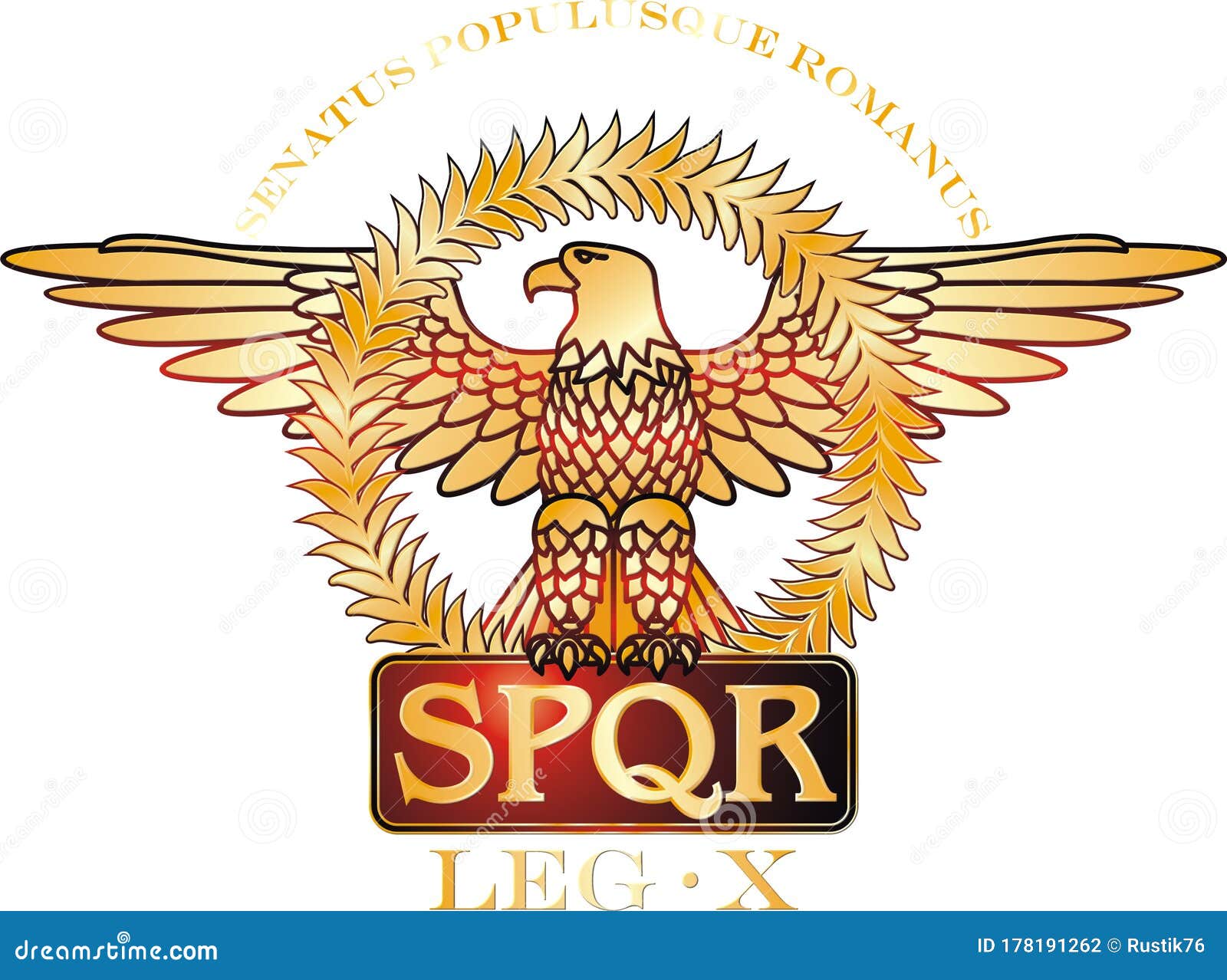
At the pinnacle of Roman military symbolism stood the aquila, or golden eagle. Introduced as the primary symbol of the Roman legion by Consul Gaius Marius during his late 2nd-century BCE military reforms, the aquila replaced a hodgepodge of earlier animal totems, including the wolf, minotaur, horse, and wild boar.
The aquila was carried by the aquilifer, a senior soldier of exceptional bravery who wore an animal skin—frequently a lion, wolf, or bear—over his helmet and armor. This distinctive pelt made the bearer instantly recognizable amid the dust and turmoil of engagement. The aquila itself was constructed of precious metals, typically gold-plated bronze, with its wings outspread and clutching a thunderbolt, symbolizing supreme command, divine sanction, and the might of Jupiter Optimus Maximus.
| Feature / Characteristic | Description / Historical Detail |
|---|---|
| Primary Bearer | Aquilifer (senior enlisted soldier, highly prestigious) |
| Material & Construction | Gold-plated bronze, mounted on a wooden shaft |
| Religious Significance | Sacred object (sacrum); embodiment of legion's spirit |
| Tactical Placement | Center of the battle line; guarded fiercely in combat |
| Consequences of Loss | Total dishonor; potential disbandment of the legion |
Because the eagle represented the living soul and honor of the entire legion, its loss during a campaign was catastrophic. Following disasters like the Teutoburg Forest in 9 CE, where multiple legions were annihilated, subsequent emperors launched decades of military campaigns with the primary strategic objective of recovering the captured eagles.
Sub-Unit Standards: Signa, Imago, and Vexilla
While the aquila belonged to the legion as a whole, smaller sub-units required their own visual markers to maneuver effectively across complex terrains. This decentralized system of standards ensured that cohorts, maniples, and centuries could maintain spatial orientation and tactical cohesion.
The Signum of the Century and Maniple
The signum was the standard carried by the signifer of each century. It consisted of a long wooden pole decorated with a series of metallic discs (phalerae), crescents, and small wreaths, which served as awards for valor earned by the unit. At the very top of the shaft was an open hand (manus), symbolizing the oath of loyalty (sacramentum) taken by the soldiers, or occasionally a small spearhead. The various discs and ornaments allowed commanders and soldiers to read the historical achievements and lineage of that specific century at a glance.
The Imago of the Emperor
During the imperial era, particularly from the reign of Augustus onward, legions added the imago to their standard collection. Carried by the imaginifer, this standard featured a three-dimensional, solid relief portrait of the reigning emperor in precious metal. The inclusion of the imago served a profound political and psychological purpose: it served as a constant reminder of personal allegiance to the commander-in-chief, reinforcing discipline and autocratic loyalty among the troops.
The Vexillum of Cavalry and Detachments
Distinct from the pole-mounted metallic standards, the vexillum was a square or rectangular piece of colored cloth hung from a horizontal crossbar attached to a vertical pole. Typically associated with cavalry units (alae), specialized task forces (vexillationes), and detached legionary elements, the vexillum often displayed the emblem, name, or title of the unit in contrasting embroidery or dye. The word vexillarius designated the soldier entrusted with carrying this fabric banner.
Specialized Insignia: The Draco and the Labarum
As the Roman Empire evolved through late antiquity, its military composition shifted to incorporate auxiliary units, Germanic federates, and cavalry-heavy operational doctrines. This cultural integration introduced new symbolic artifacts into the Roman arsenal.
The Sarmatian Draco (Dragon Standard)
Adopted primarily by cavalry units in the 2nd and 3rd centuries CE—largely influenced by contact with Sarmatian and Dacian horsemen—the draco was a striking windsock-style standard. It featured a metal wolf or dragon head with an open, gaping jaw attached to a long wooden pole. Behind the metallic head trailed a colorful, tube-like silk or fabric body. When the cavalry unit charged at a gallop, the rushing wind inflated the fabric tail, causing it to writhe and hiss, producing an intimidating acoustic and visual effect designed to terrify enemy horses and infantry lines.
The Christian Labarum
Following the conversion of Emperor Constantine I in the 4th century CE, Christian imagery was officially incorporated into Roman military iconography. The labarum was a specialized vexillum that featured the Chi-Rho monogram—the first two letters of Christ's name in Greek—embroidered on a purple banner adorned with gold fringe and precious gems. This transformation marked a monumental shift from traditional Greco-Roman pagan religion to state-sanctioned Christianity as the ideological bedrock of imperial defense.
Shield Designs (Scuta) and Unit Identification
Beyond pole standards, the visual identity of a Roman legionary was prominently displayed on his curved rectangular body shield, the scutum. During the early and middle republic, shield patterns varied widely. However, by the early imperial period, standardized designs emerged, though they retained enough variation to distinguish different legions on the battlefield.
Legionary shields were constructed of glued wooden strips covered in canvas and calfskin, finished with a painted gesso layer. While red was the predominant background color—symbolizing blood, war, and martial vigor—the decorative motifs painted on the front included:
- Wings and Wreaths: Symbols of victory, frequently associated with the goddess Victoria.
- Lightning Bolts (Fulmina): Direct references to Jupiter, highlighting divine strike power and celestial wrath.
- Animal Totems: Vestiges of earlier animal associations, such as bulls, boars, and lions.
These standardized patterns allowed centurions and tribunes to identify friendly formations instantly, preventing friendly fire incidents in melee combat and ensuring that tactical reserves could be deployed precisely where needed.
Comparative Overview of Roman Military Standards
To clarify the distinct functions, personnel, and characteristics of the primary Roman military symbols, the following reference table summarizes their operational roles:
| Standard Name | Primary Bearer | Visual Description | Core Purpose & Function |
|---|---|---|---|
| Aquila | Aquilifer | Gold-plated bronze eagle with outspread wings on a pole | Supreme symbol of legionary honor and divine protection |
| Signum | Signifer | Wooden shaft adorned with metal discs, crescents, and a hand | Rallying point for individual centuries and maniples |
| Imago | Imaginifer | Three-dimensional metal portrait bust of the reigning emperor | Symbolizes direct personal loyalty to the imperial commander |
| Vexillum | Vexillarius | Fabric cloth banner hanging from a horizontal crossbar | Used by cavalry, detachments (vexillationes), and special tasks |
| Draco | Draconarius | Metal dragon/wolf head with an inflated windsock fabric tail | Cavalry standard producing visual intimidation and wind noise |
| Labarum | Designated Bearer | Imperial purple banner bearing the Christian Chi-Rho symbol | Late Roman Christianized standard instituted by Constantine |
Practical Impact on Combat Psychology and Command
The integration of these symbols into daily military life exerted a profound psychological effect on soldiers. Roman military camps (castra) were meticulously planned urban grids where the standards were kept in secure central sanctuaries. Every morning, the changing of the guard and the inspection of the standards reinforced a deep sense of religious duty, routine, and institutional pride.
In the heat of battle, visibility was severely restricted by dust, smoke, body armor, and close-order formations. Soldiers relied on the movement of standards to discern the intentions of higher command. If a signum advanced, the century moved forward; if a vexillum wheeled to the flank, cavalry elements adjusted their vectors accordingly. Consequently, the loss of a standard or the wounding of its bearer could induce panic, signaling to the troops that their tactical anchor was compromised. Conversely, rescuing a dropped standard was often cited in Roman historical accounts as a turning point that snatched victory from the jaws of defeat.
Frequently Asked Questions
What was the most important ancient Roman military symbol?
The aquila (golden eagle) was unquestionably the most important and sacred symbol of a Roman legion. Its loss brought ultimate disgrace, and legions were frequently disbanded if their eagle was captured by an enemy force.
Who carried the legionary eagle in battle?
The eagle was carried by a specialized senior soldier known as the aquilifer. Because of the extreme prestige and danger of this role, the aquilifer wore an animal pelt over his helmet and armor to stand out clearly on the battlefield.
Did Roman shields show which legion a soldier belonged to?
Yes. Legionary shields (scuta) were painted with distinct decorative motifs—such as lightning bolts, wings, wreaths, and specific animal emblems—that identified the soldier's specific legion and distinguished friendly formations from enemies.
What is the difference between a signum and a vexillum?
A signum was a pole-mounted standard featuring metallic discs and an open hand, used by individual centuries and maniples of infantry. A vexillum was a fabric banner suspended from a crossbar, primarily utilized by cavalry units and temporary detached task forces.
How did the introduction of Christianity change Roman military symbols?
Under Emperor Constantine I in the 4th century CE, Christian symbols were integrated into military hardware. The most notable example was the labarum, a banner displaying the Chi-Rho monogram that replaced traditional pagan motifs on imperial standards.
Conclusion and Historical Legacy
Ancient Roman military symbols were far more than battlefield accessories; they were sophisticated instruments of psychological warfare, religious devotion, and tactical coordination. From the golden aquila that anchored a legion's soul to the dynamic draco that terrorized opposing cavalry, these insignia provided the structural framework that enabled the Roman war machine to conquer and hold the Mediterranean world and beyond. Understanding these symbols reveals the intricate blend of superstition, discipline, and engineering that defined the ancient Roman military mind.