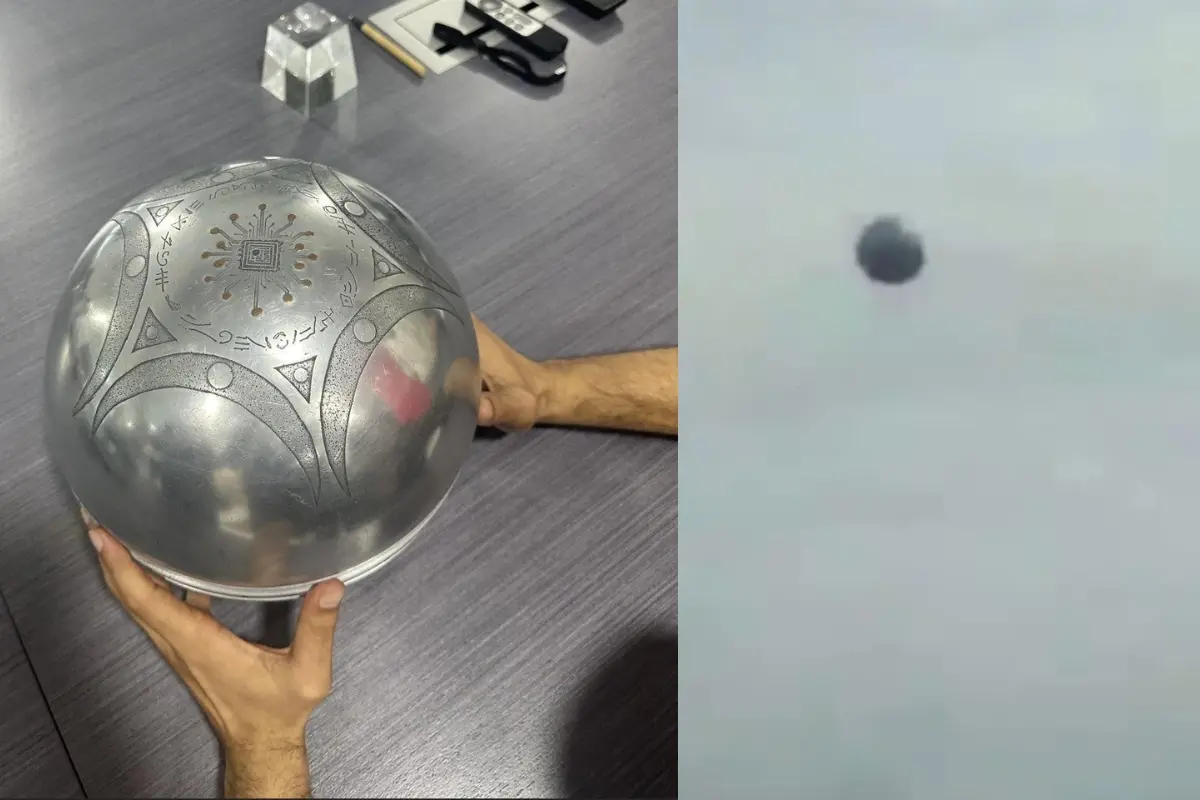
The reports of an "alien sphere found in Colombia" refer to a series of viral social media claims and anecdotal accounts surfacing in recent years concerning a metallic, non-terrestrial object recovered in the Colombian Andes. Currently, there is no peer-reviewed scientific evidence, official government confirmation, or corroborated laboratory analysis confirming the discovery of any extraterrestrial artifact or anomalous metallic sphere within Colombian territory.
The Origin of the Claims
The narrative surrounding an anomalous sphere found in Colombia typically follows a pattern common to modern fringe archaeology and internet-based ufology. These stories often begin with localized rumors in remote rural areas—most frequently citing the rugged, under-explored regions of the Colombian Andes or the Serranía de la Macarena.
The core of these claims rests on the assertion that a spherical object, often described as having highly polished or inexplicable metallic properties, was discovered by local farmers or miners. In these accounts, the object is alleged to possess physical characteristics that defy conventional metallurgy, such as a lack of visible seams, an unnaturally high heat resistance, or a weight that fluctuates in contradiction to its volume. These stories circulate through social media platforms, often accompanied by low-resolution images or videos that lack the necessary metadata or provenance to be independently verified by researchers.
Scientific Methodology for Verification
For an object of such magnitude to be classified as an "alien sphere" or an extraterrestrial artifact, it must pass through a rigorous, multi-stage scientific vetting process. As of 2026, no such object found in Colombia has successfully transitioned from anecdotal report to confirmed scientific anomaly. Researchers and credentialed geologists typically follow a standard protocol when presented with "out-of-place" artifacts:
- Non-Destructive Testing (NDT): This includes X-ray fluorescence (XRF) and computed tomography (CT) scanning. These methods allow researchers to look inside the object without damaging its structural integrity to determine internal density and elemental composition.
- Elemental Analysis: Authentic extraterrestrial material (such as meteorites) exhibits specific isotopic ratios that do not occur on Earth. If an object is found to consist of terrestrial materials—like common alloys of iron, nickel, or titanium—it is deemed man-made or a natural geological formation.
- Contextual Mapping: Archaeology relies on the "context" of a find. A legitimate discovery must be documented in situ (in its original place of deposit). Removing an object from its geological or archaeological context before professional documentation eliminates the ability to verify its age and origin.
Comparing Anomaly Claims to Natural Phenomena
When investigating claims of "alien" or "mysterious" spheres, scientists often identify terrestrial explanations that are frequently mistaken for anomalous artifacts. In the context of Colombian geography and history, these explanations include:
- Geological Concretions: Nature often produces perfectly spherical rocks known as concretions. These are formed by the precipitation of mineral cement in the spaces between sediment grains. When eroded, they can appear strikingly spherical and may have a metallic sheen due to iron oxide content.
- Industrial Debris: The Andes have a long history of mining and exploration. Industrial milling balls—used in heavy machinery to crush ore—are frequently made of high-grade steel. Over time, these can be abandoned, become buried, and emerge through erosion, looking like mysterious, smooth, metallic globes.
- Space Debris: While less common than terrestrial artifacts, pieces of human-made satellite casing or pressure vessels occasionally survive reentry and reach the surface. These are technically "objects from space," but they are man-made, not extraterrestrial.
Table 1: Criteria for Evaluating Anomalous Artifacts
| Evaluation Category | Scientific Standard | Common Pseudo-Scientific Claim |
|---|---|---|
| Composition | Isotopic analysis/Mass spectrometry | "Made of unknown material" |
| Documentation | Documented in situ by professionals | "Found by someone in a field" |
| Structure | Visible manufacturing signs or natural grain | "Perfectly smooth, no seams" |
| Verification | Peer-reviewed study/Lab report | Viral social media video/image |
| Replicability | Independent testing by multiple labs | "Hidden by government/elites" |
The Role of Media and Digital Folklore
The persistence of the "alien sphere" narrative in Colombia serves as a case study in digital folklore. In an era where information travels instantly, a photograph of an unusual rock, once labeled "alien," can reach millions of people before a geologist has the opportunity to weigh in.
Because the "alien sphere" story is compelling, it is often amplified by fringe media outlets that prioritize engagement over empirical evidence. This creates a feedback loop: the more the story is shared, the more "truth" it seems to hold for the general public, despite a total lack of supporting data from organizations like the Colombian Geological Service (Servicio Geológico Colombiano). In the 2026 information landscape, it is critical to distinguish between viral phenomena and legitimate scientific breakthroughs.
Limitations in Research and Reporting
One of the primary obstacles in debunking or confirming such finds is the lack of physical access. In many reported cases, the "owners" of the object refuse to allow independent testing, citing fears of government confiscation or a desire to maintain the object's commercial or mystical value. Without access to the physical sample, scientists cannot provide a definitive conclusion.
Furthermore, jurisdictional limitations prevent international organizations from seizing or investigating every alleged discovery. If an object is found on private property in Colombia, the owner has the right to control access to it. This legal reality often keeps "alien sphere" reports locked in a state of perpetual mystery, as the item never enters the public scientific record.
Identifying Common Mistakes in Public Perception
Public perception of "alien" finds is often hindered by common logical fallacies. Understanding these can help readers evaluate new claims with higher critical standards:
- The Appeal to Mystery: Assuming that because something is currently unexplained, it must have an extraterrestrial origin. Science operates on the principle that an unknown object is simply "unidentified," not "alien."
- Confirmation Bias: Focusing only on the characteristics that make the object seem strange (e.g., "it is heavy") while ignoring characteristics that explain it as mundane (e.g., "it contains rust-prone iron").
- The "Expert" Fallacy: Often, these claims are supported by individuals who lack credentials in geology, physics, or metallurgy, but who present themselves as authorities because they have studied the topic in an amateur capacity. Always verify if the person making a claim has published peer-reviewed work in a relevant field.
Frequently Asked Questions
Are there official reports from the Colombian government about alien spheres? No. There are no official statements or research papers from the Colombian Geological Service or any national government body acknowledging the discovery of any extraterrestrial metallic sphere.
Could the sphere be an ancient, undiscovered technology? While fascinating as a concept, no archeological evidence in Colombia supports the existence of high-technology spheres in antiquity. Most discovered artifacts are categorized as ceremonial or utilitarian pottery, gold, or stone work, all of which are well-documented in the historical record.
How can I tell if a metallic object is a meteorite? Meteorites are generally dense, exhibit a fusion crust (a thin, burned outer layer), and are often magnetic. They rarely look like perfectly machined spheres. If you believe you have found a meteorite, you should contact a university geology department for an initial visual assessment.
Why are these stories so popular on social media? Human curiosity about the unknown is powerful. The idea of "alien" technology arriving on Earth is a core component of modern pop culture. When these stories are presented in a sensationalized format, they act as entertainment, often prioritizing the "thrill of the mystery" over factual accuracy.
Is it possible that these spheres are "out-of-place artifacts" (OOPArts)? The term "OOPArts" is generally considered pseudo-scientific by the professional archaeological community. Most objects labeled as such are either hoaxes, misunderstood natural objects, or misidentified artifacts from known human civilizations.
Recommendations for Further Action
If you encounter a new report or a specific claim regarding an alien sphere in Colombia, the most productive approach is to maintain a skeptical, evidence-based stance. Rather than relying on videos or blog posts, look for:
- Peer-reviewed publications: Search platforms like Google Scholar or ResearchGate for studies regarding the specific object. If the object does not appear in a scientific database, it is not scientifically verified.
- Institutional verification: Check the official websites of major scientific institutions in Colombia. They serve as the final arbiter for physical discoveries within the nation.
- Physical evidence: Always ask for the results of an elemental analysis. If the report claims a material is "unknown," ask for the specific chemical analysis that led to that conclusion.
By applying these standards, you can distinguish between the creative digital myths of the 2026 media landscape and the rare, genuine scientific discoveries that actually advance our understanding of the universe. If a discovery were real, it would be the subject of global news, major scientific journals, and international collaboration—not merely a circulating social media post.