Aidvantage loan forgiveness refers to several federal programs that allow borrowers to have their remaining student loan balances canceled after meeting specific employment or repayment milestones. As a federal loan servicer, Aidvantage does not create these rules but is responsible for processing discharges authorized by the U.S. Department of Education.
Understanding the landscape of federal student loan forgiveness in 2026 requires a clear distinction between the entities involved. Aidvantage, a division of Maximus Federal Services, acts as the intermediary between you and the Department of Education (ED). While they manage your billing, customer service, and record-keeping, the legal authority to forgive a loan rests solely with the federal government. To successfully achieve forgiveness, you must navigate specific eligibility criteria, maintain meticulous records, and often remain on a qualifying repayment plan for a decade or more.
The primary pathways to forgiveness through Aidvantage include Public Service Loan Forgiveness (PSLF), various Income-Driven Repayment (IDR) discharges, Teacher Loan Forgiveness, and discharges based on specific circumstances like disability or institutional fraud. This guide explains how to identify the right program for your situation and the steps required to secure your discharge.
The Role of Aidvantage in the Forgiveness Process
Before seeking forgiveness, it is essential to understand what Aidvantage does—and does not—do. When the Department of Education awards a contract to a servicer like Aidvantage, that servicer becomes the "face" of your loan. They collect your monthly payments, process your deferment and forbearance requests, and track your progress toward forgiveness.
However, Aidvantage cannot unilaterally decide to forgive your debt. If you apply for Public Service Loan Forgiveness, for example, Aidvantage collects your Employment Certification Forms (ECF), but the final determination of "qualifying payments" is often a collaborative effort between the servicer and the Federal Student Aid (FSA) office. In 2024 and 2025, the Department of Education moved many of these tracking functions back to a centralized system on StudentAid.gov to reduce servicer errors, meaning your Aidvantage dashboard now reflects data verified by the federal government.
If you believe you are eligible for forgiveness, your first step is ensuring your loans are Direct Loans. Older loans, such as those under the Federal Family Education Loan (FFEL) program, are often held by commercial lenders even if Aidvantage services them. These loans generally do not qualify for most forgiveness programs unless they are consolidated into a Federal Direct Consolidation Loan.
Public Service Loan Forgiveness (PSLF) Requirements
The Public Service Loan Forgiveness program remains the most robust path for borrowers working in the non-profit and government sectors. To receive forgiveness under PSLF, you must meet four strict criteria simultaneously:
- Qualifying Employment: You must work full-time for a federal, state, local, or tribal government organization or a 501(c)(3) non-profit organization.
- Qualifying Loans: Only Federal Direct Loans are eligible. If you have "Parent PLUS" loans or older FFEL loans, they must be consolidated to qualify, though specific rules apply to the "weighted average" of qualifying payments during consolidation.
- Qualifying Repayment Plan: You must be enrolled in an Income-Driven Repayment (IDR) plan. While the 10-year Standard Repayment Plan is technically qualifying, it would result in your balance being paid off in full by the time you reach the 120th payment, leaving nothing to forgive.
- 120 Qualifying Payments: You must make 120 separate monthly payments while meeting the above criteria. These do not need to be consecutive.
In 2026, the PSLF process is more automated than in previous years. Borrowers are strongly encouraged to use the PSLF Help Tool on the StudentAid.gov website annually. This tool generates the form you and your employer must sign. Once submitted, the Department of Education verifies the employment, and Aidvantage updates your "payment count" tracker. Once the tracker hits 120, the remaining balance, including principal and interest, is discharged tax-free at the federal level.
Income-Driven Repayment (IDR) Forgiveness and the SAVE Plan
For those who do not work in public service, forgiveness is still possible through Income-Driven Repayment (IDR) plans. These plans cap your monthly payment at a percentage of your discretionary income. If your loans are not paid in full at the end of the repayment term—typically 20 or 25 years—the remaining balance is forgiven.
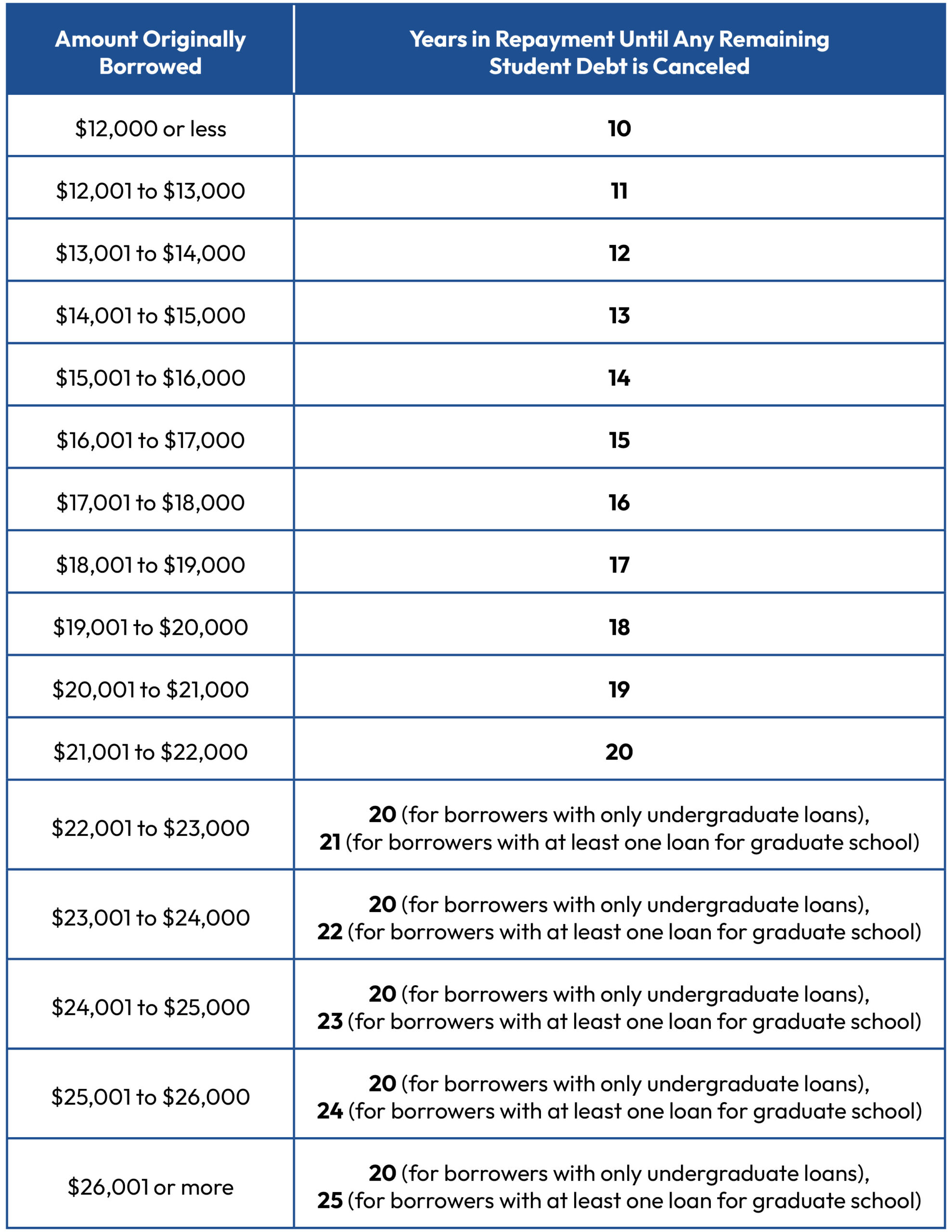
The Saving on a Valuable Education (SAVE) plan, which replaced the REPAYE plan, significantly altered the timeline for many Aidvantage borrowers. For those with original principal balances of $12,000 or less, the SAVE plan allows for forgiveness after just 10 years of payments. For every $1,000 borrowed above that amount, one year is added to the timeline, capping at 20 years for undergraduate loans and 25 years for graduate loans.
The IDR Account Adjustment Legacy
Many borrowers in 2026 are still seeing the benefits of the "one-time IDR account adjustment" (often called the IDR Waiver) that occurred between 2023 and 2024. This adjustment credited borrowers with time spent in long-term forbearances or certain deferments that previously did not count toward forgiveness. If you have been in repayment for over two decades, Aidvantage may automatically process your discharge as the Department of Education completes these audits.
Tax Implications in 2026
A critical factor for borrowers in 2026 is the taxability of forgiven debt. The American Rescue Plan Act of 2021 made all student loan forgiveness federal tax-free through December 31, 2025. Since that provision has now expired (unless newly extended by Congress), any debt forgiven under IDR plans in 2026 may be treated as taxable income by the IRS. (Note: PSLF remains tax-free under permanent internal revenue code). Borrowers should consult a tax professional to prepare for a potential "tax bomb" if they expect an IDR discharge this year.
Teacher Loan Forgiveness (TLF)
The Teacher Loan Forgiveness program is a specialized track for educators working in low-income schools or educational service agencies. Unlike PSLF, which takes 10 years, TLF can be achieved in 5 consecutive years. However, the amount forgiven is capped.
- Highly Qualified Special Education, Math, or Science Teachers: Eligible for up to $17,500 in forgiveness.
- Other Highly Qualified Teachers: Eligible for up to $5,000 in forgiveness.
To qualify, you must have been employed as a full-time teacher for five complete and consecutive academic years. At least one of those years must have been after the 1997-1998 academic year. The school must be listed in the Teacher Cancellation Low-Income (TCLI) Directory.
Important Note: You cannot receive credit for the same period of service for both TLF and PSLF. Most borrowers with high debt balances find that PSLF is the more financially advantageous route, even though it takes longer, because it forgives the entire balance rather than a capped amount.
Forgiveness for Specific Hardships and Conduct
In addition to employment-based programs, Aidvantage processes discharges for borrowers facing extreme circumstances or those who were misled by their institutions.
Total and Permanent Disability (TPD) Discharge
If you are unable to engage in substantial gainful activity due to a physical or mental impairment that is expected to result in death or has lasted (or is expected to last) for a continuous period of at least 60 months, you may qualify for a TPD discharge. The Department of Education often identifies eligible borrowers automatically through data matching with the Social Security Administration (SSA) or the Department of Veterans Affairs (VA). If not automatically identified, you must submit an application certified by a physician.
Borrower Defense to Repayment
If your school engaged in certain types of misconduct, such as making misleading claims about job placement rates or the transferability of credits, you may be eligible for a Borrower Defense discharge. This program has been subject to significant regulatory changes and litigation over the past several years. As of 2026, many "closed school" discharges and group-based borrower defense claims (such as those involving Corinthian Colleges or ITT Tech) have been processed, but individual claims are still handled via the StudentAid.gov portal.
Comparison of Major Aidvantage Forgiveness Programs
The following table compares the primary forgiveness options available to federal student loan borrowers serviced by Aidvantage in 2026.
| Program | Eligibility Focus | Service Period | Max Forgiveness Amount | Federal Tax Status (2026) |
|---|---|---|---|---|
| PSLF | Government/Non-profit | 10 Years (120 payments) | Full Balance | Tax-Free |
| SAVE (IDR) | Income-based (Low Balance) | 10–20 Years | Full Balance | Potentially Taxable |
| Standard IDR | Income-based | 20–25 Years | Full Balance | Potentially Taxable |
| Teacher Loan | Low-income Schools | 5 Consecutive Years | $5,000 or $17,500 | Tax-Free |
| TPD Discharge | Medical Disability | N/A (3-year monitor) | Full Balance | Tax-Free |
| Closed School | School Closure | N/A | Full Balance | Tax-Free |
How to Apply and Track Your Progress
Applying for forgiveness is not a single event but a series of administrative steps. To ensure your application is processed correctly by Aidvantage and the Department of Education, follow this sequence:
- Verify Your Loan Types: Log in to your Aidvantage account or StudentAid.gov to confirm you have "Direct" loans. If you see "FFELP" or "Federal Perkins," you must consolidate them first.
- Submit an IDR Application: Most forgiveness programs require you to be on an income-driven plan. You must "re-certify" your income and family size every year. Failure to do so can result in your payments increasing and your progress toward forgiveness pausing.
- Document Your Employment: For PSLF, use the PSLF Help Tool to send electronic signature requests to your HR department. Do this annually and whenever you change jobs.
- Monitor Your Payment Count: Aidvantage provides a "Loan Details" section where you can view your cumulative qualifying payments. If the number looks incorrect, you may need to request a manual recount or submit a "reconsideration request" via Federal Student Aid.
- Final Application: Once you reach the required milestone (e.g., 120 payments for PSLF), you submit a final certification. During the processing period, you may choose to place your loans in a voluntary administrative forbearance so you don't have to keep making payments while the government verifies your eligibility.
Troubleshooting Common Issues
Many borrowers encounter hurdles when dealing with Aidvantage loan forgiveness. Common issues include "missing" payments in the tracker and delays in form processing.
- Payment Count Discrepancies: This often happens if you made payments while in an ineligible status, such as "In-School Deferment" or "Grace Period." While the 2024 account adjustment fixed many of these, specific periods—like bankruptcy or certain types of default—still do not count.
- Consolidation Reset Concerns: In the past, consolidating loans would reset your forgiveness clock to zero. Under current 2026 rules, consolidating generally results in a "weighted average" or, in many cases, preserves the highest count if consolidation occurred during specific window periods. Always check the latest guidance on StudentAid.gov before consolidating.
- Employer Eligibility: Not all non-profits qualify. For example, some 501(c)(4) organizations (labor unions or partisan political groups) are excluded. If Aidvantage denies your ECF, verify the employer's EIN (Employer Identification Number) against the IRS database.
Frequently Asked Questions
Can Aidvantage deny my forgiveness application?
Aidvantage itself does not deny forgiveness; they relay the decision made by the Department of Education. If your application is rejected, it is usually because the loans did not qualify, the employment was not certified correctly, or you have not yet reached the required number of payments. You will receive a letter explaining the specific reason for the denial, which you can then appeal.
Do I have to pay a fee to apply for Aidvantage loan forgiveness?
No. There is never a fee to apply for any federal student loan forgiveness program. If you receive a call or email from a company offering to "process your Aidvantage forgiveness" for a fee, it is a scam. All applications are free and should be completed through StudentAid.gov or the Aidvantage portal.
What happens if I change jobs before I reach 120 payments for PSLF?
PSLF does not require you to stay with the same employer for 10 years. You can move between any qualifying government or non-profit employers. Your progress is cumulative. When you leave a job, it is best practice to submit a final Employment Certification Form for that period so that those payments are "locked in" your tracker.
Will my loans be forgiven automatically?
Generally, no. While some TPD and IDR discharges are automated through data matching, the vast majority of forgiveness programs—including PSLF and Teacher Loan Forgiveness—require an active application. You must be proactive in certifying your eligibility.
Is the "SAVE" plan still the best option for forgiveness in 2026?
For most borrowers, the SAVE plan offers the lowest monthly payments and the fastest route to forgiveness for low-balance loans. It also prevents interest from accruing if your calculated payment is $0. However, if you are a high earner, other plans like IBR (Income-Based Repayment) might be preferable because they have a "cap" on how high your payment can go, whereas SAVE does not.
Final Recommendation for Borrowers
To maximize your chances of successful loan forgiveness with Aidvantage, you must be your own best advocate. Start by logging into the StudentAid.gov dashboard to ensure your contact information is current and your loan types are eligible. Set a recurring annual calendar reminder to re-certify your income-driven repayment plan and submit your employment certification forms. By maintaining a paper trail of every form submitted and every payment made, you can resolve servicer errors quickly and ensure that you receive the discharge you have earned through your service or years of repayment.