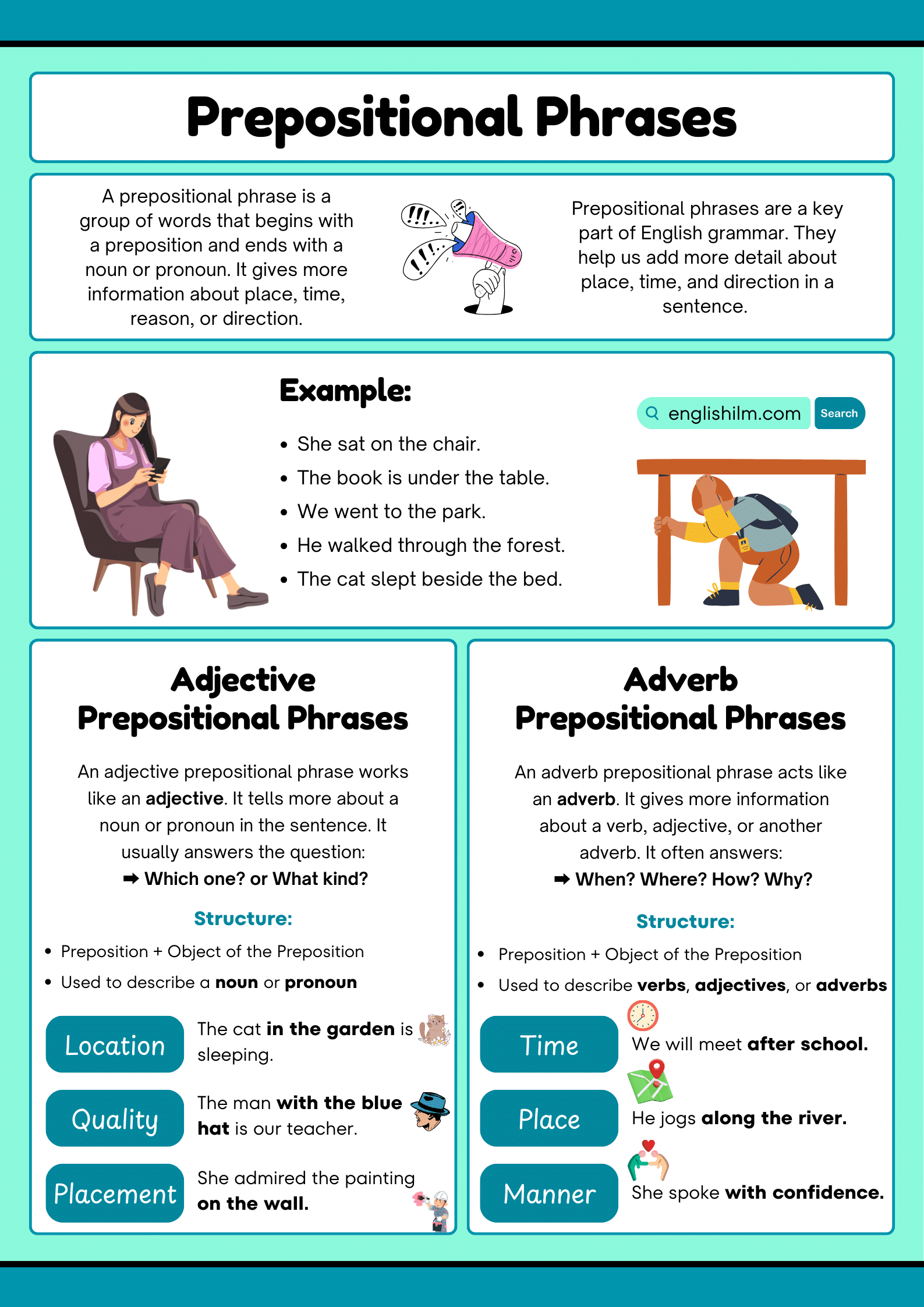
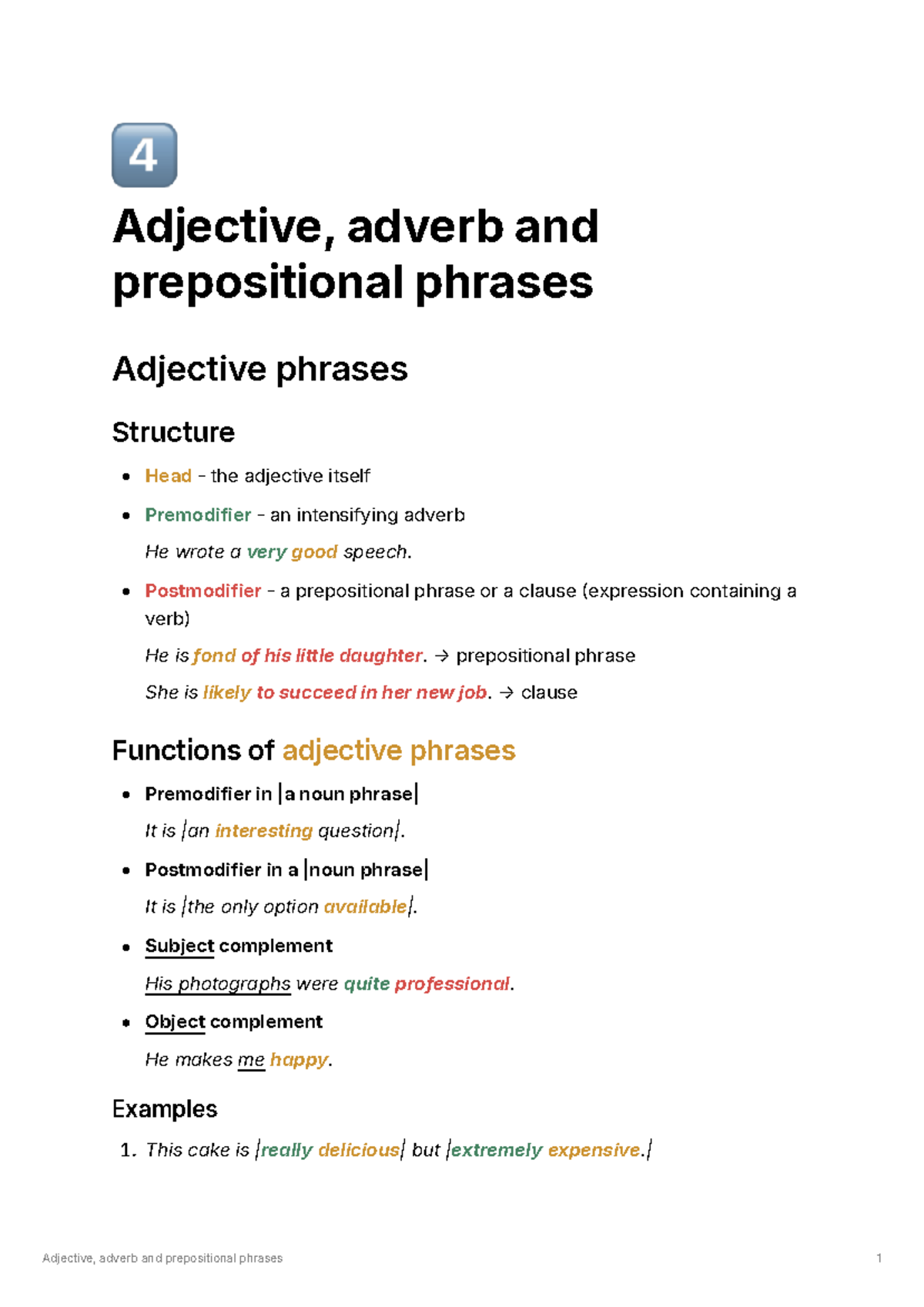
An adverb prepositional phrase is a multi-word modifier consisting of a preposition, its object, and any accompanying modifiers that function collectively as an adverb to modify a verb, adjective, or adverb in a sentence. These grammatical structures tell us how, when, where, why, or to what extent an action occurs, anchoring abstract concepts in specific physical and contextual details.
Understanding how to identify and construct these phrases transforms standard writing into precise, vivid prose. Writers often struggle to distinguish between prepositional phrases acting as adjectives and those acting as adverbs. This guide explores the definition, structural components, functional categories, and real-world examples of adverb prepositional phrases to elevate your grammatical fluency.
The Foundation: What Is a Prepositional Phrase Acting as an Adverb?
To comprehend an adverb prepositional phrase, you must first break down its individual components. A prepositional phrase always begins with a preposition (such as in, on, at, through, beneath, or without) and ends with a noun, pronoun, or noun phrase known as the object of the preposition.
When that entire phrase answers questions like How?, When?, Where?, Why?, or To what extent? regarding a verb, adjective, or other adverb, it takes on an adverbial function. Consider this simple sentence: "The train arrived on time."
- The preposition is on.
- The object is time.
- The phrase on time modifies the verb arrived by telling us when the arrival happened.
Because it targets a verb with a time-based modifier, it operates as an adverb prepositional phrase.
Adverbial vs. Adjectival Prepositional Phrases
A common hurdle in syntax is telling the difference between adverbial and adjectival prepositional phrases. While both types use the exact same structural components (preposition + object + modifiers), they perform entirely different jobs in a sentence.
- Adjectival Prepositional Phrases: These follow a noun and answer questions like Which one? or What kind?
- Example: "The book on the top shelf belongs to me." (On the top shelf modifies the noun book).
- Adverbial Prepositional Phrases: These attach to verbs, adjectives, or adverbs and answer questions like How?, Where?, When?, or Why?.
- Example: "She left her keys on the top shelf." (On the top shelf modifies the verb left, telling us where she put them).
Core Categories of Adverb Prepositional Phrases
Adverbial phrases are generally categorized by the specific question they answer. Recognizing these categories helps writers vary sentence structures and build clear mental images for readers.
1. Phrases of Time (When? or How long?)
These phrases establish the temporal boundaries of an action. They tell readers the exact moment or duration associated with the verb.
- Example: We will launch the new software at midnight.
- Example: He worked on the manuscript for three consecutive hours.
2. Phrases of Place (Where?)
These phrases locate the action physically. They specify a destination, a point of origin, or a path of movement.
- Example: The stray cat hid under the porch.
- Example: Birds migrate across the continent during autumn.
3. Phrases of Manner (How?)
Manner phrases illustrate the method or style in which an action is carried out. They provide texture and emotional weight to verbs.
- Example: She spoke with unwavering confidence.
- Example: The technician fixed the engine with meticulous care.
4. Phrases of Purpose or Reason (Why?)
These structures explain the motivation behind an action, answering why something was done.
- Example: He trained daily for the upcoming marathon.
- Example: She wept out of sheer relief.
5. Phrases of Condition or Concession (Under what circumstances?)
These phrases describe the environment, limits, or exceptions that affect the verb.
- Example: The event will proceed regardless of the weather.
- Example: You may enter on one strict condition.
Comprehensive Examples in Action
Seeing grammar rules applied in varied sentence structures bridges the gap between theory and application. The table below outlines various adverb prepositional phrases, highlights the words they modify, and identifies their specific functional categories.
| Sentence | Prepositional Phrase | Modified Word | Functional Category |
|---|---|---|---|
| The hikers rested near the rushing stream. | near the rushing stream | rested | Place (Where?) |
| She accepted the award with profound gratitude. | with profound gratitude | accepted | Manner (How?) |
| The store opens at eight o'clock. | at eight o'clock | opens | Time (When?) |
| He ran with surprising speed. | with surprising speed | ran | Manner (How?) |
| We traveled through dense fog to reach home. | through dense fog | traveled | Place / Path (Where?) |
| The patient recovered after months of therapy. | after months of therapy | recovered | Time (When?) |
Structural Flexibility: Placement and Punctuation
Unlike single-word adverbs, which often have rigid placement rules, adverb prepositional phrases are remarkably flexible. They can appear at the beginning, middle, or end of a sentence. However, placement impacts punctuation and stylistic flow.
Introductory Adverbial Phrases
When an adverb prepositional phrase introduces a sentence (often referred to as an introductory modifier), it sets the stage for the main clause.
- Rule of Thumb: If the introductory phrase is long (usually four or more words) or if it prevents misreading, follow it with a comma.
- With comma: During the fierce thunderstorm, the power grid failed completely.
- Without comma: At dawn we set sail. (Short introductory phrases of time or place often omit the comma unless a pause is needed for clarity).
Mid-Sentence Placement
Placing an adverbial phrase in the middle of a sentence can emphasize specific actions or create stylistic cadence, but careless placement can result in awkward phrasing or accidental ambiguity.
- Clear: The committee on Friday approved the budget. (Though on Friday modifies approved, placing it directly after the subject can occasionally confuse readers into thinking it modifies committee).
- Better: The committee approved the budget on Friday.
Common Mistakes and Troubleshooting
Writers frequently encounter structural pitfalls when deploying multi-word modifiers. Avoiding these errors ensures professional, polished writing.
Misplaced Modifiers
A misplaced modifier is a word, phrase, or clause that is improperly separated from the word it modifies, creating an unintended, often humorous meaning.
- Incorrect: She drove her car into the garage with a dented fender. (Did the garage have a dented fender?)
- Correct: She drove her car with a dented fender into the garage.
Confusion with Adverb Clauses
Do not confuse prepositional phrases with adverb clauses. While both modify verbs, adjectives, or adverbs, an adverb clause contains both a subject and a verb (e.g., "She left before the rain started"). An adverb prepositional phrase contains a preposition and a noun object, but no subject-verb combination (e.g., "She left before the rain").
Frequently Asked Questions
Can an adverb prepositional phrase modify an adjective?
Yes. While they most frequently modify verbs, they can also modify adjectives to explain to what extent or in what way a descriptive state applies. For example, in the sentence "She is brilliant at mathematics," the phrase at mathematics modifies the adjective brilliant.
How do I know if a phrase is adverbial or adjectival?
Test the phrase by asking questions. If the phrase answers Which one? or What kind? right after a noun, it is adjectival. If it answers How?, When?, Where?, or Why? in relation to a verb, adjective, or adverb, it is adverbial.
Can a sentence contain multiple adverb prepositional phrases?
Yes. Writers frequently stack multiple adverbial phrases to provide rich contextual detail. For example: "He practiced the piano for two hours in the basement with fierce concentration." Here, all three phrases modify the verb practiced by telling us duration, location, and manner.
Are there limits to how long an adverb prepositional phrase can be?
The phrase itself is built around a single object and its modifiers (articles, adjectives). However, if the object of the preposition contains a relative clause, the overall structure can become quite long. Keep modifiers concise to prevent sentence fatigue.
What is the best way to practice identifying these phrases?
Start by reading complex nonfiction or literature and underlining every preposition. Look at the word immediately following the preposition to find its object, then trace the whole phrase to the word it impacts. Asking whether it answers how, when, or where confirms its adverbial nature.
Conclusion and Next Actions
Mastering adverb prepositional phrases equips you with the tools to paint vivid mental pictures and establish precise timelines, locations, and methods in your writing. To apply this knowledge immediately, review a recent piece of your own writing, highlight your prepositional phrases, and check whether those modifying verbs are effectively answering how, when, or where.