An accredited investor is an individual or entity that satisfies specific financial thresholds established by the Securities and Exchange Commission (SEC) to participate in private capital markets. To qualify under the net worth test, an individual must demonstrate a net worth exceeding $1 million, either alone or with a spouse or spousal equivalent, excluding the value of their primary residence.
The landscape of private investing, which includes hedge funds, venture capital, private equity, and certain real estate syndications, is governed by stringent regulatory frameworks designed to protect retail investors. Because these offerings are generally unregistered with the SEC, they lack the detailed disclosures required of public companies. Consequently, the "accredited investor" status serves as a proxy for financial sophistication and the capacity to absorb the high risk of loss associated with these complex investments.
The Financial Thresholds and Statutory Definitions
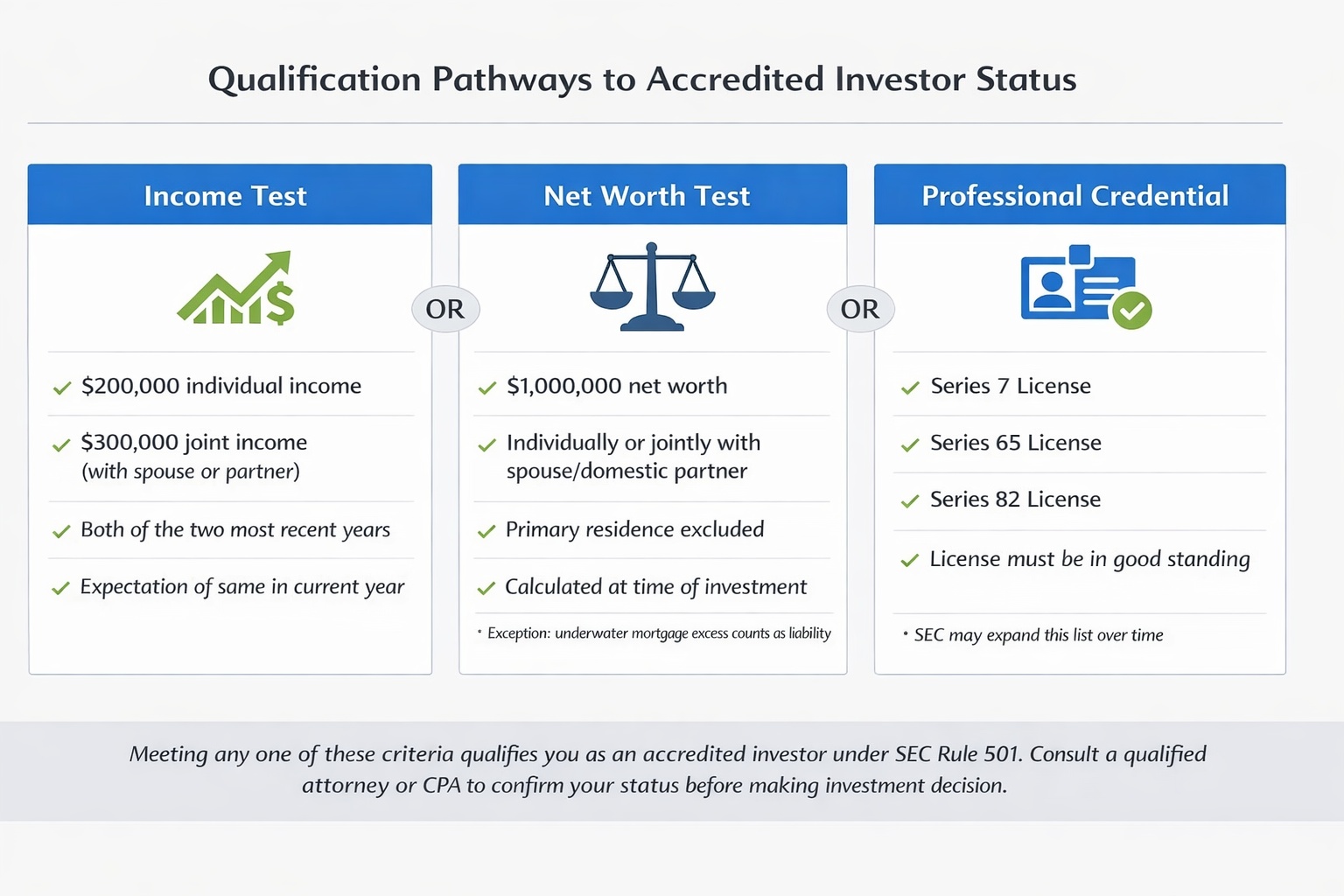
The primary regulatory authority governing these standards in the United States is the Securities Act of 1933, specifically Rule 501 of Regulation D. As of 2026, the criteria remain focused on three distinct pathways to accreditation for individuals: net worth, income, and professional certification.
1. The Net Worth Test Calculation
The net worth test is the most common path for high-net-worth individuals. To qualify, you must have a net worth of at least $1 million. Crucially, the SEC mandates that this calculation must exclude the value of your primary residence.
- Assets to include: Bank accounts, brokerage accounts, real estate holdings (excluding primary home), retirement accounts (such as 401(k) or IRA balances), business interests, and personal property (such as art or vehicles).
- Liabilities to subtract: Mortgages, credit card debt, student loans, and other outstanding personal debts.
- The Primary Residence Exclusion: This is the most critical technical detail. If you own your home, you must subtract both the fair market value of the home and any debt secured by the home (such as a mortgage) from your total net worth calculation. If the mortgage on your home is "underwater" (meaning the debt exceeds the home's value), you must add that negative equity to your liabilities, further reducing your qualifying net worth.
2. The Income Test Alternative
If you do not meet the $1 million net worth threshold, you may still qualify through your annual income. An individual qualifies if they have had an individual income in excess of $200,000 in each of the two most recent years—or a joint income with a spouse or spousal equivalent in excess of $300,000 in each of those years—and reasonably expects to reach the same income level in the current year.
3. Professional Certification (Knowledge-Based Accreditation)
The SEC expanded the definition of an accredited investor to include individuals with certain professional certifications, designations, or credentials. As of 2026, individuals in good standing who hold a Series 7, Series 65, or Series 82 license are considered accredited regardless of their net worth or income. This recognizes that certain financial professionals possess the requisite knowledge to navigate the risks of private offerings.
Why the Net Worth Test Matters in Private Markets
The accreditation requirement exists because private placements are inherently illiquid and risky. Unlike shares of Apple or Microsoft, which can be sold on a public exchange instantly, private securities are often locked up for years. There is no guarantee of a secondary market, and many early-stage companies or private funds fail entirely.
By setting the net worth bar at $1 million, the SEC presumes that an individual has sufficient financial "cushion" to survive the total loss of an investment. It is not necessarily a measure of investment skill, but rather a measure of financial resilience. For issuers—the companies or funds raising money—verifying accreditation is a legal obligation. If an issuer sells securities to a non-accredited investor under a rule that requires accreditation, they could face severe regulatory penalties and potential rescission rights, where the investor can demand their money back.
The Verification Process: How Issuers Confirm Your Status
In the past, issuers could rely on self-certification, where an investor simply checked a box stating they were accredited. Following the Jumpstart Our Business Startups (JOBS) Act, the rules have tightened. For many offerings, issuers are now required to take "reasonable steps" to verify that the investor is, in fact, accredited.
| Verification Method | Description |
|---|---|
| Documentary Review | Providing bank statements, brokerage statements, tax returns (W-2, K-1, 1040), or credit reports to the issuer for inspection. |
| Third-Party Attestation | Receiving a letter from a CPA, investment advisor, or attorney confirming that they have performed reasonable steps to verify your status. |
| Broker-Dealer/Advisor Review | Having a registered broker-dealer or investment advisor provide a written confirmation based on their existing knowledge of your finances. |
For many investors, the most convenient method is working with a third-party verification service. These platforms allow you to upload your sensitive financial documents once and receive a digital certificate of accreditation, which you can then share with various private equity or real estate sponsors. This process is generally encrypted and provides a layer of privacy by ensuring the sponsor only sees the confirmation rather than your raw tax returns.
Common Pitfalls and Compliance Mistakes
Investors and issuers often make errors in the accreditation process that lead to disqualification. Understanding these common mistakes can save time and prevent legal complications.
1. Miscalculating the Primary Residence The most frequent error is failing to properly isolate the primary residence from the net worth calculation. If you own multiple properties, the equity in your vacation home or rental properties counts toward your $1 million threshold. However, your primary residence must be completely excluded—both its value and the mortgage debt associated with it.
2. Failing the "Two-Year" Income Test Investors often look at their current year’s income and assume they qualify. However, the rule requires consistency over a two-year period. A high-earning year caused by a one-time bonus or the sale of an asset does not automatically grant accreditation if the preceding year fell below the $200,000/$300,000 requirement.
3. Ignoring Spousal Equivalence The SEC has clarified that a "spousal equivalent" (cohabitating in a relationship generally equivalent to a marriage) can be included in joint income and net worth calculations. Investors sometimes fail to account for these assets correctly or misinterpret the "joint" requirement.
4. Outdated Verification Accreditation is not a lifetime pass. Because financial situations change, most issuers require verification that is less than 90 days old. If you are participating in multiple deals, you may need to update your documentation frequently.
The Role of Regulatory Updates and Future Trends
The definition of an accredited investor is periodically reviewed by the SEC. There has been ongoing debate regarding whether the $1 million threshold—which has remained unchanged since 1982—should be adjusted for inflation. Critics argue that the threshold has captured a much larger percentage of the population over the last four decades as real estate values have surged, potentially diluting the intended protection.
Proponents of the current system, however, argue that increasing the threshold would disproportionately exclude younger, high-earning professionals or those in lower cost-of-living areas, effectively locking them out of wealth-building opportunities in private markets. As of 2026, the SEC continues to monitor the impact of these rules, focusing on balancing investor access with the necessity of capital market stability.
Frequently Asked Questions
What happens if my net worth drops after I invest? Your status as an accredited investor is determined at the time of the sale of the securities. If you meet the criteria when you make the investment, you remain an investor in that offering even if your net worth subsequently falls below $1 million.
Can I include my retirement account (401k/IRA) in my net worth? Yes. You may include the value of your vested retirement accounts in your net worth calculation. These are considered liquid assets, even if you are not currently eligible to withdraw them without penalty.
Is a letter from my accountant enough to satisfy the verification requirement? In many cases, yes. A written confirmation from a certified public accountant (CPA), licensed attorney, or registered investment advisor is specifically cited by the SEC as a valid method for "reasonable steps" verification.
Does an inheritance count toward the net worth test? Yes. Any asset you own, including inherited cash, securities, or real estate (provided it is not your primary residence), is included in the total net worth calculation.
Do I need to be accredited to invest in public stocks? No. The accredited investor standard only applies to private placements and securities not registered with the SEC. Publicly traded stocks are available to all investors regardless of income or net worth.
Next Steps for Prospective Investors
If you are considering participating in private markets, your first action should be to conduct a formal audit of your personal balance sheet. Calculate your net worth strictly according to the SEC formula: Total Assets (excluding primary residence) minus Total Liabilities (excluding primary mortgage).
If you find that you meet the threshold, consolidate your recent tax returns and brokerage statements. These will be your primary evidence when you decide to enter an investment. If you are close to the threshold but unsure of your specific categorization, consult with a financial advisor or tax professional. They can provide a written statement of accreditation, which is the gold standard for satisfying the verification requirements of private fund managers.
Ultimately, being an accredited investor is a gateway to a broader set of investment opportunities, but it also carries the responsibility of performing independent due diligence. Without the protective oversight of public financial reporting, the burden of understanding the investment's risks, fee structures, and exit strategy rests solely with you.