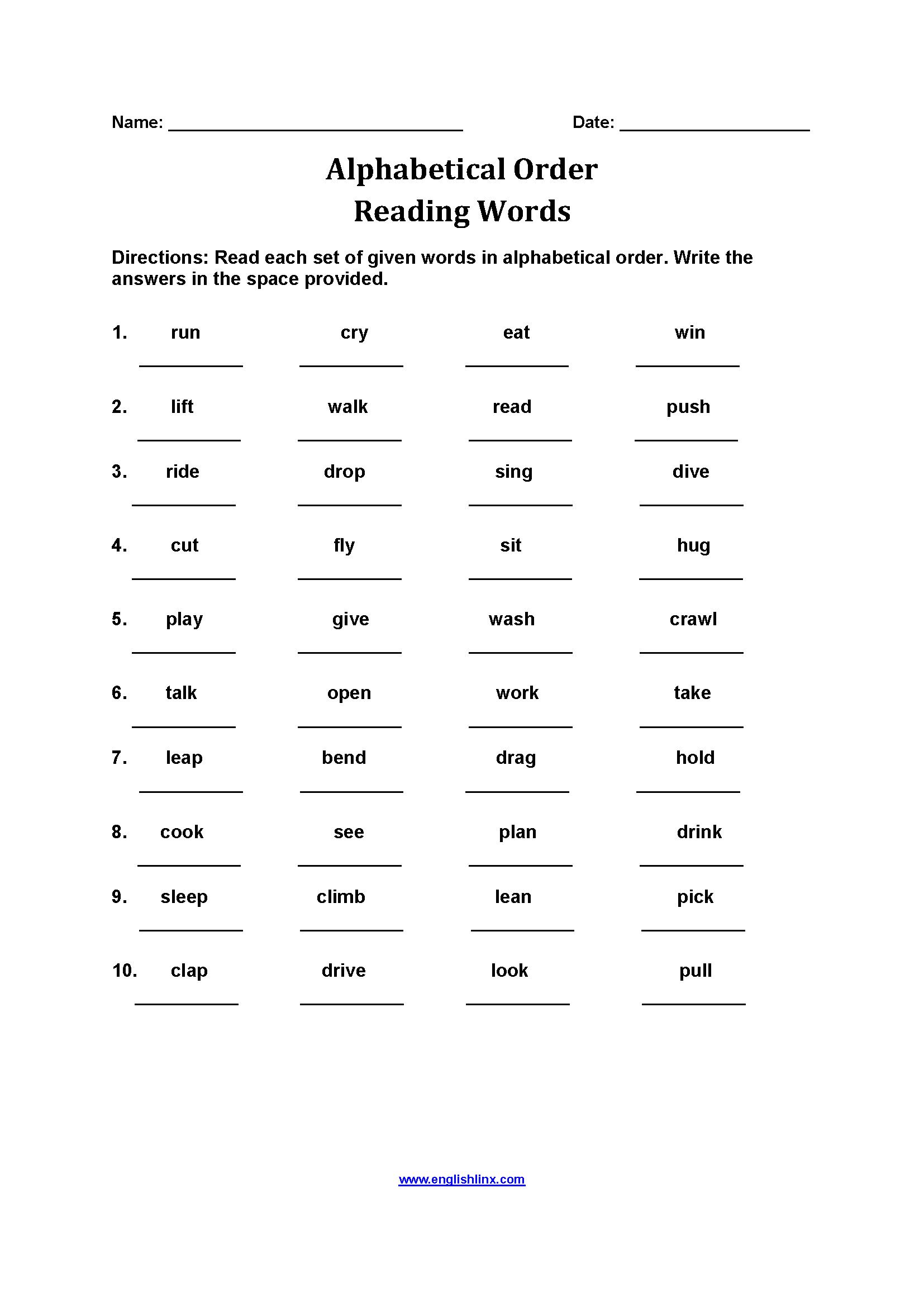
ABC order worksheets are specialized educational tools designed to help students master the art of alphabetizing words and letters. These resources facilitate a foundational literacy skill that enables learners to navigate dictionaries, indices, libraries, and digital databases efficiently. By 2026, while digital search tools are ubiquitous, the cognitive processing required to organize information alphabetically remains a critical component of executive function and language arts curricula in early childhood and primary education.
The Cognitive Significance of Alphabetizing
Learning to place items in alphabetical order is more than a rote memorization task; it is an exercise in logic, pattern recognition, and attention to detail. When a student engages with an ABC order worksheet, they are practicing a multi-step cognitive process. First, they must retrieve the sequence of the alphabet from long-term memory. Second, they must analyze the initial graphemes of a word list. Third, they must compare those graphemes against the mental or visual alphabet and determine a hierarchical placement.
In the context of 2026 educational standards, alphabetizing is often linked to the "Science of Reading." It reinforces letter recognition and the understanding that letters are symbols that follow a predictable, standardized sequence. This sequence serves as the "filing system" of the English language. Without mastery of this system, students often struggle with more complex organizational tasks, such as understanding the structure of an encyclopedia or managing digital files that default to alphabetical sorting.
Furthermore, ABC order worksheets help develop "fine-grained" visual perception. Forcing a student to look past the first letter of a word—when two words share the same starting character—requires a level of orthographic mapping that is essential for fluent reading. It shifts the student from seeing a word as a single "shape" to seeing it as a sequence of discrete units that determine its identity and its place in a list.
Developmental Progression of Alphabetizing Skills
Alphabetizing skills do not develop all at once. Effective ABC order worksheets are typically tiered to match the developmental stage of the learner. Educators and parents should select worksheets that challenge the student without causing cognitive overload.
Level 1: Sorting Single Letters
The most basic form of alphabetizing involves taking a random assortment of individual letters (e.g., G, A, M, Z) and placing them in the correct sequence (A, G, M, Z). This stage is critical for Pre-K and Kindergarten students who are still solidifying their letter-naming fluency. These worksheets often include a "key" or an alphabet strip at the top of the page to provide a visual scaffold.
Level 2: Sorting Words by the First Letter
Once students are comfortable with the letter sequence, they move to sorting words where every word starts with a different letter (e.g., Apple, Cat, Dog, Zebra). This requires the student to isolate the first letter (the onset) and ignore the rest of the word for the purpose of sorting. This level builds confidence and introduces the concept that the entire word’s position is dictated by its first character.
Level 3: The Second-Letter Rule
This is a significant hurdle for many 1st and 2nd-grade students. When words share the same first letter (e.g., "Ball" and "Boat"), the student must learn to "ignore" the "B" and move their focus to the second letter ("a" vs. "o"). Worksheets at this level are essential for teaching the "tie-breaker" logic of alphabetizing.
Level 4: Advanced Sorting (Third and Fourth Letters)
Advanced ABC order worksheets introduce lists where the first two or three letters are identical (e.g., "Track," "Train," and "Trade"). Mastering this level is a prerequisite for high-level research and academic organization. By 2026, these tasks are often integrated into STEM activities, where students might alphabetize scientific terms or geographical locations as part of a larger project.
Types of ABC Order Worksheets and Their Applications
The format of the worksheet can significantly impact student engagement and the specific motor skills being practiced. Variety in worksheet design ensures that different learning styles—kinesthetic, visual, and linguistic—are addressed.
| Worksheet Type | Primary Learning Objective | Best For |
|---|---|---|
| Cut and Paste | Kinesthetic learning and fine motor development. | Kindergarten - 1st Grade |
| Fill-in-the-Blank | Writing practice and sequence recall. | 2nd - 3rd Grade |
| Thematic (Holiday/Science) | Vocabulary building within a specific context. | All Ages |
| Dictionary Skills | Real-world application and reference navigation. | 3rd Grade - Middle School |
| Digital Drag-and-Drop | Tech literacy and rapid pattern recognition. | Remote learning/Station work |
| Error Correction | Critical thinking and proofreading. | Advanced Learners |
Kinesthetic Cut-and-Paste Worksheets
For younger learners, the physical act of moving a word helps cement the concept of "positioning." Cut-and-paste ABC order worksheets require students to cut out word strips and glue them onto a numbered list. This adds a tactile dimension to the lesson, which can be particularly helpful for students with ADHD or those who require sensory input to maintain focus.
Thematic and Contextual Worksheets
To prevent alphabetizing from feeling like a "dry" or isolated skill, many modern worksheets utilize themes. For example, a worksheet might feature a list of "Planets in our Solar System" or "Verbs for Winter Sports." This allows the educator to integrate literacy practice with science or social studies, maximizing instructional time. In 2026, many teachers use custom generators to create worksheets that reflect the specific vocabulary being taught in their current unit of study.
Digital and Interactive Formats
By 2026, the traditional paper worksheet is frequently supplemented by interactive digital versions. These may include "drag-and-drop" interfaces on tablets or interactive whiteboards. The advantage of digital ABC order worksheets is the immediate feedback; if a student places "Dog" before "Cat," the item may snap back to its original position or turn red, allowing for instant self-correction without teacher intervention.
Effective Implementation Strategies for Educators
To get the most out of ABC order worksheets, they should be used as part of a broader literacy strategy rather than in isolation. Rote completion of worksheets can lead to burnout; instead, use them as "checkpoints" for understanding.
- The "Think Aloud" Technique: Before handing out a worksheet, the teacher should model the process. For example, "I see the words 'Apple' and 'Ant.' They both start with 'A,' so I have to look at the second letter. 'p' comes after 'n' in the alphabet, so 'Ant' goes first."
- Scaffolding with Alphabet Strips: Do not hesitate to provide a visual alphabet at the top of the worksheet. The goal is to learn the sorting logic, not necessarily to test the student’s ability to recite the alphabet from memory under pressure.
- Timed Challenges for Fluency: For older students who have mastered the logic, use worksheets as a fluency drill. Seeing how many words they can correctly alphabetize in two minutes can turn a mundane task into a competitive game.
- Peer-to-Peer Verification: After completing a worksheet, have students swap papers and "audit" each other's work. Explaining to a peer why a certain word comes first reinforces the student's own understanding.
Challenges and Troubleshooting in Alphabetizing
Many students hit "plateaus" when learning ABC order. Recognizing these common errors early can prevent the development of bad habits.
Ignoring the Second Letter
The most common mistake is students stopping after the first letter. If they see "Cat" and "Cow," they might simply write them in the order they appear on the unorganized list because they both start with "C." To fix this, encourage students to circle or underline the letters they are comparing. For "Cat" and "Cow," they should underline 'a' and 'o.'
The "Nothing Comes Before Something" Rule
A nuanced rule that often confuses students is when one word is a shorter version of another (e.g., "Car" and "Cards"). Students must learn that "nothing" (the space after the 'r' in Car) comes before "something" (the 'd' in Cards). Specially designed ABC order worksheets that focus on this specific rule are vital for 3rd and 4th-grade mastery.
Letter Reversal and Dyslexia
For students with dyslexia, the alphabetizing process can be particularly grueling because of letter reversals (b/d, p/q). For these learners, worksheets should use "dyslexia-friendly" fonts (like OpenDyslexic) and perhaps use color-coded first letters to help distinguish the characters.
The Role of ABC Order in the 2026 Digital Landscape
One might argue that in 2026, with advanced AI search engines and voice-activated filing, the need for alphabetizing is obsolete. However, the opposite is true. Understanding the logic of ABC order is a prerequisite for understanding how data is structured.
When a student uses a spreadsheet, they need to know how to "Sort A-Z." When they look for a song in a digital library or a contact in a phone book, they are relying on the mental framework established by those early ABC order worksheets. It is a fundamental skill that bridges the gap between physical literacy and digital information architecture.
Furthermore, alphabetizing is a standard part of many standardized tests and entrance exams. It serves as a proxy for a student's ability to follow complex rules and manage detailed information. High-quality worksheets provide the repetitive practice needed to make this skill second nature, freeing up cognitive "bandwidth" for more complex tasks like reading comprehension or creative writing.
Creating Your Own ABC Order Worksheets
While there are thousands of pre-made worksheets available, creating custom ones can be more effective for specific classroom needs. In 2026, many educators use AI-driven template builders to generate lists based on:
- Current Weekly Spelling Words: This doubles the utility of the worksheet by reinforcing spelling and alphabetizing simultaneously.
- Student Names: Using the names of classmates is a highly engaging way for Kindergarten students to learn ABC order.
- Subject-Specific Vocabulary: Alphabetizing the names of the 50 states or types of chemical elements helps with familiarity and retention.
When creating a worksheet, ensure the font is clear and legible. For younger students, provide ample space for writing, as their handwriting is often larger and less controlled. For older students, a multi-column format can accommodate longer lists of 20 to 30 words.
FAQs About ABC Order Worksheets
At what age should children start using ABC order worksheets?
Most children are ready for basic ABC order (single letters) around age 4 or 5 (Pre-K/Kindergarten). By age 6 or 7, they should be introduced to sorting words by the first letter. The second and third-letter rules are typically introduced in 2nd and 3rd grade (ages 7-9).
Why do some students struggle with ABC order even if they know the alphabet song?
Knowing the alphabet song is a matter of auditory memory, while alphabetizing is a matter of visual processing and logic. A student may be able to sing the song but still struggle to identify which letter comes first when looking at two disparate letters like 'M' and 'K.' Worksheets bridge the gap between "singing" and "applying."
Are digital ABC order worksheets as effective as paper ones?
Both have merits. Paper worksheets help with fine motor skills and handwriting, which are linked to better memory retention. Digital worksheets offer immediate feedback and can be more engaging for "digital native" students. A hybrid approach is usually best.
How do ABC order worksheets help with dictionary skills?
A dictionary is the ultimate application of ABC order. Worksheets prepare students by teaching them how to use "guide words" (the words at the top of a dictionary page). Without the foundational logic learned on simple worksheets, a student will find a physical dictionary overwhelming.
Can ABC order worksheets be used for ESL (English as a Second Language) learners?
Absolutely. For ESL students, ABC order worksheets are an excellent way to familiarize themselves with the English alphabet and common vocabulary simultaneously. It provides a structured, low-stress environment to practice letter recognition and word structure.
Practical Recommendation
When implementing ABC order worksheets in a learning environment, always start with a diagnostic approach. Give a simple list of five words with different starting letters. If the student completes it easily, move immediately to a "second-letter" worksheet to maintain engagement. To ensure long-term retention, revisit the skill once a month with a "thematic" worksheet related to your current curriculum. This keeps the skill sharp without it becoming a tedious chore.