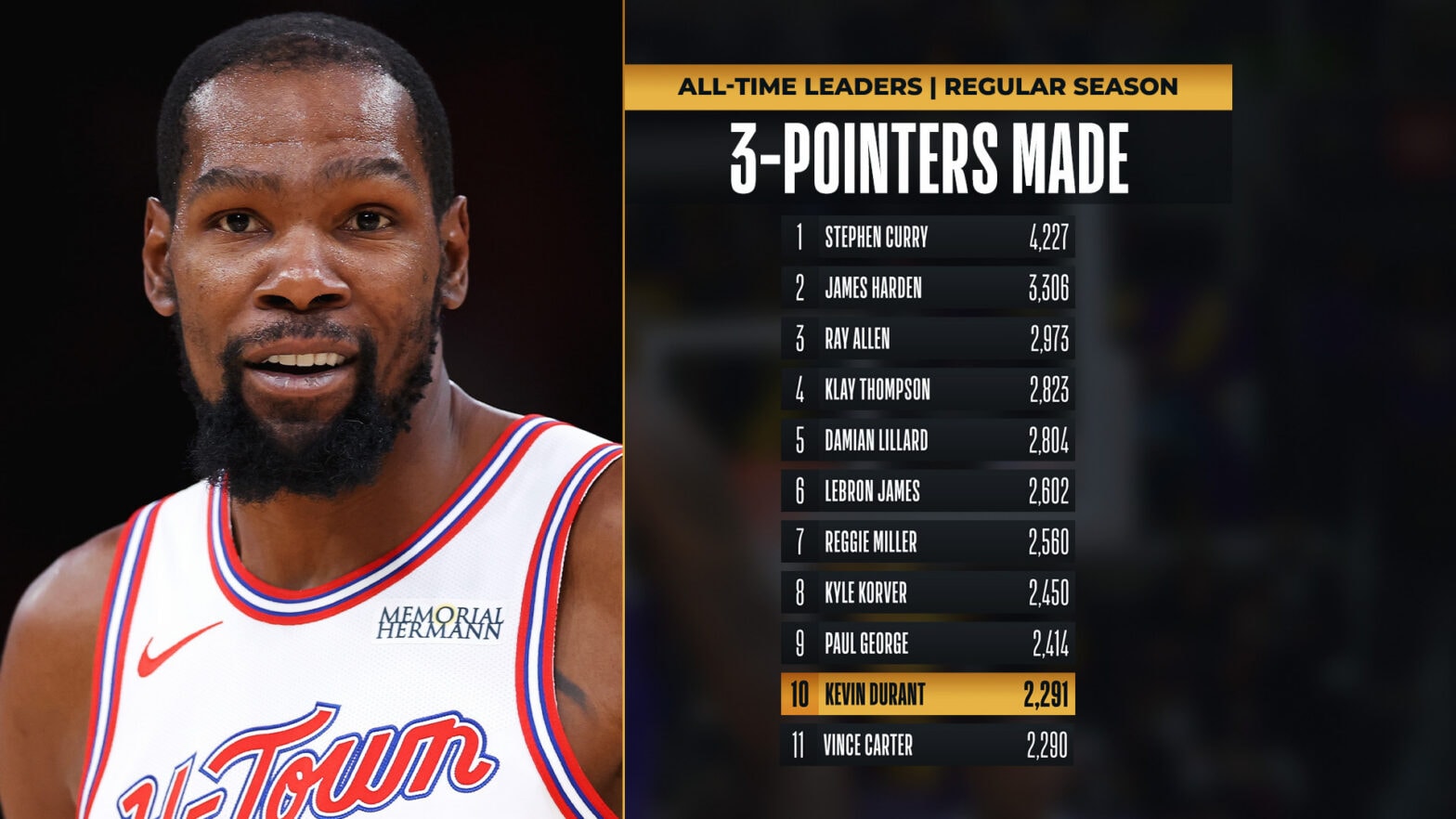
As of 2026, the five NBA all-time leaders in three-pointers made are Stephen Curry, James Harden, Ray Allen, Damian Lillard, and Reggie Miller. These athletes represent the evolution of the game, transitioning from the three-pointer as a niche tactical weapon to the primary engine of modern professional basketball offenses.
The three-point line was once considered a gimmick when the NBA first adopted it for the 1979-1980 season. Fast forward to 2026, and it is the defining characteristic of the league. The players who sit atop the all-time list are not just great shooters; they are the architects of a fundamental shift in how basketball is played, coached, and defended. To understand their place in history, one must look beyond the raw totals and examine the context of their eras, their shooting mechanics, and the sheer volume of high-pressure shots they converted.
1. Stephen Curry: The Greatest Shooter of All Time
Stephen Curry does not just lead the list; he occupies a stratosphere of his own. By 2026, Curry has extended his record well beyond the 4,000-make threshold, a number that seemed impossible a generation ago. His ascent to the top of this list culminated on December 14, 2021, at Madison Square Garden, where he officially surpassed Ray Allen.
The Gravity of Curry
Curry’s impact is often described by analysts as "gravity." Because he is a threat to score from anywhere past half-court, defenses must stretch themselves to the breaking point. This creates lanes for his teammates and forces opposing coaches to abandon traditional defensive schemes. Unlike many specialist shooters before him, Curry is equally lethal off the dribble as he is in "catch-and-shoot" situations.
Technical Superiority
The secret to Curry's longevity and volume lies in his lightning-quick release—estimated at roughly 0.4 seconds. By 2026, sports science has extensively mapped his shooting motion, noting how he generates power from his base through his core, allowing for deep range without sacrificing form. His ability to maintain a high shooting percentage (consistently over 40% for much of his career) while taking the highest degree-of-difficulty shots in league history is what cements his status at the number one spot.
2. James Harden: The King of the Step-Back
James Harden’s rise to the second spot on the all-time list is a testament to the analytical revolution of the 2010s. While Curry revolutionized the movement-based three-pointer, Harden perfected the isolation-heavy, self-created triple. By 2026, Harden has solidified his position behind Curry, having surpassed Ray Allen during his stints with the 76ers and Clippers.
The Evolution of the Step-Back
Harden’s signature move—the step-back three—changed the defensive rules of the NBA. By utilizing a legal "zero step" or gather step, Harden created massive separation from defenders. This allowed him to generate high-volume three-point attempts without needing a teammate to pass him the ball. For several seasons in Houston, Harden’s unassisted three-pointers outpaced the total three-pointers of entire NBA teams from the 1980s.
Volume and Durability
Critics often point to Harden’s lower career percentage compared to Curry or Allen, but the context matters. Harden’s role as a primary ball-handler meant he was often forced into "bail-out" shots at the end of shot clocks. His ability to stay healthy and maintain elite conditioning into the mid-2020s allowed him to accumulate the numbers necessary to climb into the top two.
3. Ray Allen: The Prototype of Precision
Before the "Splash Brothers" era, Ray Allen was the gold standard for shooting. He held the record for over a decade after passing Reggie Miller in 2011. While he has been passed by Curry and Harden as of 2026, Allen remains the ultimate example of a "pure" shooting stroke and professional preparation.
From Slashing to Shooting
Early in his career with the Milwaukee Bucks and Seattle SuperSonics, Allen was a dynamic athlete and "Slam Dunk" contest participant. However, as he transitioned to the Boston Celtics and later the Miami Heat, he reinvented himself as the league’s premier perimeter specialist. This longevity allowed him to retire with 2,973 regular-season makes.
The Most Famous Shot in History
While this list tracks regular-season totals, Allen’s legacy is inextricably linked to Game 6 of the 2013 NBA Finals. His corner three-pointer to save the Miami Heat's season is widely considered the most clutch shot in basketball history. It exemplified his "preparation is everything" mantra; Allen famously practiced that exact back-pedaling corner shot thousands of times, ensuring that when the moment arrived, his muscle memory took over.
4. Damian Lillard: "Dame Time" and Logo Range
Damian Lillard’s presence in the top five highlights the "extended range" era of the NBA. Lillard, along with Curry, pushed the boundaries of what is considered a "good shot." By 2026, Lillard has firmly entrenched himself among the leaders, fueled by a decade of high-volume shooting in Portland and his subsequent years competing for championships in Milwaukee.
Deep Range and Pressure
Lillard is famous for his "Logo Lillard" persona, frequently taking and making shots from 30 to 35 feet. This range forces defenders to pick him up as soon as he crosses the half-court line. His placement on this list is a result of his ability to hit shots in the "clutch"—the final five minutes of close games. His walk-off series-ending threes against the Houston Rockets (2014) and Oklahoma City Thunder (2019) are among the most iconic moments of the modern era.
Mechanical Consistency
Lillard employs a "one-motion" shot, which is highly efficient for long-range attempts. By not having a significant pause at the top of his jump, he transfers energy from his legs directly into the ball. This allows him to maintain his form even when fatigued at the end of games, a key reason his volume has remained consistent well into his 30s.
5. Reggie Miller: The Original Perimeter Threat
Reggie Miller rounds out the top five, a position he has held or been near for over 20 years. When Miller retired in 2005, his 2,560 career three-pointers were considered an unbreakable record. While the modern explosion in three-point frequency has allowed active players to surpass him, Miller remains the "spiritual father" of the modern shooter.
Shooting in the "Hand-Check" Era
What makes Miller’s total so impressive is the era in which he played. During the 1990s, the NBA was much more physical, and "hand-checking" (defenders using their hands to redirect offensive players) was legal. Miller had to fight through physical screens and constant contact to get his shots off. Unlike modern players who benefit from "freedom of movement" rules, Miller’s totals were earned in the trenches of a much slower, more defensive league.
The Art of the Screen
Miller was a master of off-ball movement. He would sprint through a maze of "staggered screens" set by Pacers big men like Dale Davis and Antonio Davis, catching and shooting in one fluid motion. His ability to frustrate opponents—most notably the New York Knicks—through his shooting and legendary "trash talk" made him one of the most feared players in playoff history.
Statistical Comparison of the All-Time Leaders
The following table provides a breakdown of the statistics for these five legends. Note that for active players (Curry, Harden, Lillard), these figures reflect the projected standings as of the 2025-2026 season.
| Player | Total 3PM | Games Played | 3P% (Career Avg) | Era |
|---|---|---|---|---|
| Stephen Curry | 4,100+ | 1,100+ | ~42.5% | 2009–Present |
| James Harden | 3,100+ | 1,200+ | ~36.2% | 2009–Present |
| Ray Allen | 2,973 | 1,300 | 40.0% | 1996–2014 |
| Damian Lillard | 2,950+ | 1,000+ | ~37.1% | 2012–Present |
| Reggie Miller | 2,560 | 1,389 | 39.5% | 1987–2005 |
Note: Statistics for Curry, Harden, and Lillard are based on career trajectories and active status as of early 2026.
The Technical Shift: Why Records Are Falling
The presence of three active (or recently active) players in the top four is not a coincidence. Several technical and tactical factors have contributed to the "three-point explosion" that has rewritten the record books.
1. The Analytics Revolution
In the early 2010s, data analysts proved that a three-pointer shot at a 35% clip was more valuable than a two-pointer shot at 50% (1.05 points per shot vs. 1.00 points per shot). This led teams to discourage mid-range jumpers in favor of three-pointers and layups.
2. Pacing and Space
The NBA "Pace" (the number of possessions per game) has increased significantly since the late 2000s. More possessions mean more opportunities to shoot. Additionally, teams now utilize "Five-Out" lineups where every player on the floor is a shooting threat, making it harder for defenses to double-team the elite shooters like Curry or Lillard.
3. Skill Development at the Youth Level
The "Curry Effect" has trickled down to the grassroots level. Players entering the NBA in 2026 have been practicing deep three-pointers since they were in elementary school. The mechanical proficiency of the average NBA player regarding perimeter shooting is higher today than it was in any previous decade.
Potential Challengers to the Top 5
As we look at the landscape in 2026, several players are climbing the ranks and could eventually displace Reggie Miller or move higher on the list.
- Klay Thompson: Curry’s "Splash Brother" has a career total that rivals the top five, though injuries in the early 2020s slowed his accumulation. He remains one of the most efficient high-volume shooters ever.
- Buddy Hield: Known for his incredible durability and high-volume output, Hield has consistently been near the top of the "threes per season" leaderboard.
- Luka Dončić: While he takes many difficult shots, his sheer usage rate and young age suggest he could challenge these totals by the end of the 2030s.
Common Misconceptions About Three-Point Records
When discussing the all-time leaders, fans often overlook certain nuances that differentiate these shooters.
Volume vs. Efficiency: It is much easier to maintain a high percentage on three attempts per game than on eleven. Stephen Curry is the anomaly because he leads in both volume and efficiency. Most other leaders on the list had to trade a few percentage points of accuracy for the sheer gravity they provided by taking more shots.
The Shortened Line Era: It is worth noting that from 1994 to 1997, the NBA shortened the three-point line to a uniform 22 feet. This led to a temporary spike in percentages and makes for players like Reggie Miller. However, the all-time leaders have almost all produced the bulk of their numbers at the standard distance (23 feet, 9 inches at the top of the arc).
Frequently Asked Questions
Who has the most three-pointers in a single NBA season?
Stephen Curry holds the record for the most three-pointers in a single season, making 402 during the 2015-2016 campaign. This shattered his own previous record and remains the benchmark for elite shooting seasons.
How many three-pointers did Michael Jordan make?
Michael Jordan, despite being the greatest player of his era, was not a high-volume three-point shooter. He finished his career with 581 makes, as his game was focused on the mid-range and the rim. This highlights how much the game has changed since the 1990s.
Is the three-point record only for the regular season?
Yes, the "All-Time Leaders" list typically refers to regular-season statistics. However, if you include playoff statistics, Stephen Curry’s lead becomes even more substantial, as he has played in numerous deep playoff runs.
Who is the youngest player to reach 1,000 three-pointers?
As of 2026, several players have reached this milestone at increasingly young ages due to the volume of shots taken. Generally, players like Buddy Hield and Damian Lillard reached these milestones faster than the older generation because they took more attempts per game from the start of their careers.
Will Stephen Curry's record ever be broken?
While "never" is a long time, Curry's record is currently considered one of the most "unbreakable" in sports, similar to Cy Young's wins or Wayne Gretzky's points. A challenger would need to maintain an elite shooting percentage while taking 10+ threes per game for nearly 15 seasons without significant injury.
Final Thoughts for Fans and Analysts
The list of the top five NBA three-pointer leaders is more than a statistical leaderboard; it is a timeline of the league's tactical evolution. For those looking to understand the modern game, studying these five players—Curry, Harden, Allen, Lillard, and Miller—provides the ultimate blueprint.
As a next action, fans should look at True Shooting Percentage (TS%) and Effective Field Goal Percentage (eFG%) when comparing these players. These metrics provide a more comprehensive view of how three-point shooting impacts overall scoring efficiency. While the "total makes" tell us who had the longest and most productive careers, efficiency metrics tell us who was the most dangerous with the ball in their hands.