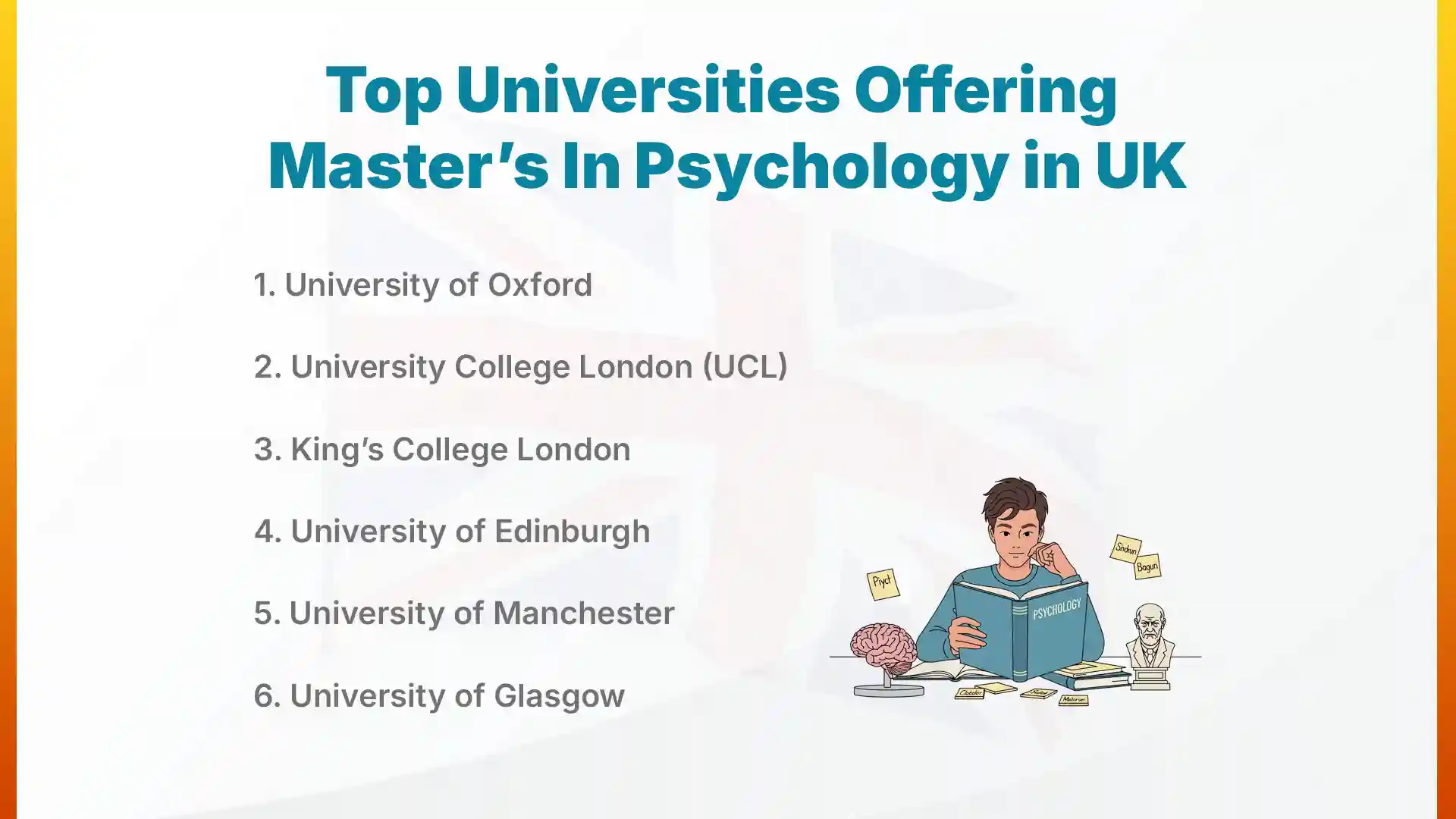
Choosing the right institution for a psychology degree in the United Kingdom involves more than just looking at a leaderboard. In 2026, the landscape of psychological science has shifted toward heavy integration with neuroscience, data science, and artificial intelligence. The best UK universities for psychology provide British Psychological Society (BPS) accreditation, world-class laboratory facilities, and a curriculum that bridges the gap between theoretical research and clinical practice.
The top five universities for psychology in the UK are the University of Cambridge, University of Oxford, University College London (UCL), King’s College London, and the University of Bath. These institutions consistently lead global rankings due to their high research output, rigorous entry requirements, and exceptional graduate employability within both the clinical and corporate sectors.
1. University of Cambridge: Psychological and Behavioural Sciences (PBS)
The University of Cambridge offers the Psychological and Behavioural Sciences (PBS) Tripos, a course that stands out for its flexibility and interdisciplinary depth. Unlike more rigid programs, Cambridge allows students to tailor their degree by incorporating papers from other departments, such as anthropology, sociology, and philosophy.
Course Philosophy and Structure
In 2026, the PBS course continues to emphasize a biological and experimental approach to the mind. Students are not just taught psychology; they are taught how to be scientists. The first year (Part IA) introduces the foundations of psychology alongside two optional papers. By the third year (Part II), students specialize intensely, often engaging in original research projects that contribute to the university’s massive body of published work.
The "Supervision" system remains Cambridge's greatest asset. Small-group teaching sessions—often just two students and a leading academic—ensure that students engage deeply with the material. This environment fosters critical thinking and allows for immediate feedback on complex psychological theories and statistical methods.
Facilities and Research
Cambridge is home to the Department of Psychology, which works in close proximity to the Medical Research Council (MRC) Cognition and Brain Sciences Unit. For a student in 2026, this means access to cutting-edge functional Magnetic Resonance Imaging (fMRI) and electroencephalography (EEG) facilities. Research at Cambridge often focuses on cognitive neuroscience, developmental psychology, and social psychology, providing a well-rounded foundation for any career path.
Entry Requirements for 2026
- A-levels: A*A*A (Typically requires at least one science or mathematics subject).
- IB: 40-42 points, with 776 at Higher Level.
- Assessment: Applicants must usually complete a pre-interview assessment and submit a portfolio of written work.
2. University of Oxford: Experimental Psychology
The University of Oxford remains a global powerhouse for psychology, specifically through its Experimental Psychology department. The course is designed for those who want to understand the "how" and "why" of human behavior through the lens of rigorous experimentation and statistical analysis.
The Experimental Edge
Oxford offers two primary pathways: Psychology (Experimental) or Psychology, Philosophy, and Linguistics (PPL). The Experimental Psychology track is intensely focused on the core areas of the discipline: biological, cognitive, social, and developmental psychology. In 2026, the curriculum has a strong emphasis on computational modeling, reflecting the modern shift toward data-heavy psychological research.
The tutorials at Oxford are legendary for their intensity. Students are expected to produce weekly essays that synthesize vast amounts of primary research, which they then defend in a one-on-one or two-on-one setting with a professor. This develops a level of communicative and analytical precision that is highly valued in both clinical psychology and high-level consultancy.
Careers and Accreditation
The degree is fully accredited by the BPS, providing the Graduate Basis for Chartered Membership (GBC). This is the essential first step for anyone intending to become a Chartered Psychologist in the UK. Oxford graduates are frequently recruited by top-tier research institutions, the Civil Service, and global tech firms specializing in human-computer interaction.
Entry Requirements for 2026
- A-levels: A*AA (Science subjects are highly recommended).
- IB: 39 (including core points) with 766 at Higher Level.
- Admissions Test: Completion of the Thinking Skills Assessment (TSA) is mandatory.
3. University College London (UCL): Division of Psychology and Language Sciences
UCL is arguably the largest and most influential hub for psychology in Europe. The Division of Psychology and Language Sciences (PALS) offers a BSc in Psychology that is renowned for its breadth and its proximity to the world-famous Queen Square Institute of Neurology.
A Diverse Research Ecosystem
What sets UCL apart in 2026 is the sheer variety of specializations available. Because the department is so large, students can choose from an unparalleled range of final-year modules, covering everything from the psychology of climate change to advanced neuropsychology. The program is heavily data-driven, ensuring students are proficient in R, Python, and advanced statistical software by the time they graduate.
UCL’s location in the heart of London provides unique networking opportunities. The university maintains strong ties with Great Ormond Street Hospital and the National Hospital for Neurology and Neurosurgery, offering students a front-row seat to the application of psychology in medical and clinical settings.
Global Standing
Consistently ranked in the top five globally for psychology, UCL’s reputation is built on "research-led teaching." This means that the person lecturing you on memory or visual perception is often the person who wrote the definitive paper on the subject.
Entry Requirements for 2026
- A-levels: A*AA (Must include at least one from Biology, Chemistry, Mathematics, or Physics).
- IB: 39 points with a total of 19 in three Higher Level subjects.
4. King’s College London (KCL): Institute of Psychiatry, Psychology & Neuroscience (IoPPN)
For students specifically interested in the intersection of psychology and mental health, King’s College London is the premier choice. The BSc Psychology program is taught at the Institute of Psychiatry, Psychology & Neuroscience (IoPPN), one of the world's leading centers for psychiatric research.
Clinical Focus and the Maudsley Connection
The IoPPN is unique because it is located on the same site as the Maudsley Hospital, the UK's largest mental health provider. This allows the undergraduate curriculum to be deeply informed by clinical practice. In 2026, KCL students benefit from placement opportunities and guest lectures from practicing clinical psychologists and psychiatrists that few other universities can match.
The course covers the full spectrum of psychology but leans more heavily into the biological and clinical aspects compared to the social-science focus of other institutions. If your goal is to pursue a Doctorate in Clinical Psychology (DClinPsy), the foundation provided at King’s is second to none.
Innovation in 2026
King's has pioneered the use of Virtual Reality (VR) in treating phobias and psychosis. Undergraduate students often have the chance to see these technologies in action or participate in research projects involving neuroimaging and genomic studies of mental health.
Entry Requirements for 2026
- A-levels: A*AA (One science or math subject required).
- IB: 35 points including 766 at Higher Level.
5. University of Bath: The Placement Specialist
While the other four universities on this list are often chosen for their pure research prestige, the University of Bath earns its spot through a combination of academic excellence and professional focus. Bath’s psychology program is consistently ranked in the top five by UK domestic guides like The Guardian and The Times.
The Professional Placement Year
The defining feature of psychology at Bath is the optional (but highly encouraged) four-year sandwich degree. In the 2025/2026 academic year, Bath continues to lead the way in placing students in high-impact year-long internships. These placements occur in clinical settings, forensic units, corporate HR departments, and high-performance sports organizations.
This focus on employability makes Bath graduates some of the most "work-ready" in the country. The university’s Department of Psychology is known for its friendly, supportive atmosphere, which contrasts with the high-pressure environments of Oxbridge.
Research Specializations
Bath excels in health psychology, social psychology, and digital behavior. Their research into how people interact with technology—a critical field in 2026—is particularly strong, providing students with insights into the future of the digital economy.
Entry Requirements for 2026
- A-levels: A*AA.
- IB: 36 points with 766 at Higher Level.
Comparison of Top 5 UK Psychology Programs (2026)
| University | Degree Title | BPS Accredited? | Primary Strength | Typical A-level Offer |
|---|---|---|---|---|
| Cambridge | PBS Tripos | Yes | Interdisciplinary & Tutorials | A*A*A |
| Oxford | Experimental Psychology | Yes | Scientific Rigour & Research | A*AA |
| UCL | BSc Psychology | Yes | Breadth & Neuroscience | A*AA |
| King's (KCL) | BSc Psychology | Yes | Clinical & Mental Health | A*AA |
| Bath | BSc Psychology | Yes | Industry Placements | A*AA |
Understanding BPS Accreditation and the Path to Chartership
A critical factor for any student in 2026 is ensuring their chosen degree is accredited by the British Psychological Society (BPS). All five universities listed above meet this requirement. Accreditation is the quality mark that ensures the curriculum covers the core areas of psychology required for professional practice.
The GBC Requirement
The "Graduate Basis for Chartered Membership" (GBC) is the first step on the ladder. Without a BPS-accredited undergraduate degree (or an accredited conversion course), you cannot progress to specialized postgraduate training in fields such as:
- Clinical Psychology
- Educational Psychology
- Forensic Psychology
- Occupational Psychology
- Sport and Exercise Psychology
The Shift to "Chartered Scientist" Status
By 2026, there is an increasing emphasis on psychologists also achieving Chartered Scientist (CSci) status. This reflects the discipline's evolution into a hard science. Choosing a university with strong laboratory components, such as Oxford or UCL, provides a significant advantage for those pursuing this technical designation.
Key Considerations for Applicants in 2026
When deciding between these top institutions, prospective students should look beyond the general ranking and consider the specific "flavor" of each department.
- Mathematical and Statistical Proficiency: In 2026, psychology is a quantitative discipline. You will spend a significant amount of time learning statistics and coding. If you dislike mathematics, you may find the courses at UCL or Oxford particularly challenging.
- The Role of AI: Many UK psychology departments have integrated AI and machine learning into their research. Consider if you want to study the psychology of AI or use AI as a tool for psychological research.
- Location and Environment: The collegiate system of Oxford and Cambridge offers a very different lifestyle compared to the urban, multi-campus feel of UCL or King's.
- Tuition Fees and Funding: For 2026, home student fees remain capped (currently around £9,250 per year), but international fees can vary significantly between these five institutions, often ranging from £28,000 to £40,000 per year.
Frequently Asked Questions
Which UK university is best for clinical psychology?
While all five are excellent, King’s College London (KCL) is widely considered the best for clinical psychology due to its direct link with the IoPPN and the Maudsley Hospital. This provides students with clinical exposure and research opportunities specifically geared toward mental health.
Do I need A-level Mathematics for a psychology degree?
While not strictly required by every university on this list, A-level Mathematics or a science (Biology, Chemistry, Physics) is highly recommended. Oxford and Cambridge specifically look for scientific aptitude, and most top-tier programs involve significant statistical analysis that assumes a high level of mathematical comfort.
Is a BA in Psychology different from a BSc in Psychology?
In the UK, the BSc (Bachelor of Science) is the standard for psychology because it emphasizes the scientific method and empirical research. A BA (Bachelor of Arts) may focus more on the social or philosophical aspects. However, both can be BPS-accredited. The most important thing is to check the GBC accreditation status, not just the title.
How competitive are these universities in 2026?
Entry remains extremely competitive. Most of these programs receive 10 to 15 applications for every available spot. Successful applicants in 2026 typically have a strong profile that includes not just top grades, but also evidence of "super-curricular" engagement, such as reading academic journals or completing relevant work experience.
Can I practice as a psychologist immediately after a BSc?
No. In the UK, the title "Psychologist" is not protected, but "Chartered Psychologist" is. To practice clinically, you must complete a BSc, followed by relevant work experience, and finally a three-year Doctorate (DClinPsy). Your undergraduate degree is only the first phase of a minimum 6-year journey.
Next Steps for Prospective Students
If you are aiming for a 2027 entry (applying in late 2026), your first action should be to attend University Open Days (typically held in June and September). Research the specific modules offered at each university, as the elective choices in years two and three are what truly differentiate these programs. Finally, ensure your UCAS personal statement demonstrates a clear understanding of psychology as an empirical science, rather than just a "helping profession."