William Shakespeare’s Sonnet 130, famously titled "My mistress' eyes are nothing like the sun," serves as a revolutionary subversion of the Petrarchan ideal. By systematically dismantling the hyperbolic metaphors common in Elizabethan love poetry, Shakespeare offers a grounded, authentic portrayal of human affection that favors honest imperfection over conventional, idealized beauty.
The Context of the Dark Lady Sonnets
To understand Sonnet 130, one must place it within the context of the "Dark Lady" sequence, typically identified as Sonnets 127 through 152 in the 1609 Quarto. Unlike the "Fair Youth" sequence, which often employs elevated and philosophical language to praise male beauty and virtue, the Dark Lady poems are characterized by a raw, complex, and often cynical tone.
In the 1590s, when Shakespeare was composing these works, the standard for love poetry was set by Italian poet Petrarch. Petrarchan sonnets relied heavily on blazons—a literary convention where the poet inventories a woman’s features, comparing her eyes to the sun, her lips to coral, and her breath to perfume. Shakespeare, fully aware of these tropes, utilizes Sonnet 130 not to disparage his mistress, but to mock the artificiality of the very tradition he mastered.
Line-by-Line Breakdown and Analysis
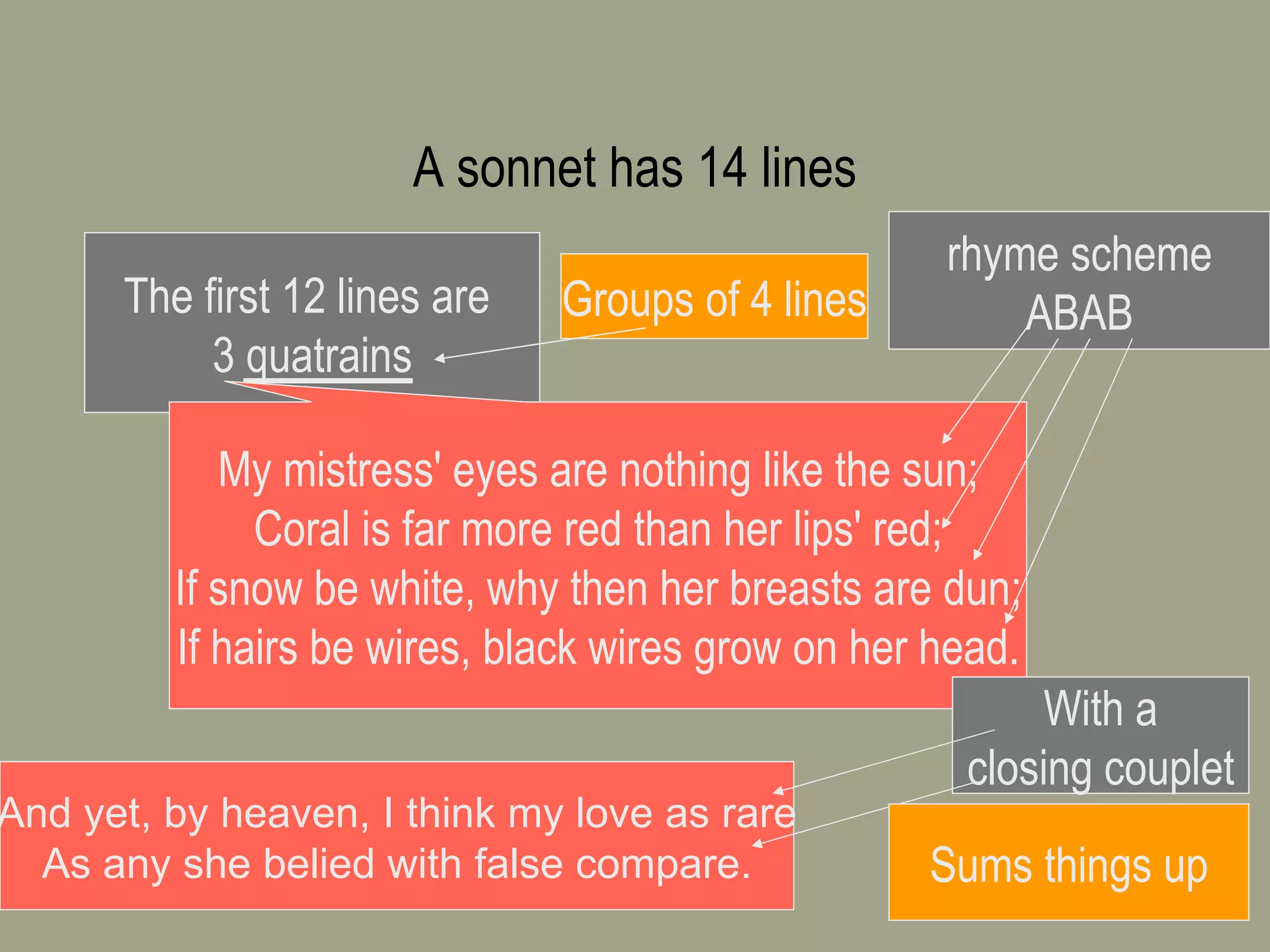
The structure of the sonnet follows the standard English (or Shakespearean) form: three quatrains and a final rhyming couplet, following an ABAB CDCD EFEF GG rhyme scheme.
Quatrain 1: Deconstructing the Visual Ideal
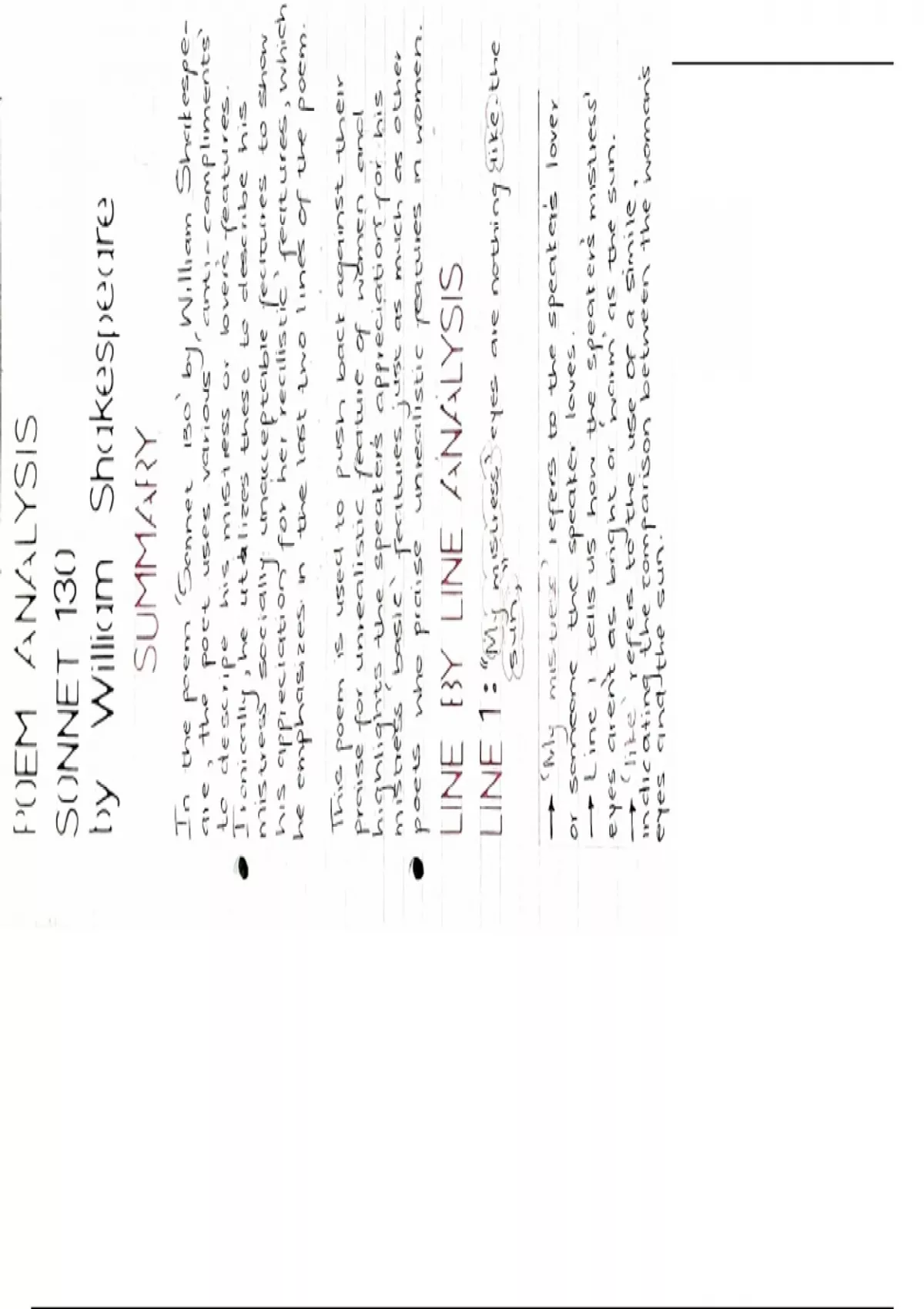
Line 1: "My mistress' eyes are nothing like the sun;" Shakespeare immediately rejects the most common superlative in Renaissance literature. By stating her eyes are "nothing like" the sun, he frames his subject in reality rather than celestial light.
Line 2: "Coral is far more red than her lips' red;" The poet compares his mistress’s lips to coral. Finding them less vibrant than the mineral suggests he is not interested in false, saturated descriptions. He acknowledges a deficit of color but implies it is not a deficit of attractiveness.
Line 3: "If snow be white, why then her breasts are dun;" The term "dun" refers to a grayish-brown or dusky color. By contrasting this with the standard "whiteness" of idealized beauty, Shakespeare emphasizes her natural, earthy complexion over the pale, alabaster standard demanded by society.
Line 4: "If hairs be wires, black wires grow on her head." In the 17th century, the ideal was golden hair. Calling her hair "wires" is a bold, almost jarring choice. Yet, it grounds the poem in a tactile reality—her hair is coarse and dark, not the thin, ethereal gold of poetic fantasy.
Quatrain 2: Addressing Scent and Sound
Line 5: "I have seen roses damask'd, red and white," "Damask'd" refers to a mixture of colors, often found in variegated roses. The poet acknowledges he has seen the high standard of natural beauty.
Line 6: "But no such roses see I in her cheeks;" He admits his mistress does not possess this specific, idealized rosy flush. By highlighting what she lacks, he validates his own powers of observation; he is not blind, just honest.
Line 7: "And in some perfumes is there more delight" He pivots to the sense of smell, again referencing the common practice of comparing a lover's breath to rare spices or perfumes.
Line 8: "Than in the breath that from my mistress reeks." "Reeks" in the Elizabethan period meant "to emit a scent" (not necessarily a foul one), but its choice here is pointed. It is a biological, human reality that acknowledges her as a living, breathing person rather than a floral abstraction.
Quatrain 3: Challenging the Romanticized Ideal
Line 9: "I love to hear her speak, yet well I know" The turn of the poem shifts from physical attributes to the experience of presence. He loves her voice, despite knowing it lacks the musicality of a goddess.
Line 10: "That music hath a far more pleasing sound;" He concedes that instruments are more harmonious than human speech. He establishes a hierarchy where artifice (music) is "better" than nature, but he maintains his preference for his mistress.
Line 11: "I grant I never saw a goddess go;" A "goddess go" refers to the way a divine being walks. He admits he has never seen a supernatural being, distancing his love from the realm of mythology.
Line 12: "My mistress, when she walks, treads on the ground." This is the ultimate realist statement. She is human, subject to gravity, and earthbound. By saying she "treads on the ground," he centers her humanity as the very reason for his affection.
The Couplet: The Final Realization
Line 13: "And yet, by heaven, I think my love as rare" "And yet" serves as the volta (the turn). Despite all the physical "shortcomings" he has listed, he concludes she is unique ("rare").
Line 14: "As any she belied with false compare." "Belied" means lied about or misrepresented. "False compare" refers to the hyperbolic metaphors of his peers. He asserts that his love is more valuable than those described with false, flattering comparisons, because his love is rooted in truth.
Comparative Analysis of Imagery
| Feature | Conventional Trope | Shakespeare's Realism (Sonnet 130) |
|---|---|---|
| Eyes | The Sun | Natural, human, non-radiant |
| Lips | Coral (Red) | Less red than coral |
| Skin | White as Snow | Dun (grayish-brown) |
| Hair | Golden threads | Black, wire-like |
| Breath | Perfume | Natural human scent |
| Motion | Goddess-like | Treads on the ground |
The Philosophy of Honest Love
The primary intent of Sonnet 130 is to define love as an acceptance of reality. Throughout the 15th and 16th centuries, the sonnet form was often a vehicle for vanity. A poet would write a sonnet to prove his own wit by creating increasingly elaborate metaphors for his subject.
Shakespeare flips this on its head. By creating an inventory of "imperfections," he invites the reader to consider what constitutes true love. Does loving someone require us to pretend they are something they are not? Shakespeare argues that such falsehoods actually cheapen the affection. By calling her a human woman who walks on the ground, he elevates her status to something attainable, tangible, and, ultimately, more profound than an imaginary goddess.
Common Interpretations and Academic Disputes
There has been significant debate regarding the tone of this sonnet. Some critics in the 20th century interpreted the poem as a misogynistic attack, arguing that the poet is insulting the woman by calling her hair wires and her breath a "reek."
However, a modern critical consensus—and one that fits the intellectual climate of 2026—suggests that the poem is a defensive reaction against the dehumanizing tendencies of the sonnet tradition. Shakespeare is not critiquing the woman; he is critiquing the society that expects women to be measured against unreachable, inanimate, or divine standards. The "Dark Lady" is allowed to be human, and that humanity is her most attractive quality.
Practical Implications for Modern Readers
When reading or teaching Sonnet 130 today, one should focus on the concept of aesthetic honesty. In an era dominated by curated digital appearances, the sonnet serves as a timeless reminder that authentic connection requires us to discard the "false compares" that filter our experiences.
If you are analyzing this poem for academic purposes, remember to focus on:
- The Subversion of the Blazon: Identify how he uses the form while mocking the content.
- The Role of the Volta: The transition in the final couplet is the hinge upon which the entire argument turns.
- The Humanizing Language: Note how every negative comparison actually serves to bring the mistress closer to the reader's own experience of humanity.
Frequently Asked Questions
Why does Shakespeare compare her hair to "black wires"? He uses this imagery to contrast his mistress with the Elizabethan ideal of long, golden, flowing hair. It establishes her as a woman of color and signifies that he prefers her natural, coarse texture over the soft, artificial ideals of his contemporaries.
Is Sonnet 130 an insult to the mistress? It is not an insult, but a subversion. By rejecting "false compares," Shakespeare argues that his love for her is more genuine than the love expressed by poets who use flowery, dishonest metaphors. He is praising her by seeing her as she truly is.
What does the word "damask'd" mean in this context? "Damask'd" refers to a rose that has variegated or mixed colors, specifically red and white. It was a common poetic descriptor for the idealized complexion of a woman’s cheek, which the poet explicitly denies his mistress possesses.
What is the "volta" in Sonnet 130? The volta, or turn, occurs in line 13 with the words "And yet." Before this point, the poet has listed various ways his mistress fails to meet beauty standards. After the turn, he asserts that his love for her is actually more valuable because it is honest and not based on lies.
Why is this poem considered "revolutionary"? It is revolutionary because it effectively killed the standard Petrarchan fashion of comparing women to celestial objects. It paved the way for more realistic, grounded, and psychologically complex love poetry that prioritized human truth over decorative artifice.
Conclusion and Next Steps
Sonnet 130 remains a cornerstone of English literature because it validates the human experience over the idealized abstraction. To deepen your understanding, I recommend reading Sonnet 127, which introduces the Dark Lady and provides further insight into why Shakespeare chose to celebrate this specific, non-traditional beauty. By moving away from the "false compares" of his predecessors, Shakespeare reminds us that true affection is found in the clarity of sight—seeing the person in front of you, not the reflection of a myth.