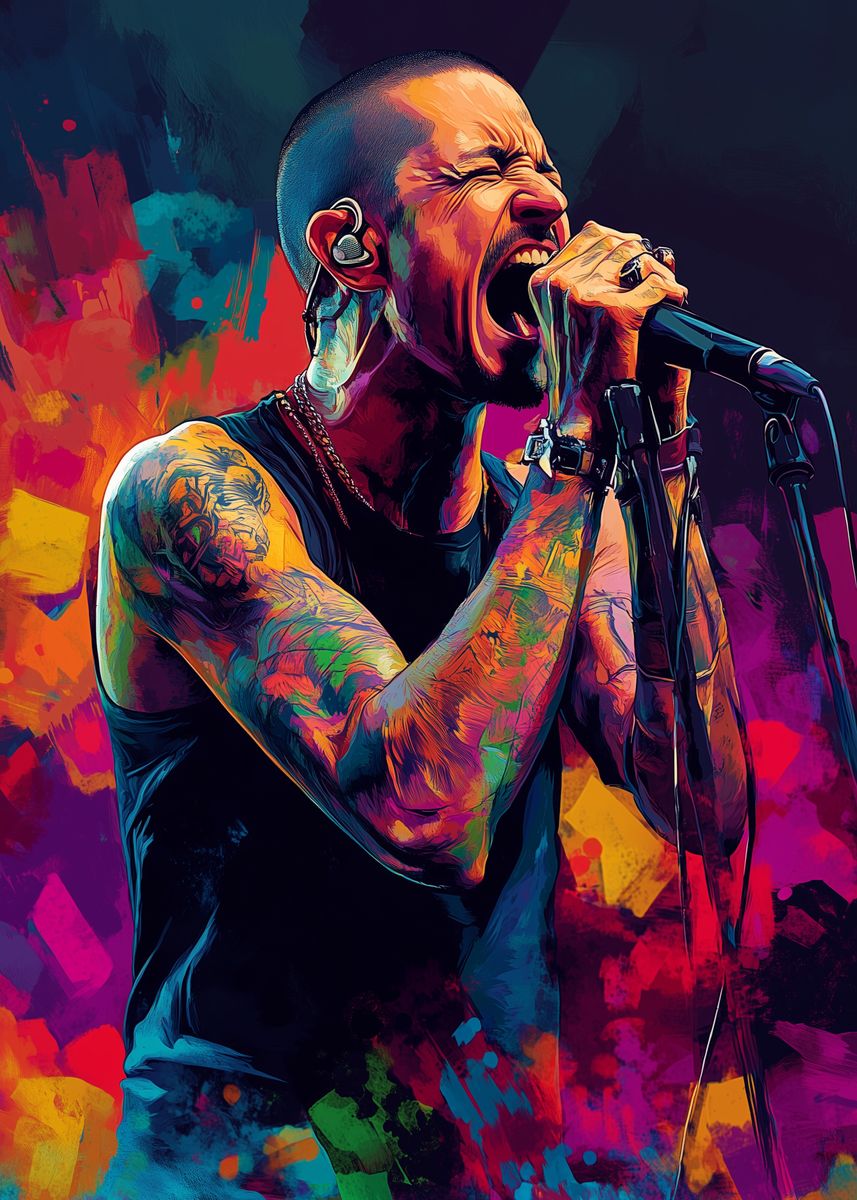
Chester Bennington is widely regarded as one of the most versatile and influential rock vocalists of his generation. His ability to seamlessly transition between hauntingly clean melodies and powerful, controlled grit—paired with a three-octave range—sets a technical standard in alternative rock and nu-metal that remains a benchmark for vocalists in 2026.
Vocal Classification and Range
To assess Chester Bennington as a singer, one must first identify his vocal type. Bennington was a natural tenor, a classification characterized by a high-lying tessitura and a bright, resonant timbre. While many rock singers rely on a limited "shouting" range, Bennington possessed a documented vocal range of approximately three octaves, spanning from G2 to G5.
His lower register, though less frequently showcased in Linkin Park’s early discography, was surprisingly warm and stable. Tracks like "The Messenger" from A Thousand Suns or his various acoustic performances of "Rolling in the Deep" demonstrated a grounded, baritone-adjacent quality in the lower third octave. However, it was his upper-mid and high registers that defined his career. Bennington could sustain high tenor notes (A4 to C5) with immense power, using a mix of chest and head voice that allowed for a "belting" sound without the thinness often associated with higher male voices.
The technical difficulty of Bennington’s range lies not just in the notes he reached, but in how he reached them. He often navigated the "passaggio"—the transition zone between chest voice and head voice—with remarkable fluidity. This allowed him to perform melodic hooks that required both the weight of a rock singer and the agility of a pop artist.
The Mastery of Vocal Distortion and the "Fry Scream"
Perhaps the most iconic element of Bennington’s vocal arsenal was his ability to apply distortion to his voice without losing pitch or damaging his vocal folds. In technical terms, Bennington utilized a combination of vocal fry and false cord activation to achieve his signature screams.
Unlike amateur vocalists who might "shout" from the throat (leading to immediate vocal fatigue and long-term damage), Bennington’s technique was rooted in high-pressure breath control and diaphragm support. This is most famously evidenced in the song "Given Up," where he holds a distorted, high-intensity scream for a continuous 17 seconds. From a physiological standpoint, maintaining that level of subglottic pressure while modulating the grit of the vocal folds requires elite-level athletic conditioning of the laryngeal muscles.
In 2026, vocal coaches still use Bennington’s isolated tracks to teach "distorted singing." His "grit" was not a random texture; it was a rhythmic and melodic tool. He could add distortion to specific syllables to emphasize emotional weight, then immediately pull back into a crystal-clear falsetto. This duality is a hallmark of a "good" singer: the ability to choose texture based on artistic intent rather than physical limitation.
Dynamic Range and Emotional Expressiveness
A common metric for assessing a singer’s quality is their dynamic range—the distance between their quietest and loudest functional singing. Bennington excelled here. His performance style was often described as "cathartic," but that catharsis was built on a foundation of careful dynamic building.
In songs like "Crawling" or "Numb," Bennington begins with a restrained, almost breathy delivery. This "breathy" quality is actually a deliberate technical choice (often called an aspirate onset), which conveys vulnerability. As the song progresses toward the chorus, he increases the vocal compression and air volume, transitioning into a full-voiced belt.
The Role of Emotional Resonance
While technicality can be measured, the "soul" of a singer is often subjective. However, in Bennington’s case, his emotional expressiveness was tied to his technical control. He used minor pitch inflections and "vocal cracks" (intentional breaks in the voice) to simulate genuine distress or passion. This isn't just "good singing" in a classical sense; it is master-level vocal acting. He understood how to match the timbre of his voice to the lyrical content, a skill that made Linkin Park’s music resonate across global cultures and languages.
Versatility Beyond Nu-Metal
To truly assess Bennington’s skill, one must look past his work with Linkin Park. His tenure as the lead singer of Stone Temple Pilots (2013–2015) and his side project Dead by Sunrise highlighted his ability to adapt to different genres.
In Stone Temple Pilots, Bennington had to step into the shoes of Scott Weiland, a singer known for a lower, "sludgy" grunge baritone. Bennington successfully adapted his tenor voice to fit the "swung" rhythms and blues-influenced melodies of STP, proving that he wasn't a "one-trick pony" reliant on nu-metal tropes. Furthermore, his collaborative work—ranging from the hip-hop infusions of Collision Course with Jay-Z to the electronic experimentalism of A Thousand Suns—showed a musician who could harmonize with synthesizers just as easily as he could compete with wall-of-sound guitar distortion.
Live Performance and Consistency
A "good singer" must be able to replicate their studio magic on stage. Throughout the 2000s and 2010s, Bennington was known for his rigorous touring schedule. Singing Bennington’s repertoire is notoriously difficult; the songs require high-energy belting and screaming for 90 minutes straight.
While he occasionally faced vocal strain (leading to canceled shows in 2003 and 2015), his overall career was a testament to his stamina. Live recordings, such as Live in Texas (2003) or Road to Revolution (2008), demonstrate that he rarely relied on backing tracks for his primary melodies. His ability to hit the high C#5 in "New Divide" live, night after night, confirmed that his studio recordings were not the product of digital pitch correction but rather genuine physical capability.
Technical Comparison with Contemporary Rock Vocalists
The following table compares Bennington’s vocal characteristics with other prominent vocalists of the same era to provide context for his standing in the industry.
| Vocalist | Primary Range | Signature Technique | Notable Strength |
|---|---|---|---|
| Chester Bennington | Tenor (G2 - G5) | Distorted Fry Scream | Seamless transitions between grit and clean; emotional intensity. |
| Chris Cornell | Baritone/Tenor (C2 - A5) | Power Belt / Head Voice | Immense power in the 5th octave; bluesy grit. |
| Maynard James Keenan | Tenor (G2 - Bb4) | Legato / Phrasing | Control, breath support, and rhythmic complexity. |
| Corey Taylor | Baritone (Eb2 - C6) | False Cord Screaming | Extreme range and aggressive percussive delivery. |
| Amy Lee | Mezzo-Soprano (Eb3 - E6) | Classical Legato / Belting | Ethereal tone and operatic control in high registers. |
Criticisms and Limitations
No assessment is complete without addressing limitations. Early in his career, some critics argued that Bennington’s delivery was overly "angsty" or repetitive. Technically, his early reliance on high-compression singing led to occasional pitch instability during high-energy live sets, where he would occasionally go sharp (singing slightly above the intended pitch) due to excessive adrenaline and air pressure.
Additionally, as he aged, the toll of his aggressive screaming technique became evident. In later years, particularly around the One More Light era, Bennington moved toward a much softer, pop-oriented vocal style. While fans of his heavier work missed the screams, this transition actually demonstrated a different kind of vocal maturity: the ability to sing with restraint and focus on pure tonal beauty rather than raw power.
The 2026 Perspective: Why He Still Matters
As of 2026, the landscape of rock and alternative music has shifted, yet Bennington’s influence is more prevalent than ever. The "emo-rap" and "genre-fluid" movements of the early 2020s owe a massive debt to Bennington’s vocal vulnerability. New generations of singers use digital tools to mimic the distortion he achieved naturally, but the "Bennington Standard" remains the goal for those seeking authentic, high-impact rock vocals.
His technical legacy is preserved through the rigorous study of his isolated vocal stems. Musicians in 2026 use these stems to analyze his vocal placement—how he resonated sound in the "mask" of his face to achieve projection without straining his throat. For any aspiring singer, Bennington represents the pinnacle of "hybrid" singing: the marriage of raw, unbridled emotion with disciplined, athletic technique.
Frequently Asked Questions
How did Chester Bennington scream for so long without losing his voice? Bennington utilized a technique known as "fry screaming," which involves using the diaphragm to push air through a partially closed glottis, creating a distorted sound without slamming the vocal folds together. This requires immense breath control and muscle memory to ensure the tension remains in the torso rather than the throat.
Was Chester Bennington a trained singer? While Bennington had a natural aptitude, he worked with various vocal coaches throughout his career, most notably during the mid-2000s, to refine his technique and protect his voice for touring. He was a proponent of vocal warm-ups and hydration to maintain his high-tenor range.
What is Chester Bennington’s most difficult song to sing? Technically, "Given Up" is often cited as his most difficult due to the 17-second scream. However, "The Messenger" and "One More Light" are also considered difficult because they require extreme vulnerability and perfect pitch control with very little instrumental backing to hide flaws.
How does Bennington's range compare to Freddie Mercury? Both Bennington and Freddie Mercury were tenors with roughly a three-to-four-octave range. While Mercury had a more operatic and vibrato-heavy style, Bennington specialized in contemporary rock textures and aggressive distortion. Both are considered among the greatest vocalists in rock history for their respective styles.
Did Bennington's voice change over time? Yes, like all singers, Bennington's voice matured. In the early 2000s (Hybrid Theory era), his voice was brighter and more nasal. By the 2010s, he developed a richer, more resonant mid-range and moved away from constant screaming toward more complex melodic phrasing.
Final Recommendation for Students of Voice
To truly appreciate and learn from Chester Bennington, one should listen to the unplugged and isolated vocal tracks of Linkin Park’s discography. Study the way he shapes his vowels—often opening his mouth wider on high notes to create more space for resonance. If you are a singer looking to emulate his style, prioritize breath support and clean melodic accuracy before attempting to add distortion. Bennington was a "good" singer because he mastered the fundamentals of pitch and tone before he ever mastered the scream.