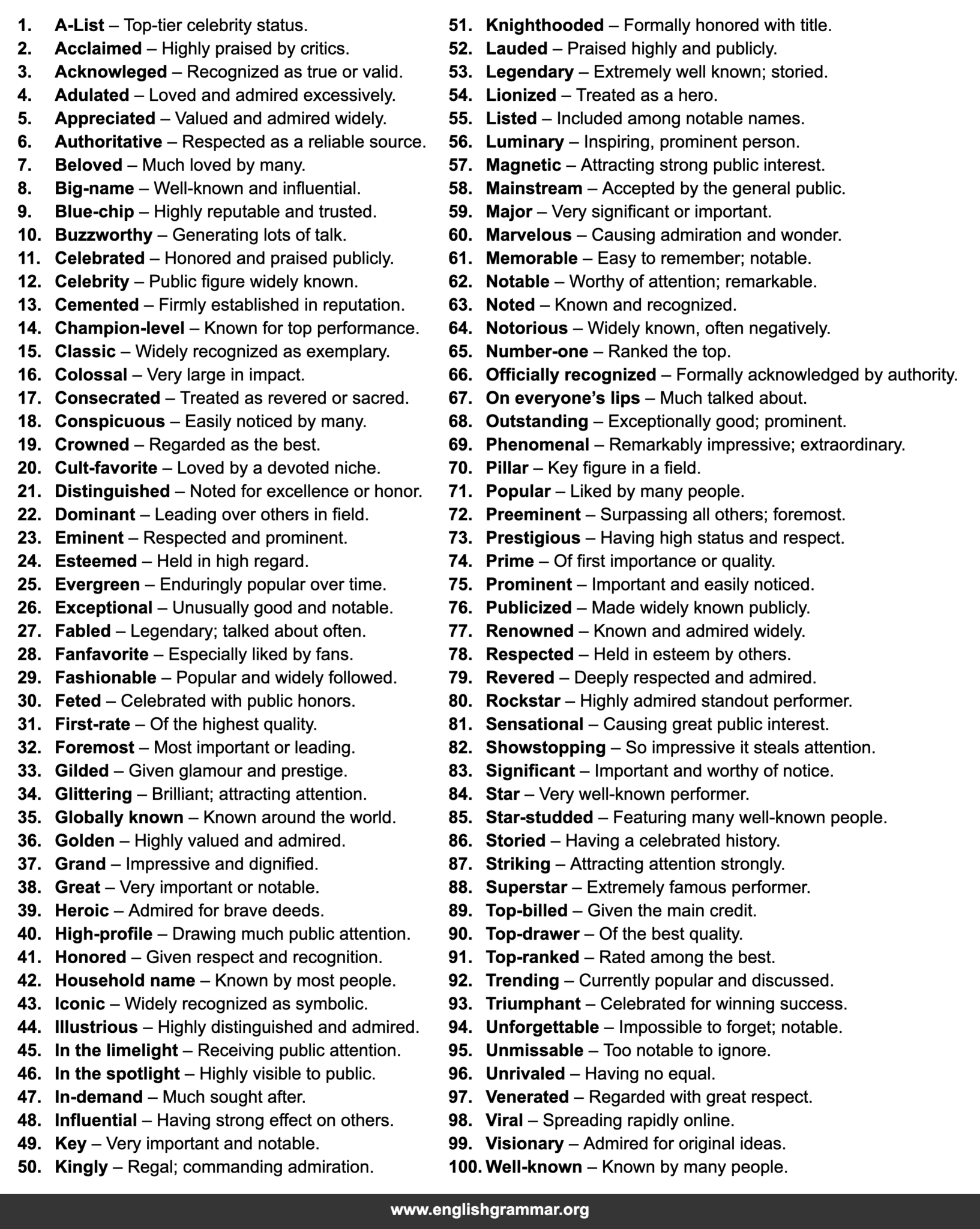
Seeking another word for famed often leads to terms like renowned, celebrated, or illustrious. While these words share a general meaning of being widely recognized, each carries unique connotations regarding prestige, duration, and the nature of the acclaim. Selecting the right alternative depends on the specific context and tone of your writing.
Understanding the Nuance of Fame
In the linguistic landscape of 2026, the word "famed" often feels slightly archaic or overly formal when used in casual conversation, yet it remains a staple in journalism, biography, and historical writing. At its core, "famed" describes a state of being known by many people, usually for something positive or remarkable. However, the English language offers a vast spectrum of alternatives that allow a writer to be much more precise.
When you look for a synonym, you aren't just looking for a word that means the same thing; you are looking for a word that captures the specific "flavor" of that fame. Is the person famous for their dignity? Use distinguished. Are they famous for a specific talent? Use renowned. Are they famous for their historical impact? Use storied. By moving beyond the basic term, you provide your reader with a clearer mental image of the subject's reputation.
High-Prestige Synonyms for Professional Success
When describing individuals who have reached the pinnacle of their careers or fields, certain synonyms carry a weight of authority and respect that "famed" lacks.
Renowned
Renowned is perhaps the most versatile high-level synonym. It suggests that the person or entity is known far and wide specifically for a particular skill, achievement, or quality. We often speak of a "renowned surgeon" or a "renowned university." The implication is that their fame is well-deserved and based on substantive work rather than mere celebrity.
Illustrious
If you are describing a career that is not only famous but also marked by brilliance and honor, illustrious is the superior choice. This word, which shares roots with "illustrate" and "luster," suggests a shining or glowing reputation. It is most frequently applied to historical figures, long-standing institutions, or families with a multi-generational legacy of achievement.
Eminent
Eminent conveys a sense of standing "above" others in a specific profession. While "famed" might imply that the general public knows who someone is, "eminent" suggests that they are highly respected within their specific niche. An eminent scholar might not be a household name, but they are a giant in their field of study.
Preeminent
Taking it a step further, preeminent describes someone who is the very best or most famous within a specific group. It combines the idea of fame with the idea of being "first" or "surpassing all others."
Synonyms Based on Public Praise and Celebration
Sometimes, fame is less about professional standing and more about the public's emotional response or the fanfare surrounding a subject.
Celebrated
To call someone celebrated is to highlight the fact that they are publicly praised and honored. This word works exceptionally well for artists, authors, and performers. A celebrated novel is one that has not only sold well but has been the subject of critical acclaim and public discussion. Unlike "famed," which can feel static, "celebrated" feels active—as if the world is currently in the process of applauding the subject.
Acclaimed
Similar to celebrated, acclaimed focuses on the reception of a work or person. It is almost always used in the context of positive reviews or official recognition. We hear of "critically acclaimed" films or "highly acclaimed" speakers. Use this when you want to emphasize that the fame comes from the high opinions of experts or the masses.
Noted
Noted is a more restrained synonym. It suggests that someone is well-known enough to be mentioned or observed, but it lacks the grandiosity of "illustrious." It is a professional, neutral term. For example, "a noted expert on climate change" sounds more objective than "a famed expert."
The Scale of Time: Legendary and Storied
Fame often changes as it ages. Words that describe contemporary fame differ from those used to describe figures from the past.
Legendary
When fame reaches a point where it borders on myth, legendary is the appropriate term. This synonym implies that the person’s deeds are so great that they are talked about as if they were part of a legend. It is commonly used for sports stars (a legendary quarterback) or cultural icons whose influence has spanned decades.
Storied
Storied is most often applied to places, objects, or institutions. A "storied past" suggests a history filled with interesting events and famous occurrences. If a stadium is "storied," it means many famous games have been played there. It captures the idea of fame that is built layer by layer over a long period.
Immortal
While literal immortality is rare, in literature and biography, immortal is used to describe fame that will never die. An "immortal poet" is one whose works will be read for centuries to come. This is the ultimate level of fame.
Distinguishing Fame from Infamy
One of the most important aspects of choosing a synonym for "famed" is ensuring the connotation is correct. Fame is generally positive, but being "well-known" is not always a good thing.
Notorious
If the subject is famous for something bad, do not use "famed." Instead, use notorious. A notorious criminal is widely known, but for reasons of shock or disapproval. Using "famed" in this context can mistakenly imply admiration.
Infamous
Infamous is the strongest synonym for negative fame. It describes a reputation that is "beyond fame" in its negativity. History is full of infamous villains. Interestingly, in some modern slang, "infamous" is used playfully, but in formal writing, it should strictly be reserved for those with a truly bad reputation.
Comparing Synonyms for "Famed"
The following table provides a quick reference to help you choose the correct word based on the context and the level of intensity you wish to convey.
| Synonym | Tone | Best Used For... | Example Sentence |
|---|---|---|---|
| Renowned | Formal/Respectful | Experts, artists, and specialized skills. | The city is renowned for its Gothic architecture. |
| Celebrated | Positive/Active | Publicly honored works or individuals. | The celebrated author signed copies of her new book. |
| Illustrious | Highly Formal | Long, honorable careers or histories. | He retired after an illustrious forty-year career in law. |
| Noted | Professional | Academic or specific expertise; factual. | A noted historian provided the keynote address. |
| Legendary | Grandiose | Larger-than-life figures or myths. | The legendary singer returned to the stage one last time. |
| Prominent | Neutral/Visible | People with influence or high visibility. | She is a prominent figure in the local tech scene. |
| Iconic | Modern/Popular | Symbols or people representing an era. | The skyscraper has become an iconic part of the skyline. |
| Notorious | Negative | People known for bad deeds or scandals. | The desert is notorious for its unpredictable flash floods. |
Contextual Usage: When to Use Which Word
In Business and Technology
In the corporate world of 2026, "famed" can sound a bit too much like a storybook. Instead, professional writers often use prominent or influential. For example, "a prominent venture capitalist" suggests they have power and visibility in the market. If a company is known for innovation, they might be called a distinguished leader in their field.
In Arts and Literature
When writing about the arts, the focus is often on the quality of the work. Acclaimed and celebrated are the standard here. If an artist has a very specific, recognizable style that others imitate, iconic is a highly effective synonym. It suggests that the person has become a symbol for their genre.
In Academic and Scientific Writing
Precision is key in academia. "Famed" is rarely used because it feels subjective. Instead, scholars use noted, eminent, or recognized. These words imply that the person’s "fame" is a result of peer-reviewed excellence and verifiable contributions to their field of study.
Practical Tips for Replacing "Famed"
- Identify the Source of Fame: Before picking a synonym, ask yourself why the subject is famous. If it is for their wisdom, use venerable. If it is for their bravery, use valiant or renowned.
- Check the Intensity: Don't use "legendary" for a local baker unless they truly have a mythic status in the community. Overusing high-intensity words can lead to "semantic bleaching," where the words lose their power.
- Consider the Audience: If you are writing a formal report, stay with noted or distinguished. If you are writing a blog post or a feature article, you have more freedom to use celebrated or iconic.
- Avoid Redundancy: Avoid phrases like "the famed and well-known actor." Since both words mean the same thing, pick the one that fits the sentence's rhythm better and stick with it.
The Evolution of "Fame" Vocabulary
As we move through 2026, the way we describe fame continues to evolve. With the rise of digital influence, new terms like high-profile or widely followed are beginning to act as modern synonyms for "famed." While these may not be appropriate for a historical biography, they are increasingly common in contemporary journalism.
However, the classic synonyms—renowned, illustrious, and noted—remain the most reliable tools for a writer. They provide a bridge between the reader and the subject, offering a specific window into how that person or thing is perceived by the world.
Frequently Asked Questions
What is the best synonym for "famed" in a formal essay?
In a formal essay, renowned or distinguished are typically the best choices. These words convey a sense of objective recognition and respect. Noted is also an excellent, more conservative option if you want to avoid sounding overly flowery.
Can "famed" and "famous" be used interchangeably?
While they are very close in meaning, "famous" is a more general, everyday term. "Famed" is often used as a past-participle adjective (e.g., "the famed explorer") and carries a slightly more literary or "storied" connotation than the simple "famous."
Is "infamous" just another word for "famed"?
No. While both words mean that a person is widely known, their meanings are opposite in terms of quality. "Famed" is positive or neutral, while "infamous" specifically means being well-known for something bad, shameful, or criminal.
When should I use "iconic" instead of "famed"?
Use iconic when the subject serves as a representative symbol of something larger. For example, the Eiffel Tower is famed, but it is also iconic because it symbolizes Paris and French culture. If a person or object has become a cultural shorthand for an idea, "iconic" is the better word.
What is a synonym for "famed" that implies historical importance?
Storied and illustrious are the best choices for historical contexts. Storied suggests a long history filled with many events, while illustrious emphasizes the greatness and honor associated with that history.
Final Recommendation for Writers
When you find yourself reaching for the word "famed," take a moment to pause and consider the specific nature of the recognition you are describing. If the subject is a respected professional, choose renowned. If they are a beloved artist, go with celebrated. If they are a historical figure of great dignity, use illustrious. By selecting the most precise synonym, you not only avoid repetition but also add layers of meaning and sophistication to your prose, ensuring your writing is as impactful as the subjects you describe.