Yes, former German Chancellor Angela Merkel speaks fluent English. Although she grew up in East Germany, where Russian was the mandatory foreign language, she learned English during her school years and expanded her skills as a quantum chemist. In private diplomatic talks, Merkel regularly conversed in English, though she frequently used official interpreters for public speeches and formal press conferences to guarantee precise wording.
Angela Merkel’s English Proficiency: Overview and Skill Level
Angela Merkel’s mastery of the English language is advanced, characterized by strong listening comprehension, a functional and precise vocabulary, and comfortable conversational fluency. While her public image for sixteen years as Germany’s Chancellor (2005–2021) was defined by her careful, measured German address, observers, diplomats, and world leaders have repeatedly verified that she is entirely capable of conducting high-level discussions in English without translation.
Her English accent is distinctly German, but her grammar, syntax, and grasp of complex political and economic terms are refined. She possesses a working proficiency that allows her to read complex international reports, policy briefs, and academic papers directly in English.
In informal settings, such as bilateral walks during G7 or G20 summits, working dinners, and private phone calls, Merkel routinely dispensed with interpreters. Foreign statesmen—including former U.S. Presidents George W. Bush and Barack Obama, as well as former British Prime Ministers David Cameron and Theresa May—have noted that their one-on-one interactions with Merkel were predominantly conducted in English.
However, a clear distinction exists between Merkel’s private fluency and her public execution. To understand why a leader who speaks fluent English might choose to deliver formal statements in German, it is necessary to examine her background, her career as a scientist, and the strategic demands of international diplomacy.
Language Education in East Germany: Russian, English, and Scientific Academia
Angela Merkel’s linguistic repertoire was heavily influenced by the geopolitical realities of her upbringing. Born in Hamburg in 1954, she moved to East Germany (the German Democratic Republic, or GDR) as an infant when her father, a Lutheran pastor, accepted a parish in Templin.
The Mandatory Focus on Russian
In the GDR educational system, Russian was compulsory for all students from an early age. Merkel excelled academically and demonstrated an extraordinary aptitude for languages. She won the nationwide East German Russian Language Olympiad multiple times, earning a trip to Moscow as a prize. Her fluency in Russian remained a core asset throughout her life, giving her a direct line of communication with Russian leaders later in her career.
- East German Education System (1960s–1970s)
- Compulsory Foreign Language: Russian (Merkel achieved national top marks)
- Secondary / Elective Language: English (Basic to intermediate school instruction)
Learning English in the Schoolroom and the Laboratory
While Russian took precedence in the GDR curriculum, English was also taught as a secondary foreign language. Merkel studied English at school, laying a foundational knowledge of grammar and basic vocabulary.
Her English skills expanded significantly when she entered higher education. She studied physics at the University of Leipzig from 1973 to 1978 and later earned her doctorate in quantum chemistry at the Central Institute for Physical Chemistry of the Academy of Sciences in East Berlin.
In the natural sciences—even behind the Iron Curtain—English was the universal language of academic literature. To keep up with international developments in quantum mechanics and molecular chemistry, scientific researchers were required to read, digest, and cite papers written in English. By the time the Berlin Wall fell in 1989, Merkel possessed advanced reading comprehension and functional literacy in scientific English.
Public Speeches vs. Behind-the-Scenes Diplomacy: How Merkel Used English
Throughout her political career, observers often asked why Merkel did not speak English more frequently in front of cameras if she was capable of doing so. The answer lies in the distinction between informal negotiation and formal public accountability.
| INFORMAL / PRIVATE SETTINGS | FORMAL / PUBLIC SETTINGS |
|---|---|
| • One-on-one meetings with US/UK leaders• Working dinners at summits (G7, G20, EU)• Direct phone calls with international heads• Goal: Build rapport and speak candidly | • Official press conferences• Bilateral summit statements• Keynote speeches abroad• Goal: Precise legal record |
The Strategic Value of Private English
Behind closed doors, direct communication builds trust and speeds up negotiation. Former U.S. officials recounted that during private sessions in the Oval Office or at Camp David, Merkel would switch seamlessly into English. This direct link allowed her to express subtle points, engage in humor, and negotiate fine policy points without waiting for sequential translation.
Her ability to speak English privately ensured that she was never isolated during informal social gatherings at summits. While larger formal roundtables featured simultaneous translation through earpieces, the spontaneous conversations that occurred in corridors or during breaks relied heavily on English as a lingua franca.
The Tactical Choice of Using German Publicly
In front of the media, Merkel almost exclusively used German, relying on professional diplomatic interpreters. This deliberate choice offered three distinct advantages:
- Absolute Precision: In international relations, a single misplaced word, tone, or nuance can trigger market volatility or diplomatic friction. Speaking in her native German allowed Merkel to control her exact phrasing.
- Cognitive Time: Working through an interpreter gives a speaker several extra seconds while the translation is delivered. This brief window allows a leader to process questions, evaluate strategic answers, and formulate responses under intense pressure.
- Domestic Representation: As the head of government for the Federal Republic of Germany, speaking German at official engagements reinforces national sovereignty and respects the domestic electorate back home.
Key Moments When Angela Merkel Spoke English Publicly
While Merkel preferred German for official duties, she made notable exceptions for international audiences, demonstrating her command of the language on high-profile global stages.
1. Address to the Houses of British Parliament (2014)
In February 2014, Merkel addressed a joint session of the British Parliament in London—an honor accorded to few foreign leaders. She began her historic address with several minutes of fluent English, acknowledging the significance of the invitation and playfully apologizing for her German-accented English before transitioning into German for the core policy section of the speech. Her opening remarks were widely praised for their warmth, humor, and linguistic clarity.
2. CNN Interview with Christiane Amanpour (2019)
Following the 2019 European Parliament elections, Merkel granted an extensive interview to CNN’s chief international anchor, Christiane Amanpour. While parts of the formal broadcast were translated for television formatting, Merkel conducted the session in English, responding directly to complex questions on nationalism, transatlantic relations, and climate change.
3. Harvard University Commencement Address (2019)
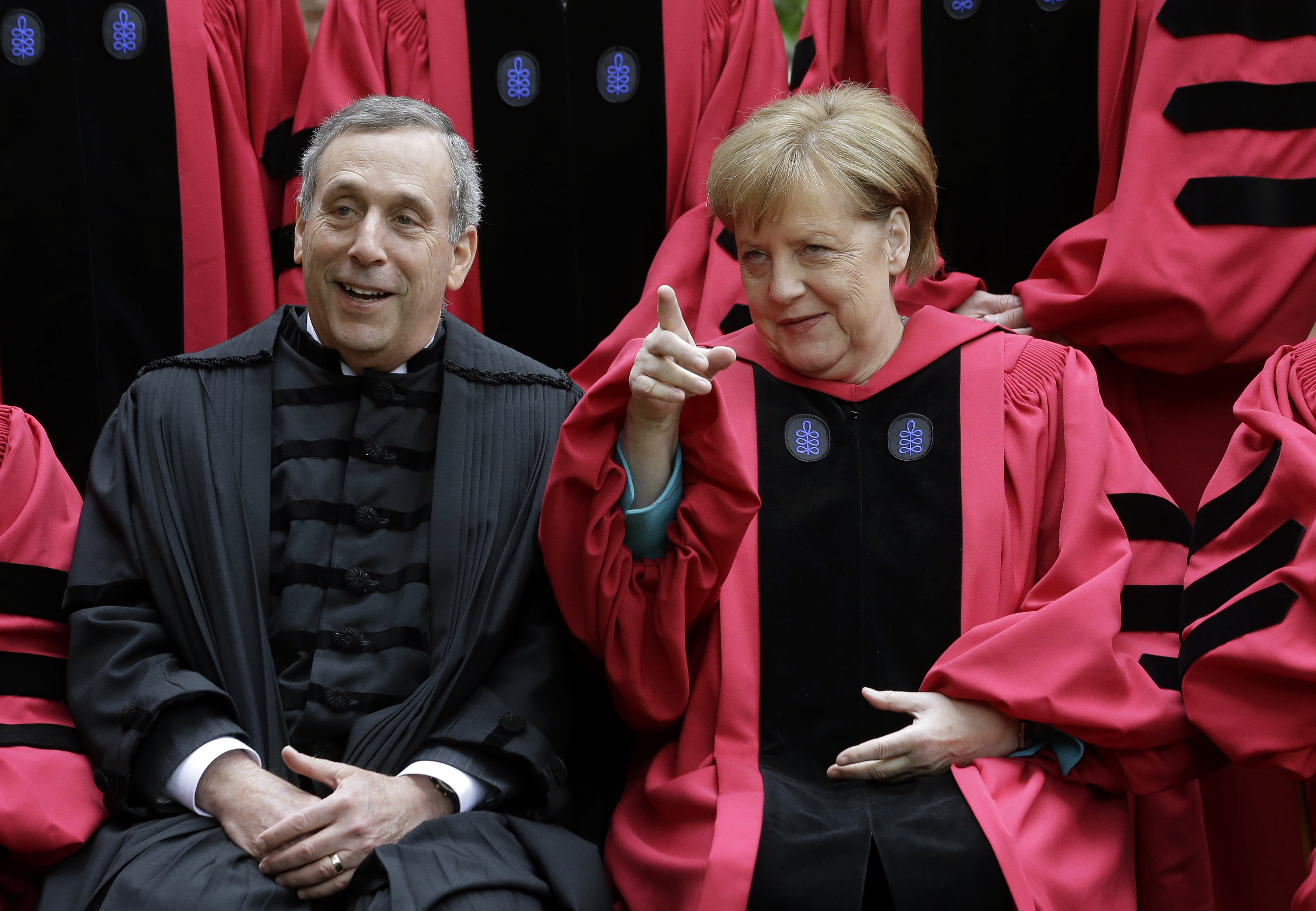
When Merkel delivered the keynote address at Harvard University’s 368th Commencement in May 2019, the core of her speech was delivered in German with live English translation for the audience. However, she delivered her introductory and concluding remarks directly in English, receiving standing ovations from the graduating class. Her capacity to engage the crowd in English highlighted her warmth and global perspective.
4. International Award Acceptance Speeches
Over her long career, Merkel received numerous international honors, including the Presidential Medal of Freedom in the United States and various honorary doctorates across Europe and North America. On several of these occasions, she delivered complete acceptance remarks in English, expressing gratitude to her hosts in their native language.
Comparative Analysis: Language Skills of European Leaders
To place Merkel’s language abilities in context, it helps to compare her skills with those of other major European political figures who have governed alongside or after her.
| Leader | Country | Native Language | English Proficiency Level | Russian Proficiency Level | Primary Public Strategy |
|---|---|---|---|---|---|
| Angela Merkel | Germany | German | Advanced / Fluent (C1) | Fluent (C1-C2) | Speaks native German publicly; uses English & Russian privately. |
| Emmanuel Macron | France | French | Advanced / Fluent (C1-C2) | None / Basic | Frequently delivers entire public speeches in English abroad. |
| Olaf Scholz | Germany | German | Advanced / Fluent (C1) | None | Speaks English fluently in international press and interviews. |
| Mark Rutte | Netherlands | Dutch | Native-Equivalent (C2) | None | Switches effortlessly to English in all international contexts. |
| Ursula von der Leyen | Germany (EU) | German | Native-Equivalent (C2) | Basic | Fully trilingual (German, English, French); speaks English publicly. |
| Vladimir Putin | Russia | Russian | Intermediate (B1-B2) | Advanced / Fluent in German | Speaks Russian publicly; uses fluent German with German leaders. |
This comparison highlights a generational and regional shift. While Northern European leaders like Mark Rutte or French President Emmanuel Macron frequently use English in public broadcasts, leaders of Merkel's generation from the former Eastern Bloc often relied on a mix of Russian and English, exercising greater caution in public foreign-language usage.
Dual Language Capabilities: Comparing Merkel’s English and Russian
Angela Merkel is one of the few post-Cold War Western leaders fluent in both English and Russian. This dual capability gave her a unique vantage point in global diplomacy, particularly during crisis negotiations involving Eastern Europe.
- ANGELA MERKEL'S LINGUISTIC TRIAD
- GERMAN (Native)
- Primary Governance
- Formal Press
- Public Speeches
- RUSSIAN (Fluent)
- Cold War Schooling
- Moscow Olympiad Winner
- Direct Putin Discussions
- ENGLISH (Fluent)
- Academic Career
- Transatlantic Talks
- G7/G20 Summits
- GERMAN (Native)
Direct Communication with Vladimir Putin
Merkel’s fluency in Russian played a historic role in her relationship with Russian President Vladimir Putin. Putin, who served as a KGB officer in Dresden during the late 1980s, speaks fluent German.
During their numerous bilateral summits and phone calls, the two leaders frequently swapped languages. Merkel would speak Russian to Putin, and Putin would respond in German, allowing them to bypass interpreters entirely when testing arguments or negotiating delicate ceasefire terms (such as during the Minsk agreements in 2014 and 2015).
Comparing Her Fluency Levels
- Russian: Her structural knowledge of Russian was honed in her youth through formal competitions, giving her a deep grammatical foundation. She can converse fluently on policy and cultural matters.
- English: Her English was developed through academic necessity and polished during decades of high-level political interaction. While less formal in its early training than her Russian, her English became equally functional for executive leadership and international governance.
Why World Leaders Use Interpreters Even When Fluent in English
Public curiosity often arises when fluent speakers like Angela Merkel choose to use interpreters during official visits. In high-stakes diplomacy, relying on professional translators is standard practice for several practical reasons.
Legal and Diplomatic Precision
Diplomatic declarations, treaties, and press conferences carry legal weight. A subtle difference between terms like "agrees to," "considers," or "notes" can alter the obligations of a sovereign state. Even native speakers can stumble over precise terminology under press interrogation. Using an interpreter ensures that the official record reflects the leader's exact intent in their national language.
Psychological and Tactical Timing
When a foreign journalist asks a complex question in English, a leader fluent in English understands the question immediately. While the interpreter translates the question into the leader's native language, the leader gains 10 to 15 seconds to formulate a strategic answer. This extra time helps prevent reactionary or emotional statements.
Cultural Pride and National Protocol
Head of state protocols often dictate that leaders speak the official language of the country they represent. Using one's native language asserts national identity and signals that all sovereign nations participate on equal linguistic footing, regardless of the dominance of global English.
Frequently Asked Questions
Can Angela Merkel speak English fluently?
Yes, Angela Merkel is fluent in English. She can hold complex conversations, read detailed documents, and conduct private diplomatic negotiations without the assistance of an interpreter.
What languages does Angela Merkel speak?
Angela Merkel speaks three languages: German (her native language), Russian (which she learned fluently in East German schools), and English (which she studied in school and expanded during her career as a physicist).
Did Angela Merkel speak English with Barack Obama and Joe Biden?
Yes. Multiple diplomatic sources and former White House officials have confirmed that Angela Merkel regularly spoke English during one-on-one meetings, private dinners, and informal conversations with U.S. Presidents, including Barack Obama and Joe Biden.
Why did Angela Merkel usually speak German in press conferences?
Merkel spoke German during press conferences to ensure absolute diplomatic and legal precision, to avoid misquotation by international media, to buy thinking time while waiting for translation, and to speak officially on behalf of the German public.
How did Angela Merkel learn English if she grew up in East Germany?
Although Russian was the compulsory primary foreign language in East Germany, basic English was taught as a secondary subject. Merkel expanded her English skills dramatically during her scientific training as a quantum chemist, where reading English research papers was mandatory.
Key Takeaways: Lessons from Merkel’s Approach to Language
Angela Merkel’s use of English offers valuable insights into leadership, strategic communication, and pragmatic diplomacy:
- Pragmatism Over Display: Merkel treated language as a functional tool for solving problems rather than a platform for public performance. She prioritized clear communication in private and extreme caution in public.
- Strategic Flexibility: Her ability to switch between German, English, and Russian allowed her to bridge divides between Western democracies and Eastern European powers for over a decade and a half.
- Respect for Precision: Even with advanced fluency, recognizing when to use an interpreter is a sign of diplomatic discipline, protecting leaders from preventable misunderstandings on the international stage.