Aldebaran is a prominent orange giant star located approximately 65 light-years from Earth in the constellation Taurus. Characterized by its distinct reddish-orange hue and its position as the "Eye of the Bull," it is the 14th brightest star in the night sky and serves as a primary navigational marker for astronomers.
The Physical Identity of Aldebaran
Aldebaran, scientifically designated as Alpha Tauri, is an evolved star that has moved past the main sequence stage of its life cycle. Classified as a K5 III giant, its physical characteristics are vastly different from those of our Sun. While the Sun is a yellow dwarf, Aldebaran has exhausted the hydrogen fuel in its core and expanded significantly.
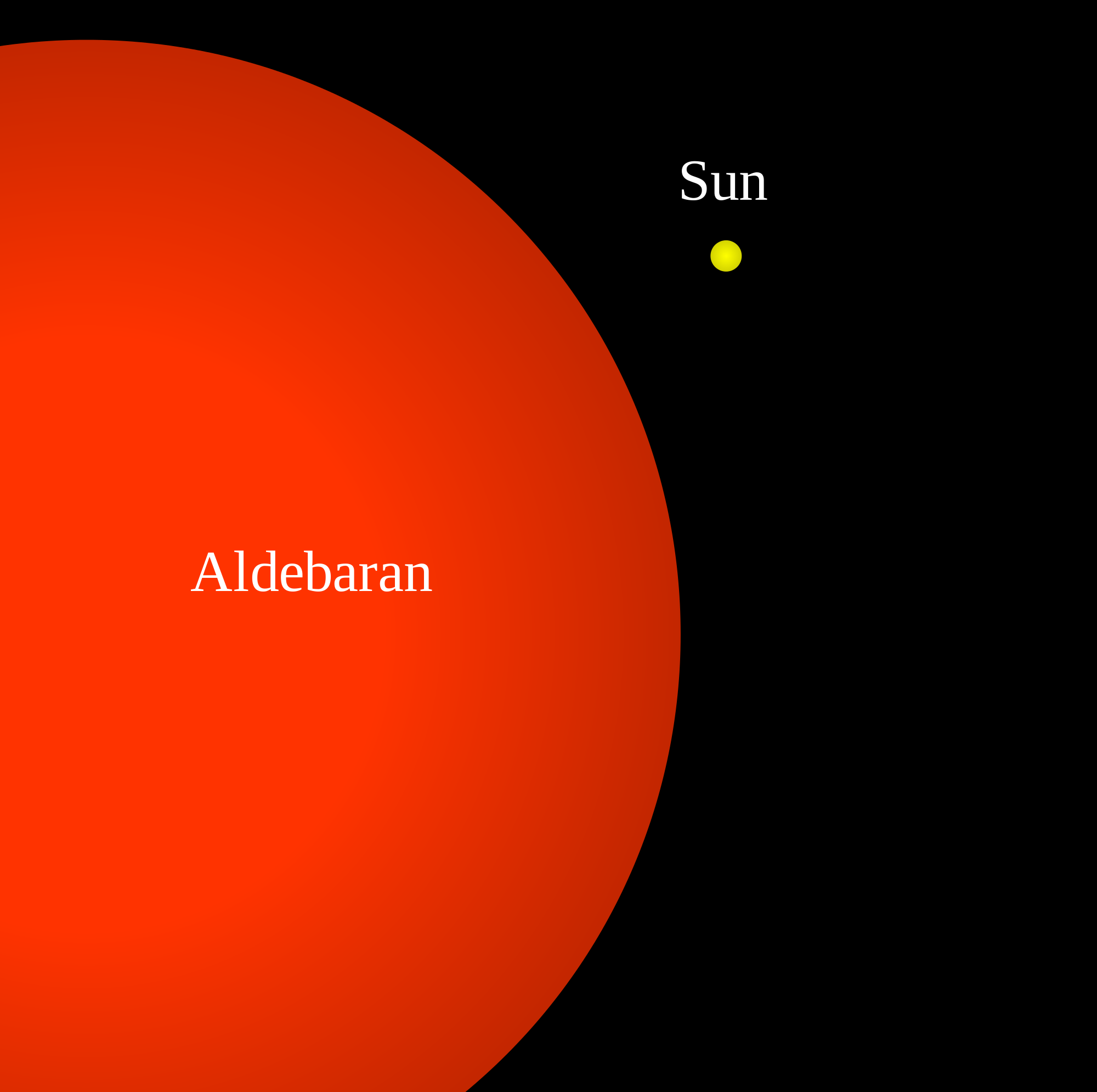
The most striking feature of Aldebaran is its size. It has a radius approximately 44 times that of the Sun. If Aldebaran were placed at the center of our solar system, its surface would extend halfway to the orbit of Mercury. Despite this massive volume, its mass is estimated to be only 1.1 to 1.7 times that of the Sun. This disparity between mass and volume indicates that the star has a very low average density; its outer layers are tenuous and "puffy" compared to the compact nature of main-sequence stars.
In terms of luminosity, Aldebaran shines about 400 times brighter than the Sun when considering all wavelengths of light. However, because it is cooler than the Sun—with a surface temperature of approximately 3,900 Kelvin—much of its energy is emitted in the infrared spectrum. To the naked eye, this lower temperature manifests as the warm, orange-red glow that makes it easily identifiable even in light-polluted urban skies.
Location and the Hyades Illusion
When observing the constellation Taurus, Aldebaran appears to be the brightest member of a V-shaped group of stars known as the Hyades cluster. This is a common misconception in amateur astronomy. In reality, Aldebaran is not a member of the Hyades.
The Hyades cluster is located about 150 light-years away from Earth. Aldebaran, situated at just over 65 light-years, is less than half that distance. It is a foreground star that happens to lie along the same line of sight. This geometric coincidence creates the visual "Eye of the Bull" within the V-shaped head of Taurus. Astronomers use the term "optical alignment" to describe this phenomenon, where stars at vastly different distances appear to be physically grouped together from our perspective on Earth.
Finding Aldebaran is relatively simple for observers in both the Northern and Southern Hemispheres. By locating the three stars of Orion’s Belt, an observer can follow an imaginary line through the belt toward the right (in the Northern Hemisphere) or left (in the Southern Hemisphere). The first bright, reddish star encountered along that line is Aldebaran.
The Evolution of an Orange Giant
To understand Aldebaran facts, one must understand the lifecycle of stars. Aldebaran was once a main-sequence star, likely an A-type star, much hotter and more massive than the Sun is now. As it consumed the hydrogen in its core, the resulting helium ash began to contract under gravity, heating up the surrounding shell of hydrogen.
This process caused the outer layers of the star to expand and cool, transitioning it into the Red Giant Branch (RGB) phase. Currently, Aldebaran is likely burning helium in its core or hydrogen in a shell surrounding the core. This stage of evolution is characterized by instability; Aldebaran is a slow irregular variable star (type LB). Its brightness fluctuates by about 0.2 magnitudes, though these changes are usually too subtle for the casual observer to notice without photometric equipment.
Eventually, Aldebaran will shed its outer layers, creating a planetary nebula, and leave behind a dense, cooling core known as a white dwarf. This process mirrors the future path of our own Sun, though Aldebaran is further along in this evolutionary journey.
The Planetary System: Aldebaran b
For decades, astronomers debated whether Aldebaran hosted any planets. The star’s inherent pulsations and "noise" in its light profile made it difficult to distinguish between stellar activity and the gravitational tug of an orbiting body. However, evidence for a massive planet, Aldebaran b, was first suggested in the 1990s and later supported by more refined radial velocity measurements.
Aldebaran b is a gas giant with a mass at least 6.5 times that of Jupiter. It orbits the star at a distance of roughly 1.45 Astronomical Units (AU)—about 45% further than Earth is from the Sun. Because Aldebaran is so much more luminous than the Sun, the "habitable zone" where liquid water could exist is much further out than in our solar system. Aldebaran b, being a gas giant, likely does not have a solid surface, though it remains a subject of intense study for exoplanet researchers interested in how planets survive the expansion of their host stars into giants.
| Characteristic | Aldebaran (Alpha Tauri) | The Sun (Sol) |
|---|---|---|
| Spectral Type | K5 III (Orange Giant) | G2 V (Yellow Dwarf) |
| Distance | 65.3 Light-Years | 0 Light-Years (Center) |
| Radius | ~44 Solar Radii | 1 Solar Radius |
| Mass | ~1.5 Solar Masses | 1 Solar Mass |
| Surface Temp | ~3,900 K | ~5,778 K |
| Luminosity | ~425 x Sun | 1 x Sun |
| Age | ~6.6 Billion Years | ~4.6 Billion Years |
Historical and Cultural Significance
The name Aldebaran is derived from the Arabic "al Dabarān," which translates to "The Follower." This refers to the star's apparent behavior in the night sky: it follows the Pleiades (the Seven Sisters) star cluster as the sky rotates from east to west.
Throughout history, Aldebaran has held a "royal" status. In ancient Persia, it was recognized as one of the Four Royal Stars, along with Regulus, Antares, and Fomalhaut. These stars were seen as guardians of the four quarters of the sky and were used to mark the seasons. Aldebaran was the watcher of the East and was associated with the vernal equinox approximately 5,000 years ago.
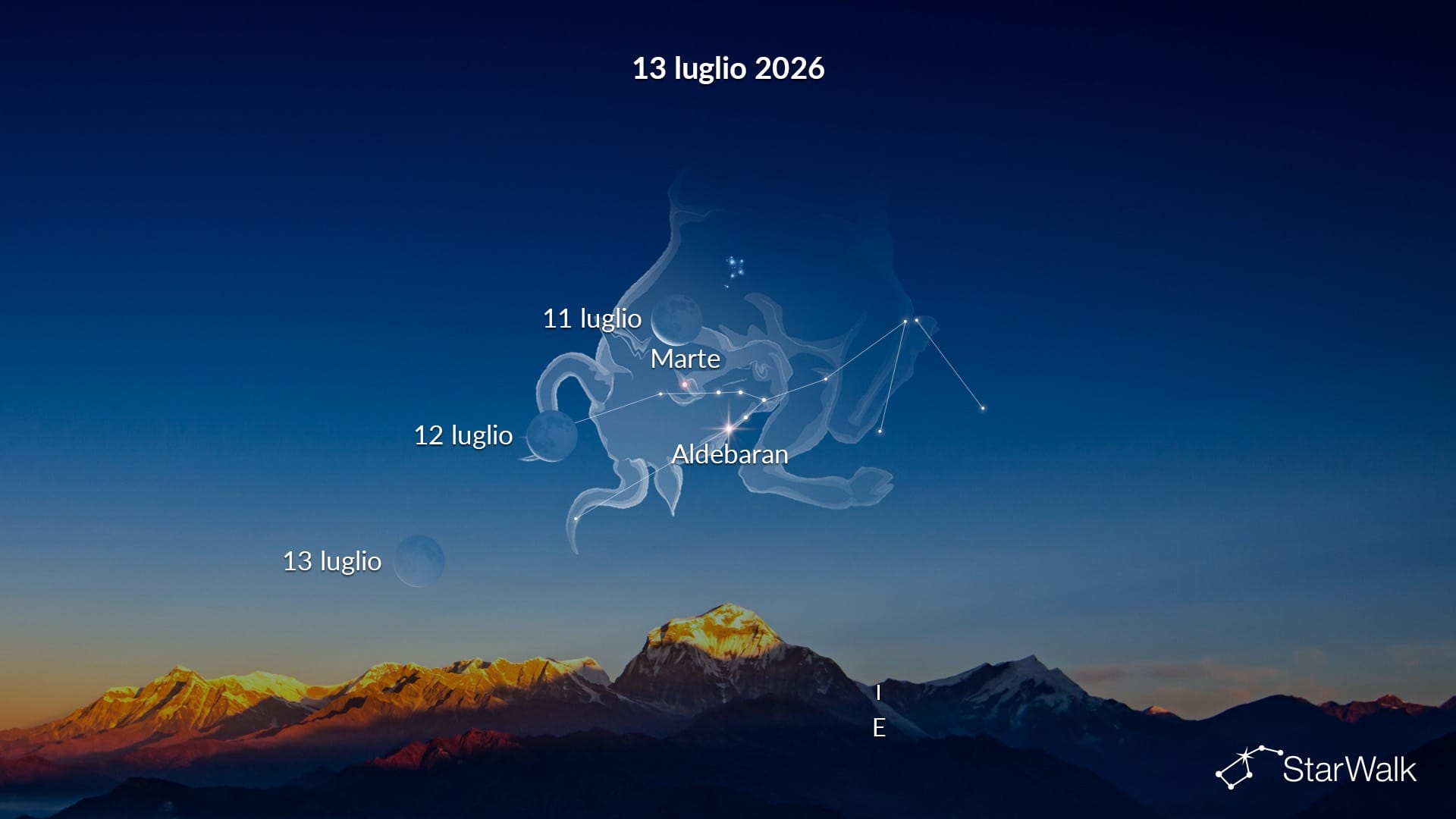
In Western astrology and mythology, its position as the eye of the bull in the Taurus constellation has linked it to themes of strength, steadfastness, and sometimes omen-bearing power. Its proximity to the ecliptic (the path the Sun and planets take through the sky) means that it is frequently occulted (covered) by the Moon, providing unique opportunities for astronomers to measure its angular diameter with extreme precision.
Aldebaran and Space Exploration
Interestingly, Aldebaran is the ultimate destination for one of humanity's earliest interstellar messengers. The Pioneer 10 spacecraft, launched by NASA in 1972, is currently traveling in the general direction of Aldebaran.
While Pioneer 10 sent its last signal to Earth in 2003, it continues its silent journey through the vacuum of space. It is moving at a speed of approximately 12 kilometers per second. Even at this immense speed, space is so vast that it will take Pioneer 10 roughly 2 million years to reach the vicinity of Aldebaran. By that time, the star will have moved significantly from its current position, and the spacecraft will likely pass by at a great distance rather than entering the system.
Observing Aldebaran in 2026
As of 2026, Aldebaran remains a primary target for amateur astronomers. Because of its high luminosity, it is one of the best stars for testing telescope optics and learning about stellar color.
- Best Time to View: In the Northern Hemisphere, Aldebaran is most prominent during the winter months (December through February). In the Southern Hemisphere, it is best viewed during the summer.
- Color Contrast: To truly appreciate its hue, compare it to nearby Rigel (in Orion) or Sirius. Rigel is a blue-white supergiant, and the contrast between its clinical white-blue light and Aldebaran’s warm orange glow is a classic exercise in stellar classification.
- Lunar Occultations: Check local astronomical calendars for 2026 for occultation events. When the Moon passes in front of Aldebaran, the star’s light disappears almost instantly, demonstrating its status as a point source of light despite its massive physical size.
- Binocular Targets: While Aldebaran itself is a single star to the naked eye, using binoculars reveals the depth of the Hyades cluster behind it. Although they are not physically related, the view of the bright orange giant framed by the dozens of dimmer, white stars of the Hyades is one of the most beautiful sights in the night sky.
Technical Measurement and Challenges
Determining the exact size and distance of Aldebaran has required the use of advanced techniques like interferometry. By combining the light from multiple telescopes, astronomers can resolve the "disk" of the star rather than seeing it as a mere point of light.
Because Aldebaran is relatively close to Earth (65 light-years), its parallax—the slight shift in its position as Earth orbits the Sun—is large enough to be measured with high precision by satellites like the European Space Agency's Gaia mission. These measurements are crucial for calibrating the cosmic distance ladder, allowing scientists to estimate the distances to much farther objects in the universe.
However, its nature as a giant star presents challenges. Giant stars often have complex atmospheres with large convection cells. This can create "hot spots" on the surface that may shift the apparent center of the star, complicating radial velocity measurements used to detect planets. Ongoing observations in 2026 continue to refine our understanding of Aldebaran b's orbit and whether other, smaller planets might be hiding in the glare of the orange giant.
Common Misconceptions
One of the most frequent errors regarding Aldebaran is the belief that its color indicates it is "burning" more intensely than other stars. In fact, the opposite is true. The reddish color indicates a cooler surface temperature. Just as a piece of heated metal glows red before it glows white-hot, stars that appear red or orange are cooler than blue or white stars.
Another misconception is that Aldebaran is part of a binary system with a close companion. While there are several dim stars located near Aldebaran in the sky (labeled Aldebaran B, C, etc.), most are not physically bound to it. They are independent stars at different distances that simply appear close due to our perspective.
Summary of Importance
Aldebaran is more than just a bright light in the sky; it is a laboratory for stellar evolution. By studying this orange giant, astronomers gain insights into the future of our own Sun and the mechanics of planetary systems around evolving stars. Its cultural legacy as "The Follower" and a "Royal Star" ensures it remains a bridge between ancient navigation and modern astrophysics.
Whether you are a professional researcher using interferometry to map its surface or a casual observer looking up on a cold winter night, Aldebaran serves as a reminder of the scale and beauty of the Milky Way galaxy.
Frequently Asked Questions
Is Aldebaran bigger than the Sun? Yes, Aldebaran is significantly larger than the Sun. It has a radius approximately 44 times that of the Sun. While the Sun is a G-type main-sequence dwarf, Aldebaran is a K-type orange giant that has expanded as it aged.
What color is Aldebaran? Aldebaran is characterized by a distinct reddish-orange color. This is due to its surface temperature of roughly 3,900 Kelvin, which is significantly cooler than the Sun’s 5,778 Kelvin.
Does Aldebaran have any planets? Current astronomical data confirms at least one planet, Aldebaran b. It is a massive gas giant, several times the mass of Jupiter, orbiting the star at a distance similar to Mars's orbit in our solar system.
Is Aldebaran part of the Big Dipper? No, Aldebaran is located in the constellation Taurus. The Big Dipper is an asterism within the constellation Ursa Major. Aldebaran is best found by using the belt of Orion as a pointer.
Will Aldebaran eventually explode as a supernova? No. Aldebaran does not have enough mass to end its life as a supernova. Instead, it will eventually shed its outer layers to form a planetary nebula and leave behind a white dwarf core.
Why is it called the "Eye of the Bull"? Aldebaran is the brightest star in the Taurus constellation and is positioned at the head of the "V" shape that represents the bull’s face. Its reddish-orange glow makes it look like a fiery eye within the constellation's outline.
Practical Recommendation for Observers
If you wish to observe Aldebaran in 2026, begin by identifying the constellation Orion. Follow the three stars of Orion's Belt in an upward/sideways trajectory (depending on your latitude) until you reach the bright orange star. For the best experience, use a pair of 10x50 binoculars to see the contrast between Aldebaran and the hundreds of stars in the Hyades cluster situated directly behind it. This provides a three-dimensional perspective of the local galactic neighborhood.