Agentic AI represents a shift from passive generative assistants to autonomous systems capable of executing complex, multi-step insurance workflows. In 2026, these agents handle proactive risk assessment, "fluidless" underwriting, and seamless claims adjudication, significantly reducing operational friction while enhancing the precision and personalization of life insurance products for global consumers.
Defining Agentic AI in the Life Insurance Context
As we move through 2026, the distinction between "Generative AI" and "Agentic AI" has become the defining factor in insurance digital transformation. While earlier iterations of AI—primarily Large Language Models (LLMs)—focused on summarizing documents or drafting emails, Agentic AI possesses "agency." This means the system can reason, plan, and use external tools to complete a goal without constant human prompting.
In the life insurance sector, an AI agent is not just a chatbot; it is a digital worker. When a policyholder notifies the system of a marriage, a standard AI might explain how to change a beneficiary. An agentic AI, however, identifies the need for a beneficiary update, verifies the legal requirements in the specific jurisdiction, accesses the policy administration system (PAS), drafts the endorsement, and sends a confirmation to the policyholder—all while checking for potential needs for increased coverage based on the new life stage.
The "agentic" nature relies on a loop of observation, orientation, decision, and action. In 2026, these systems are integrated into the core architecture of major carriers, moving beyond the experimental phase into high-stakes operational roles.
The Core Components of Insurance-Specific AI Agents
To understand how agentic AI functions within life insurance, one must look at the four technical pillars that support these systems:
- Reasoning and Planning: Unlike simple chatbots that predict the next token in a sentence, agentic AI uses "Chain of Thought" reasoning to break down a complex request (e.g., "Process this death benefit claim") into smaller, logical steps.
- Tool Use (Function Calling): The agent is granted secure access to external APIs. It can "call" a medical data bureau, query a premium calculator, or trigger a payment via a financial gateway.
- Memory (Long-term and Short-term): Agents maintain the context of a customer’s lifelong relationship with the insurer. They remember previous health disclosures, lifestyle changes, and interaction preferences to provide a cohesive experience.
- Self-Correction: If an agent attempts to pull data from a legacy database and encounters an error, it doesn't simply fail. It can attempt an alternative path, such as querying a different database or flagging the specific error for a human developer.
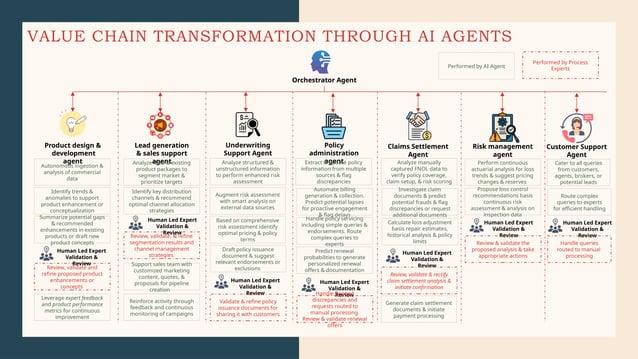
Transforming the Life Insurance Value Chain
The application of agentic AI spans the entire lifecycle of a life insurance policy, from the initial quote to the final payout.
Automated Underwriting and "Fluidless" Processes
Underwriting has historically been the greatest bottleneck in life insurance. In 2026, agentic AI has perfected the "fluidless" underwriting model. When an applicant applies for a term life policy, the AI agent acts as a digital medical examiner. With the applicant’s consent, it orchestrates the retrieval of Electronic Health Records (EHRs), prescription histories, and even data from wearable devices.
The agent doesn't just aggregate this data; it analyzes it against the carrier's proprietary mortality tables and underwriting guidelines. If it finds a discrepancy—such as a missing blood pressure reading from a specific year—it can autonomously reach out to the applicant’s primary care physician's portal to request the specific record. This reduces the time-to-issue from weeks to minutes for a vast majority of healthy applicants.
Autonomous Claims Adjudication
The death of a loved one is the most sensitive touchpoint in life insurance. Agentic AI has transformed claims from a bureaucratic hurdle into a supportive service. Upon receiving a claim notification, an agentic system can:
- Verify the death certificate against national registries.
- Cross-reference the policy's contestability period.
- Identify all named beneficiaries and verify their identities via digital ID protocols.
- Assess the "cleanliness" of the claim.
If the claim meets all automated criteria, the agent can authorize the payment. For complex cases involving secondary beneficiaries or disputed causes of death, the agent organizes the evidence into a "decision-ready" dossier for a human claims adjuster, highlighting the specific areas that require human judgment.
Personalized Policy Servicing and Retention
Retention in life insurance often fails because carriers only interact with customers during billing or when a policy is about to lapse. Agentic AI enables proactive servicing. For example, if an agent detects (via integrated financial data or public records) that a policyholder has recently purchased a new home, it can calculate the "protection gap"—the difference between the current death benefit and the new mortgage debt. It then presents a tailored recommendation to increase coverage, facilitating the entire upsell process through a simple digital interaction.
Comparison: Generative AI vs. Agentic AI in 2026
The following table highlights the functional evolution from the early generative models of 2023 to the agentic systems currently dominating the 2026 landscape.
| Feature | Generative AI (2023-2024) | Agentic AI (2025-2026) |
|---|---|---|
| Primary Function | Content creation and summarization. | Goal-oriented task execution. |
| Interaction Model | Reactive (responds only to prompts). | Proactive (initiates tasks based on triggers). |
| Data Integration | Static training data; limited RAG. | Real-time tool use and API orchestration. |
| Underwriting Role | Summarizing medical notes. | Executing the full underwriting workflow. |
| Claims Handling | Drafting claim acknowledgement letters. | Verifying documents and triggering payments. |
| Error Handling | Hallucinates or provides "I don't know." | Iterates, self-corrects, and uses alternative tools. |
Technical Implementation: RAG and Tool-Calling
The engine behind these agents is often a combination of Retrieval-Augmented Generation (RAG) and advanced function calling. In a life insurance context, RAG allows the agent to access the insurer’s massive, private knowledge base—including complex policy language, state-specific regulations, and internal actuarial standards—without needing to retrain the underlying model.
When a query arrives, the agent "retrieves" the relevant policy clauses and "generates" a response or action plan based on that specific evidence. This is crucial for compliance; the agent can cite the exact page and paragraph of the policy document that justifies a particular decision.
Furthermore, Tool-Calling allows the agent to interact with the "real world." In 2026, most insurance software vendors have moved to an "API-first" architecture, making it easy for AI agents to "talk" to legacy mainframes or modern cloud-based CRM systems.
Ethical and Regulatory Challenges in 2026
The deployment of autonomous agents in life insurance is not without friction. Regulatory bodies, such as the National Association of Insurance Commissioners (NAIC) and various European authorities under the EU AI Act, have established strict guidelines for AI "agency."
The "Black Box" Problem and Explainability
One of the primary concerns is the "right to an explanation." If an agentic AI denies a life insurance application, the law requires a clear, non-technical explanation for the consumer. In 2026, insurers use "transparent reasoning traces." This means the AI must log every step of its decision-making process, showing which data points influenced the risk score.
Bias Mitigation
Agentic AI can inadvertently pick up biases present in historical data. If past underwriting was biased against certain demographics, the AI might learn to replicate those patterns. Leading insurers now employ "Adversarial Testing," where a second AI agent is tasked with trying to "break" or find bias in the primary underwriting agent before it goes live.
Human-in-the-Loop (HITL)
To maintain trust, 2026 standards require a Human-in-the-Loop for high-impact decisions. While an agent can handle a $50,000 term life claim autonomously, a $5,000,000 whole life claim involving a complex trust will always trigger a mandatory human review. The agent's role here is to prepare the environment so the human can make an informed decision in seconds rather than hours.
Operational Requirements for Implementation
For life insurers looking to scale agentic AI in 2026, several prerequisites are mandatory:
- Data Liquidity: AI agents are only as good as the data they can access. Breaking down data silos between "new business," "billing," and "claims" is essential.
- Orchestration Layers: Using platforms like LangChain or Microsoft’s Semantic Kernel, insurers must build an orchestration layer that manages the "hand-offs" between different specialized agents.
- Cybersecurity and Privacy: Agents often handle Highly Protected Health Information (PHI). In 2026, Zero-Knowledge Proofs (ZKP) and confidential computing are used to ensure the agent can verify health status without ever "seeing" or storing the underlying raw medical data in a vulnerable way.
Common Pitfalls and How to Avoid Them
Even with the advancements of 2026, failures occur. The most common mistake is "Agent Sprawl," where an organization creates hundreds of disconnected agents that eventually conflict with one another. A central "Master Orchestrator" is necessary to govern agent permissions and ensure they are all following the same compliance rules.
Another pitfall is over-reliance on the model's inherent knowledge. Insurers must ensure that their agents prioritize retrieved data (the actual policy and law) over the parametric knowledge (what the AI learned during training), as laws and rates change frequently.
Frequently Asked Questions
Is agentic AI replacing human underwriters in 2026?
No, it is shifting their focus. Human underwriters are increasingly becoming "exception handlers" and "system auditors." They focus on high-complexity cases—such as applicants with rare medical conditions or high-net-worth individuals—while the agentic AI handles the high-volume, standard applications. This allows humans to apply empathy and nuanced judgment where it matters most.
How does agentic AI protect policyholder data?
In 2026, data protection is built into the agent's architecture. Most agents operate using Federated Learning or Differential Privacy, which allows the AI to learn from data patterns without accessing individual personal records in a readable format. Furthermore, strict API permissions ensure that an agent can only access the specific data needed for the task at hand.
What are the cost implications of implementing AI agents?
The initial setup costs for agentic AI are high, involving significant investments in API integration, cloud infrastructure, and specialized talent. However, the long-term operational expenditure (OPEX) is significantly lower. Carriers in 2026 report a 30% to 50% reduction in administrative costs for policy servicing and a 20% improvement in underwriting throughput.
Can agentic AI detect insurance fraud?
Yes, it is highly effective at fraud detection. Because agentic AI can analyze non-linear patterns across multiple data sources—such as social media, medical records, and financial history—it can identify "synthetic identities" or staged death claims that traditional rule-based systems would miss.
How do insurers manage AI "hallucinations" in 2026?
Hallucinations are managed through Fact-Verification Loops. Before an agent provides an answer or takes an action, it is programmed to "cross-check" its proposed output against a trusted source of truth (like the policy PDF). If the generated response does not have a high enough confidence score based on the source text, the agent is restricted from acting and must escalate the issue.
Practical Recommendation
For life insurance professionals and IT leaders, the priority in 2026 should be "Agentic Readiness." This involves auditing your existing API ecosystem to ensure that an autonomous system can actually do things—like update a database or trigger a letter—rather than just read information. Start by deploying agents in low-risk environments, such as internal employee HR portals or simple policy address changes, to refine the reasoning loops before moving into underwriting or claims. Ensuring a robust "Human-in-the-Loop" protocol will be your strongest defense against the reputational risks associated with autonomous decision-making.