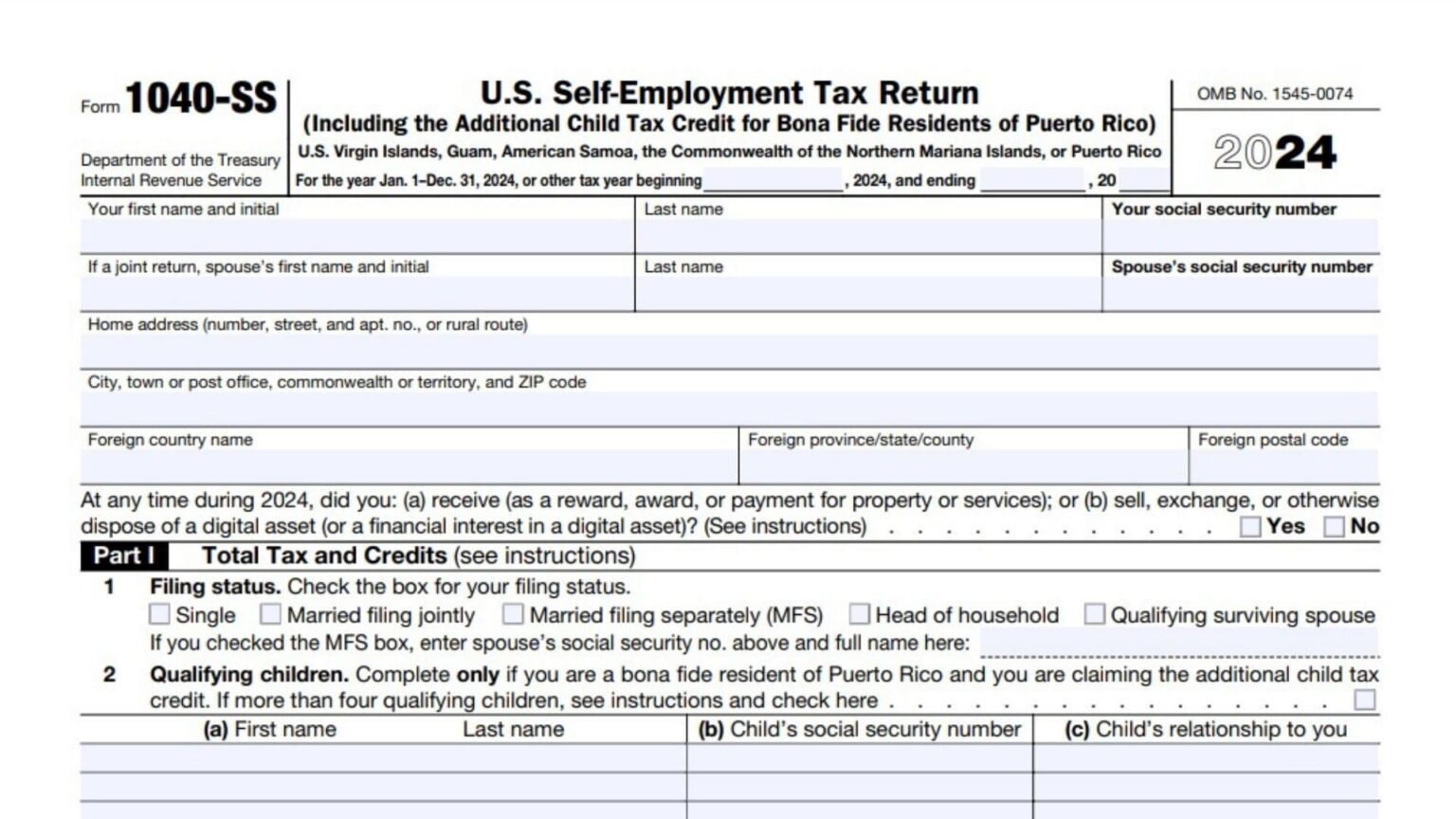
IRS Form 1040-ES, Estimated Tax for Individuals, is the official tax document used by self-employed workers, freelancers, investors, and taxpayers with income not subject to standard employer withholding to calculate and pay estimated federal taxes. It ensures individuals pay income and self-employment taxes incrementally throughout the 2025 tax year.
What Is IRS Form 1040-ES and Who Needs to File It?
The United States operates on a "pay-as-you-go" federal tax system. Under this system, income tax and social security/Medicare taxes must be paid as income is earned during the year, rather than in a single lump sum when filing an annual tax return. For traditional W-2 employees, employers automatically withhold these taxes from each paycheck and remit them to the Internal Revenue Service (IRS). However, individuals who earn income outside standard W-2 wages must manage these payments independently using Form 1040-ES.
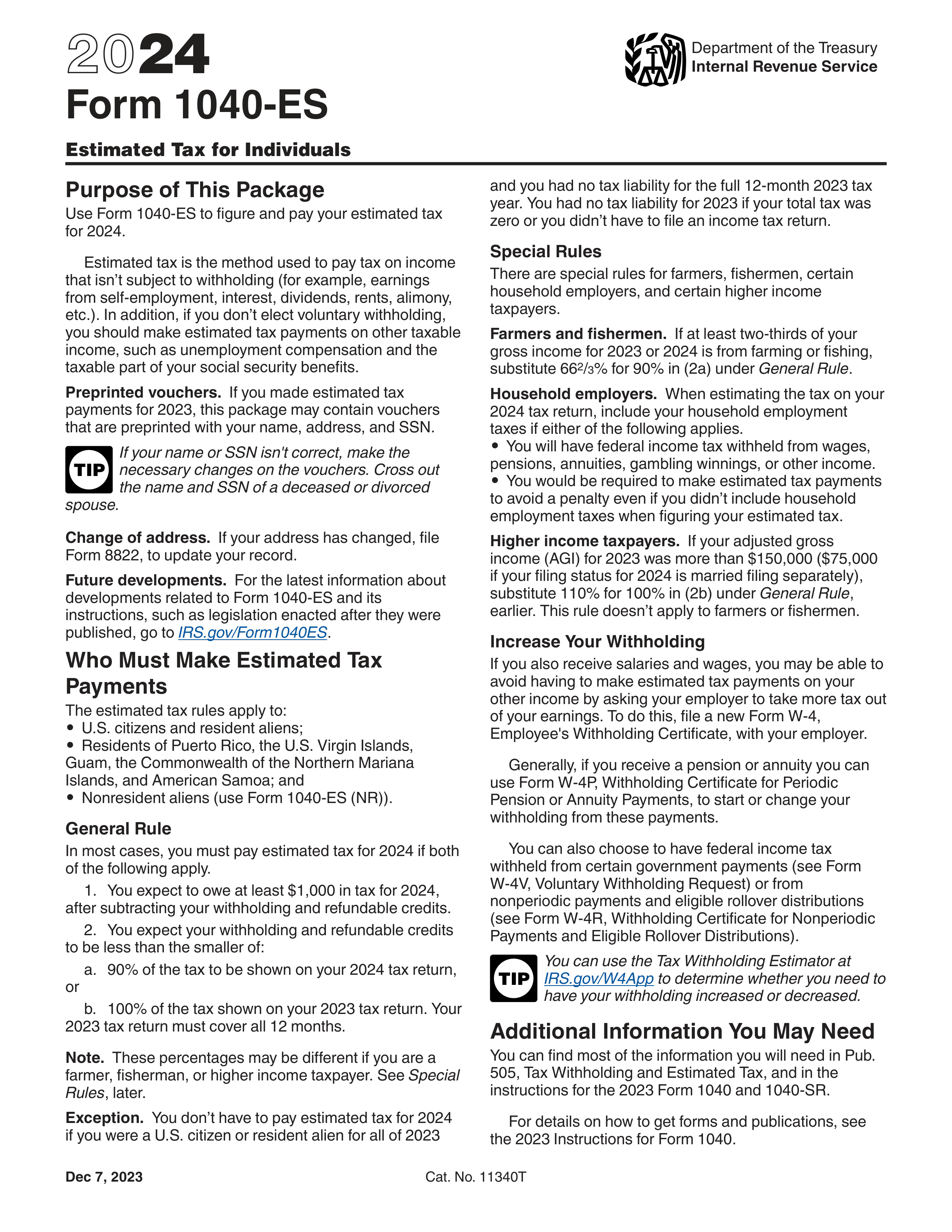
Form 1040-ES contains background instructions, an estimated tax worksheet, standard deduction tables, and four printable payment vouchers (numbered Voucher 1 through Voucher 4). It addresses two primary federal obligations: individual income tax and self-employment tax under the Federal Insurance Contributions Act (FICA) equivalent rules.
You generally must make estimated tax payments using Form 1040-ES if both of the following conditions apply:
- You expect to owe at least $1,000 in federal tax for the tax year after subtracting your federal income tax withholding and refundable credits.
- You expect your federal withholding and refundable tax credits to be less than the smaller of 90% of the tax to be shown on your current tax return or 100% of the tax shown on your prior year's tax return (provided your prior year return covered a full 12 months).
Common taxpayer categories required to utilize Form 1040-ES include:
- Sole Proprietors and Independent Contractors: Freelancers, gig economy drivers, trade specialists, and consultants operating as sole proprietorships or single-member LLCs.
- Partners and S Corporation Shareholders: Business owners receiving distributive shares of trade or business income that are not subject to W-2 withholding.
- Investors and Landlords: Individuals generating significant capital gains, dividends, interest, or rental property income.
- Retirees: Individuals receiving pension payouts, annuity distributions, or traditional IRA distributions who have not elected sufficient voluntary tax withholding.
- W-2 Employees with Secondary Income: Higher earners whose primary employer withholding does not cover the additional liability created by secondary side hustles, stock grants, or investment portfolios.
Safe Harbor Rules: Avoiding Estimated Tax Penalties
To prevent taxpayers from facing underpayment penalties, federal tax law establishes clear "safe harbor" guidelines. If your total tax payments—combining employer withholding and timely quarterly estimated tax payments—meet specific percentage thresholds, the IRS will not assess an underpayment penalty, even if you owe a balance when filing your tax return.
Understanding these legal thresholds allows taxpayers to structure their quarterly payments predictable and legally sound.
| SAFE HARBOR QUALIFICATION |
|---|
| Option A: Pay 90% of your total tax liability for the current tax year. |
| OR |
| Option B: Pay 100% of your total tax liability reported on your prior-year return (Increased to 110% if prior-year Adjusted Gross Income > $150,000). |
The 90% Current-Year Rule
Under this standard, you must pay at least 90% of the total tax liability that will ultimately be reported on your tax return for the tax year. This method works well for taxpayers with consistent, predictable monthly earnings. However, if your earnings fluctuate unexpectedly late in the year, relying solely on the 90% current-year rule can lead to unintended underpayment if your overall liability spikes.
The 100% / 110% Prior-Year Rule
The prior-year safe harbor calculation offers greater predictability because it is based on a fixed figure already finalized on your previous year's return:
- Standard Threshold (100% Rule): If your Adjusted Gross Income (AGI) on the prior year's return was $150,000 or less ($75,000 or less if married filing separately), your total payments for the current year must equal at least 100% of the total tax shown on that prior-year return.
- High-Income Threshold (110% Rule): If your prior-year AGI exceeded $150,000 ($75,000 if married filing separately), you must pay 110% of the prior year's total tax liability to meet safe harbor requirements.
Special Exceptions for Farmers and Fishermen
Qualifying farmers and fishermen receive specialized safe harbor treatment due to the seasonal nature of their income. If at least two-thirds of your gross income comes from farming or fishing, your safe harbor target drops to 66.66% of your current-year tax, or 100% of your prior-year tax. Additionally, farmers and fishermen can make a single estimated payment for the tax year by mid-January of the following year, rather than four quarterly installments.
2025 Estimated Tax Payment Schedule
Estimated tax payments for the 2025 tax year are divided into four payment periods. Payments must be submitted or postmarked on or before the corresponding due date. When a due date falls on a weekend or federal holiday, the deadline automatically shifts to the next business day.
The schedule below outlines the payment periods and official deadlines for the 2025 tax year:
| Payment Period | Income Earned Window | Official Due Date | Taxpayer Action Required |
|---|---|---|---|
| 1st Payment (Voucher 1) | Jan 1, 2025 – Mar 31, 2025 | April 15, 2025 | Calculate year's projected liability; submit Q1 installment. |
| 2nd Payment (Voucher 2) | Apr 1, 2025 – May 31, 2025 | June 16, 2025 | Review Q2 income; adjust and submit Q2 installment (June 15 is Sunday). |
| 3rd Payment (Voucher 3) | Jun 1, 2025 – Aug 31, 2025 | September 15, 2025 | Re-evaluate annual projections; submit Q3 installment. |
| 4th Payment (Voucher 4) | Sep 1, 2025 – Dec 31, 2025 | January 15, 2026 | Finalize tax estimates; submit final Q4 payment installment. |
Note: Taxpayers who file their completed 2025 Form 1040 and pay their entire balance in full by February 2, 2026 (as January 31, 2026, falls on a Saturday) can skip the January 15, 2026 estimated payment without incurring a penalty.
How to Calculate Your 2025 Estimated Tax Payments
To determine your quarterly estimated tax obligation, you must complete the Form 1040-ES Estimated Tax Worksheet provided in the official IRS publication instructions. The step-by-step calculation integrates income projections, self-employment tax computations, standard or itemized deductions, and available tax credits.
Taxpayers can download official form packages and detailed instructions directly through the IRS Form 1040-ES Information Page.
Step 1: Estimate Adjusted Gross Income (AGI)
Begin by estimating your total gross income expected during 2025. Combine all expected revenue streams, including:
- Net business profit from sole proprietorships or LLCs (gross revenues minus ordinary and necessary business expenses).
- Dividends, interest income, capital gains, and rental profits.
- Pension, IRA, or annuity income not subject to mandatory tax withholding.
- W-2 wages from primary or secondary employment.
Subtract eligible above-the-line adjustments to income (such as student loan interest deductions, health savings account contributions, deductible contributions to traditional SEPs or IRAs, and the deductible portion of self-employment tax).
Step 2: Compute Self-Employment Tax Liability
If you have self-employment earnings of $400 or more, you must compute self-employment tax using Schedule SE rules:
- Multiply net self-employment earnings by 92.35% (0.9235) to establish taxable net earnings.
- Apply the 15.3% self-employment tax rate, which consists of two parts:
- 12.4% Social Security tax on net earnings up to the annual Social Security wage base limit.
- 2.9% Medicare tax on all net earnings (plus an additional 0.9% Additional Medicare Tax for earnings exceeding income thresholds based on filing status).
- Record the total self-employment tax. You can deduct 50% of this total from your gross income when calculating your income tax liability in Step 1.
Step 3: Apply Deductions and Calculate Taxable Income
Subtract your expected standard deduction or itemized deductions from your projected AGI to determine net taxable income. Apply the federal income tax brackets corresponding to your filing status (Single, Married Filing Jointly, Head of Household, or Married Filing Separately) to compute your base income tax.
Step 4: Subtract Credits and Federal Withholding
Deduct any personal tax credits for which you qualify, such as the Child Tax Credit, Credit for Other Dependents, or American Opportunity Tax Credit. Next, subtract the total federal income tax you expect to have withheld during 2025 from W-2 salaries, pensions, or backup withholdings.
Step 5: Determine Quarterly Installment Amounts
The remaining figure represents your net estimated tax liability for the full year. If this figure is $1,000 or greater, divide the total required annual payment (based on safe harbor calculations) by four to arrive at your required quarterly payment for each due date.
- Net Projected Business Profits
- Minus: Above-the-Line Tax Adjustments
- Equals: Projected Adjusted Gross Income
- Minus: Standard or Itemized Deductions
- Equals: Projected Taxable Income
- Multiplied by: Applicable Income Tax Rate
- Plus: Self-Employment Tax (Schedule SE)
- Minus: Tax Credits & Expected W-2 Withholding
- Equals: Total Annual Required Estimated Tax
- Divided by: 4 Installments
- Equals: REQUIRED QUARTERLY 1040-ES PAYMENT
The Annualized Income Installment Method
If your business earnings are seasonal or irregular—for instance, if you earn 70% of your annual revenue in the fourth quarter—paying four equal installments might cause cash flow strain in earlier quarters.
In such cases, you can use the Annualized Income Installment Method detailed in IRS Form 2210. This method allows you to calculate each quarterly payment based on your actual income and expenses accrued up to the end of each specific payment period. If you use this approach, you must complete and attach IRS Form 2210, Underpayment of Estimated Tax by Individuals, Estates, and Trusts to your tax return.
Submitting Your 2025 Form 1040-ES Payments
The IRS provides several electronic and physical channels for submitting estimated tax payments. Electronic submission methods process faster, generate instant payment confirmation receipts, and eliminate the risks of mail loss or postmark disputes.
1. IRS Direct Pay (Electronic Bank Transfer)
The most popular electronic option is IRS Direct Pay. This free online service enables individual taxpayers to pay directly from a checking or savings account without registering for an account.
When submitting via Direct Pay:
- Select "Estimated Tax" as the reason for payment.
- Select "1040-ES" as the payment application.
- Select "2025" as the tax year.
2. Electronic Federal Tax Payment System (EFTPS)
For taxpayers who prefer to schedule all four quarterly payments in advance, the Electronic Federal Tax Payment System (EFTPS) provides a robust platform. Operated by the U.S. Department of the Treasury, EFTPS allows you to set up recurring automated bank debits or modify scheduled payments up to two business days before the due date. New enrollment requires identity verification, so register early to meet upcoming deadlines.
3. Credit Card, Debit Card, or Digital Wallet
The IRS authorizes several third-party payment processors to handle payments made via credit card, debit card, or digital wallet payment solutions. While convenient, these approved payment processors charge processing fees (typically a fixed fee for debit cards or a percentage-based fee for credit cards).
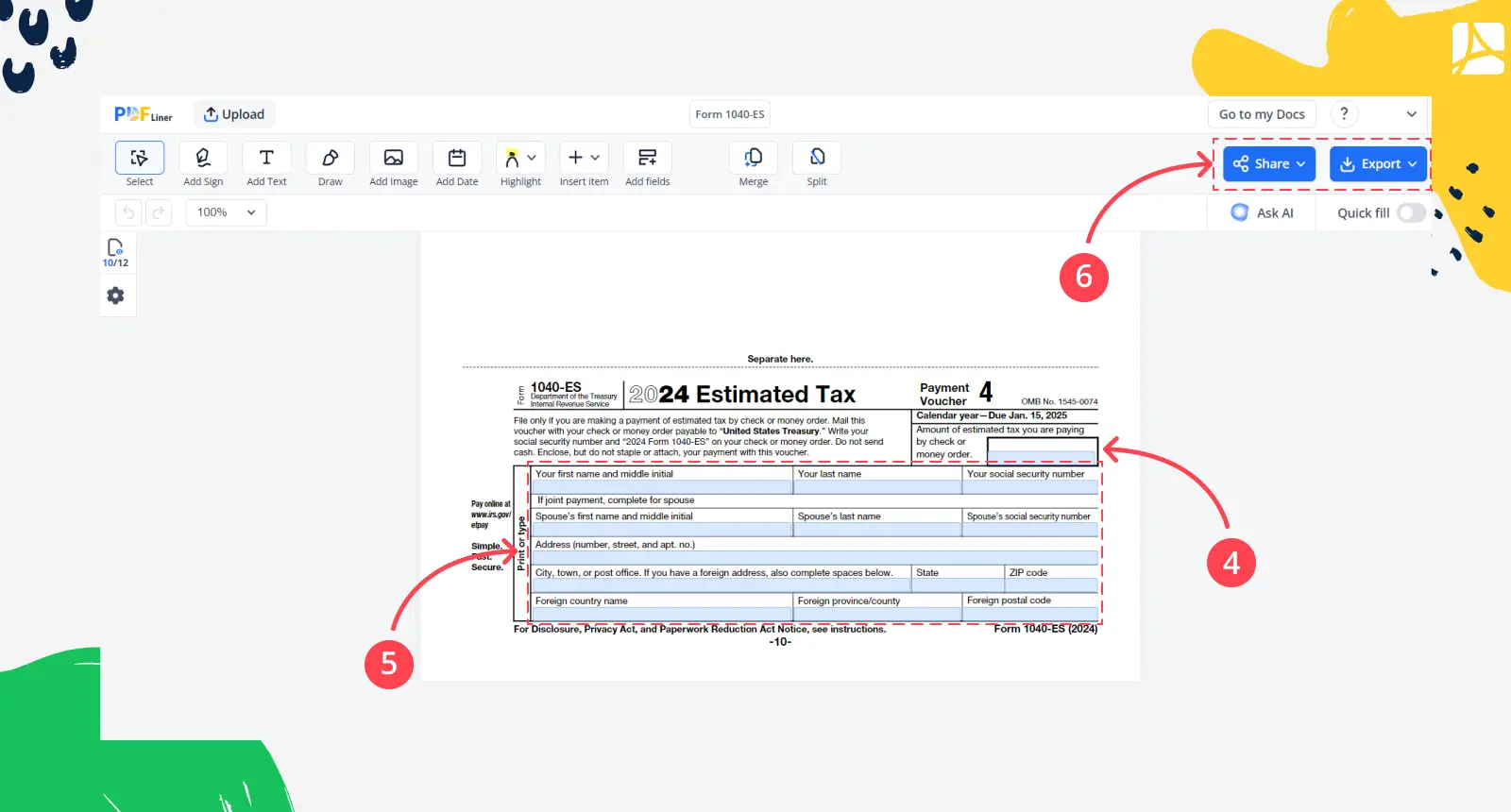
4. Mailing Paper Payment Vouchers
If you prefer to pay by check or money order, you must use the physical payment vouchers included with Form 1040-ES:
- Make your check or money order payable to "United States Treasury."
- Write your Social Security Number (or Individual Taxpayer Identification Number), daytime phone number, and "2025 Form 1040-ES" on the memo line of the check.
- Detach the appropriate quarterly voucher (Voucher 1, 2, 3, or 4).
- Mail the voucher and check to the designated IRS mailing address for your state of residence, as listed in the Form 1040-ES instructions.
Caution: Do not send cash through the mail. Ensure your check is postmarked on or before the official due date to prevent late payment penalties.
What Happens If You Underpay or Miss a Deadline?
Failing to make required estimated tax payments, paying late, or underpaying an installment can result in an underpayment penalty assessed by the IRS under Section 6654 of the Internal Revenue Code.
How Underpayment Penalties Are Calculated
The underpayment penalty is not a flat fee; it functions as an interest charge on the underpaid amount for the exact number of days the payment remains outstanding. The interest rate applied is set quarterly by the IRS based on the federal short-term rate plus three percentage points.
Because penalties are calculated separately for each quarterly period, you can incur a penalty for an early quarter (e.g., April) even if you overpay in a later quarter (e.g., September) or receive a tax refund when filing your annual return.
How to Request Penalty Relief
The IRS may waive underpayment penalties under limited, specific circumstances:
- Casualty, Disaster, or Unusual Circumstances: The underpayment was caused by a natural disaster, severe casualty, or other extraordinary situation where imposing a penalty would be unfair.
- Retirement or Disability: You retired after reaching age 62 or became disabled during the tax year (or prior tax year), and the underpayment was due to reasonable cause rather than willful neglect.
To request a waiver, taxpayers must complete IRS Form 2210 and attach supporting documentation detailing the hardship or circumstance.
Common Mistakes to Avoid with Form 1040-ES
- Forgetting State and Local Estimated Taxes: Form 1040-ES applies exclusively to federal obligations. Most state departments of revenue (and some municipal tax authorities) enforce separate estimated tax requirements and voucher systems.
- Applying Payments to the Wrong Tax Year: When making payments online early in the calendar year, taxpayers often mistakenly select the prior tax year instead of the current tax year. Verify that your selection clearly states 2025 Form 1040-ES.
- Ignoring Mid-Year Income Spikes: If you sell a profitable asset, receive a sudden business windfall, or take an unexpected bonus mid-year, recalculate your remaining quarterly payments immediately to avoid underpayment penalties.
- Failing to Adjust W-2 Withholding: If you have a secondary W-2 job, you can often avoid filing quarterly vouchers altogether by requesting higher federal income tax withholding from your W-2 paycheck using IRS Form W-4.
Key Takeaways and Next Steps
Managing estimated taxes requires ongoing monitoring, accurate bookkeeping, and adherence to federal deadlines. By following these practical next actions, you can stay compliant and protect your business cash flow:
- Review Your Prior-Year Return: Check line 24 (total tax) of your previous Form 1040 to determine your prior-year safe harbor baseline target (100% or 110%).
- Calculate Your Quarterly Target: Use the Form 1040-ES worksheet to project your net earnings, self-employment tax, and income tax for 2025.
- Schedule Digital Payments: Set up payments using IRS Direct Pay or EFTPS ahead of each deadline (April 15, June 16, September 15, and January 15) to avoid postmark issues or missed dates.
- Track Income Quarterly: Re-evaluate your revenue and expenses at the end of each quarter. Adjust your estimated payments if your actual earnings deviate significantly from your original projections.
Frequently Asked Questions
Do I need to send Form 1040-ES if I pay my estimated taxes electronically?
No. If you make your estimated tax payments electronically using IRS Direct Pay, EFTPS, or an approved card payment processor, you do not need to mail physical paper vouchers or the Form 1040-ES worksheet. The electronic system records your payment directly to your account using your Social Security Number or Tax Identification Number.
What should I do if my income changes mid-year?
If your income increases or decreases substantially during the year, complete a fresh Form 1040-ES worksheet to calculate an updated annual liability. Subtract payments already made for prior quarters, and divide the remaining balance equally among the remaining payment due dates.
Can W-2 withholding replace Form 1040-ES payments?
Yes. Federal tax law treats tax withheld from W-2 wages as paid evenly throughout the tax year, regardless of when it is withheld. If you have W-2 employment, you can submit an updated Form W-4 to your employer requesting extra withholding per pay period to cover tax liabilities from self-employment, investments, or side hustles.
Is the January 15 estimated tax payment mandatory?
The fourth-quarter payment (due January 15 following the tax year) is mandatory unless you qualify for an exception. If you file your full Form 1040 tax return and pay your entire tax balance due on or before January 31 (or the next business day if January 31 is a weekend), you are not required to make the January 15 estimated payment.
What is the difference between Form 1040-ES and Form 1040?
Form 1040 is your annual income tax return, filed after the tax year ends to report final income, deductions, and credits. Form 1040-ES is a planning form accompanied by vouchers used during the tax year to calculate and pay your tax liabilities in quarterly installments.
Disclaimer: This guide is provided for educational and informational purposes only and should not be construed as legal, financial, or tax advice. Federal tax laws and regulations are subject to change. Consult a qualified Certified Public Accountant (CPA), Enrolled Agent (EA), or licensed tax professional regarding your specific tax situation.