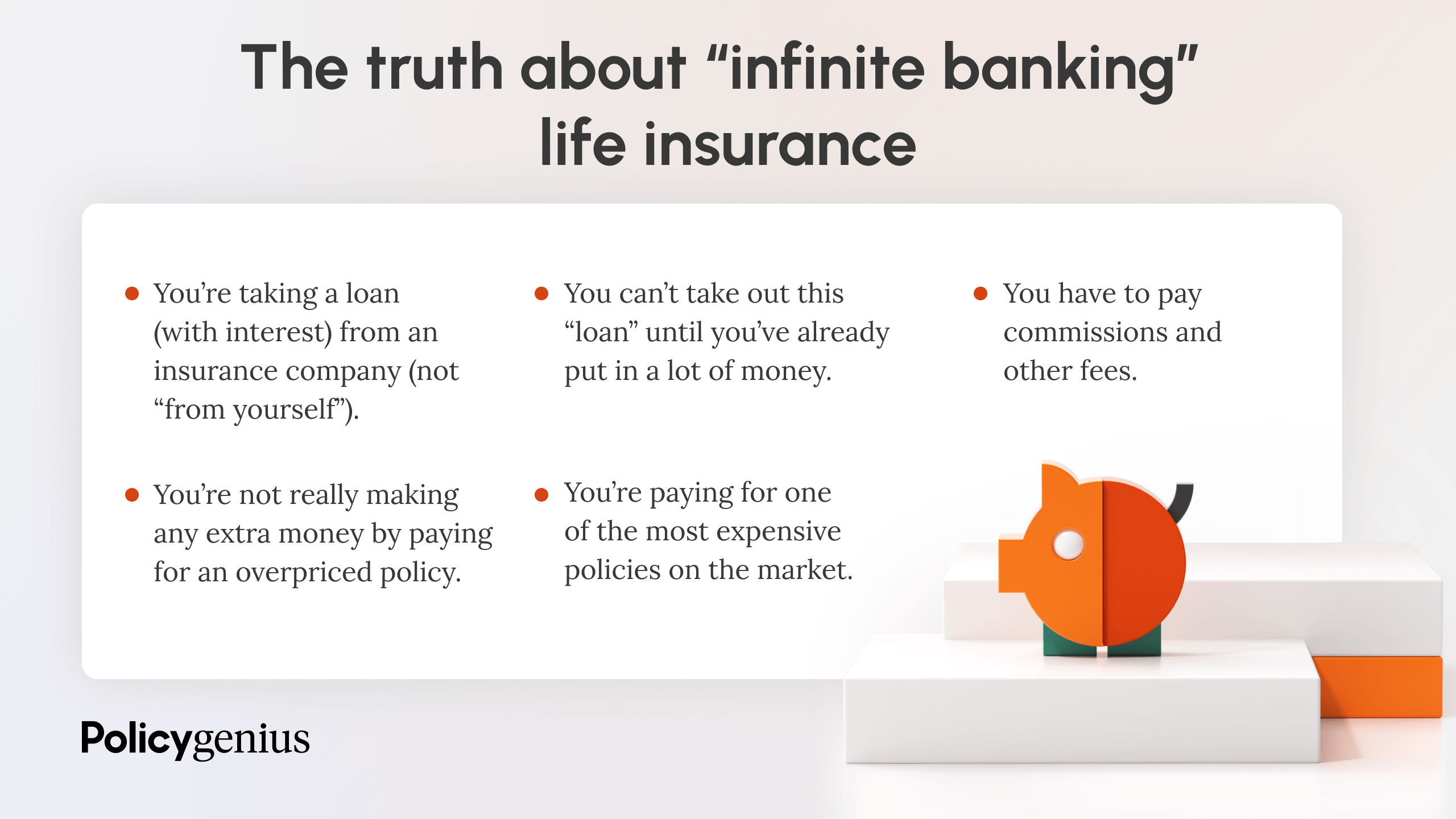
When implementing the Infinite Banking Concept, choosing the right whole life insurance policy is crucial because you need a high cash value early on, maximum paid-up additions riders, and a mutual insurance company with a strong history of dividend payouts. The two best whole life insurance picks for infinite banking are policies issued by Guardian Life Insurance Company of America and MassMutual (Massachusetts Mutual Life Insurance Company), both renowned for their structural flexibility and mutual company status.
Understanding Infinite Banking and Policy Design
The Infinite Banking Concept (IBC), originally popularized by Nelson Nash in his book Becoming Your Own Banker, relies on using specially designed dividend-paying whole life insurance policies. The primary mechanism involves leveraging the cash value of the policy through policy loans to finance major purchases, investments, or business capital, all while the underlying cash value continues to compound uninterrupted.
However, standard whole life insurance policies sold by stock companies are poorly suited for this strategy. Standard policies feature high initial commissions and low early cash values, which severely restrict your ability to borrow against the policy in the first few years.
To execute infinite banking effectively, a policy must be meticulously engineered using specific riders. Understanding these structural requirements is the first step toward evaluating the top insurance carriers in the industry.
The Role of Paid-Up Additions (PUA) Riders
A Paid-Up Additions (PUA) rider is an optional provision attached to a whole life insurance policy that allows the policyholder to inject extra money directly into the policy to buy paid-up insurance. This immediately increases both the death benefit and, more importantly, the cash value.
For infinite banking practitioners, maximizing the PUA rider is non-negotiable. While base premiums buy permanent death protection and build modest cash value slowly over decades, PUA contributions bypass much of the traditional commission structure and flow almost entirely into liquid cash value.
Term Insurance Riders to Lower the Base Premium
Internal Revenue Service (IRS) guidelines dictate that life insurance contracts must maintain a certain ratio between cash value and the death benefit to maintain their tax-advantaged status, as outlined in sections like the Modified Endowment Contract (MEC) rules.
To maximize cash value growth without triggering a MEC (which permanently strips the policy of its tax-free growth and loan benefits), agents attach a Term Insurance Rider. This rider increases the total death benefit of the policy without substantially increasing the mandatory base premium, allowing you to pump higher volumes of capital into the PUA rider while staying safely under IRS funding limits.
Criteria for Selecting the Best Infinite Banking Policies
Not all mutual insurance companies treat dividend-paying whole life contracts the same way. When evaluating carriers for infinite banking, experts look for specific operational characteristics that ensure long-term stability and optimal cash accumulation.
- Mutual Company Structure: Mutual companies are owned by their policyholders rather than outside shareholders. This alignment ensures that dividends—when declared—are distributed back to the owners, reducing the cost of insurance and accelerating cash value growth.
- Dividend History and Financial Strength: Look for carriers with an unbroken history of paying dividends annually, even through major economic downturns like the Great Depression and the 2008 financial crisis. Financial ratings from agencies like A.M. Best, Moody’s, and Standard & Poor’s should consistently sit at the highest tiers (e.g., A++ or AAA).
- Underwriter Flexibility: A superior infinite banking carrier must offer robust riders, liberal PUA limits (allowing up to 10 times the base premium in some cases), and favorable provisions for policy loans, such as direct versus non-direct recognition.
- Direct vs. Non-Direct Recognition: While both have merits, many infinite banking purists prefer non-direct recognition companies. Under a non-direct recognition policy, the insurance company continues to pay dividends on your total cash value as if you had never taken a policy loan, keeping your compounding growth intact.
Top Pick 1: Guardian Life Insurance Company
Founded in 1860, Guardian is widely considered by authorized practitioners to be the premier carrier for infinite banking. The company has consistently maintained an A++ (Superior) financial strength rating from A.M. Best and boasts a long-standing history of robust dividend payouts to policyholders.
Why Guardian Excels at Infinite Banking
Guardian’s flagship whole life insurance product stands out because of its exceptional structural flexibility. Their underwriting guidelines allow for aggressive PUA rider funding, enabling clients to maximize their early cash value accumulation.
Furthermore, Guardian is a non-direct recognition carrier for many of its core products (though product variations exist by state and specific rider configurations). This means that when you borrow against your cash value to finance a real estate purchase or business venture, your remaining cash value continues to earn the full dividend rate without interruption.
Guardian Policy Features at a Glance
| Feature Category | Guardian Life Policy Characteristics |
|---|---|
| Company Structure | Mutual Company (Policyholder-owned) |
| Financial Strength Rating | A.M. Best: A++ (Superior) |
| Primary PUA Flexibility | High limits allowing aggressive early funding |
| Loan Recognition | Primarily Non-Direct Recognition on core contracts |
| Dividend Track Record | Unbroken annual dividend payments since 1868 |
Potential Drawdowns with Guardian
Despite its stellar reputation, Guardian’s underwriting process can be rigorous. Securing a policy with maximum PUA capacity requires medical underwriting and approval, and individuals with pre-existing health conditions may face higher rating classes that alter the mathematical efficiency of their infinite banking design. Additionally, Guardian policies often require a higher initial premium commitment to make the specialized engineering cost-effective.
Top Pick 2: MassMutual (Massachusetts Mutual Life Insurance Company)
Established in 1851, MassMutual is another mutual insurance titan that competes neck-and-neck with Guardian for the top spot in the infinite banking space. MassMutual holds top-tier financial ratings across all major rating agencies and manages a massive portfolio of assets supporting its policyholders.
Why MassMutual Excels at Infinite Banking
MassMutual is celebrated for its financial conservatism, stability, and scale. Their whole life products feature competitive dividend interest rates and highly customizable riders.
MassMutual accommodates high-cash-value design through its Lifetime 10 or Lifetime 65 series, paired with comprehensive term riders and PUA options. While MassMutual utilizes a direct recognition approach on certain policy loans, their dividend scale is often robust enough to offset the economic difference, and they offer specific provisions that make borrowing predictable and efficient.
MassMutual Policy Features at a Glance
| Feature Category | MassMutual Policy Characteristics |
|---|---|
| Company Structure | Mutual Company (Policyholder-owned) |
| Financial Strength Rating | A.M. Best: A++ (Superior) |
| Primary PUA Flexibility | Excellent short- and long-term funding options |
| Loan Recognition | Direct Recognition (varies slightly by specific product lines) |
| Dividend Track Record | Continuous dividend payouts stretching back to the 19th century |
Potential Drawdowns with MassMutual
MassMutual’s primary drawback for aggressive infinite banking users is its loan recognition posture. Because they utilize direct recognition on many contracts, the dividend rate paid on the borrowed portion of your cash value may be adjusted based on the interest rate charged for the policy loan. While this does not break the banking system, it requires more careful mathematical tracking during the capitalization and velocity phases of your strategy.
Comparative Analysis: Guardian vs. MassMutual
When deciding between Guardian and MassMutual for your infinite banking setup, you are essentially choosing between two of the safest, most reliable financial institutions in North America. However, structural differences matter.
| Feature | Guardian Life | MassMutual |
|---|---|---|
| Founding Year | 1860 | 1851 |
| Corporate Structure | Mutual | Mutual |
| A.M. Best Rating | A++ | A++ |
| Loan Recognition | Non-Direct Recognition (Standard) | Direct Recognition (Standard) |
| PUA Agility | Exceptionally High Early Liquidity | Highly Stable Long-Term Growth |
Guardian tends to appeal more strongly to practitioners who prioritize non-direct recognition and maximum short-term liquidity through heavy PUA allocation. MassMutual appeals to those who value supreme institutional scale, conservative risk management, and reliable long-term dividend distribution consistency across varying economic climates.
Alternative Mutual Carriers to Consider
While Guardian and MassMutual occupy the top two positions for infinite banking, a few other mutual companies offer competitive whole life products that are worth evaluating if your underwriting profile or geographic preferences dictate otherwise:
- Northwestern Mutual: Known for having the largest financial agent network in the United States and exceptionally high financial stability, though their contracts traditionally feature more rigid PUA limits and direct recognition structures.
- New York Life: Another A++ rated mutual giant with an extensive history, though historically conservative regarding early cash value design riders.
- Penn Mutual: Frequently utilized by independent life insurance brokers who specialize in infinite banking because of their flexible underwriting and cooperative stance on high-PUA design limits.
Common Mistakes to Avoid When Setting Up an IBC Policy
Choosing the right company is only half the battle; how the policy is designed dictates its performance. Avoid these frequent pitfalls:
- Working with Traditional Agents: Buying a standard whole life policy from a captive agent who does not understand the Infinite Banking Concept will result in a policy with low cash value for the first decade. Always work with a specialist trained in IBC design.
- Exceeding MEC Limits: Failing to monitor your contributions relative to the death benefit can accidentally trigger a Modified Endowment Contract status, locking in tax penalties for withdrawals and loans.
- Overextending Commitments: Committing to an annual premium that strains your monthly cash flow is dangerous. If you lapse the policy in the first few years due to poor liquidity planning, you will experience financial losses.
- Ignoring the Spread: When borrowing against your policy to invest elsewhere, ensure the rate of return on your external investment exceeds the net cost of the policy loan to maintain positive arbitrage.
Frequently Asked Questions
What makes a whole life insurance policy good for infinite banking?
A policy suitable for infinite banking must be issued by a mutual insurance company and designed with a high Paid-Up Additions (PUA) rider and a term insurance rider. This combination minimizes the base commissionable premium, drives down the cost of insurance relative to cash value, and maximizes early liquidity so you can access capital quickly.
Are policy loans from Guardian or MassMutual taxable?
Generally, policy loans from a properly structured whole life insurance policy are not considered taxable income by the IRS, as loans are treated as debt secured by the cash value rather than a withdrawal of earnings, provided the policy remains in force and does not lapse into a MEC.
Can I do infinite banking with any life insurance company?
Technically no. Stock-owned insurance companies distribute profits to shareholders rather than policyholders, and their policy designs rarely accommodate the heavy PUA funding required for efficient banking. Mutual companies with strong dividend histories are virtually always required for this strategy.
What is the difference between direct and non-direct recognition?
Under a non-direct recognition company (like Guardian on many products), your entire cash value continues to earn dividends regardless of whether a portion of it is currently tied up in an outstanding policy loan. Under a direct recognition company, the dividend rate paid on the borrowed portion of your cash value may be adjusted or reduced.
How long does it take for an infinite banking policy to become efficient?
While cash value is accessible immediately in the first year due to PUA riders, the policy typically reaches peak efficiency—where the annual increase in cash value begins to equal or exceed the annual premium paid—between years 3 and 7, depending on the funding speed and structural design chosen.
Next Steps and Professional Guidance
Implementing the Infinite Banking Concept requires precise mathematical modeling, clear understanding of tax rules, and alignment with your overarching financial objectives. Because whole life insurance contracts are complex legal and financial instruments, you should consult with a licensed insurance professional who specializes exclusively in dividend-paying, high-cash-value policy design before submitting an application. Request formal ledger illustrations from both Guardian and MassMutual to compare projected cash values and loan provisions side-by-side based on your specific age, health class, and funding capacity.