Agroforestry integrates trees and shrubs into crop and animal farming systems, combining agricultural and forestry technologies to create more diverse, productive, profitable, healthy, and sustainable land-use systems. By deliberately combining woody perennials with agricultural crops or livestock on the same land management unit, farmers can optimize ecological interactions, enhance biodiversity, improve soil structure, and buffer against climate variability. Far from being a modern theoretical concept, agroforestry encompasses a wide spectrum of traditional and contemporary land-management practices tailored to specific climates, soils, and economic needs.
Examining functional agroforestry systems reveals how intentional design bridges the gap between intensive production and ecological conservation. The following ten examples illustrate how trees and agricultural crops can coexist across various environmental contexts, offering scalable solutions for modern landowners, smallholders, and commercial agricultural enterprises alike.
1. Alley Cropping
Alley cropping involves planting agricultural crops between rows of trees or shrubs, creating productive alleys or lanes. This configuration allows annual crops to receive sufficient sunlight while benefiting from the microclimate modifications provided by the tree rows.
The primary advantage of alley cropping lies in nutrient recycling and soil protection. Deep-rooting trees act as nutrient pumps, drawing minerals from deep subsoil layers and depositing them on the surface via leaf litter. When tree prunings (often called green manure) are applied to the alley floor, they decompose and release vital nutrients for the adjacent cash crops. Additionally, tree roots stabilize the soil profile, significantly reducing water and wind erosion, while the tree canopy breaks strong winds, lowering evapotranspiration rates in fragile crops.
- Common Tree Species: Black walnut, pecan, hybrid poplar, and various nitrogen-fixing species like alder or acacia.
- Target Crops: Corn, soybeans, wheat, vegetables, and shade-tolerant specialty crops.
- Operational Considerations: Managing root and light competition is critical. Root pruning or selecting deep-rooted tree species prevents trees from robbing adjacent crops of water and nutrients.
2. Silvopasture
Silvopasture intentionally integrates trees, forage plants, and livestock into a single, managed production system. Unlike unmanaged forest grazing, which often damages ecosystems, silvopasture applies active management to optimize tree growth, forage production, and animal welfare.
In a well-designed silvopasture system, trees provide critical shade and shelter for livestock, reducing heat stress and improving weight gain and milk production. Simultaneously, livestock graze on understory forages and naturally fertilize the soil with manure, accelerating nutrient cycling. The trees themselves grow valuable timber, fruit, or nuts, diversifying the farm's revenue streams over medium- to long-term horizons.
- Common Tree Species: Pine, oak, honey locust, and various fruit or fodder trees.
- Livestock: Cattle, sheep, goats, and occasionally poultry.
- Operational Considerations: Stocking rates must be carefully calibrated to prevent soil compaction and excessive browsing or barking of young trees by livestock.
3. Windbreaks and Shelterbelts
Windbreaks and shelterbelts consist of strips of trees and shrubs planted strategically around agricultural fields, pastures, or farmsteads to reduce wind velocities. By interrupting wind flow, these barriers protect vulnerable crops, prevent wind erosion, and reduce physical damage to plants.
The protective zone created by a windbreak typically extends downwind for a distance equal to 15 to 20 times the height of the shelterbelt. Beyond soil conservation, shelterbelts trap snow evenly across fields, increase moisture retention, reduce heating costs for farm buildings, and create vital wildlife corridors for beneficial insects and pollinators.
- Common Tree Species: Conifers like spruce and pine combined with fast-growing deciduous trees like poplar or willow.
- Target Areas: Arid crop fields, open pastures, and livestock housing perimeters.
- Operational Considerations: Careful species selection is required to avoid root competition near field edges and to prevent the shading of adjacent sun-loving crops.
4. Riparian Forest Buffers
Riparian forest buffers are complex ecosystems composed of trees, shrubs, and grasses planted along the banks of streams, rivers, and lakes. These buffer zones act as natural filters, intercepting non-point source pollution before agricultural runoff reaches aquatic environments.
The multizone design typically features unmanaged native trees closest to the water, followed by managed trees or shrubs, and a band of stiff-stemmed grasses nearest the upland crop fields. This structure stabilizes stream banks, filters sediment, absorbs excess agricultural nutrients like nitrogen and phosphorus, and moderates water temperatures through shading, which benefits aquatic life.
- Common Tree Species: Willow, cottonwood, sycamore, river birch, and dogwood.
- Placement: Stream banks, drainage ditches, and pond perimeters.
- Operational Considerations: Buffers require initial protection from livestock and wildlife browsing until established, and occasional maintenance to manage invasive species.
5. Forest Farming
Forest farming involves the cultivation of high-value specialty crops under the protection of a managed forest canopy. Unlike clearing land for agriculture, forest farming utilizes the understory microclimate—characterized by dappled shade, high humidity, and organic-rich soil—to produce marketable commodities.
This system capitalizes on the natural ecological requirements of shade-loving crops. Forest farmers typically focus on medicinal plants, edible mushrooms, decorative florals, and specialty forest products that thrive in woodland environments, generating income while preserving the integrity of the overstory timber canopy.
- Common Overstory Species: Mature hardwoods such as oak, maple, walnut, and ash.
- Understory Crops: Ginseng, goldenseal, black cohosh, shiitake mushrooms, and decorative ferns.
- Operational Considerations: Yields can vary based on canopy density, and harvesting must be carefully monitored to ensure sustainable populations of wild-simulated crops.
6. Multi-Tier Homegardens
Traditional homegardens are complex, intensive agroforestry systems located close to human settlements. They mimic the structural diversity of natural tropical rainforests, featuring multiple vertical layers of vegetation ranging from root crops to tall canopy trees.
These systems maximize space, sunlight, and nutrient capture by arranging plants in vertical tiers. Ground-level root crops grow beneath shrubs, which in turn sit below small fruit trees and towering timber or coconut palms. Homegardens supply households with a continuous, diverse harvest of fruits, vegetables, medicinal herbs, and fuel wood throughout the year while recycling organic household waste.
- Common Species: Papaya, banana, citrus, cassava, taro, and various medicinal vines.
- Location: Homestead perimeters and peri-urban backyards.
- Operational Considerations: These systems are typically labor-intensive, relying on manual management rather than heavy machinery.
7. Forest Gardens and Food Forests
Forest gardens, often referred to as food forests, are designed edible ecosystems modeled after natural young woodlands. They integrate perennial plants, shrubs, and trees in a self-sustaining matrix that requires minimal external inputs once established.
Food forests are categorized into distinct functional layers: canopy, sub-canopy, shrub, herbaceous, ground cover, rhizosphere (root), and vertical vine layers. Each plant serves multiple ecological roles—such as dynamic accumulation, pest deterrence, nitrogen fixation, or mulch production—while collectively yielding an abundance of edible fruits, nuts, and greens.
- Common Species: Apple, pear, hazelnut, berry bushes, comfrey, and perennial brassicas.
- Application: Permaculture sites, community gardens, and small-scale homesteads.
- Operational Considerations: Establishment requires detailed knowledge of plant guilds, succession, and long-term pruning management.
8. Shaded Coffee and Cocoa Systems
Traditional coffee and cocoa production relied heavily on the shade provided by an overstory canopy of native or planted trees. While modern industrial production often shifts to full-sun monocultures, shaded agroforestry systems maintain high biodiversity and product quality.
Shade trees protect coffee and cocoa shrubs from extreme heat and heavy rainfall impacts, slow fruit ripening for improved flavor profiles, and provide crucial habitat for migratory birds and beneficial insects. Additionally, the leaf litter from diverse canopy trees maintains soil organic matter and moisture.
- Common Shade Species: Inga species, legume trees, fruit trees, and native rainforest hardwoods.
- Primary Cash Crops: Coffea arabica, Coffea canephora, and Theobroma cacao.
- Operational Considerations: Pruning of shade trees is necessary to regulate light penetration and balance crop yield with ecological benefits.
9. Intercropped Orchards
Intercropped orchards combine traditional fruit or nut tree orchards with annual or perennial understory crops during the establishment phase or throughout the orchard's productive life. This practice bridges the economic gap during the years before young fruit trees begin bearing significant commercial harvests.
By growing cash crops between tree rows, farmers optimize land use, generate intermediate cash flow, and suppress weed growth that would otherwise compete with young trees. As the orchard matures and the canopy closes, understory crops transition from sun-loving annuals to shade-tolerant species or forage for livestock.
- Common Tree Species: Apple, peach, walnut, almond, and olive orchards.
- Intercrops: Squash, beans, pumpkins, herbs, and cover-crop legumes.
- Operational Considerations: Equipment maneuverability for harvesting and spraying must be factored into the row spacing design.
10. Live Fences and Living Barriers
Live fences replace traditional wooden or wire fencing with dense lines of living trees and shrubs. These barriers are established by planting closely spaced cuttings or seedlings that are subsequently pruned and managed to contain livestock and mark property boundaries.
Beyond functioning as durable physical barriers, live fences offer numerous ecological benefits. They act as stepping-stone habitats for wildlife in fragmented agricultural landscapes, supply timber, stakes, and animal fodder, and require far less maintenance and material replacement than synthetic fencing over time.
- Common Species: Gliricidia sepium, Erythrina species, and various thorny shrubs.
- Application: Pasture boundaries, property lines, and corral perimeters.
- Operational Considerations: Initial establishment requires protective wire until plants are robust enough to withstand animal rubbing and browsing.
Comparison of Agroforestry Systems
| Agroforestry System | Primary Output | Main Ecological Benefit | Establishment Complexity |
|---|---|---|---|
| Alley Cropping | Grain, vegetables, timber | Soil erosion control, nutrient recycling | Moderate to High |
| Silvopasture | Meat, dairy, timber, nuts | Animal thermal comfort, soil fertility | Moderate |
| Windbreaks | Crop protection, fuelwood | Wind erosion reduction, microclimate control | Low to Moderate |
| Riparian Buffers | Timber, biomass (rarely harvested) | Water filtration, bank stabilization | Moderate |
| Forest Farming | Medicinals, mushrooms, herbs | Native woodland conservation | High |
| Homegardens | Diverse food, herbs, fuel | Household food security, waste recycling | Low to Moderate |
| Food Forests | Fruits, nuts, perennial vegetables | Maximum biodiversity, self-sustainability | High |
| Shaded Perennials | Coffee, cocoa, shade timber | Wildlife habitat, microclimate buffering | Moderate |
| Intercropped Orchards | Fruit, nuts, seasonal cash crops | Early income diversification, weed suppression | Moderate |
| Live Fences | Posts, fodder, boundary security | Wildlife corridors, reduced fencing costs | Low |
Frequently Asked Questions
What are the main economic benefits of integrating trees into farming?
Integrating trees diversifies farm income streams by adding long-term high-value products such as timber, nuts, and fruit alongside traditional annual crops. Trees also reduce input costs by improving natural soil fertility, providing on-farm livestock fodder, and reducing wind damage to crops.
How do tree roots and crop roots avoid competing for resources?
Careful design and species selection prevent resource competition. Deep-rooting trees access water and minerals far below the root zone of shallow-rooted annual crops. Additionally, root pruning trenches or selecting taproot over lateral-root species helps maintain a functional separation.
Does agroforestry reduce overall crop yields?
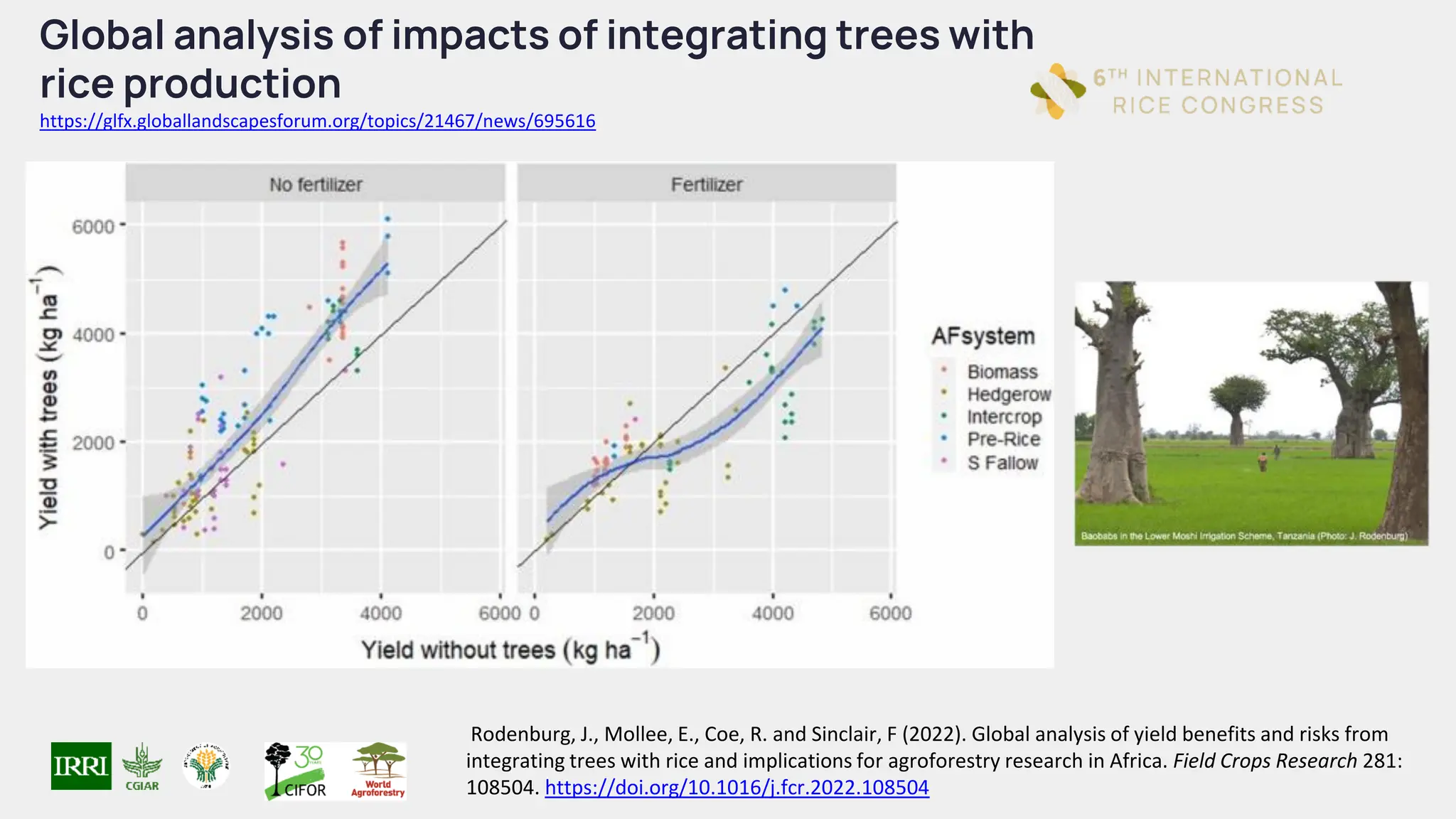
While the space occupied by tree trunks removes a fraction of land from annual crop production, overall land equivalent ratios (LER) in well-managed systems often exceed 1.0. This means the combined yield of trees and crops per unit area is frequently higher than monoculture equivalents due to better resource capture.
What are the primary challenges when starting an agroforestry project?
The most significant challenges include high upfront establishment costs, long lag times before tree crops generate revenue, increased management complexity, and the need for specialized equipment or pruning knowledge. Land tenure security is also essential, as tree-planting represents a long-term commitment.
How do agroforestry systems help mitigate climate change?
Agroforestry systems sequester significant amounts of carbon dioxide in woody biomass and deep soil organic matter. Furthermore, they enhance farm resilience against extreme weather events such as droughts, heavy downpours, and temperature spikes by buffering local microclimates.
Practical Next Actions for Landowners
Transitioning to agroforestry requires careful planning, site assessment, and a phased implementation strategy. Landowners interested in adopting these practices should begin by evaluating their property's topography, soil type, water availability, and existing infrastructure.
- Conduct a Resource Assessment: Map out sun exposure, prevailing winds, drainage patterns, and existing vegetation zones across the land.
- Define Production Goals: Determine whether the primary objective is soil conservation, livestock welfare, or economic diversification through timber or specialty crops.
- Start Small: Pilot a single system—such as planting a riparian buffer, establishing a single windbreak, or intercropping a small orchard—before scaling up across the entire farm.
- Consult Extension Services: Engage with local agricultural extension agents, forestry departments, or agroforestry networks to access technical guidance, regional species lists, and potential grant or incentive programs.