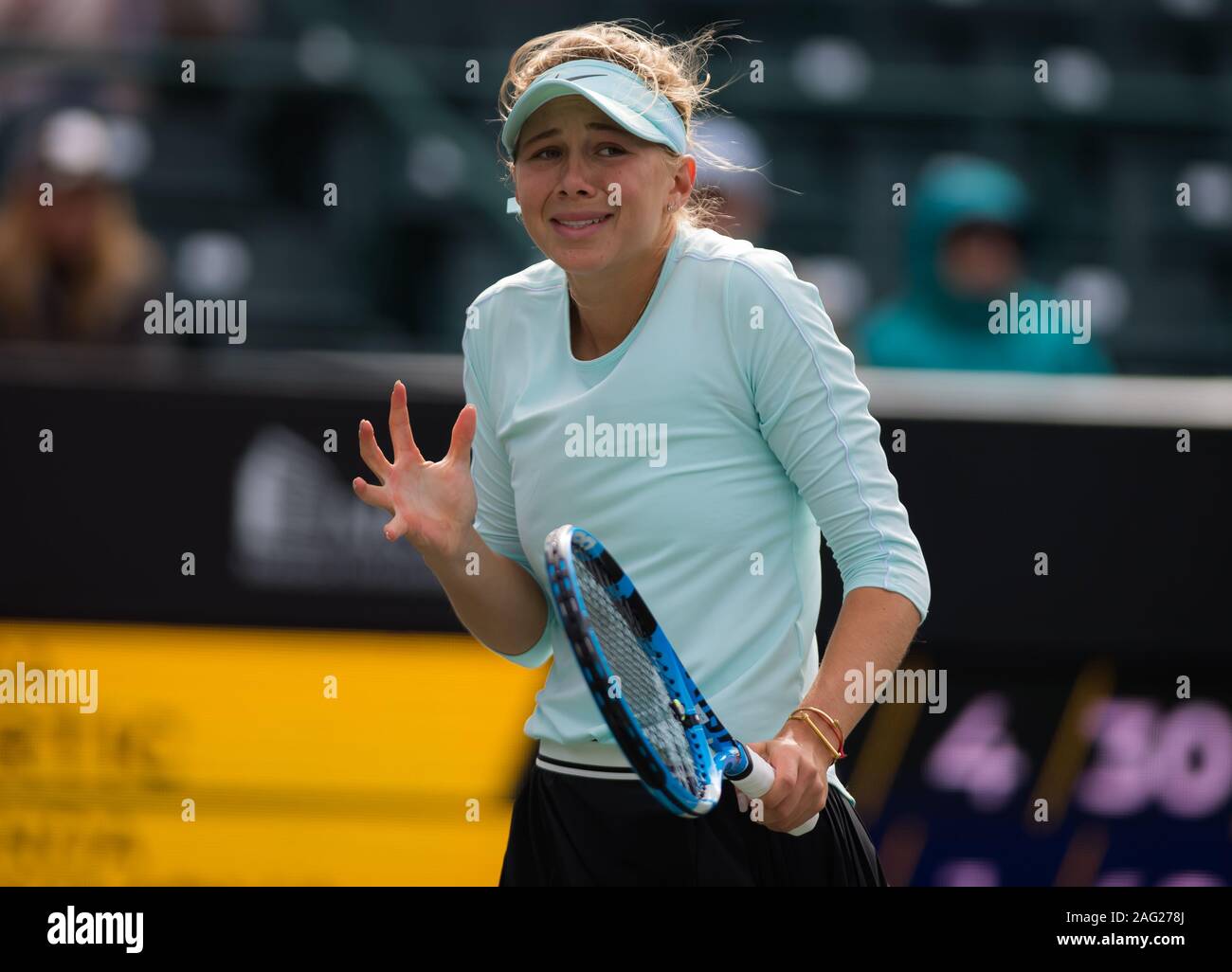
Amanda Anisimova remains one of the most compelling figures on the WTA circuit in 2026, known for her elite ball-striking and remarkable resilience. After navigating significant personal challenges and a high-profile hiatus, she has solidified her position as a top-tier competitor capable of defeating any opponent through aggressive baseline play and improved mental fortitude.
The trajectory of Amanda Anisimova’s career is a study in both precocious talent and the demanding nature of professional athletics. Since her debut as a teenager, she has been identified by analysts and peers alike as possessing some of the cleanest groundstrokes in the game. However, her journey on the WTA circuit has not been a simple linear climb. It has been marked by historic breakthroughs, profound personal loss, a necessary break for mental well-being, and a sophisticated tactical evolution that defines her current status in 2026.
The Early Ascent: A Teenage Phenomenon
Anisimova’s arrival on the international stage was nothing short of explosive. Born in New Jersey to Russian parents and raised in Florida, she benefited from a rigorous developmental environment. By the time she was 17, she had already signaled her intent to dominate the WTA circuit.
In 2019, Anisimova achieved what many veterans spend a decade chasing. At the French Open, she became the first player born in the 2000s to reach a Grand Slam semifinal. Her victory over the defending champion, Simona Halep, in the quarterfinals remains a benchmark for aggressive clay-court tennis. She didn't just win; she dictated play, taking the ball remarkably early and redirecting Halep’s pace with a composure that belied her age.
Earlier that same year, she secured her maiden WTA title in Bogotá. This victory was significant because it proved her versatility. While her flat, powerful shots are often associated with hard courts, her ability to slide and construct points on clay demonstrated a high "tennis IQ" that made her a dual-surface threat from the outset.
Navigating Adversity: Grief and the Mental Health Hiatus
The momentum of 2019 was tragically interrupted by the sudden passing of her father and coach, Konstantin Anisimova, just prior to the US Open. This event fundamentally altered her career path. For several seasons, Anisimova fluctuated in the rankings, grappling with the immense weight of grief while trying to maintain the rigors of the professional tour.
Despite these challenges, she continued to show flashes of brilliance, such as winning her second title in Melbourne in 2022 and reaching the quarterfinals of Wimbledon that same year. However, the cumulative toll of professional pressure and personal recovery led to a pivotal decision in May 2023. Anisimova announced an indefinite break from tennis, citing burnout and concerns for her mental health.
This hiatus was a turning point for her career on the WTA circuit. Rather than pushing through exhaustion—a common pitfall that leads to career-ending injuries—she chose a path of sustainability. When she returned at the start of the 2024 season, she appeared physically rejuvenated and, more importantly, mentally refreshed. Her run to the fourth round of the 2024 Australian Open and her subsequent final appearance in Washington later that year signaled that her "second career" would be defined by a more balanced approach to the sport.
Technical Analysis: The Mechanics of an Aggressive Baseliner
To understand Anisimova’s success on the WTA circuit, one must look at the mechanics of her game. She is widely considered one of the purest ball-strikers of her generation. Her game is built on a foundation of timing rather than raw muscular force.
The Backhand: A World-Class Weapon
Anisimova’s two-handed backhand is her signature shot. It is characterized by a short take-back and an incredibly fast acceleration through the hitting zone. Unlike many players who use heavy topspin for safety, Anisimova hits a relatively flat ball. This allows the ball to "skid" off the court surface, giving her opponents less time to react. In 2026, she has refined this shot to include more varied angles, allowing her to pull opponents off the court even when she is in a defensive position.
Improved Serve Dynamics
Earlier in her career, Anisimova’s serve was often viewed as a liability, prone to double faults under pressure. Working with various coaching consultants during her comeback, she stabilized her toss and improved her leg drive. By 2026, her first-serve percentage has stabilized, and she uses her height (5'11") more effectively to generate "free points" via aces or unreturnable serves, which is essential for preserving energy during long tournament weeks.
Return of Serve
Anisimova is statistically one of the most aggressive returners on the WTA circuit. She stands close to or inside the baseline, even against first serves. This "front-foot" pressure forces opponents into uncomfortable service rhythms. Her ability to neutralize high-velocity serves and immediately take control of the point is a primary reason she maintains a high break-point conversion rate.
Comparison of Career Phases
The following table outlines the evolution of Amanda Anisimova’s performance metrics and career focus across three distinct eras of her time on the WTA circuit.
| Feature | Early Career (2017–2019) | Transitional Period (2020–2023) | Current Status (2024–2026) |
|---|---|---|---|
| Primary Strength | Raw Pace & Fearlessness | Tactical Variety (Inconsistent) | Mental Resilience & Shot Selection |
| Major Achievement | French Open Semifinalist | Wimbledon Quarterfinalist | Consistent Top 20 Presence |
| Physical Condition | High Agility, Low Endurance | Injury Struggles | Optimized Strength & Recovery |
| Tactical Approach | High-Risk "First Strike" | Defensive Experimentation | Aggressive but Measured |
| Mental Focus | Rapid Growth | Grief Management & Burnout | Longevity & Well-being |
Strategic Schedule Management in 2026
One of the most significant changes in Anisimova’s approach to the WTA circuit in 2026 is her "quality over quantity" scheduling. In previous years, many young players fell into the trap of over-playing to chase ranking points. Anisimova, having experienced burnout, now employs a strategic calendar that prioritizes peak performance at WTA 1000 events and Grand Slams.
By limiting her participation in smaller tournaments, she ensures that her body—specifically her lower back and joints, which have been points of concern in the past—receives adequate recovery time. This professional maturity has allowed her to maintain a high winning percentage against Top 10 opponents, as she enters matches with the physical and mental freshness required to execute her high-intensity game plan.
The Role of Coaching and Support Systems
The current iteration of "Team Anisimova" in 2026 reflects a holistic approach to professional tennis. After the loss of her father, finding the right coaching fit was a long process. Her current setup includes not only a technical coach but also a dedicated traveling physiotherapist and a mental performance consultant.
This support system has helped her move away from a "win-at-all-costs" mentality toward a process-oriented approach. On the court, this is visible in her improved body language. She no longer lets a single lost game or a string of unforced errors derail her entire match. This emotional regulation is perhaps the most significant "technical" improvement she has made on the circuit.
Impact on the WTA Circuit and American Tennis
Anisimova is a vital part of the "Golden Generation" of American women’s tennis. Alongside peers like Coco Gauff and Jessica Pegula, she has helped maintain the United States' dominance in the top rankings. However, Anisimova occupies a unique niche. While Gauff is known for her defensive prowess and athleticism, Anisimova represents the pinnacle of offensive baseline tennis.
She serves as an inspiration for many younger players on the circuit due to her transparency regarding mental health. By stepping away and returning successfully, she challenged the old-school narrative that a hiatus is a sign of weakness or a "career killer." In 2026, her presence on the tour is seen as a testament to the fact that career longevity is built on more than just physical training.
Common Challenges and Troubleshooting Performance
Even for a player of Anisimova's caliber, certain challenges persist on the WTA circuit.
- Handling Heavy Spin: Because Anisimova hits a flat ball, she can sometimes struggle against opponents who use heavy "moonball" tactics or excessive topspin (such as Iga Świątek). To counter this, she has worked on her footwork to ensure she strikes the ball at its apex rather than letting it get above her shoulders.
- Surface Adaptation: While she has a title on clay and has performed well on grass, her game is most naturally suited to hard courts. Navigating the transition from the slow clay of Europe to the fast grass of Wimbledon remains a yearly tactical hurdle.
- Unforced Error Count: Her aggressive style naturally leads to a higher error count. The "troubleshooting" for this has been a shift in targets—aiming for larger margins inside the lines rather than painting the corners when she is not perfectly balanced.
Frequently Asked Questions
What are Amanda Anisimova's most significant WTA titles?
Anisimova won her first title in 2019 at the Copa Colsanitas in Bogotá (clay) and her second at the Melbourne Summer Set 2 in 2022 (hard). These victories demonstrated her ability to win on different surfaces against diverse playing styles. Since her return in 2024, she has remained a consistent contender in the deep rounds of WTA 1000 events.
How did Amanda Anisimova’s 2023 hiatus affect her ranking?
When Anisimova took her break in May 2023, her ranking naturally dropped as she was unable to defend points. However, the WTA’s "Special Ranking" or "Protected Ranking" rules, along with wildcard entries afforded to a player of her pedigree, allowed her to reintegrate into main-draw events quickly upon her return in 2024. By 2026, she has successfully climbed back into the elite tiers of the rankings.
What makes Anisimova’s playing style different from other WTA players?
Most modern WTA players rely on a mix of heavy topspin and defense. Anisimova is a "pure" ball-striker who prioritizes flat power and early timing. She takes time away from her opponents by standing close to the baseline, which is a high-risk, high-reward strategy that requires exceptional hand-eye coordination.
Who are Anisimova’s biggest rivals on the circuit in 2026?
Her rivalries often involve other heavy hitters and elite defenders. Matches against players like Iga Świątek, Aryna Sabalenka, and Coco Gauff are highly anticipated because they represent a clash of different tennis philosophies—Anisimova’s flat power versus Świątek’s spin or Gauff’s movement.
How can fans follow Amanda Anisimova's progress?
Fans can track her live scores and tournament schedules via the official WTA Tour website. Her matches are typically broadcast on major sports networks like Tennis Channel and ESPN, depending on the tournament's jurisdiction and level.
Final Recommendations for Following Her Career
For those following Amanda Anisimova on the WTA circuit in 2026, the key is to look beyond the win-loss column. Her career is now defined by the quality of her engagement with the sport. Watch for her performance in the "Sunshine Double" (Indian Wells and Miami) and the lead-up to the French Open, as these segments of the season typically highlight her strengths in hard-court aggression and clay-court point construction.
As she enters the peak years of her career, the focus remains on her ability to stay healthy and maintain the mental balance she fought so hard to achieve. For tennis enthusiasts and aspiring players, Anisimova’s game provides a masterclass in clean hitting and the importance of psychological health in the high-stakes environment of professional sports.