The constitutionality of the Alabama Workers' Compensation Act is frequently challenged by injured employees and labor advocates who argue that its statutory limitations on benefits, caps on recovery, and restricted legal remedies violate state constitutional rights. While courts generally uphold the framework's legislative intent to provide a balanced administrative trade-off, ongoing legal arguments focus on whether structural reforms have eroded workers' fundamental protections.
Introduction to the Alabama Workers' Compensation System
The Alabama Workers' Compensation Act serves as the primary statutory framework governing occupational injuries and illnesses within the state. Established to provide a predictable, administrative mechanism for injured workers to receive medical treatment and wage replacement without proving employer negligence, the system operates as an exclusive remedy. Under this legislative bargain, employees surrender their right to sue employers in tort for workplace injuries in exchange for guaranteed, no-fault benefits.
However, this statutory bargain has faced persistent scrutiny. Critics, labor attorneys, and constitutional scholars periodically challenge the framework, asserting that the act has become unconstitutional as legislative amendments over decades have reduced benefits, capped non-economic damages, and limited access to jury trials. To understand these challenges, one must examine how the act functions, the legal doctrines governing its constitutionality, and the specific provisions that draw the heaviest judicial and legislative criticism.
The Constitutional Framework and the Legislative Bargain
At the heart of every workers' compensation challenge is the concept of the "legislative bargain" or quid pro quo. When states originally enacted workers' compensation laws in the early 20th century, courts evaluated them against state constitutional provisions guaranteeing access to courts, trial by jury, and remedies for personal injury.
Judicial precedent has historically sustained these statutes by reasoning that the certainty of prompt medical care and partial wage replacement outweighs the loss of common-law tort rights. In Alabama, the courts have long recognized the legislature's broad police power to regulate workplace safety and economic relationships.
Nevertheless, constitutional challenges arise when plaintiffs argue that the balance has been irrevocably skewed. If the statutory benefits provided under the Alabama Workers' Compensation Act become so inadequate that they no longer constitute a meaningful quid pro quo, attorneys argue that the exclusive remedy provision violates state constitutional guarantees, such as:
- Access to Courts: Provisions ensuring that every person suffering an injury shall have a remedy by due process of law.
- Trial by Jury: Protections safeguarding the right to a jury trial for common-law civil claims.
- Equal Protection and Due Process: Clauses prohibiting arbitrary legislative classifications that treat injured workers differently from other tort victims.
Key Grounds for Constitutional Challenges
Litigants attempting to invalidate parts of the Alabama Workers' Compensation Act typically focus on specific structural limitations within the code. These challenges rarely succeed in overturning the entire act, but they target specific statutory constraints that impact severely injured workers.
Caps on Permanent Partial and Total Disability Benefits
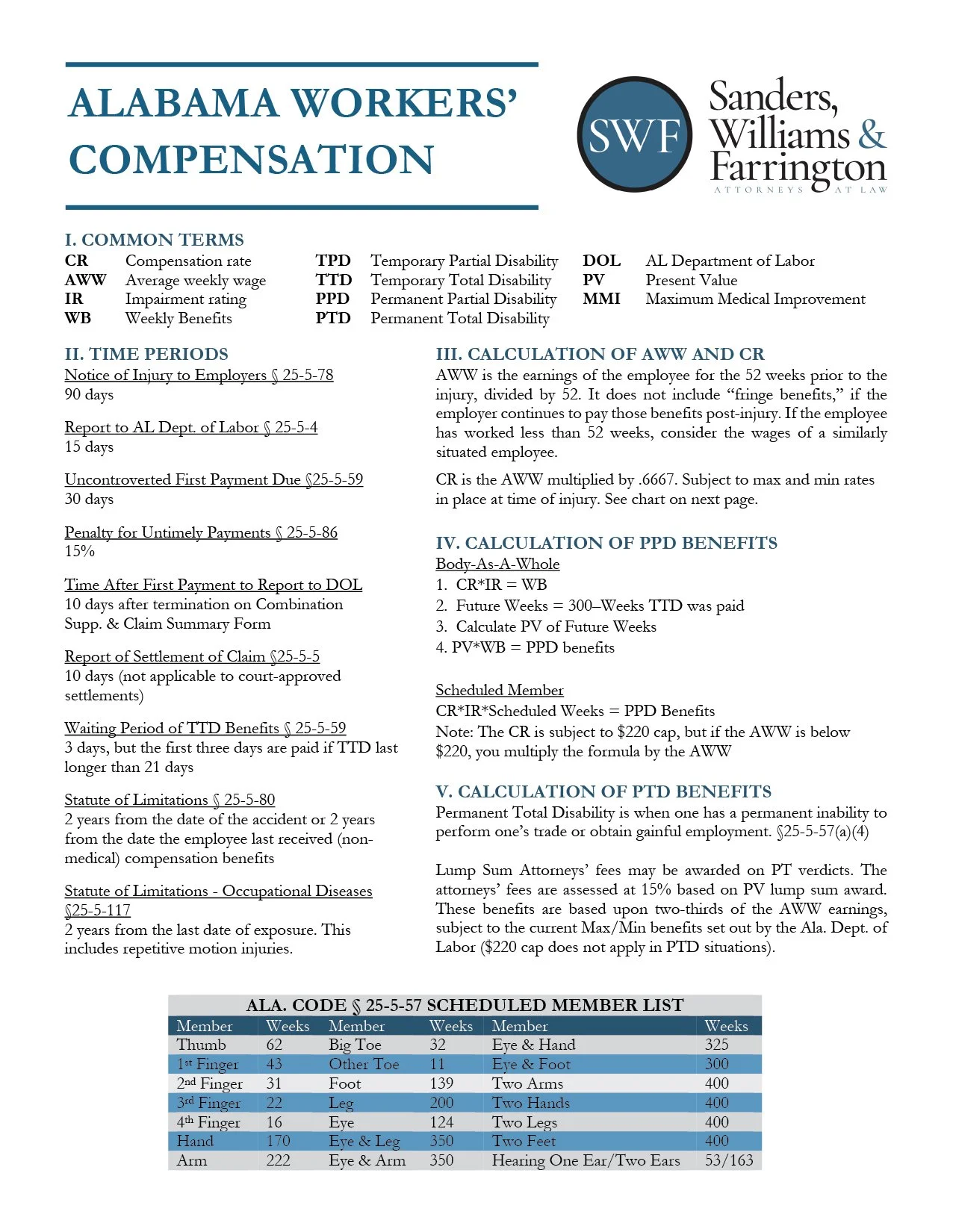
One of the most frequent points of contention involves statutory caps on compensation. Alabama law imposes strict limitations on the duration and monetary amounts recoverable for various types of permanent partial disabilities, particularly those involving scheduled members (such as fingers, hands, arms, legs, and feet) or unscheduled body parts. Injured workers argue that arbitrary caps fail to account for actual wage loss or lifelong earning capacity reductions, effectively leaving catastrophically injured employees without adequate support.
The Exclusive Remedy Rule and Third-Party Liability
The exclusive remedy provision shields employers and, in many cases, co-employees from civil lawsuits arising from workplace negligence. When an employee suffers severe harm due to gross negligence or intentional corporate misconduct, the absolute bar of the workers' compensation system prevents them from seeking punitive damages. Plaintiffs have periodically argued that shielding employers from accountability for reckless behavior violates public policy and constitutional protections against arbitrary legislative immunity.
Attorney Fee Restrictions
The Alabama Workers' Compensation Act regulates and caps the attorney fees that legal counsel can charge injured workers, typically limiting them to 15% of the recovery and requiring court approval. While designed to protect workers from exorbitant legal costs, critics argue that these stringent limits discourage qualified trial attorneys from taking complex, heavily contested workers' compensation cases, thereby impairing an injured worker's practical ability to secure legal representation against corporate insurers.
Judicial History and Precedent in Alabama Courts
The Alabama Supreme Court has historically maintained a deferential stance toward the legislature regarding workers' compensation reform. When evaluating challenges claiming the act violates state constitutional rights, the judiciary applies the rational basis test or examines whether the statutory scheme provides a reasonably substitute remedy for common-law rights.
In landmark decisions over the decades, the state's appellate courts have repeatedly affirmed that the legislature holds the authority to define and limit remedies for industrial injuries. For instance, the court has ruled that the complete elimination of common-law tort actions against employers is permissible under the state constitution so long as the alternative workers' compensation system remains operational and provides baseline benefits.
However, dissenting opinions in notable cases have occasionally echoed arguments raised by plaintiffs, suggesting that if statutory benefits drop below a constitutional threshold of adequacy, the courts may eventually be forced to declare certain restrictive provisions void. Despite these intellectual debates, no broad judicial ruling has struck down the core mechanics of the Alabama Workers' Compensation Act as entirely unconstitutional.
Comparison of Workers' Compensation Models and Statutory Rigidity
To contextualize the debate surrounding Alabama's framework, it is helpful to examine how state systems vary regarding benefit adequacy, legal recourse, and constitutional vulnerability.
| State System Feature | Alabama Workers' Compensation | Alternative/Progressive State Models | Key Legal Implications |
|---|---|---|---|
| Exclusive Remedy | Strict bar against tort suits with narrow intentional tort exceptions. | Some jurisdictions permit broader exceptions for gross negligence or OSHA violations. | Limits employer accountability in exchange for guaranteed no-fault processing. |
| Benefit Caps | Rigid statutory caps on permanent partial and total disability durations. | Periodic indexing to state average weekly wages without arbitrary drop-off cliffs. | Impacts long-term financial security for permanently impaired workers. |
| Attorney Fee Controls | Strictly capped at 15% with mandatory court approval. | Flexible contingency fee arrangements subject to standard ethical guidelines. | Influences the availability of specialized legal representation for claimants. |
| Alternative Opt-Out | Not permitted; mandatory participation for covered employers. | Select states (e.g., Texas) permit non-subscription models with alternative benefit plans. | Affects employer liability exposure and employee dispute resolution pathways. |
Practical Implications for Injured Workers and Employers
While constitutional challenges make for significant legal debate, the practical reality for participants in the Alabama system remains governed by current statutory law. Injured workers must navigate administrative procedures through the Alabama Department of Labor and the circuit courts rather than standard civil litigation.
For employers and insurers, the stability of the exclusive remedy rule provides predictable risk management. Knowing that liability is largely capped by statutory schedules allows businesses to secure workers' compensation insurance without facing unpredictable catastrophic jury verdicts for ordinary workplace accidents.
Nevertheless, employers face strict compliance mandates. Failure to secure mandatory workers' compensation coverage in Alabama can result in severe civil penalties, stop-work orders, and exposure to direct civil lawsuits where the traditional defense of contributory negligence is abrogated, creating significant financial risk for non-compliant businesses.
Frequently Asked Questions
Has the Alabama Workers' Compensation Act ever been declared completely unconstitutional?
No. The Alabama Supreme Court has consistently upheld the constitutionality of the act as a valid exercise of legislative police power, maintaining that the exchange of common-law tort rights for guaranteed no-fault benefits satisfies constitutional requirements.
Can an injured worker sue their employer outside of the workers' compensation system?
Generally, no. The exclusive remedy provision prevents employees from filing personal injury or negligence lawsuits against their employers. Exceptions are exceptionally narrow, typically requiring proof of an actual, specific intent on the part of the employer to injure the employee.
Why do critics argue the act is unconstitutional?
Critics argue that decades of legislative amendments have reduced benefit levels and imposed strict caps, creating a situation where the statutory benefits no longer provide a fair or adequate substitute for the common-law rights that workers surrendered.
Does the act restrict legal representation for injured workers?
The act places strict statutory limits on attorney fees, capping them at 15% of the recovery and requiring judicial approval. While intended to protect claimants from excessive fees, critics note it can make it difficult for workers to retain counsel for complex, heavily contested claims.
Where can official information regarding Alabama workers' compensation rules be found?
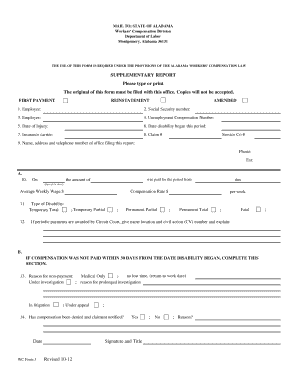
Official guidance, statutory text, and administrative forms can be accessed through the Alabama Department of Labor website or by consulting the Code of Alabama.
Conclusion and Next Actions
While legal scholars and advocates continue to debate the constitutional fairness of the Alabama Workers' Compensation Act, the framework remains the binding law governing workplace injuries in the state. Injured workers seeking relief must operate within its statutory boundaries, ensuring they report injuries promptly, meet filing deadlines, and consult qualified legal professionals who understand the complexities of the Alabama court-supervised system. Employers must maintain compliant coverage to protect their operations from severe statutory penalties and potential direct liability.