In the world of commercial insurance and contract management, requesting an "additional insured" status on a workers' compensation policy is a frequent but technically inaccurate request. While standard for general liability policies, workers' compensation law generally does not allow for additional insureds; instead, parties utilize a Waiver of Subrogation or an Alternate Employer Endorsement to achieve similar risk-transfer goals.
The confusion surrounding the "additional insured workers compensation certificate" usually stems from boilerplate contract language. When a general contractor or a project owner asks a subcontractor to name them as an "additional insured" on all policies, they are attempting to shift the financial burden of potential workplace injuries. However, because workers' compensation is a statutory benefit specifically tied to the employer-employee relationship, adding a third party as an "insured" is fundamentally incompatible with the legal structure of most state workers' compensation systems.
To satisfy contractual obligations in 2026, business owners and risk managers must understand why this request is made, what the legal limitations are, and how to provide the correct documentation to remain compliant while protecting their financial interests.
Why "Additional Insured" Does Not Exist for Workers' Compensation
To understand why an additional insured workers compensation certificate is a misnomer, one must look at the nature of the policy. Workers’ compensation is a "no-fault" system. It provides medical benefits and wage replacement to employees injured in the course of employment. In exchange for these guaranteed benefits, employees generally give up the right to sue their employer for negligence—a concept known as "exclusive remedy."
An "Additional Insured" status, commonly used in General Liability (GL) or Auto Liability, grants a third party coverage under the policyholder’s insurance. If that third party is sued for an accident caused by the policyholder, the insurance company defends them.
In workers’ compensation, however:
- The Statutory Limit: Benefits are strictly defined by state law. An insurance company cannot pay workers' comp benefits to someone who is not an employee of the policyholder.
- Employer-Employee Relationship: Since the third party (e.g., a project owner) does not employ the subcontractor’s workers, they cannot be an "insured" for the purpose of paying those workers' benefits.
- Third-Party Liability: If a subcontractor’s employee is injured due to the project owner’s negligence, that employee can still sue the project owner (since the owner is not their employer and thus not protected by the "exclusive remedy" rule).
Because of these factors, insurance carriers in 2026 do not have a standard "Additional Insured" endorsement for workers' compensation. When you see a certificate of insurance (COI) where the "Additional Insured" box is checked for workers' comp, it is often a clerical error or a misunderstanding of the form.
The Role of the Certificate of Insurance (COI) in 2026
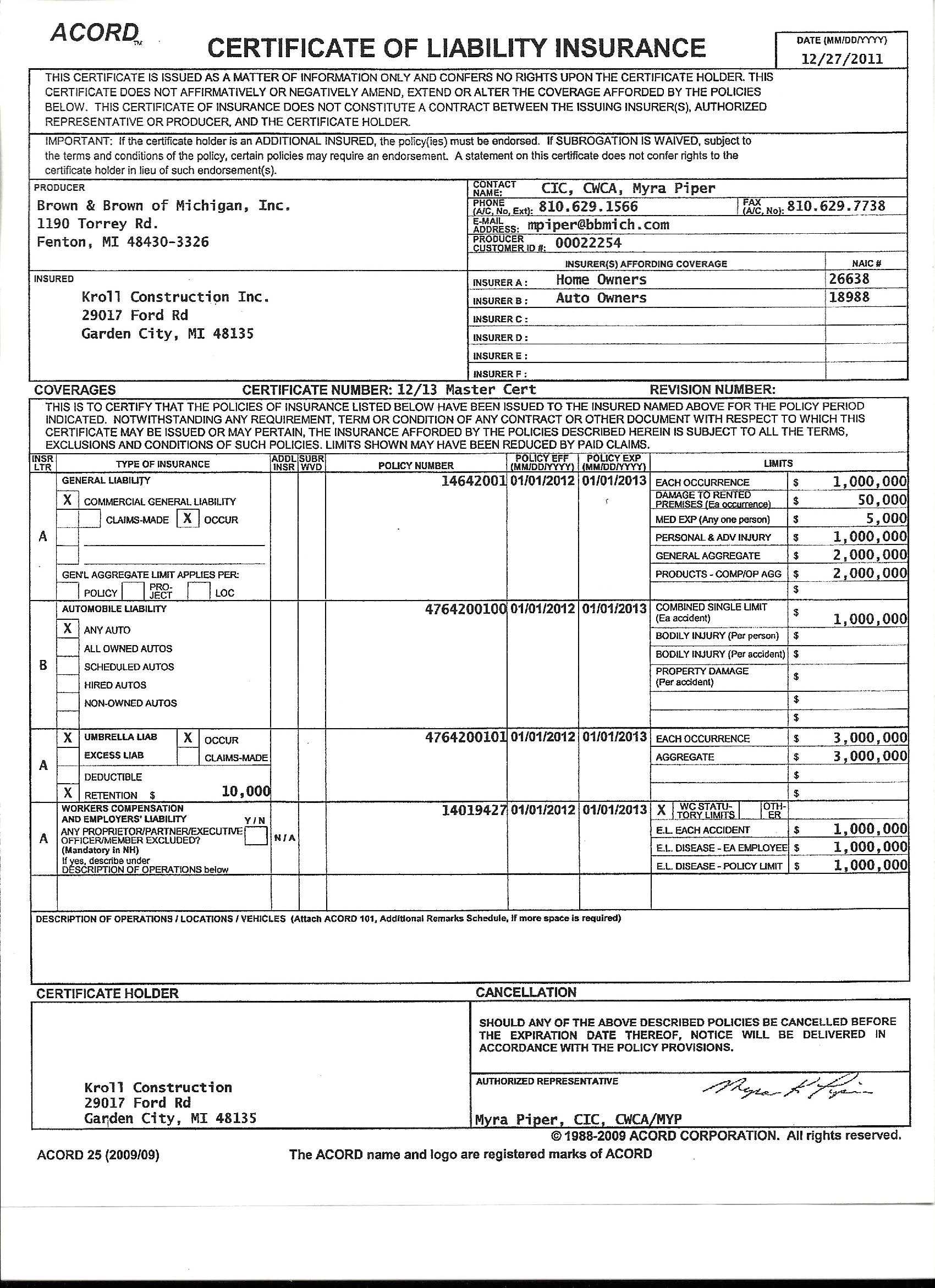
The document most people refer to as a "workers compensation certificate" is actually the ACORD 25 Certificate of Liability Insurance. This is a summary document used to prove coverage to a third party.
In 2026, the ACORD 25 form remains the industry standard. It contains several columns next to the types of insurance (General Liability, Automobile Liability, Excess/Umbrella, and Workers' Compensation). There are two specific columns:
- ADDL INSR (Additional Insured): This is where you would typically check "Y" for General Liability.
- WVD SUBR (Waiver of Subrogation): This is the column that is relevant to workers' compensation.
When a contract asks for an "additional insured workers compensation certificate," the professional response is to provide a certificate that shows a Waiver of Subrogation in favor of the requesting party. This satisfies the intent of the contract—which is to protect the hiring party from financial loss—without violating the legal constraints of workers' compensation statutes.
The Real Solution: Waiver of Subrogation
Since you cannot add a third party as an additional insured, the industry uses the Waiver of Subrogation (WC 00 03 13) endorsement. This is the "Why" and "How" of satisfying a request for additional insured status on a workers' comp policy.
What is Subrogation?
Subrogation is the legal process by which an insurance company, after paying a claim to an injured worker, seeks to recover those costs from a third party who may have been responsible for the injury.
Example: A subcontractor’s employee is injured on a job site because the General Contractor (GC) left a floor opening uncovered. The subcontractor’s insurance pays the medical bills. The insurance company then sues the GC to get that money back.
How the Waiver Works
When you add a Waiver of Subrogation to your workers' compensation policy, your insurance company gives up its right to sue the party named in the waiver (the GC or project owner). This protects the hiring party from being "back-sued" by your insurance company.
For the hiring party, this is the primary goal of asking for "additional insured" status. They want to ensure that if someone gets hurt on their site, the financial responsibility stays with the employer’s insurance company and doesn't bounce back to them.
Blanket vs. Scheduled Waivers
In 2026, most businesses choose between two types of waivers:
- Scheduled Waiver: You name a specific entity (e.g., "XYZ Construction") on the endorsement. This usually carries a flat fee per entity.
- Blanket Waiver: This covers any party you are required by a written contract to provide a waiver for. While more expensive upfront, it is more efficient for businesses handling multiple contracts.
The Alternate Employer Endorsement: A Rare Exception
While a standard "Additional Insured" doesn't exist, there is a technical cousin called the Alternate Employer Endorsement (WC 00 03 01). This is used in very specific circumstances, primarily involving staffing agencies or Professional Employer Organizations (PEOs).
If a company hires temporary workers from a staffing firm, they are the "Alternate Employer." If one of those temp workers gets hurt, the staffing firm’s workers' comp policy responds. The Alternate Employer Endorsement ensures that the company using the temp workers is treated as an employer under the policy, giving them the protection of the "exclusive remedy" rule and preventing the temp worker from suing them for negligence.
If your contract specifically demands "insured status" rather than just a waiver, and you are acting in a capacity similar to a staffing arrangement, the Alternate Employer Endorsement is the correct technical tool to use.
Comparison of Coverage Types and Requests
The following table clarifies the differences between the common terms used in 2026 insurance certificates and contracts.
| Provision | Available for Workers' Comp? | Primary Purpose | Who it Protects |
|---|---|---|---|
| Additional Insured | No | Protects third parties against lawsuits for negligence. | The Hiring Party (Project Owner/GC). |
| Waiver of Subrogation | Yes | Prevents the insurer from suing the hiring party for reimbursement. | The Hiring Party and their Insurer. |
| Alternate Employer | Yes (Specific) | Extends "employer" status to a client (used in staffing/leasing). | The Client/Temp Agency User. |
| Primary & Non-Contributory | No (Liability Only) | Ensures one policy pays before others without seeking contribution. | The Hiring Party’s loss history. |
How to Handle an "Additional Insured" Request in Your Contract
If you are a business owner in 2026 and your client provides a contract requesting an "additional insured workers compensation certificate," follow these steps to resolve the issue:
1. Analyze the Contract Language
Look for phrases like "Additional Insured for all policies required herein." This is standard legal boilerplate. Identify if the contract specifically lists workers' compensation under the additional insured requirements.
2. Consult Your Insurance Broker
Explain that the client is asking for additional insured status on workers' comp. Your broker will confirm that this is not possible and will instead suggest a Waiver of Subrogation.
3. Communicate with the Client’s Risk Manager
Often, the person requesting the certificate is a junior administrator following a checklist. You may need to provide a brief explanation (or have your broker provide one) stating that workers' compensation law does not allow for additional insureds, but that you are providing a Waiver of Subrogation to meet the risk-transfer intent of the contract.
4. Verify State Laws
Workers' compensation is governed by state law, not federal law. As of 2026, some states have strict regulations regarding Waivers of Subrogation. For example:
- Texas: Very common and widely used.
- New Hampshire: Generally prohibited unless specific conditions are met.
- Kansas/Kentucky: Have specific restrictions on how waivers are applied in construction.
Ensure your endorsement is valid in the state where the work is being performed.
5. Issue the Correct ACORD 25
When the certificate is issued:
- Ensure the "WVD SUBR" box for Workers' Compensation is checked.
- In the "Description of Operations" box at the bottom, include specific language: "A Waiver of Subrogation in favor of [Client Name] is included as per the attached endorsement WC 00 03 13."
Costs and Financial Considerations
Adding endorsements to a workers' compensation policy is not free. In 2026, insurers typically calculate the cost of a Waiver of Subrogation based on a percentage of the manual premium associated with the specific project or a flat fee.
- Flat Fees: These range from $100 to $500 per endorsement for a scheduled waiver.
- Percentage Fees: Some carriers charge between 2% and 5% of the premium generated by the payroll for the specific job requiring the waiver.
- Blanket Waiver Cost: A blanket waiver might cost between $500 and $2,500 annually, depending on the size of your company and the volume of your contracts.
It is vital to factor these insurance costs into your project bids. If a contract requires a waiver for a small $5,000 job, and the endorsement costs $250, you have just lost 5% of your gross revenue to a single insurance requirement.
Common Pitfalls and Mistakes
Even experienced contractors often make mistakes when dealing with these certificates. Avoid these common errors:
- Assuming the COI is the Endorsement: A Certificate of Insurance is merely an information document. It does not change the policy. If the "WVD SUBR" box is checked but the actual endorsement (the legal amendment to the policy) hasn't been filed with the carrier, the waiver may not legally exist.
- Filing "Additional Insured" for WC: If a broker accidentally issues a certificate showing a third party as an additional insured on workers' comp, it could lead to a breach of contract claim later if a loss occurs and the carrier denies coverage because the endorsement is invalid.
- Ignoring the "Exclusive Remedy" Rule: Hiring parties sometimes think that being an "additional insured" or having a waiver makes them immune to all lawsuits. This is false. A waiver only stops the insurance company from suing; it does not stop the injured employee from suing the third party for gross negligence or safety violations.
Frequently Asked Questions
Can a General Contractor be an Additional Insured on my Workers' Comp?
Technically, no. General Contractors are added as Additional Insureds on General Liability policies. For Workers' Comp, they should be listed as a party to whom you have granted a Waiver of Subrogation. This provides the protection they are looking for without violating insurance statutes.
What happens if I provide a certificate that says "Additional Insured" for Workers' Comp?
If the underlying policy doesn't actually have an "Additional Insured" endorsement (which standard WC policies don't), the certificate is essentially inaccurate. In the event of an injury and a subsequent lawsuit, the General Contractor may find they have no protection, leading to a legal dispute between you and the GC for providing a misleading certificate.
Is a Waiver of Subrogation the same as being an Additional Insured?
No, but they serve similar goals in risk management. An Additional Insured is granted direct coverage and defense under a policy. A Waiver of Subrogation simply prevents the insurance company from seeking reimbursement from a third party after a claim is paid.
Why do some contracts still insist on "Additional Insured" status for Workers' Comp?
Most of the time, this is due to outdated contract templates or a lack of understanding by the legal department drafting the agreement. They use "blanket" language for all insurance types without realizing that Workers' Comp is treated differently under the law than Liability insurance.
How much does it cost to get the waiver added to my certificate?
Costs vary by carrier and state. Generally, expect to pay a flat fee of $150–$300 or a percentage (2-5%) of the premium for the payroll associated with that specific contract. In 2026, many carriers offer "Blanket Waivers" for a higher annual fee that covers all contracts automatically.
Practical Recommendation
When faced with a request for an "additional insured workers compensation certificate," do not simply check the box on a form. Instead, reach out to your insurance agent and request a Waiver of Subrogation endorsement. Provide your client with the ACORD 25 certificate showing the "WVD SUBR" box checked, and if necessary, include a copy of the actual endorsement page from your policy. This demonstrates professional competence, ensures you are in compliance with state laws, and provides the hiring party with the actual financial protection they require to mitigate their risk on the project.