A workers' compensation classification code, often referred to in specific rating systems or policy schedules under unique identification markers like "6ue," is a standardized numeric or alphanumeric code used by insurance rating bureaus to categorize business operations by industry type, assess occupational injury risk, and determine accurate premium rates for employers.
Navigating the mechanics of workers' compensation insurance can be a daunting task for business owners, human resources professionals, and financial managers. Among the most critical components of calculating commercial insurance premiums is the classification rating system. Underwriters and rating bureaus use specific codes to evaluate the inherent hazards associated with distinct job duties.
Understanding how these classification ratings operate, how modifications are applied, and what businesses can do to manage their rating outcomes is essential for maintaining compliance and controlling operating costs. This guide breaks down the framework behind workers' compensation ratings, the role of classification codes, and the actionable steps organizations can take to optimize their insurance expenses.
The Foundation of Workers' Compensation Classification Systems
Workers' compensation insurance provides wage replacement and medical benefits to employees injured on the job in exchange for relinquishing the employee's right to sue their employer for negligence. Because the risk of workplace injury varies dramatically between a desk-bound administrative worker and an industrial construction laborer, insurance companies cannot charge a flat rate across all businesses.
To solve this, rating bureaus—such as the National Council on Compensation Insurance (NCCI) in the United States, alongside independent state bureaus in non-NCCI jurisdictions—maintain elaborate classification systems. These systems group businesses into specific categories based on their primary operations.
How Classification Codes Are Assigned
Every business is assigned one or more classification codes based on the nature of its operations. The fundamental principle governing classification assignment is the "payroll separation" rule, which dictates that payroll must be segregated by type of work unless explicit manual rules state otherwise.
- Primary Operations: The principal business activity dictates the main classification code. For example, a manufacturing facility will have codes that reflect machining, assembly, and warehousing hazards.
- Standard Exceptions: Certain occupations are considered standard exceptions across almost all industries and are generally given separate codes. These typically include clerical office employees, outside salespersons, and drivers, provided they do not perform direct operational or manufacturing duties.
- The Go-Round of Risk Assessment: Field auditors review annual payroll reports to ensure that employees are properly categorized. Misclassifying high-risk workers into low-risk codes can result in severe premium adjustments, penalties, or retroactive billing during an audit.
Anatomy of a Workers' Compensation Rating
The final premium a business pays for workers' compensation insurance is not arbitrary. It is derived from a standardized mathematical formula that incorporates the classification code rate, the employer's payroll, and an individualized safety performance modifier.
The Standard Premium Formula
The calculation of a manual premium follows a direct formula established by actuarial data:
$$\text{Manual Premium} = \left(\frac{\text{Payroll}}{100}\right) \times \text{Classification Rate}$$
Because payroll is traditionally expressed per $100 of remuneration, the total insurable payroll is divided by 100 and then multiplied by the specific rate assigned to that classification code by the state rating bureau.
Experience Modification Rates (EMR)
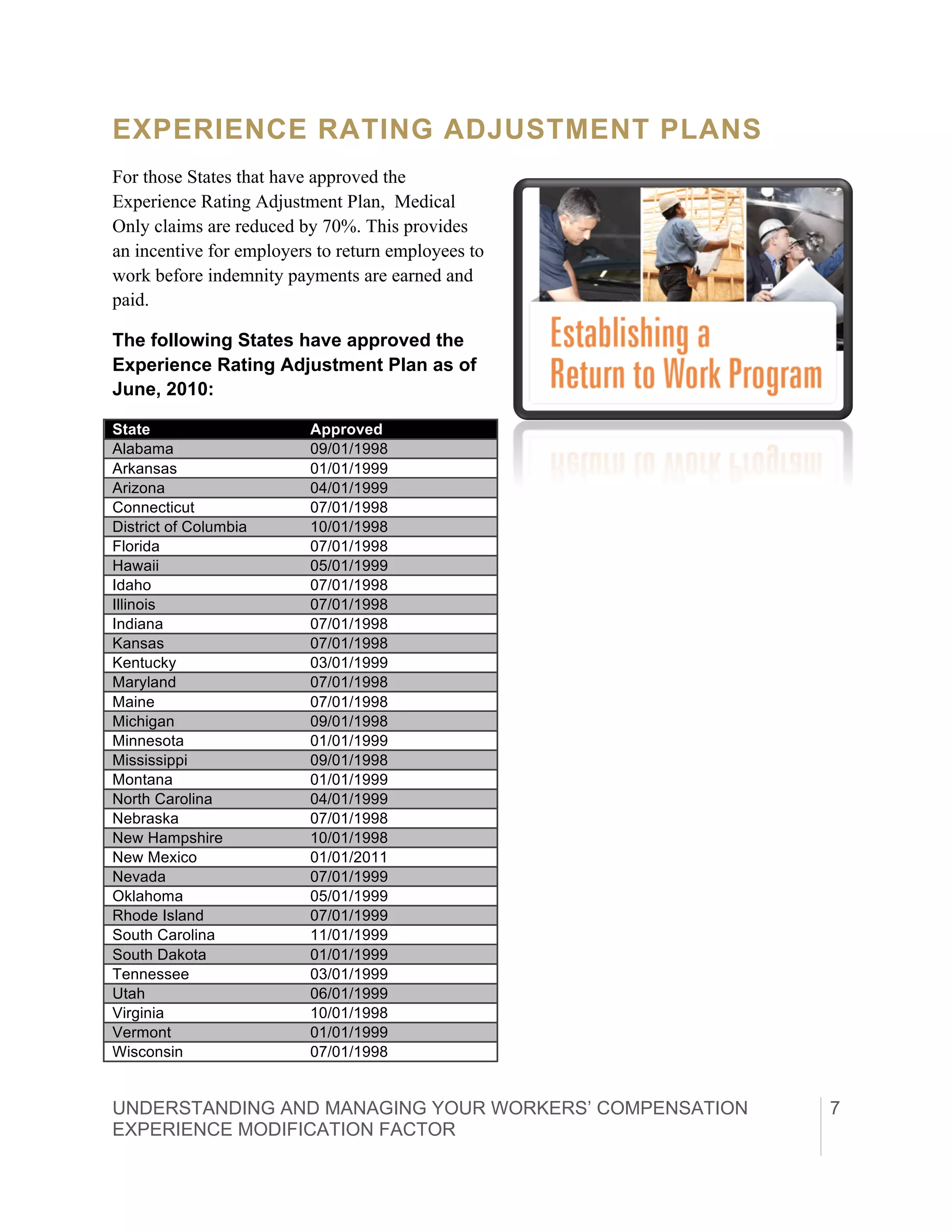
Once the manual premium is calculated, insurance underwriters apply the Experience Modification Rate (EMR)—often simply called the "Mod." The EMR is a multiplier derived from a company’s historical loss record compared to the average company in the same industry segment.
- An EMR of 1.00: Indicates an industry-average safety record and loss history.
- An EMR Below 1.00 (e.g., 0.80): Rewards companies with fewer or less severe claims than average, resulting in a discounted premium.
- An EMR Above 1.00 (e.g., 1.20): Penalizes organizations with a higher-than-average frequency or severity of workplace injuries, increasing the final premium by 20% or more.
Comparing Rating Factors and Insurance Components
To understand how individual classifications and ratings translate into overall financial obligations, it is helpful to examine the core components that interact to form the final insurance policy cost.
| Rating Component | Definition | Impact on Premium |
|---|---|---|
| Classification Code | Numeric identifier grouping business operations by occupational hazard level. | Sets the baseline rate per $100 of payroll. |
| Payroll Exposure | The total gross remuneration paid to employees within a specific class code. | Scales the baseline rate to the size of the workforce. |
| Experience Modifier (EMR) | Statistical factor measuring a company's historical claims vs. industry expected losses. | Adjusts the manual premium upward or downward based on safety performance. |
| Schedule Rating | Discretionary debits or credits applied by underwriters based on safety programs. | Fine-tunes the final premium based on workplace conditions and management practices. |
| Premium Discounts | Sliding-scale reductions applied to larger policies to reflect administrative savings. | Decreases the total cost as the overall premium size increases. |
Operational Impact and Cost Management Strategies
Because workers' compensation is a mandatory coverage in nearly every jurisdiction, controlling its cost is a vital operational priority. Organizations that treat classification and rating as a passive administrative chore frequently overpay for their coverage.
Conducting Regular Job-Duties Audits
Job roles evolve over time. Administrative staff may take on warehouse duties, or manufacturing processes may shift toward automation. Conducting internal reviews of job descriptions ensures that payroll is allocated accurately, preventing unwelcome surprises during the annual insurance audit.
Implementing Proactive Safety Programs
Because the Experience Modification Rate looks back over a rolling three-year window (excluding the most recent policy year), historical claims cast a long shadow over premium calculations. Effective risk management directly suppresses future EMR increases:
- Comprehensive Safety Training: Regular, documented safety meetings reduce the incidence of preventable ergonomic and mechanical injuries.
- Early Return-to-Work Programs: Providing light-duty assignments for injured workers minimizes lost-time severity, which heavily influences EMR calculations compared to medical-only claims.
- Immediate Incident Reporting: Investigating accidents immediately helps identify root causes, correct hazardous conditions, and manage claims efficiently through third-party administrators (TPAs).
Common Mistakes in Workers' Compensation Rating
Misunderstandings surrounding rating systems can lead to financial drain and compliance disputes. Employers should watch out for several frequent errors:
- Failure to Separate Payroll: Allowing all employees to fall under a single high-risk code rather than separating clerical or driving payroll can drastically inflate the manual premium.
- Ignoring Audit Discrepancies: Failing to review final premium audit statements often leaves erroneous classification assignments uncorrected. Employers have the right to dispute audit findings through their state rating bureau.
- Neglecting EMR Data Verification: Errors in payroll reporting or claim valuation submitted to rating bureaus can artificially spike an EMR. Companies should audit their loss runs annually to ensure closed or subrogated claims are accounted for properly.
Frequently Asked Questions
What determines whether a business qualifies for experience rating?
Most state rating bureaus and the NCCI establish a specific dollar threshold for manual premium (typically ranging from $5,000 to $10,000 over a three-year period, depending on the jurisdiction). If a business meets or exceeds this threshold, it is mandatory to calculate an Experience Modification Rate rather than relying solely on the manual rate.
Can an employer challenge a classification code assignment?
Yes. If an employer believes an insurance carrier or rating bureau has assigned an incorrect classification code, they can file a formal dispute or classification appeal through their state’s department of insurance or the local rating bureau. Documentation supporting the actual day-to-day duties of employees is required to substantiate the request.
How do sub-contractor costs affect my workers' compensation rating?
If an employer hires sub-contractors who do not carry their own workers' compensation insurance, the hiring business may be held legally responsible for coverage. In audits, uninsured sub-contractor payroll or total contract costs can be treated as direct payroll exposure, significantly increasing the rating basis and premium unless valid certificates of insurance are provided.
What is the difference between a manual rate and an adjusted rate?
The manual rate is the baseline cost per $100 of payroll established for a specific industry classification by actuarial rating bureaus. The adjusted rate incorporates individual modifiers, schedule rating credits or debits, and premium discounts tailored to the specific risk profile of the individual business entity.
Next Steps for Employers
To ensure accurate workers' compensation ratings and prevent overpayment, businesses should immediately review their current policy declarations page, verify that employee duties match the assigned classification codes, and request a copy of their current experience rating worksheet from their insurance broker or state bureau. Regularly auditing payroll distributions and investing in proactive workplace safety will stabilize modification rates over the long term.