Training for ISO 31000 provides professionals with a structured approach to managing uncertainty within their organizations. Unlike other standards, ISO 31000 training focuses on personal competency and the application of risk management principles rather than organizational certification. It equips individuals with the tools to integrate risk management into all aspects of decision-making and governance.
As we move through 2026, the landscape of global risk has become increasingly complex. From the rapid integration of artificial intelligence into core business processes to the intensifying pressures of climate-driven supply chain disruptions, the ability to manage uncertainty is no longer a niche skill—it is a leadership requirement. ISO 31000 remains the international benchmark for risk management, providing a "common language" that allows organizations of all sizes and sectors to communicate risk effectively.
Whether you are a seasoned risk officer or a manager looking to bolster your strategic decision-making, understanding the nuances of ISO 31000 training is essential. This guide breaks down the five critical facts regarding this training, the certification paths available, and how the standard interacts with the broader ecosystem of international management systems.
1. ISO 31000 Training Leads to Personal Certification, Not Organizational Compliance
One of the most frequent misconceptions in the professional training space is the belief that a company can become "ISO 31000 Certified." This is factually incorrect. Unlike ISO 9001 (Quality Management) or ISO 27001 (Information Security Management), ISO 31000 is a guideline standard, not a requirement standard.
Because ISO 31000 is intended to be adapted to the specific needs, culture, and context of an organization, it does not contain the "shall" requirements necessary for a formal third-party audit of a business entity. Instead, training is focused on the individual. When you enroll in an ISO 31000 course, you are seeking to validate your personal expertise in applying the standard’s principles.
The Individual Value Proposition
For the professional, this distinction is vital. Since the organization cannot hold the certificate, the value resides entirely within the person who has undergone the training. In 2026, as companies face increasingly diverse threats, having a certified Risk Manager on staff provides a level of internal assurance that the organization's risk framework is aligned with international best practices.
Why This Matters for Careers
Because there is no "corporate" certification, the market places a high premium on individuals who hold credentials such as "ISO 31000 Lead Risk Manager." These professionals act as the architects of an organization’s risk strategy. Training programs are designed to prove that the individual understands how to customize the standard’s generic framework to fit a specific corporate environment, whether that be a tech startup or a multinational manufacturing firm.
2. Training is Structured into Three Distinct Tiers
To accommodate various levels of responsibility, ISO 31000 training is generally divided into three primary levels. Each tier serves a specific purpose and requires a different depth of study.
ISO 31000 Foundation
The Foundation level is designed for those who need a fundamental understanding of risk management terminology and principles. This is often the starting point for junior risk analysts, project managers, or department heads who want to speak the same language as the risk department. The training focuses on the "What" and "Why" of the standard, covering the basic definitions of risk (the "effect of uncertainty on objectives") and the core principles that drive effective management.
ISO 31000 Risk Manager (Practitioner)
The Practitioner or Risk Manager level is a significant step up. This training moves from theory to application. It focuses on the "How." Participants learn how to design a risk management framework, how to conduct risk assessments using various techniques (often referencing ISO 31010), and how to monitor and review risk treatments. This level is essential for those who will be responsible for the day-to-day operation of a risk management program.
ISO 31000 Lead Risk Manager
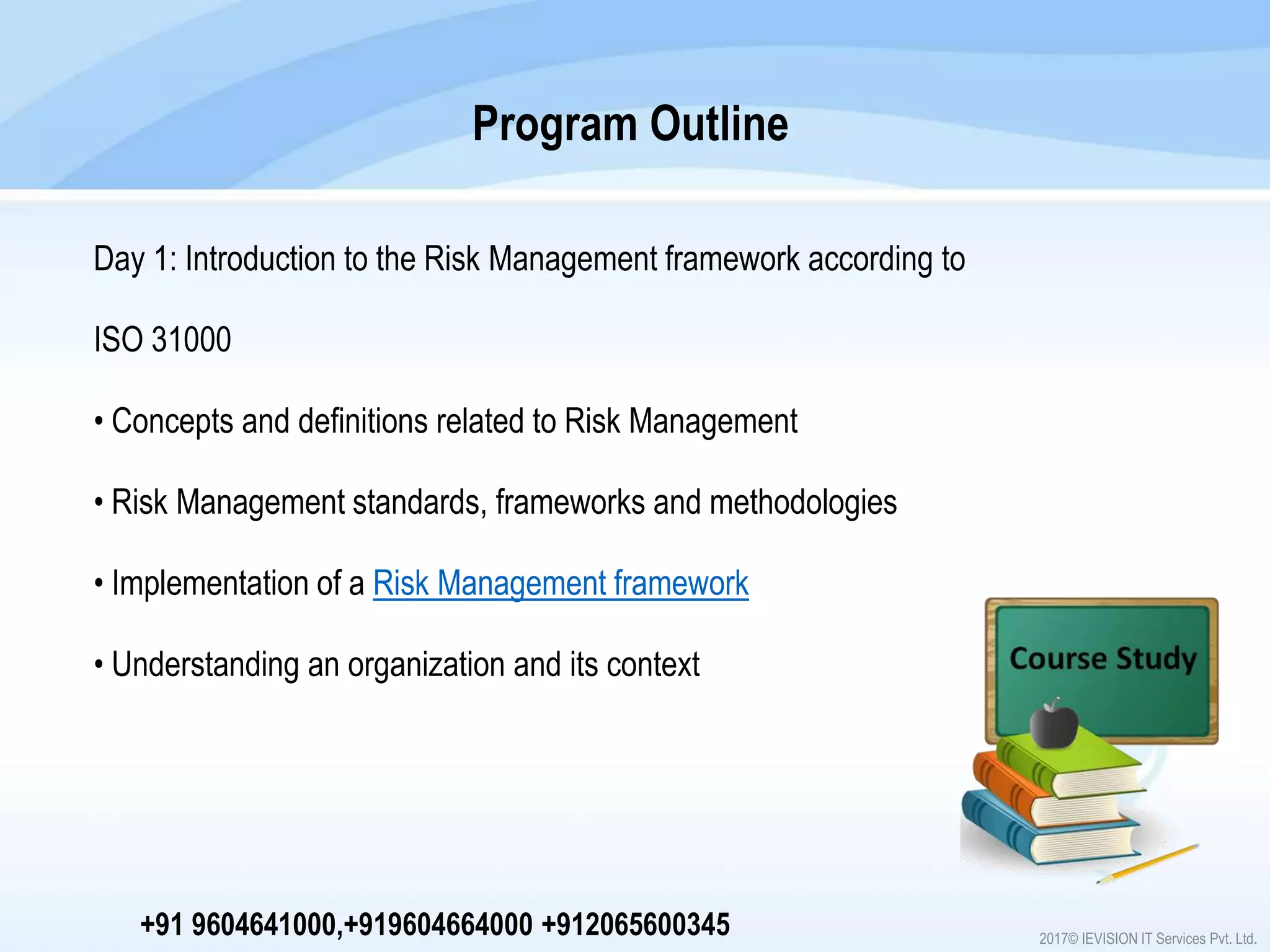
The Lead Risk Manager is the most comprehensive tier. This training is geared toward senior professionals who will oversee the implementation of the entire risk management framework across an enterprise. It includes modules on leadership, organizational culture, and the integration of risk into the strategic planning process. In 2026, this level of training often includes advanced modules on digital risk and the ethical implications of automated risk-treatment systems.
| Training Level | Target Audience | Primary Focus | Duration (Typical) |
|---|---|---|---|
| Foundation | All staff, new risk analysts | Terminology, Principles, Process Overview | 1-2 Days |
| Risk Manager | Risk officers, Department heads | Framework design, Assessment techniques | 3 Days |
| Lead Risk Manager | Senior executives, Consultants | Implementation, Strategy, Governance | 5 Days |
3. The Curriculum Centers on the 2018 "Process Loop"
While ISO standards are reviewed periodically, the 2018 version of ISO 31000 (which remains the active core of the 2026 training curriculum) shifted the focus from a rigid process to a more integrated, dynamic approach. Training programs focus heavily on the relationship between three core components: Principles, Framework, and Process.
The Principles: The "Why"
Training begins with the eight principles of risk management. These are the "must-haves" for any risk program to be effective. They include being inclusive, dynamic, and based on the best available information. A key focus in current training is the principle of continual improvement, teaching professionals how to use past mistakes and new data to refine their risk strategies.
The Framework: The "How"
The framework is the structure that supports the risk management process. Training covers how to gain "Leadership and Commitment," which is the heart of the framework. Without buy-in from the C-suite, risk management often becomes a "check-the-box" exercise. Coursework involves role-playing and case studies to help managers communicate the ROI of risk management to stakeholders.
The Process: The "Action"
This is the operational side of the training. It involves the sequence of activities:
- Scope, Context, and Criteria: Defining what we are trying to achieve and what risks we can tolerate.
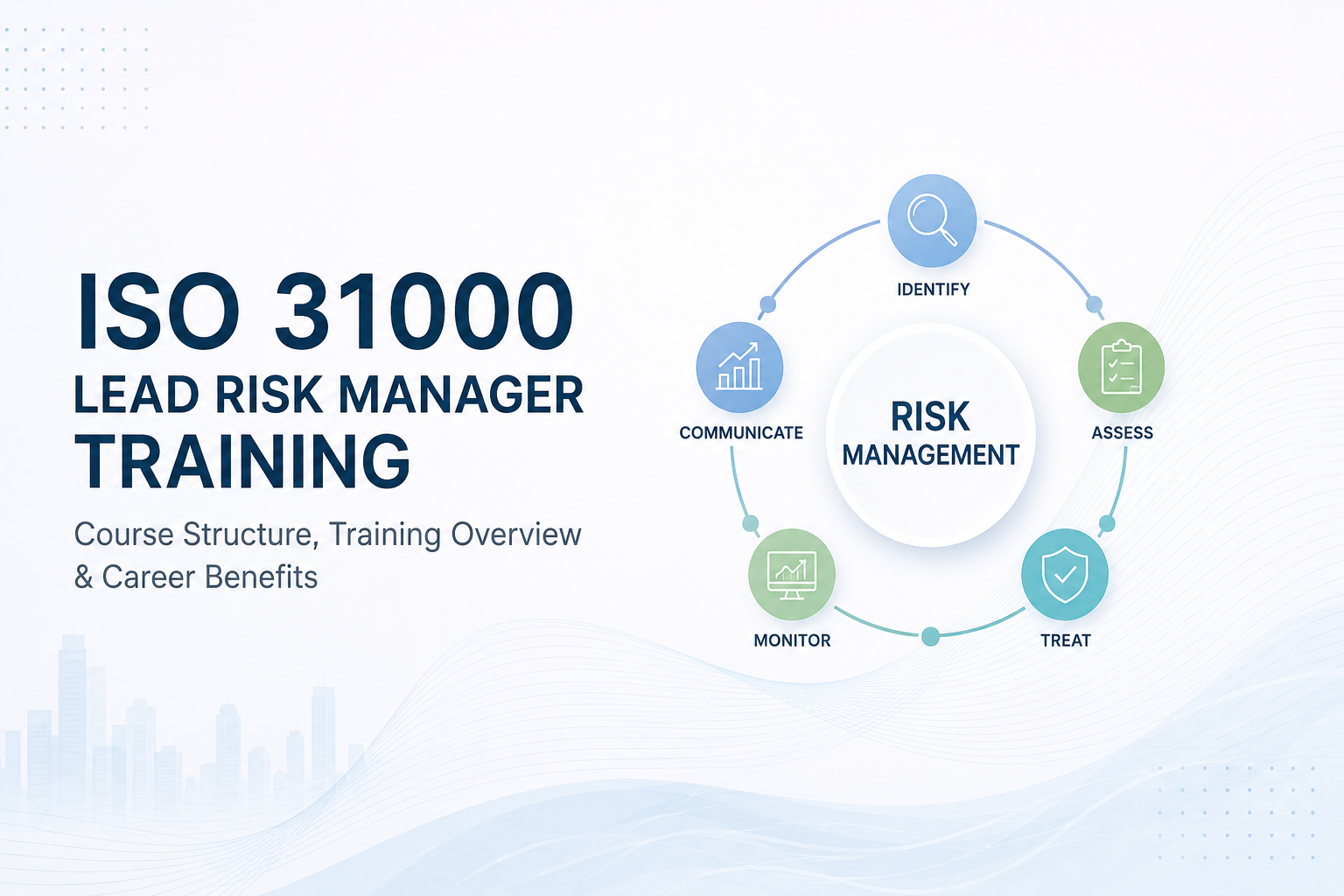
- Risk Assessment: The combined stages of identification, analysis, and evaluation.
- Risk Treatment: Choosing whether to avoid, mitigate, share, or accept the risk.
- Monitoring and Review: Ensuring the treatments are working as intended.
- Recording and Reporting: Creating the documentation necessary for transparency.
4. ISO 31000 Training is the Key to "Risk-Based Thinking" in Other ISO Standards
One of the most important facts for any professional in the compliance space is that ISO 31000 acts as the "operating system" for other management standards. Since the introduction of the High-Level Structure (HLS), now known as Annex SL, almost all ISO management standards require "risk-based thinking."
Integration with ISO 9001 and ISO 14001
If an organization is pursuing ISO 9001:2015 (Quality) or ISO 14001 (Environment), they are required to address risks and opportunities. However, those standards do not provide a detailed methodology for how to do that. ISO 31000 training fills that gap.
By obtaining ISO 31000 training, a Quality Manager becomes significantly more effective because they have the specific tools to identify and evaluate risks that could impact product quality or environmental compliance. In 2026, this inter-disciplinary approach is the standard for high-performing organizations.
Supporting Resilience and Continuity
Similarly, ISO 31000 training is a prerequisite for excellence in ISO 22301 (Business Continuity Management). You cannot have a business continuity plan without first understanding the risks that could cause an interruption. Training helps professionals align these different silos—Risk, Quality, and Continuity—into a single, cohesive strategy. This prevents "audit fatigue" and ensures that the organization isn't measuring the same risks in three different, conflicting ways.
5. Certification Exams Require Both Knowledge and Experience
Earning an ISO 31000 credential is not merely a matter of sitting through a lecture. Most reputable training providers, such as the Professional Evaluation and Certification Board (PECB) or various national standards bodies, require candidates to pass a rigorous examination and, in some cases, prove relevant professional experience.
The Nature of the Exam
The exams are typically designed to test application rather than rote memorization. For a Lead Risk Manager certification, you might be presented with a complex business scenario—such as a merger between two companies with different risk appetites—and asked to describe how you would design a unified risk framework. This ensures that the certification holds weight in the job market; it proves the holder can handle real-world volatility.
Continuing Professional Development (CPD)
In 2026, the shelf-life of technical knowledge is shorter than ever. Most ISO 31000 certifications require the holder to earn CPD units to maintain their status. This encourages lifelong learning and ensures that risk managers stay updated on emerging threats like generative AI vulnerabilities, geopolitical shifts, and new regulatory requirements like ESRS (European Sustainability Reporting Standards).
Global Portability
Because the training is based on an international standard, the certification is globally portable. A professional trained in ISO 31000 in London can apply the exact same principles and process loop in Singapore or New York. This makes the training an excellent investment for professionals looking to work in multinational corporations or as independent consultants.
Common Pitfalls to Avoid During Training
While the benefits of training are clear, many professionals make mistakes that limit the effectiveness of their certification:
- Treating it as a "One-and-Done" Exercise: ISO 31000 is about culture, not just a certificate. If the training isn't used to change how an organization makes decisions, it is wasted.
- Ignoring the "Context" Phase: Many students rush into risk assessment (finding the "bad things") without first defining the organization's context. Training emphasizes that risk is relative; a risk for a bank is not the same as a risk for a hospital.
- Over-Complicating the Process: ISO 31000 is intentionally simple. Some professionals try to use overly complex mathematical models where a simple qualitative assessment would be more effective. Good training teaches you when to use which tool.
Frequently Asked Questions
Is there a prerequisite for the ISO 31000 Lead Risk Manager course?
While anyone can attend the training, most certification bodies require 5 years of professional experience, including at least 2 years in risk management, before they will grant the "Lead" designation. If you pass the exam but lack the experience, you may be granted a "Provisional" status until the experience requirements are met.
How does ISO 31000 training differ from the CRM (Certified Risk Manager) credential?
ISO 31000 training is specifically focused on the ISO international standard, making it highly relevant for those working with ISO management systems (like 9001 or 27001). Other credentials like the CRM or ARM (Associate in Risk Management) may be more focused on insurance-based risk management or specific financial industry requirements.
Can I take ISO 31000 training online?
Yes, in 2026, most major training providers offer both synchronous (live-instructor) and asynchronous (self-paced) online options. However, for the Lead Risk Manager level, live sessions are highly recommended due to the value of peer discussion and case study analysis.
Does the training cover specific risk software?
ISO 31000 training is "software agnostic." It teaches the principles and logic of risk management. While some providers may demonstrate how to use GRC (Governance, Risk, and Compliance) software, the core focus is on the human decision-making and framework design that must happen before any software is implemented.
How often should I refresh my ISO 31000 training?
The standard itself is typically reviewed by ISO every 5 to 10 years. However, from a professional development standpoint, it is wise to attend a "refresher" or an advanced seminar every 2 to 3 years to stay abreast of how the standard is being applied to new technologies and global challenges.
Practical Recommendation: Your Next Steps
If you are ready to pursue ISO 31000 training, your first step should be to identify your primary goal. If you are looking to improve your department's efficiency, a Risk Manager (Practitioner) course is the best balance of time and depth. If you are aiming for a C-suite role or a specialized risk consultancy position, the Lead Risk Manager path is indispensable.
Before enrolling, verify that the training provider is accredited by a recognized body like IAS (International Accreditation Service) or is an authorized partner of PECB. This ensures that your certificate will be recognized by employers worldwide. Once certified, focus on the "Leadership and Commitment" aspect of the framework; the most successful risk managers are those who can translate the technical principles of ISO 31000 into the language of business value and organizational resilience.