Salesforce remains a dominant force in customer relationship management (CRM), but its high cost, steep learning curve, and complex implementation cycles drive many organizations to seek alternatives that offer better value, agility, or ease of use.
Choosing the right CRM platform depends heavily on your organization's specific operational requirements, technical resources, and growth strategy. While Salesforce excels in massive, highly customized enterprise environments, smaller teams, agile tech companies, and budget-conscious enterprises often find themselves hindered by its licensing fees and administrative overhead. To help you navigate this crowded market, examining the top alternatives requires a close look at feature sets, pricing models, customization capabilities, and ideal user profiles.
Understanding the Shift Away from Salesforce
Salesforce has long been considered the industry standard for enterprise-level CRM software. However, the software-as-a-service (SaaS) market has evolved significantly. Organizations are increasingly reevaluating their technology stacks to eliminate feature bloat and reduce total cost of ownership (TCO).
When evaluating alternatives, businesses typically run into a few common friction points with Salesforce:
- Implementation Complexity: Deploying Salesforce often requires certified administrators, developers, and expensive consulting partners, dragging out time-to-value.
- Aggressive Pricing Tiers: Basic features are frequently locked behind higher-tier plans, and the cost of add-ons, storage, and API calls can escalate rapidly.
- Over-Engineering: For small-to-medium-sized businesses (SMBs) and even many mid-market companies, the platform offers deep customization they will never utilize, resulting in a cumbersome user experience.
Recognizing these challenges, several competitors have carved out distinct niches by offering streamlined interfaces, transparent pricing, or hyper-focused industry solutions.
The 5 Best Alternatives to Salesforce
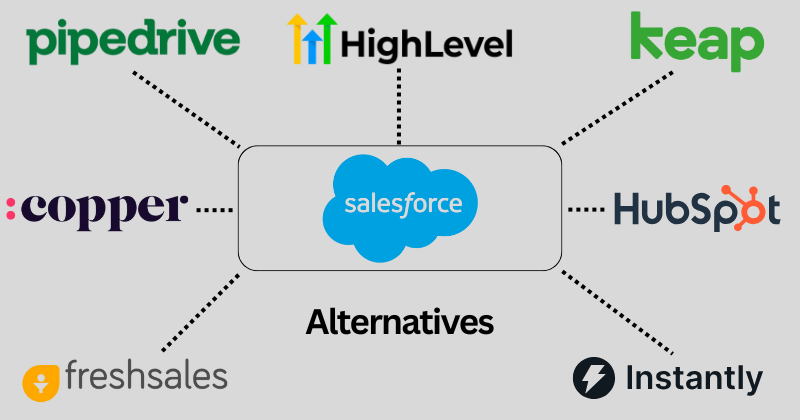
Evaluating CRM software requires looking beyond marketing claims to examine how platforms handle pipeline management, automation, reporting, and integration capabilities. Below are five leading alternatives to Salesforce, each suited to different organizational needs.
1. HubSpot CRM: Best for Ease of Use and Marketing Alignment
HubSpot has grown from an inbound marketing pioneer into a full-fledged enterprise CRM platform. It is widely recognized for its intuitive user interface and rapid onboarding process, making it a favorite among growing sales and marketing teams.
Core Features and Strengths
HubSpot operates on a unified codebase across its Marketing, Sales, Service, and Operations Hubs. This architecture eliminates the data silos that often plague organizations using disconnected tools.
- Contact Management: Automatically enriches contact records with company data and tracks every interaction across email, phone, and social media.
- Pipeline Visibility: Offers visual, drag-and-drop deal pipelines that allow sales reps to update deal stages with minimal friction.
- Email Integration: Deep integration with Gmail and Outlook tracks opens, clicks, and replies in real time.
Pricing and Limitations
While HubSpot offers a robust free tier for basic contact management, costs scale significantly as you unlock advanced automation, custom reporting, and larger contact tiers. Furthermore, while HubSpot has scaled up-market to challenge Salesforce directly in enterprise accounts, heavily customized legacy pipelines can still be challenging to migrate over.
2. Microsoft Dynamics 365: Best for Enterprise Ecosystem Integration
For organizations deeply embedded in the Microsoft ecosystem—utilizing Azure, Office 365, and Teams—Microsoft Dynamics 365 serves as a natural, highly integrated alternative to Salesforce.
Core Features and Strengths
Dynamics 365 combines CRM and enterprise resource planning (ERP) capabilities into a single cloud-based environment.
- Native Microsoft Integration: Seamlessly syncs with Outlook, Excel, and Microsoft Teams, allowing users to update CRM records directly from their communication and productivity apps.
- Advanced Analytics: Leverages Microsoft Power BI for deep business intelligence, predictive scoring, and advanced reporting.
- Modular Architecture: Businesses can license specific modules—such as Sales, Customer Service, or Field Service—paying only for the functionality they require.
Pricing and Limitations
Dynamics 365 is competitively priced relative to Salesforce, but implementation remains complex and typically requires specialized Microsoft partners. The user interface can feel rigid and corporate, requiring deliberate change management to secure high user adoption rates.
3. Zoho CRM: Best Value for Small-to-Mid-Sized Businesses
Zoho CRM is renowned for offering a comprehensive suite of enterprise-grade features at a fraction of the cost of its legacy competitors. It is an ideal choice for growing businesses seeking deep customization without high software budgets.
Core Features and Strengths
Zoho provides an extensive ecosystem of business applications that integrate effortlessly with its core CRM.
- Omnichannel Support: Manages customer interactions across email, live chat, social media, telephone, and customer portals from a single dashboard.
- Zia AI: Built-in artificial intelligence provides sentiment analysis, anomaly detection, and predictive sales forecasting.
- Canvas Design Studio: Allows administrators to completely redesign the CRM interface using a drag-and-drop builder without writing code.
Pricing and Limitations
Zoho offers one of the most generous free tiers in the industry, and its paid plans scale affordably. However, customer support can be less responsive on lower tiers, and configuring complex, multi-department workflows requires technical expertise.
4. Pipedrive: Best for Sales-Driven Pipelines
Pipedrive was built by salespeople, for salespeople. Unlike Salesforce, which attempts to serve every department across an enterprise, Pipedrive focuses relentlessly on managing sales pipelines and closing deals.
Core Features and Strengths
Pipedrive strips away administrative clutter to keep sales representatives focused on revenue-generating activities.
- Visual Pipeline Management: Highly intuitive Kanban boards make tracking deals through distinct stages straightforward and frictionless.
- Activity-Based Selling: Prompts users to schedule follow-up actions after every call or email, ensuring deals do not stall in the pipeline.
- Smart Contact Data: Automatically pulls public social profiles and company details to enrich lead records.
Pricing and Limitations
Pipedrive is exceptionally user-friendly and requires virtually no training to adopt. However, because it is fundamentally a sales tool, it lacks the native customer service ticketing, complex marketing automation, and expansive ERP capabilities found in Salesforce or Microsoft Dynamics.
5. Freshsales (Freshworks): Best for AI-Powered Context and Speed
Freshsales, part of the Freshworks product suite, combines sales automation, chat, and telephony into a single, high-speed workspace designed to accelerate sales cycles.
Core Features and Strengths
Freshworks emphasizes out-of-the-box productivity and modern user experience design.
- Freddy AI: Provides lead scoring, deal insights, and next-best-action recommendations based on historical win/loss data.
- Built-in Phone and Email: Allows sales reps to make calls and send emails directly from the platform while automatically logging interactions.
- Visual Workflow Automations: Enables teams to build trigger-based automation rules visually to assign leads, send follow-ups, and update fields.
Pricing and Limitations
Freshsales offers transparent pricing tiers with minimal hidden costs. While it scales well for SMBs and mid-market teams, organizations with highly complex, multinational enterprise structures may find its customization limits restrictive compared to Salesforce.
Comparison of Salesforce Alternatives
To evaluate which platform aligns best with your organizational goals, review the high-level comparison below:
| Platform | Primary Focus | Best Suited For | Pricing Model | Ease of Use |
|---|---|---|---|---|
| HubSpot CRM | Inbound Marketing & Sales | Growing SMBs to Mid-Market | Tiered / Freemium | High |
| Microsoft Dynamics 365 | Enterprise Ecosystems | Microsoft-centric Enterprises | Modular per User | Moderate |
| Zoho CRM | Feature-Rich Affordability | Budget-Conscious Growing Teams | Low-Cost Tiers / Freemium | Moderate |
| Pipedrive | Pipeline & Deal Tracking | Sales Teams and Small Businesses | Flat Per-User Pricing | Very High |
| Freshsales | AI-Driven Sales Velocity | Fast-Paced Inside Sales Teams | Tiered / Freemium | High |
Key Factors to Consider When Making the Switch
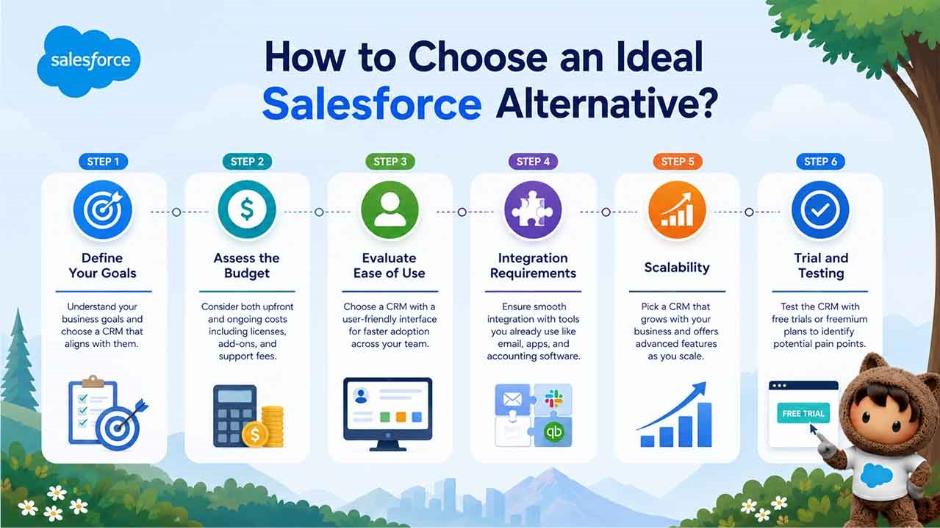
Transitioning away from Salesforce requires careful planning. Rushing a CRM migration can lead to data loss, dropped customer leads, and user resistance. Keep the following factors in mind during your evaluation process:
- Data Migration Complexity: Assess the cleanliness of your current database. Migrating custom objects, historical communication logs, and associated attachments from Salesforce requires specialized data mapping tools or developer support.
- User Adoption Rates: The best CRM is the one your team actually uses. Involve end-users early in the evaluation process to test out interfaces and run trial pipelines.
- Integration Ecosystem: Audit your current tech stack (e.g., accounting software, customer support helpdesks, marketing automation tools) to ensure seamless API connections are available with your chosen alternative.
- Total Cost of Ownership: Factor in implementation costs, third-party consulting fees, staff training time, and potential add-on licenses—not just the baseline monthly subscription fee.
Frequently Asked Questions
Is it difficult to migrate data from Salesforce to an alternative CRM?
Data migration complexity depends entirely on the volume and structure of your data. Standard objects like contacts, accounts, and deals export easily via CSV files. However, custom objects, deeply nested relationships, and historical activity logs often require third-party migration tools or dedicated engineering support to ensure data integrity.
Which Salesforce alternative is best for small businesses?
For small businesses seeking simplicity and speed, Pipedrive or Freshsales offer intuitive pipeline management with minimal administrative overhead. If you require integrated marketing tools alongside your sales pipeline, HubSpot’s entry-level tiers provide a scalable foundation.
Are these alternatives cheaper than Salesforce?
In almost all cases, alternatives such as Zoho, Pipedrive, and Freshsales offer a lower total cost of ownership than Salesforce, particularly when factoring in mandatory admin overhead, implementation consulting, and costly add-on modules.
Can these platforms scale to enterprise levels?
Platforms like HubSpot and Microsoft Dynamics 365 are fully equipped to handle enterprise-scale operations, managing hundreds of users, complex global business units, and heavy transaction volumes. However, smaller tools like Pipedrive may hit ceilings for organizations with complex, multi-tiered corporate hierarchies.
Conclusion and Next Actions
Selecting an alternative to Salesforce is a strategic decision that shapes how your organization manages customer relationships and drives revenue. Begin by auditing your current operational bottlenecks: if licensing costs and complexity are holding you back, tools like Zoho or Pipedrive offer immediate relief. If you need deep enterprise integration, Microsoft Dynamics 365 provides a robust framework.
Your next step should be scheduling live product demonstrations and requesting sandbox environments for your top two choices. Involve your sales, marketing, and IT leads in hands-on testing to verify that the platform meets your daily workflow requirements before committing to a long-term contract.