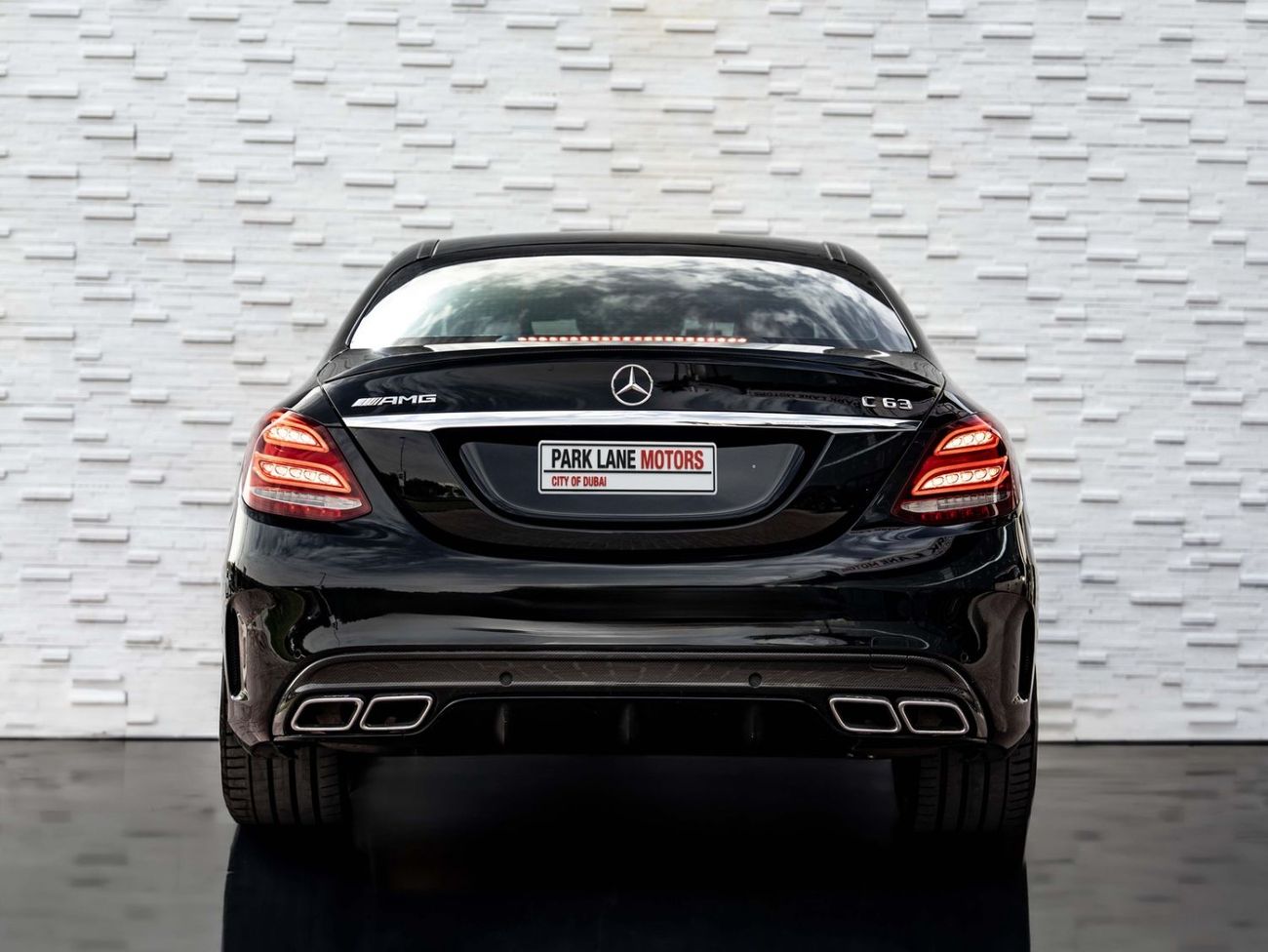
The 2017 Mercedes-AMG C 63 pairs a hand-built 4.0-liter twin-turbocharged V8 engine with a 7-speed multi-clutch transmission in a rear-wheel-drive chassis. Delivering 469 horsepower in base trim and 503 horsepower in the C 63 S, it offers exceptional straight-line acceleration and track capability, provided buyers account for specialized maintenance requirements and high tire wear.
Overview of the 2017 AMG C 63 Generation
The 2017 model year holds a distinct position in the W205 generation of the Mercedes-AMG C 63. Following the departure of the naturally aspirated 6.2-liter M156 V8 found in the preceding W204 platform, this second-generation C 63 firmly established AMG’s forced-induction strategy. The 2017 model year expanded the lineup significantly by introducing the redesigned C205 Coupe and A205 Cabriolet alongside the existing W205 Sedan and S205 Estate (available in select international markets).
Unlike earlier AMG models that shared substantial body paneling with standard Mercedes-Benz models, the 2017 C 63 Coupe featured bespoke wider front and rear fenders, a modified rear axle structure, and a track widened by 2.5 inches at the front and 2.6 inches at the rear. This engineering divergence gave the two-door model distinct handling characteristics compared to its four-door counterpart.
As a pre-facelift W205 model, the 2017 C 63 retains the analog gauge cluster with a central digital display, the 7-speed AMG SPEEDSHIFT MCT transmission (prior to the 9-speed update in 2019), and the classic twin-slat front grille. For buyers evaluating the vehicle in the pre-owned market, the 2017 model represents an appealing sweet spot: it delivers modern biturbo performance and chassis rigidity at a significantly discounted secondary-market price point.
Engine Architecture: The Hand-Built M177 4.0L Biturbo V8
At the heart of the 2017 C 63 sits the M177 engine, a 3,982 cc (4.0-liter) 90-degree V8 utilizing direct fuel injection and dual single-scroll turbochargers. The M177 is closely related to the dry-sump M178 engine found in the AMG GT supercar, though the M177 utilizes a traditional wet-sump lubrication system to suit daily driving and packaging requirements.
M177 V8 Layout ("Hot-Inside-V"):
- Engine Cover / Intake
- Cylinder Bank 1 and Cylinder Bank 2
- Turbos Inside
- Wet Sump
"Hot-Inside-V" Configuration
The primary engineering innovation of the M177 is its "Hot-Inside-V" (Hot-V) layout. Rather than mounting the turbochargers on the outer flanks of the cylinder banks, AMG engineers placed the turbos within the cylinder V. This design yields three distinct mechanical benefits:
- Compact Packaging: Reduces overall engine dimensions, allowing the V8 to fit into the relatively tight engine bay of the C-Class.
- Optimized Throttle Response: Dramatically shortens the air paths between the exhaust valves, turbocharger turbine wheels, and intake manifolds, minimizing turbo lag.
- Thermal Management Control: Allows targeted air routing to cool the exhaust-gas turbochargers, though it increases heat accumulation inside the upper engine compartment.
Direct Injection and Cylinder Coating
The engine features piezo fuel injectors capable of delivering up to five fuel injections per combustion cycle at pressures up to 200 bar. Cylinder walls are lined with Nanoslide—a iron-carbon coating applied via twin-wire arc spraying. This technology creates an ultra-smooth, low-friction surface that is twice as hard as conventional cast-iron liners, extending cylinder longevity while reducing internal friction.
Power Output Differences: Base C 63 vs. C 63 S
Mercedes-AMG offered the 2017 C 63 in two performance tiers: the standard C 63 and the higher-output C 63 S. Both use the identical 4.0-liter M177 engine block, but variance in maximum boost pressure and engine calibration results in distinct performance profiles.
| Standard C 63 | C 63 S |
|---|---|
| 469 hp @ 5,500–6,250 RPM | 503 hp @ 5,500–6,250 RPM |
| 479 lb-ft tq @ 1,750–4,500 RPM | 516 lb-ft tq @ 1,750–4,500 RPM |
| Peak Boost: ~1.2 bar (17.4 psi) | Peak Boost: ~1.3 bar (18.8 psi) |
| Mechanical LSD | Electronic LSD |
| Standard Rubber Engine Mounts | Dynamic (Magnetorheological) Engine Mounts |
The standard C 63 generates 469 horsepower and 479 lb-ft of torque, with maximum torque available low in the rev range from 1,750 to 4,500 rpm. The C 63 S elevates output to 503 horsepower and 516 lb-ft of torque.
The primary hardware distinction beyond ECU tuning lies in the drivetrain and chassis mounts. While the base C 63 uses a mechanical rear limited-slip differential, the C 63 S adopts an electronically controlled rear limited-slip differential (e-LSD). Furthermore, the C 63 S equips active dynamic engine and transmission mounts. These magnetorheological mounts adjust their stiffness within milliseconds based on driving conditions—softening to isolate engine vibrations during cruising and stiffening under hard cornering to reduce mass transfer and sharpen turn-in response.
Drivetrain, Transmission, and Suspension Dynamics
Power delivery in the 2017 AMG C 63 is managed exclusively through the rear wheels via the AMG SPEEDSHIFT MCT 7-speed sport transmission.
Power Flow Architecture:
- M177 Biturbo V8
- AMG SPEEDSHIFT MCT 7-Speed (Wet Start Clutch)
- Carbon Driveshaft
- Mechanical / Electronic LSD
- Rear Wheels
AMG SPEEDSHIFT MCT 7-Speed Transmission
Unlike standard Mercedes-Benz models that utilize a traditional torque converter, the MCT (Multi-Clutch Technology) unit replaces the torque converter with a compact wet start-up clutch. This setup provides a direct mechanical link to the drivetrain, offering rapid gear shifts and minimized power loss.
The transmission features four selectable drive modes via the AMG DYNAMIC SELECT switch:
- Comfort (C): Smoother shift parameters, early upshifts, active engine Start/Stop, and a coasting function that decoupling the engine from the powertrain when lifting off the throttle at speed.
- Sport (S): Higher shift points, faster gear changes, and rev-matching on downshifts.
- Sport+ (S+): Maximum shift speed, aggressive downshift timing, and partial cylinder suppression during shifts to produce distinct exhaust pops.
- Race (C 63 S Exclusive): Tailored for closed-circuit driving, offering manual control shift responses down to 100 milliseconds and maintaining optimal engine speeds during heavy braking.
Suspension Architecture and AMG RIDE CONTROL
The chassis utilizes a four-link front axle design with motorsport-derived radial brake connections and a multi-link rear suspension with independent wheel mounts. Variable-damping AMG RIDE CONTROL adaptive steel suspension comes standard, offering three electronically controlled modes: Comfort, Sport, and Sport+.
Because AMG tailored the chassis rigidity aggressively, even the "Comfort" mode exhibits a firm ride quality compared to non-AMG C-Class models. The C205 Coupe chassis is particularly rigid, employing additional body bracing at the floorpan, strut towers, and rear subframe.
Technical Specifications Comparison
The table below outlines the core factory specifications for the primary 2017 Mercedes-AMG C 63 variants available across global markets.
| Technical Metric | C 63 Sedan | C 63 S Sedan | C 63 Coupe | C 63 S Coupe |
|---|---|---|---|---|
| Engine Code | M177 DE 40 AL | M177 DE 40 AL | M177 DE 40 AL | M177 DE 40 AL |
| Displacement | 3,982 cc | 3,982 cc | 3,982 cc | 3,982 cc |
| Horsepower | 469 hp @ 5,500 rpm | 503 hp @ 5,500 rpm | 469 hp @ 5,500 rpm | 503 hp @ 5,500 rpm |
| Torque | 479 lb-ft @ 1,750 rpm | 516 lb-ft @ 1,750 rpm | 479 lb-ft @ 1,750 rpm | 516 lb-ft @ 1,750 rpm |
| Transmission | 7-Speed MCT | 7-Speed MCT | 7-Speed MCT | 7-Speed MCT |
| Differential Type | Mechanical LSD | Electronic LSD | Mechanical LSD | Electronic LSD |
| 0–60 mph (0–100 km/h) | 4.0 sec (4.1 sec) | 3.9 sec (4.0 sec) | 3.9 sec (4.0 sec) | 3.8 sec (3.9 sec) |
| Top Speed (Limited) | 155 mph (250 km/h) | 180 mph (290 km/h)* | 155 mph (250 km/h) | 180 mph (290 km/h)* |
| Curb Weight | ~3,800 lbs (1,724 kg) | ~3,835 lbs (1,740 kg) | ~3,950 lbs (1,792 kg) | ~3,970 lbs (1,801 kg) |
| Front Brake Rotors | 14.2 in (360 mm) | 15.4 in (390 mm) | 14.2 in (360 mm) | 15.4 in (390 mm)** |
*Requires AMG Driver's Package / AMG Track Package.**Optional Carbon Ceramic Matrix rotors measuring 15.8 in (402 mm) were available on front wheels for C 63 S.
Pre-Owned Inspection Points, Common Issues, and Maintenance
Purchasing a pre-owned 2017 Mercedes-AMG C 63 requires an understanding of high-performance vehicle degradation patterns. The following components demand thorough inspection prior to purchase.
Common Maintenance Focus Areas:
- Auxiliary Radiators: Vulnerable to road debris damage
- Ignition Coils/Plugs: Prone to high-rpm misfires under load
- Dynamic Engine Mounts: Magnetorheological fluid leaks (C 63 S)
- Wet Start Clutch: Requires fluid flushing every 30,000–40,000 miles
- Brake System: High wear rate on rotors; expensive replacement
1. Auxiliary Radiators and Cooling System Vulnerability
The low-mounted outer auxiliary radiators positioned behind the lower front bumper intakes lack protective mesh grilles from the factory on early 2017 production runs. Road debris, stones, and gravel can easily puncture these heat exchangers, resulting in coolant loss and engine overheating. Prospective buyers should inspect the lower air intakes for damage or evidence of aftermarket mesh screen installation.
2. Ignition System Misfires (Coil Packs and Spark Plugs)
The high combustion pressures and elevated under-hood temperatures generated by the Hot-V turbo layout accelerate the degradation of spark plugs and ignition coils.
- Symptoms: Engine misfires under heavy acceleration (often throwing OBD-II codes P0300 through P0308).
- Remediation: Plugs should be changed every 20,000 to 30,000 miles on driven examples, using correctly gapped performance spark plugs.
3. Dynamic Engine Mount Failure (C 63 S Models)
The active magnetorheological engine mounts on C 63 S variants utilize electrical current to adjust fluid viscosity. Over time, heat exposure causes internal seal failure, leaking metallic fluid or triggering a dashboard warning light reading "AMG Performance Mount Malfunction." Replacement requires supporting the engine and dropping the front subframe, making it a labor-intensive repair.
4. MCT Transmission Behavior and Maintenance
The wet start-up clutch package in the 7-speed MCT requires fresh fluid and filter changes every 30,000 to 40,000 miles. Neglected transmission service manifests as jerky low-speed engagement, delayed reverse gear selection, or hesitant shifts when cold. Performing a adaptation reset via diagnostic software often restores original shift quality if fluid health is verified.
5. Braking System Wear and Carbon Ceramic Considerations
Standard steel rotors are 2-piece floating designs. Front rotor replacement costs are significantly higher than standard C-Class components.
- Carbon-Ceramic Rotors (Optional on C 63 S): Identified by gold/bronze painted brake calipers. While offering superior track heat resistance and virtually no brake dust, replacing carbon-ceramic rotors can cost several thousand dollars per axle. Verify rotor thickness and inspect for edge chipping using a specialized optical surface gauge before purchasing an optioned car.
6. Tires and Rear Axle Alignment
Due to rear-wheel drive and heavy low-end torque delivery, rear tires typically last between 8,000 and 15,000 miles depending on compound and driving style. Inspect rear tires for severe inner-edge wear, which indicates sagging suspension bushings or improper toe alignment settings.
Daily Usability, Exhaust Notes, and Interior Technology
Despite its track capability, the 2017 C 63 remains an practical luxury vehicle. Understanding its functional traits helps clarify what to expect during daily ownership.
AMG Performance Exhaust System (Option Code U78)
One of the most desirable factory options is the AMG Performance Exhaust System. Unlike the standard exhaust, which features passive exhaust flaps, option U78 incorporates three electronically controlled exhaust flaps—one in each rear muffler and one in a cross-over pipe connecting both exhaust banks.
Standard Exhaust vs. AMG Performance Exhaust (U78):
- Standard:
- Engine
- Downpipes
- Mid-Pipes
- Passive Mufflers
- U78 Option:
- Engine
- Downpipes
- Valved X-Pipe (Consistently managed via console button/drive modes)
- Active Valved Mufflers
By pressing the exhaust button on the center console or selecting Sport+/Race modes, the system redirects exhaust gases to bypass internal dampening chambers, creating a deep, resonant V8 soundtrack. Cars lacking option U78 sound noticeably muted across all rev ranges.
Interior Features and Infotainment
The cabin features standard MB-Tex/DINAMICA or optional Nappa leather sport seats with heavy lateral bolstering. The optional AMG Performance Seats offer even firmer support and integrated headrests, though some drivers find them overly rigid for extended road trips.
Infotainment is managed through the COMAND system featuring an 8.4-inch central display operated via a console-mounted touchpad and rotary dial. While the system supports Bluetooth audio and satellite navigation, original 2017 models lacked native Apple CarPlay and Android Auto compatibility, requiring aftermarket retrofits or factory smartphone integration package updates available late in the model year.
Frequently Asked Questions
What is the primary mechanical difference between the 2017 C 63 and C 63 S?
The primary mechanical differences include power output (469 hp vs. 503 hp), rear differential type (mechanical limited-slip on base vs. electronic limited-slip on C 63 S), and dynamic magnetorheological engine mounts, which are standard on the C 63 S but unavailable on the base model. The C 63 S also offers larger 15.4-inch front brake rotors and an optional carbon-ceramic braking package.
Does the 2017 AMG C 63 have all-wheel drive (4MATIC)?
No. The 2017 W205/C205 AMG C 63 and C 63 S are strictly rear-wheel drive (RWD). All-wheel drive (4MATIC+) was introduced to the C-Class AMG lineup with the subsequent hybrid four-cylinder generation (W206).
How can I tell if a pre-owned 2017 C 63 has the optional AMG Performance Exhaust?
Look at the center console switch panel to the right of the touchpad controller. If the car is equipped with the AMG Performance Exhaust (Option U78), it will feature a dedicated physical button displaying an icon of dual exhaust tips with an LED indicator light.
What causes high-speed vibrations or rough idling in the C 63 S?
Rough idling accompanied by diagnostic fault code messaging often stems from failing dynamic engine mounts or worn ignition coils. Dynamic mounts use a magnetorheological fluid that hardens under electrical current; when internal seals fail, fluid leaks out, transferring engine harmonics directly to the chassis frame.
What transmission fluid service interval should be followed for the AMG SPEEDSHIFT MCT?
The 7-speed MCT transmission requires fluid and filter changes every 30,000 to 40,000 miles or every 4 years, whichever comes first. Regular service prevents rough low-speed clutch engagement and protects the internal wet start-up clutch pack from thermal wear.
Pre-Owned Buying Recommendation
The 2017 Mercedes-AMG C 63 remains a highly compelling choice for performance drivers seeking a V8 rear-wheel-drive platform. When shopping in the secondary market, prioritize vehicles with clear service records showing timely oil services (every 5,000–7,500 miles) and documented transmission flushes.
If driving dynamics and track capability are primary goals, target the C 63 S Coupe for its wider track, electronic differential, and stiffer chassis construction. For prospective owners focused on daily commuting and family hauling, the standard C 63 Sedan offers excellent performance with slightly lower maintenance complexity due to its traditional engine mounts and mechanical differential. Regardless of trim, verifying the presence of the AMG Performance Exhaust (Option U78) and getting a thorough Pre-Purchase Inspection (PPI) from an independent Mercedes-Benz specialist are essential steps before finalizing a transaction.