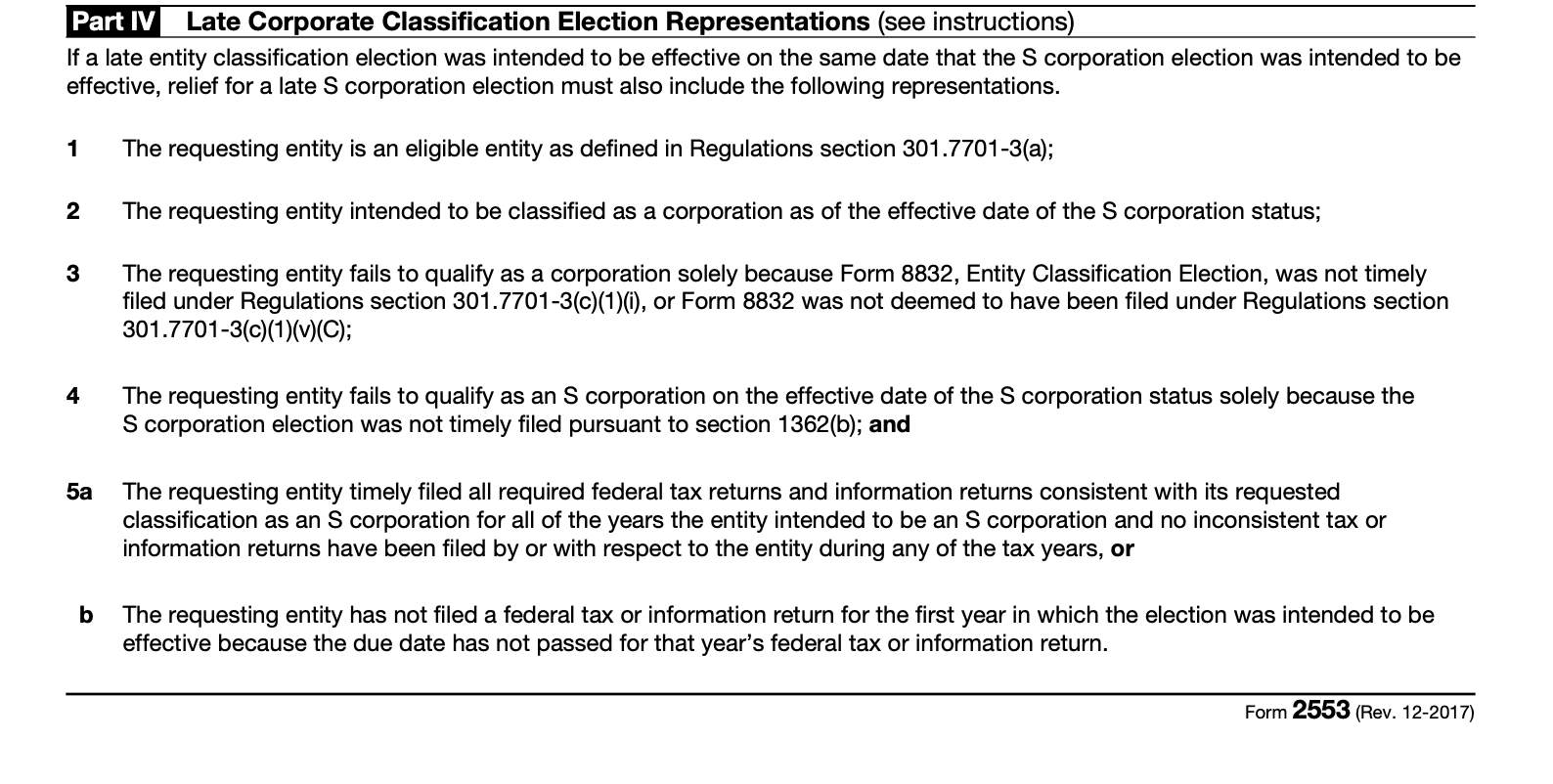
The primary key issue when filing Form 2553 (Election by a Small Business Corporation) late is the potential loss of S corporation tax status for the current tax year, forcing the entity to default to C corporation taxation. While the IRS provides a mechanism for late election relief under specific conditions, missing the statutory deadline necessitates a formal request for reasonable cause and can lead to significant administrative, financial, and tax-planning complications for small business owners.
Understanding the Statutory Deadlines for Form 2553
To understand the risks associated with late filing, it is essential first to grasp the strict timing requirements established by the Internal Revenue Service (IRS). For an entity to be treated as an S corporation for a given tax year, Form 2553 must be filed no later than two months and 15 days after the beginning of the tax year the election is intended to take effect. Alternatively, the form may be filed at any time during the preceding tax year.
This window is rigid. If a business starts its tax year on January 1, the deadline is March 15. If a business forms in the middle of a calendar year, the election must be filed within two months and 15 days of the date the entity was incorporated or otherwise established. Failing to meet this window triggers the "late filing" status, which serves as the core hurdle for tax compliance officers and business owners.
The Mechanism of Automatic Late Election Relief
The IRS recognizes that administrative errors, miscommunications, or misunderstandings often lead to missed deadlines. Consequently, Revenue Procedure 2013-30 provides a pathway for "automatic" late election relief. This is not a guaranteed amnesty, but rather a structured procedure that allows taxpayers to demonstrate that they had reasonable cause for the failure.
To qualify for relief under this provision, the following conditions must generally be met:
- The entity intended to be classified as an S corporation.
- The failure to file on time was due to reasonable cause.
- The request is filed within three years and 75 days of the intended effective date.
- All shareholders reported their income consistently with S corporation status on their tax returns for all relevant years.
If these conditions are met, the taxpayer should write "FILED PURSUANT TO REV. PROC. 2013-30" at the top of Form 2553. This acts as a signal to the IRS that the taxpayer is seeking retroactive validation of their election despite the elapsed time.
Financial and Operational Impacts of Late Filing
The consequences of failing to secure timely or retroactive S corporation status are primarily financial. When an election is late and cannot be validated, the business remains a C corporation by default. In a C corporation structure, the entity is subject to double taxation: the corporation pays tax on its profits, and shareholders pay personal income tax on those same profits when they are distributed as dividends.
Furthermore, if a business operated as if it were an S corporation—such as by passing through losses or income to shareholders on their individual returns—without having a valid election in place, the IRS may conduct an audit to reclassify those items. This often results in:
- Assessment of corporate-level taxes that were previously ignored.
- Penalties and interest on underpaid corporate taxes.
- The requirement to file amended personal returns for all shareholders to correct the misreporting of pass-through income.
- Potential loss of salary-vs-distribution planning strategies, which are common benefits of the S corporation structure.
Reasonable Cause: Defining the IRS Standard
The most critical factor in late filing relief is the concept of "reasonable cause." The IRS does not provide a static list of acceptable excuses; rather, they evaluate the facts and circumstances of each case. However, historically, they prioritize situations where the error was outside the taxpayer's control.
Common factors that may constitute reasonable cause include:
- Professional Error: Where a tax professional was specifically engaged to handle the election and failed to do so due to oversight, provided the taxpayer acted in good faith.
- Administrative Oversight: Instances where the business entity was unaware of the S corporation requirement due to a lack of formal guidance, provided the intention to be an S corporation was documented in corporate minutes or shareholder agreements.
- Uncontrollable Events: Significant natural disasters, health emergencies, or other extreme circumstances that prevented the timely submission of paperwork.
It is vital to note that "I forgot" or "I was unaware of the law" is rarely considered reasonable cause. Documentation is key; taxpayers should maintain detailed records, including correspondence with attorneys or accountants, meeting minutes, and evidence of how the business operated to support the claim.
Procedural Steps for Remediation
When a business discovers a late filing issue, time is of the essence. The process to correct this is not merely a matter of mailing the form.
- Review Internal Records: Ensure that all shareholders have signed the Form 2553 and that all information matches the entity’s formation documents.
- Consult a Tax Professional: Because late relief involves interpreting revenue procedures and legal standards, professional guidance is highly recommended.
- Submit the Late Election: Prepare the form with the required "FILED PURSUANT TO REV. PROC. 2013-30" notation. Ensure the request letter clearly states the reasons for the delay.
- Follow Up: Track the submission and be prepared to respond to IRS notices if further explanation or documentation is requested.
- Evaluate Compliance: Verify that all shareholders are eligible to hold S corporation stock (e.g., they must be U.S. citizens or residents and not ineligible entities like certain corporations or partnerships).
Comparison of Filing Scenarios
| Scenario | Filing Status | Likely Outcome |
|---|---|---|
| Timely Filing | Within 2 months, 15 days | Election accepted, S-Corp status granted. |
| Late (Qualified Relief) | Within 3 years, 75 days | Relief possible under Rev. Proc. 2013-30 if cause exists. |
| Late (No Relief) | Exceeds 3 years, 75 days | Election denied; business defaults to C-Corp. |
| Incomplete Form | Any time | IRS notice of rejection; opportunity to cure errors. |
Common Pitfalls to Avoid
Beyond the deadline, many taxpayers struggle with the technicalities of the form itself. Incomplete submissions are a frequent cause of processing delays or outright rejection. Common mistakes include:
- Missing Shareholder Signatures: All shareholders who owned stock at any time during the period between the beginning of the tax year and the date of filing must sign the form.
- Incorrect Effective Dates: Confusing the incorporation date with the intended election date can cause a mismatch in the IRS system.
- Inconsistent Reporting: If a corporation files as an S corporation on its tax return but fails to submit the Form 2553, the IRS will eventually flag the discrepancy. Relying on an "implied" election through tax filing is a high-risk practice that rarely holds up under scrutiny.
Managing Shareholder Eligibility
A core issue that complicates late filings is the nature of the shareholders. To be an S corporation, the entity must have no more than 100 shareholders, all of whom must be "eligible" shareholders. If a late filing is submitted for a company that has an ineligible shareholder—such as a foreign entity or a corporation—the election will be denied regardless of the lateness of the filing. Before seeking late election relief, verify that your shareholder composition is entirely compliant with Subchapter S requirements.
Professional Advisory and Due Diligence
When dealing with late filing, the role of a qualified CPA or tax attorney cannot be overstated. They can provide an objective assessment of whether a "reasonable cause" argument is likely to succeed. Furthermore, they can help prepare the statement of facts that must accompany the late-filed Form 2553. This statement is the primary document the IRS agent uses to determine if the relief will be granted. It must be professional, factual, and directly address the specific requirements of the Revenue Procedure.
Frequently Asked Questions
1. Can I retroactively elect S corporation status indefinitely? No. Generally, relief is limited to three years and 75 days after the intended effective date. Beyond this, the ability to obtain relief becomes significantly more difficult and may require a private letter ruling, which is costly and time-consuming.
2. What happens if the IRS rejects my request for late relief? If the IRS denies the request, the entity remains a C corporation for the relevant tax year. You will need to determine whether it is more beneficial to keep the entity as a C corporation or to terminate the C corporation and form a new, properly structured S corporation for the future.
3. Do all shareholders need to sign the Form 2553? Yes. Every person who held stock at any point during the tax year up to the date of filing must sign the form. Failure to secure these signatures is a common reason for rejection.
4. Does a late election affect the personal tax returns of shareholders? Yes. If you are seeking retroactive relief, you are asserting that the business was an S corporation for those years. Consequently, all shareholders must have reported their share of the income, deductions, and credits on their personal returns. If they did not, they must file amended returns to match the S corporation status.
5. How long does the IRS take to process late relief requests? Processing times vary significantly based on the current workload of the IRS. It can take several months, and the taxpayer should continue to operate in good faith while awaiting the determination letter.
Conclusion and Next Steps
The late filing of Form 2553 is a serious administrative issue that carries tangible financial consequences, but it is a hurdle that can often be cleared with the right evidence and procedural adherence. If you find your business in this position, your immediate next step should be to audit your shareholder eligibility, gather all relevant dates and documents, and consult with a tax professional to draft a formal request under Revenue Procedure 2013-30. Proactive management of this issue is the best way to protect your business’s tax structure and avoid the burdens of double taxation.