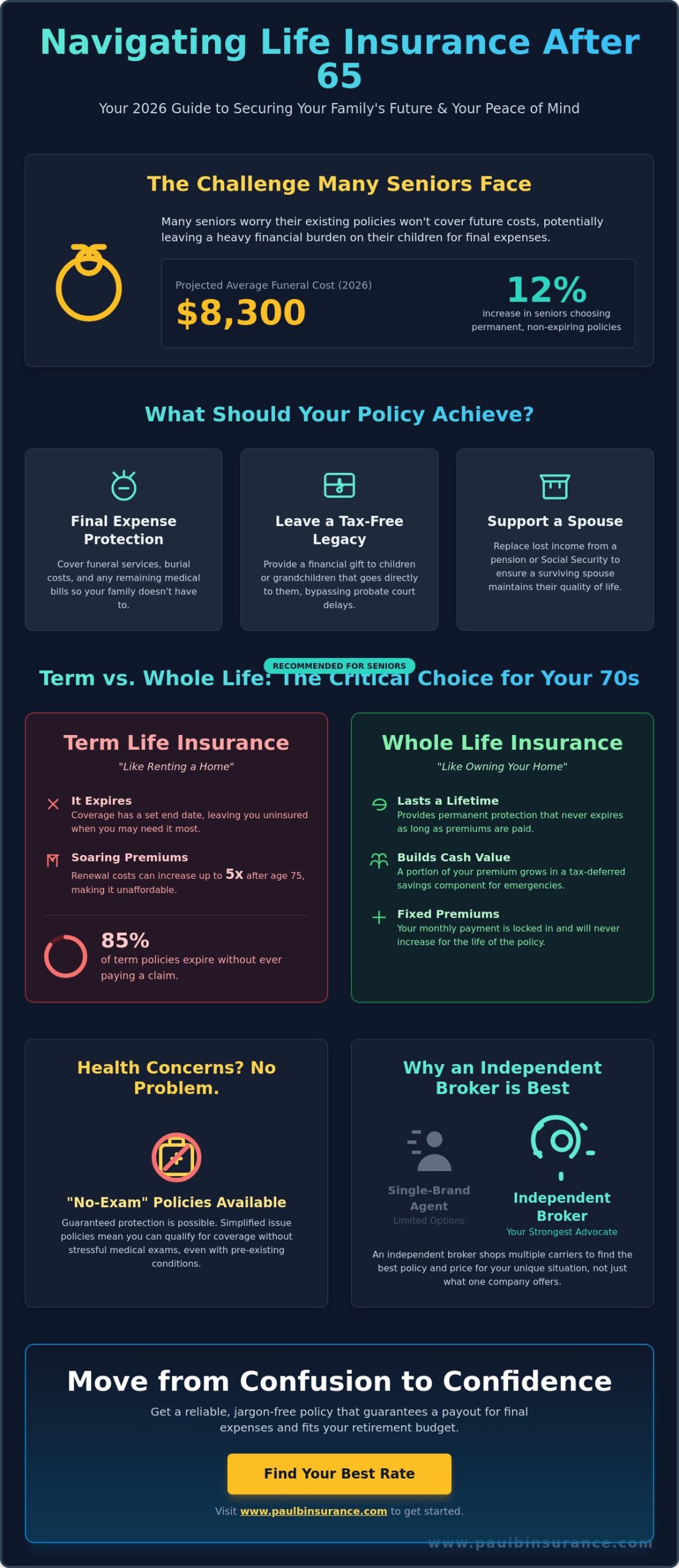
Finding a-rated life insurance for seniors over 85 in Georgia involves navigating specialized final expense products, strict underwriting standards, and state-specific regulatory protections governed by the Office of the Commissioner of Insurance and Safety Fire. Because individuals over 85 fall into advanced age brackets, traditional term or whole life policies with medical exams are virtually unavailable or cost-prohibitive. Instead, coverage relies on simplified issue or guaranteed issue whole life insurance policies issued by financially strong carriers rated "A" or higher by independent agencies like A.M. Best. These plans are specifically designed to cover end-of-life expenses, medical bills, and remaining debts without requiring a physical medical examination.
Understanding the Landscape of Life Insurance at Age 85 and Beyond
Securing life insurance coverage past the age of 85 requires a realistic understanding of how the insurance industry evaluates risk, mortality, and financial stability. At this stage of life, insurance companies do not look at coverage as a tool for income replacement or long-term wealth building. Instead, policies function as final expense insurance—frequently referred to as burial insurance—intended to cover funeral costs, cremation services, final medical bills, and modest legacy gifts.
The term "A-rated" refers to the financial strength and claims-paying ability of the insurance carrier, as evaluated by independent rating organizations such as A.M. Best, Standard & Poor's, Moody's, and Fitch. An "A" rating (which includes A, A+, A–, or superior tiers like A++), indicates that the insurer has a strong historical track record of paying out death benefits even during economic downturns. For seniors over 85, choosing an A-rated carrier is paramount because final expense policies are long-term commitments where the financial stability of the company over the next decade or more is vital.
In the state of Georgia, insurance is heavily regulated to protect elderly consumers from predatory sales tactics while ensuring that carriers remain solvent. The Georgia Department of Insurance enforces strict consumer protection laws, including mandatory free-look periods, transparent policy disclosures, and guaranteed renewability clauses for whole life contracts. Understanding how these state rules intersect with advanced-age underwriting helps applicants secure the most reliable coverage available.
Types of Life Insurance Available for Seniors Over 85
Seniors over 85 have narrow choices when shopping for new coverage. Traditional underwriting is rarely an option, meaning policies are almost exclusively permanent whole life products. These policies are categorized by their underwriting requirements and how they handle preexisting health conditions.
Simplified Issue Whole Life Insurance
Simplified issue policies do not require a medical exam, blood draws, or urine tests. However, applicants must answer a series of health questions on the application.
- Underwriting Focus: The questions generally screen for terminal illnesses, recent hospitalizations, organ failure, or active cancer treatments.
- Approval Process: If the applicant passes the health questionnaire, approval can be granted within days or even hours.
- Pricing: Premiums are higher than standard policies issued at younger ages, but they remain fixed for the life of the policy.
Guaranteed Issue Whole Life Insurance
For seniors over 85 with complex or chronic health conditions, guaranteed issue is often the only viable path.
- Health Requirements: No medical exam and no health questions. Acceptance is legally guaranteed based solely on age and residency in Georgia.
- The Graded Benefit Catch: Because the insurer takes on unknown medical risks, these policies almost universally feature a graded death benefit (typically a 2-year or 3-year waiting period). If the insured passes away from natural causes during this window, the beneficiary receives a refund of all premiums paid plus interest (usually 10% compounding), rather than the full face value. Accidental death, however, usually pays out immediately.
- Cost: Because of the lack of medical underwriting, monthly premiums per thousand dollars of coverage are significantly higher than simplified issue plans.
Financial Strength Ratings: Why "A-Rated" Matters
When purchasing a life insurance policy that may last for many years, the financial health of the issuing company is just as important as the policy terms. Rating agencies analyze an insurer's balance sheet, operating performance, asset quality, and enterprise risk management.
- A.M. Best Categories: Look for companies rated "A" (Excellent), "A+" (Superior), or higher. An A-rated carrier possesses a robust ability to meet ongoing insurance obligations.
- State Guarantee Associations: In Georgia, policyholders have an additional layer of protection through the Life and Health Insurance Guaranty Association. If an A-rated insurer were to become insolvent, the association steps in to cover policy obligations up to statutory limits, though relying on a financially stable company from inception prevents unnecessary stress.
| Rating Agency | Top Tier | Strong Tier (A-Rated Range) | Adequate Tier |
|---|---|---|---|
| A.M. Best | A++, A+ | A, A– | B++, B+ |
| Standard & Poor's | AAA, AA+, AA | A+, A, A– | BBB+, BBB |
| Moody's | Aaa, Aa1, Aa2, Aa3 | A1, A2, A3 | Baa1, Baa2 |
Cost Factors and Policy Specifications for Georgia Residents
Life insurance pricing for seniors over 85 reflects the statistical reality of advanced mortality tables. Because the life expectancy window is shorter, insurance carriers compress the cost of the death benefit into higher monthly premiums.
Key Pricing Determinants
- Face Amount: Policies for seniors over 85 generally range from $2,000 to $25,000. Higher face amounts drive monthly premiums up quickly.
- Age and Gender: Premiums increase with every advancing year past 85. Additionally, women statistically live longer than men, meaning female applicants enjoy lower monthly rates than male applicants of the exact same age.
- Tobacco Use: Even at age 85, smoking or using other tobacco products increases the cost of insurance significantly, sometimes doubling the premium compared to non-smoker rates.
- Geographic Regulation: Georgia insurance laws prohibit unfair discrimination in pricing among residents of the same risk class, ensuring transparent rate tables filed directly with the state commissioner.
Common Policy Features
- Level Premiums: Once issued, the monthly payment never increases, regardless of age or declining health.
- Cash Value Accumulation: Whole life policies build a modest cash value over time against which the policyholder can borrow, though cash value growth is minimal for policies issued at age 85 due to the short accumulation timeline.
- Non-Forfeiture Options: Provisions that ensure accumulated value is not entirely lost if payments lapse.
Step-by-Step Guide to Applying for Coverage in Georgia
Applying for life insurance at age 85 requires organization, honesty, and strategic navigation of the application process. Following a structured approach minimizes delays and prevents avoidable denials.
- Determine the Exact Financial Need: Calculate the expected costs of a funeral, burial plot, headstone, and outstanding medical bills. Avoid buying excessive coverage that strains monthly fixed incomes.
- Review Medical History Accurately: If applying for a simplified issue policy, gather a list of current prescription medications and recent doctor visits. Even minor inaccuracies on health questionnaires can lead to claim denials later.
- Compare A-Rated Carriers Licensed in Georgia: Work with an independent insurance broker who has access to multiple A-rated carriers rather than a captive agent who represents only one company.
- Submit the Application and Complete Telephone Interviews: Many simplified issue applications for seniors involve a brief, recorded telephone health interview conducted by the insurance carrier.
- Review State-Specific Disclosures: Ensure you receive and review all Georgia-mandated buyer's guides, outline of coverage documents, and the mandatory free-look period notice (which typically allows you 10 to 30 days to review the policy and return it for a full refund if unsatisfied).
Common Mistakes to Avoid
Seniors and their adult children frequently make avoidable errors when securing life insurance late in life. Being aware of these pitfalls protects both financial resources and family peace of mind.
- Failing to Disclose Preexisting Conditions on Simplified Issue Forms: Hiding a serious illness on a simplified issue application constitutes material misrepresentation. If the insured passes away during the contestability period (usually the first two years), the carrier can rescind the policy and deny the death benefit.
- Ignoring the Graded Benefit Period: Purchasing a guaranteed issue policy without realizing there is a 2-year waiting period for natural death can leave beneficiaries unprotected if an unexpected health event occurs shortly after policy inception.
- Purchasing Non-Guaranteed Universal Life or Term Insurance: Term insurance expires before age 85 or becomes unaffordable upon renewal. Universal life policies with flexible premiums can lapse if interest rates drop and the cash value cannot support the internal administrative fees. Whole life is the only secure vehicle for this age group.
- Working with Unlicensed or Unrated Entities: Always verify that the insurance agent is licensed by the Georgia Office of the Commissioner of Insurance and Safety Fire and that the carrier holds a current A-rating.
Frequently Asked Questions
Can an 85-year-old qualify for standard or preferred life insurance rates?
No. Standard and preferred risk classes are reserved for younger, healthier applicants. At age 85, underwriting categories shift entirely to specialized senior final expense brackets, where health qualifications are either evaluated on a relaxed simplified scale or waived entirely through guaranteed issue programs.
What happens if I miss a monthly premium payment in Georgia?
Georgia insurance regulations mandate a grace period—typically 30 days—for life insurance policies. If a payment is missed, the policy remains active during this window. If the premium is not paid by the end of the grace period, the policy may lapse, though whole life policies often have automatic premium loan provisions or reduced paid-up options if cash value is available.
Are life insurance death benefits taxable in Georgia?
Generally, life insurance death benefits paid to a designated beneficiary are income-tax-free under federal and Georgia state tax laws. However, if the policy is owned by the insured and the estate is the named beneficiary, the proceeds may become subject to state and federal estate administration rules.
How do insurance companies verify my identity and background without a medical exam?
For simplified issue policies, carriers utilize electronic databases including prescription history databases (such as MIB, Inc. and Milliman IntelliScript), motor vehicle records, and public records to cross-reference the health and background information provided on the application.
Is it better to buy life insurance or put money into a savings account for final expenses?
While a dedicated savings account avoids underwriting hurdles, life insurance provides immediate liquidity. If an insured passes away shortly after opening a policy, the full face value (or the accumulated premiums plus interest in a graded plan) is paid out instantly, whereas a savings account requires years of steady monthly deposits to accumulate the same amount.
Next Actions and Recommendations
To secure reliable A-rated life insurance as a senior over 85 in Georgia, start by auditing your exact financial obligations to determine the necessary coverage amount—typically between $5,000 and $15,000. Next, contact an independent insurance broker licensed in Georgia who specializes in senior final expense planning. Request quotes exclusively from carriers maintaining an "A" or higher rating with A.M. Best. Carefully evaluate whether you qualify for a simplified issue policy (immediate coverage) or if a guaranteed issue policy (graded benefit) is necessary due to health history. Finally, review all policy documents during your state-guaranteed free-look period to ensure the terms align precisely with your financial goals.